
David Fincher | 145 mins | Blu-ray | 15 / R
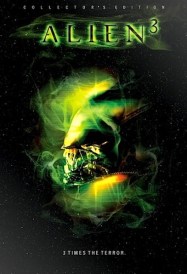 It’s getting on for two years since I last (and first) watched most of the Alien
 Quadrilogy series, provoking some relatively lengthy (for this blog, anyway) debate on my reviews of the three sequels. I refer you to those at the outset for a couple of reasons. One, because a lot of my review of Alien³’s theatrical cut still holds true for this half-hour-longer version; two, because other points in that review may make an interesting counterpoint to the more positive thoughts I now have (“may”); and three, because some of the comments on the reviews also discuss this extended cut, which may also interest you.
They’re also relevant to highlight this point: it’s been two years since I watched Alien³ and I’ve only seen it once. Despite this extended version being 26% longer, that means I still found it hard to spot much of the additional material. I’m sure fans who’d seen the original multiple times in the decade between its theatrical release and this cut appearing in 2003 were able to spot changes much more readily. Nonetheless, a few obvious additions and modifications stand out: an extended opening when Clemens discovers Ripley on the beach; the Alien birthing from an ox (rather than a dog); the lack of a Queen chestburster at the very end. I could’ve turned on the Blu-ray’s “deleted scenes” marker of course, and I did consider that, but I thought it might just get distracting on a first viewing. And speaking technically, I don’t know what the new scenes looked like on the Quadrilogy DVD (as I haven’t watched that copy, obviously), but on Blu-ray the added footage, 2003-era new effects and 2010 re-recorded audio are indistinguishable from the rest of the film.
Readers interested in the history and reasoning of this new, significantly longer cut may appreciate the introduction it had in the Quadrilogy set’s booklet (sadly nowhere to be found on the Anthology Blu-ray). I’ve reproduced the majority of it below:
Following its troubled production and controversial release, Alien 3 slowly became something of a curiosity among serious enthusiasts of the Alien series. Not only would its first-time director, David Fincher, go on to become one of Hollywood’s most sought-after filmmakers but the film itself would generate quite a mystique thanks to heated rumours of creative interference, lost scenes and even a completely different cut of the film that supposedly restored Fincher’s original vision of what many believed to be a seriously compromised work.
Rumour control, here are the facts. There is no wondrous lost “director’s cut” of Alien 3. It doesn’t exist. Indeed, for such a dream to be realised, Fincher would have to be allowed to remake the film from scratch with complete creative control. What does exist is something perhaps equally fascinating.
For the first time, fans can now experience a restored and re-mastered presentation of the 1991 assembly cut of Alien 3. With a running time increased by more than 30 minutes, this Special Edition contains several never-before-seen sequences that offer a fascinating insight into the film’s difficult editing process. This cut also reveals a combination of vintage, previously unreleased optical effects shot and several newly-composited digital effects necessary to seamlessly integrate new footage into the body of the film…
The Alien 3 Special Edition offers fans a unique chance to witness the lost work of a remarkable director.
So there you go. As I mentioned, this version updates the 2003 one with some re-recorded dialogue.
On my original review, Matthew McKinnon commented that as he watched this new cut he realised “it wasn’t shaping up into a more coherent or purposeful movie… just a longer version with more of the same.” I agree that, to an extent, it’s “a longer version with more of the same”, but I found it more coherent too. While the major plot beats still occur at the same time and in fundamentally the same way, perhaps the myriad tweaks have made it clearer just what’s going on? Or perhaps I was just more familiar, having seen it once already? Either way, sequences and events that left me a bit lost last time seem to make perfect sense on this outing.
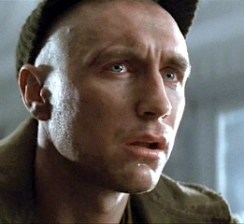 One of the biggest things I remember being told about Alien³, before the Special Edition, was that most of Paul McGann’s performance had been cut; that originally he had a sizeable role that justified his fourth billing, rather than his cameo-sized part in the theatrical cut. It doesn’t feel like there’s an awful lot more of him in this version, though scanning through Movie-Censorship.com’s thorough list of changes one can see a lot of brief shots as well as one or two significant scenes featuring him. Again, despite the sense that little has changed, his character does feel more comprehensible, so maybe these barely-noticeable additions do make all the difference?
As a little aside, I sometimes feel a little sorry for McGann — since his acclaim in The Monocled Mutineer, numerous shots at bigger success seem to have passed him by. He gets a key role in a Hollywood blockbuster, but is then largely cut out; he’s cast as Richard Sharpe in a major ITV series, but is injured and has to pull out (and we can see where that led career-wise for Sean Bean); he’s cast as the Doctor in a big-budget American backdoor pilot for Doctor Who, which flops Stateside and goes nowhere… He’s undoubtedly talented, but these days seemingly forced into lacklustre supporting roles in the likes of Luther. Maybe he doesn’t mind, I don’t know (at least he got “the largest insurance settlement in British television history” for missing out on Sharpe), but it seems like he deserved greater success. Poor guy.
Still, McGann’s performance here is exceptional, even if it’s still brief. He’s just one member of an outstanding British cast though, many of whom are recognisable for the excellent work they’ve done since.  Unsurprisingly, therefore, they’re almost all totally underused. Charles Dance gets the biggest slice of the cake and is as good as ever, but doing little more than show their face we have Pete Postlethwaite, Phil Davis, Peter Guinness, Danny Webb (they don’t all begin with P…) Alien³ is 19 years old now, no one could’ve predicted the future; but viewed with hindsight, the volume of under-utilised talent is almost astounding.
Hindsight also affords other interesting perspectives. Dance’s death is still very effective, for instance. It’s not surprising once you’ve seen the film more than once — obviously — but killing off really the only character our hero (and, by extension, the audience) has become sympathetic to at around the halfway mark? Not unheard of, true (see: Psycho), but still rare enough to be a shock, to disconcert and wrong-foot the viewer.
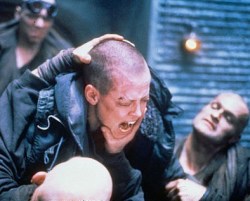
Plus, we can now look at it in the context of Fincher’s following work. Even though he had limited — often, no — control over much of the project, there are still signs that link it with his later films. It’s stylishly shot for one thing, most of the locations either soaked in shadow or cold light, with an often fluid camera. Darkness litters the film thematically too: setting it on a prison colony for murderers and rapists, the violent attempted gang rape of Ripley, the death and autopsy of a 10-year-old girl… Even if we see no real detail on screen (thank goodness this wasn’t made in recent torture porn-obsessed years), the implication and the emotional connection is harrowing enough. Then there’s the Alien itself, from its ugly birth to its violent murders. Fincher may have not turned so explicitly to horror since, but that brand of darkness does flow on into most of his best films: Se7en, Fight Club, Zodiac.
 It’s also, perhaps, interesting to remember this being Fincher’s first film. He might seem like an odd choice, a first-timer paling beside the experienced hands of Scott and Cameron. But that would be to forget that, for both, their Alien films were only their second time helming a feature*; and while Cameron’s previous had been sci-fi (The Terminator), Scott’s was period drama The Duellists. A first-timer — especially one versed in commercials and music videos — isn’t all that different, really, and Fincher has certainly gone on to show his worth. Indeed, his very next film was the incredible Se7en.
Alien³’s Special Edition didn’t strike me as massively different from the theatrical cut, despite some obvious changes, with the exception that I now found it to be more intelligible. Whereas before I thought it started well and became less coherent — and, consequently, less good — as it went on, with this version I felt I was following the story and characters throughout. As a result, I enjoyed it more. Perhaps it also benefitted from my viewing situation: the first time I watched it within days of both Alien and Aliens; this time, I chose to watch it in isolation. Whatever the reasons, this Special Edition earns Alien³ an extra star from me.

* Cameron’s name is on Piranha II, and it is a fun joke to think such dross was his directorial debut, but his version (at least) of the behind-the-scenes story suggests it should in honesty be ignored. If you prefer, imagine I said Aliens was only his second major feature.
I watched the Alien³: Special Edition as part of a David Fincher Week. Read my thoughts on all his films to date here.
 Do you need me to tell you how great Beauty and the Beast is? I imagine not. If you’ve seen it, you’ll know. If you haven’t, you really should, and then you’ll know.
 It’s not a bad song — not at all — but it’s a notch below the others. (There are a few more changes to the film than just adding the song, listed
 Post
Post  depending on your point of view, either supports the “it was all a dream” reading or is just a case of artistic licence, hardly uncommon in SF cinema.
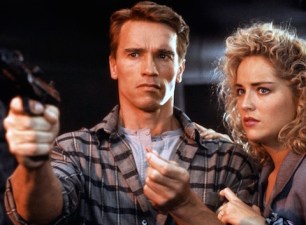 Perhaps it’s ultimately destined for an afterlife as a film representative of its era; the kind of thing that comes up as a footnote or personal favourite in texts & documentaries specifically discussing things like The Sci-fi Cinema of the ’90s. Or perhaps I’m doing it a disservice. We shouldn’t really try to predict these things too much, it’ll only lead to embarrassment when the opposite happens.
 The world, so they say (and by “they” I mean “absolutely no one” — I’m making this up), is divided into three sorts of people: those who love
 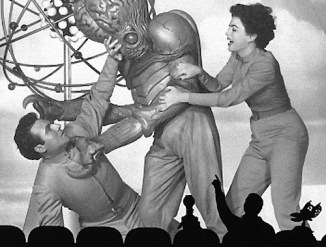 Anyway, the gang set their sights on one film per episode — or, in this feature film, one film per film. They’re being forced to watch these movies, for various unimportant reasons, and every once in a while we get comedic ‘host segments’, where they get up to hijinks on their space station (I forgot to mention, they live on a space station). These bits are well-meaning and quite funny — and in this big screen outing have been shot with a suitably filmic gloss that the video-shot TV episodes lack, which adds a surprising magnitude to the still-small-and-cheap sets and props — but the real meat of the humour is in the riffing over the film.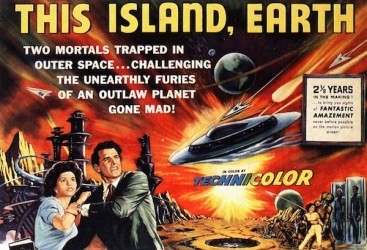
 when you’re in the mindset to take the piss out of the film. That is, if you get on with the characters (as it were) and sync with their sense of humour; if you dislike them or their humour, or like whatever they’re watching too much, then it’s probably more like some irritating yobs nattering away over something you’d quite like to watch thank you very much. (Equally, if you embark on this intending to watch This Island Earth, more fool you.)
 Hercules is the first post-me Disney; the point where, for whatever reason, I stopped watching their output. But, of course, Disneys — good Disneys, at any rate — are suited to every age group.
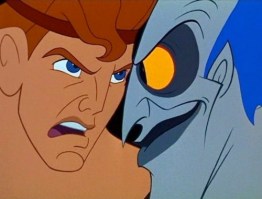 animal-sidekicks-with-no-dialogue-who-can-still-convey-their-thoughts-and-feelings-perfectly (I feel this tradition needs a snappier name.) Love interest Meg, meanwhile, starts out intensely irritating but is gradually redeemed. Good work, I say to the film’s
 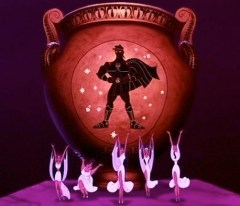 (though even mentioning it in the same sentence as that number makes it sound better than it is). Only love interest Meg gets a passable song, not that I could remember it within hours of watching the film. Maybe it’s not all that bad really, but when early-’90s Disneys could produce several unforgettable tunes per film, it feels like a weak album from a band you usually enjoy.
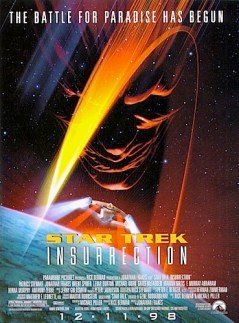 Many years ago, back when both the shows I’m about to mention were still on the air, someone drew a comparison that I felt summed up the whole of ’90s/’00s
 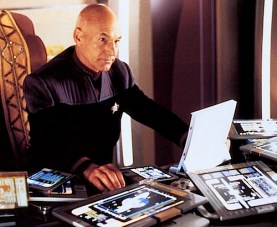 Actually, this is when Insurrection is at its best. Action-adventure undoubtedly has a place in science-fiction, but so do wordier stories — when they’re done right, and when they’re where you expect them to be. You shouldn’t expect them from Star Wars; you should from Star Trek. (That doesn’t make Voyager’s attitude better than Farscape’s, incidentally; not if it was boring or implausibly honourable considering their situation. But that isn’t the matter at hand.) And so the first 45 minutes or so are mostly enjoyable. Critics say even this isn’t as deep as
  There’s a greater array of fan-pleasing nods and winks this time out. As with First Contact, they have to find an excuse to get Worf back on board (at the time, in universe continuity, he was on Deep Space 9 in
 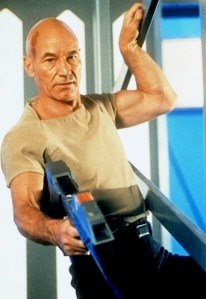 Most negative reviews — so, most reviews — accused the film of being essentially a TV episode (or two, of course), not earning itself a spot on the big screen. They may have a point. The subject matter isn’t at fault — a planet with the ability to make everyone live forever has suitably large potential — but the execution of it is frequently low-key. This isn’t too bad in the first half, which maintains the interest as it unfurls the story, but when it degenerates into action in the second half it falls apart. It’s no longer interesting and, ironically, looks made-for-TV, lacking inspired direction or suitable scope. Perhaps it would’ve been better served as a TV episode; or, as a film, better served by a writer and/or director and/or producer with greater vision.
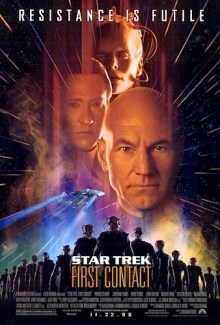 “Even ones good, odd ones bad.” So went
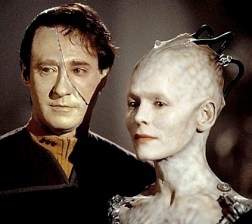
  For all that, I still got the sense of it being a bit like two or three episodes of TV stuck together, albeit two particularly epic stories with a slightly bigger budget. The story on Earth is a bit of a sideline, for example, the kind of thing that’s added to give half the cast something to do. Perhaps that’s unfair — it’s a decent enough tale, with significant relevance to the Trek universe, but it’s also low-key and, aside from being kicked off by a Borg attack, entirely unrelated to the goings-on on the Enterprise. Visually it’s even more of a mixed bag. Borg costumes and effects are at times impressive — the Queen being lowered into her body, robotic spine dangling, still looks good today, and her makeup is exemplary — but other drones seem to be clad in cheap bodysuits… which the actors surely are, but it looks it.
 For a newbie, or a viewer light on Trek knowledge, it all works fine. There’s an awareness one’s missing out on something — Picard’s previous encounter with the Borg is alluded to often but not explained in full; even for me, as someone well aware that it’s one of sci-fi’s Big Stories, but who has never actually seen it, there’s a certain lack of explanation. Featuring a couple of new characters from hundreds of years before TNG’s regular timeline helps, because the crew occasionally have to tell them things everyone else would know; the downside is they’re not meant to be telling them everything, so some stuff still passes us by. But, importantly, none of this ever swamps the story; they’re just touches and moments that I know I’m not getting.
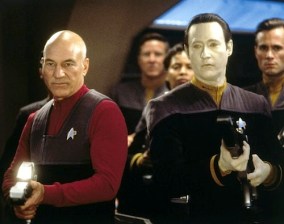
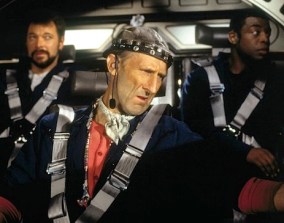 early on Picard explains that they won’t be noticed until they seem a threat… but they’re all carrying whopping great guns. And surely the very fact the humans have turned up deems them a threat? Also, why don’t the Borg recognise Picard? And later, during the largely fantastic sequence on the Enterprise’s hull, Picard, Worf and Hawk are clearly up to something nefarious and yet the Borg let them carry on. One or two Borg stop to intervene; Picard & co dispatch them; the rest of the Borg just keep working. Surely the fact these humans have just done away with several of your compatriots qualifies them as a threat that needs to be dealt with? It’s all a bit too convenient.
 Daylight is a disaster movie; the kind they apparently made lots of in the ’70s, and has seen a revival (to some degree) thanks to Roland Emmerich and his brand of apocalypse-bringing. This was made in the ’90s though and, lacking any self-aware qualities, might be seen as a throwback. Whether that matters is probably an issue for more well-versed disaster movie fans than I.
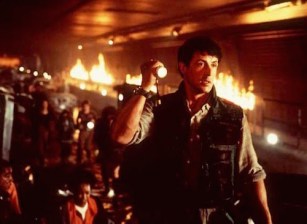 Which Characters Would It Be Most Tragic To Lose and started to work his way through them until he reached the end of the screenplay. I suppose it’s flat-out good advice for a disaster movie, but, try not to get too attached.
 inadvertently overshadows the whole film. I suppose any shot of the Center calls up those memories now, but it’s unfortunate that this one comes at the end of a disaster movie.
 The debut feature from director Gurinder Chadha (of
 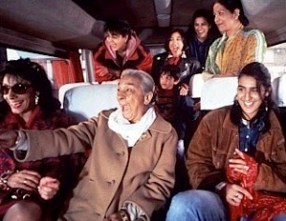 Indeed, there’s certainly evidence that the film was constructed with such an audience in mind: when the women settle down for a traditionally British ‘picnic on the beach’, we’re given a close-up to show they’re eating samosas and bhajis instead of sandwiches and what-have-you. If all the talk of pregnancies, abuse and racism sounds a bit serious, there’s also a good degree of humour and an appropriate lashing of sentiment.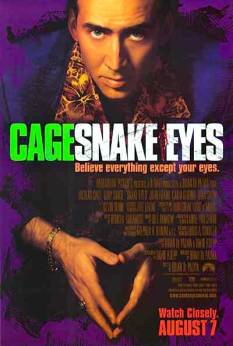
 later seasons didn’t and, in my opinion, suffered. Johnny Depp-starer
  If there’s one significant flaw, it’s that the ending is too much based on convenience and coincidence; and someone in the editing room should’ve paid more attention to removing all references to the original, deleted ending in which the casino got flooded. I have no idea why that was removed — maybe someone thought it was a bit ludicrous. But it sounds more satisfying than what was included, which, as noted, relies on a handy spot of coincidence and at least one action that seems out of character. I can forgive it though, because I liked everything else. And the post-climax montage is a suitably downbeat ending to our hero’s story — another noir trait there.
 100Films.co.uk