
Richard Lester | 85 mins | download | 15
 I’ve never actually seen a Richard Lester film before, and so spectacularly failed to put two-and-two together about who the director was and what else he’d done before I watched this. If I had, recent (at the time of viewing) reviews of the BFI’s release of Lester’s later The Bed Sitting Room (such as John Hodson’s or Clydefro Jones’) might’ve prepared me for what was to come.
As it was, all I had to go on was the DVD art (as used by iTunes — this was another 99p Film of the Week), the bright and breezy title, and that it stars Frank Spencer. From that you’d be forgiven (I hope) for thinking The Knack was a colourful Swinging Sixties sex-com romp. Upon watching it, however, it’s immediately clear it’s nothing of the sort: it begins with a dream/nightmare sequence, complete with horror-esque music, before settling into a style and rhythm more reminiscent of Breathless than Confessions of a Window Cleaner.
At least, it does for a bit. In fact, it does a lot of things for a bit: Carry On-level double entendres, intense thriller-like scenes, slapstick sequences, an occasional New Wave-esque light jazz score… If it were an American schoolchild The Knack would surely be diagnosed with ADD, flitting around from one style to another with no immediately obvious rhyme nor reason, except perhaps a desire to try out interesting things and see where they lead. This will undoubtedly put some people off — on another day, I might be included among them — but instead I found it quite intriguing.
Stuck in the middle of what could have been a slew of directorial flourishes, the cast are allowed to surprise with some layered performances. Michael Crawford more or less does an early version of Frank Spencer (in fairness, that’s perfect for the role), leaving him overshadowed by Ray Brooks as lothario Tolen and Donal Donnelly as the slightly kooky Tom. Both subvert their initial impressions: Donnelly’s oddness hides a perceptive intelligence, while Brooks’ suave lover hides a subtly unnerving, menacing, dominating sexual predator. Some of the time, anyway.
There’s no doubt that I’m severely under-qualified to pass any kind of serious judgement on The Knack (some would say any film, but there you go). I’ve not even mentioned Rita Tushingham (apparently something of a ’60s icon), or Ray McBride (who or what is he, and what is his relevance?), or that it won the Palme d’Or at Cannes in 1965 (I do know what that is at least). A proper, informed judgement is therefore best left to those with a greater familiarity with Lester’s films (or at least his early work, before he went on to the likes of The Four Musketeers and Superman III). But to those equally as uninitiated as I, The Knack can be recommended as an unusual but surprising piece of work, full of things to pique one’s interest.

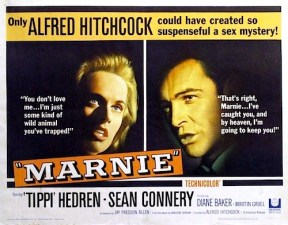 Marnie is a film grounded in the field of psychoanalysis, though that word is never used and none of the characters are a therapist. Instead, it just concerns itself with a main character suffering under the strain of repressed childhood memories, though this isn’t revealed until the end. Unfortunately, psychoanalysis was only an emerging area at the time of production, and the price Marnie pays for being ahead of the pack in the mid ’60s is that it looks dated and inaccurate now.
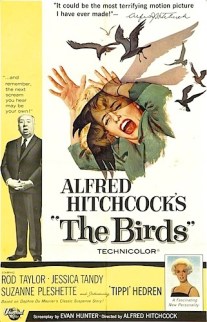 I first saw The Birds on TV so long ago that I can’t even remember how long ago it was. Only two parts of it have stuck with me since: the justly famous scene with the climbing frame (ooh it’s brilliant), and a dead Dan Fawcett with his eyes pecked out (ooh it’s chilling).
 Having finished 2007 with
 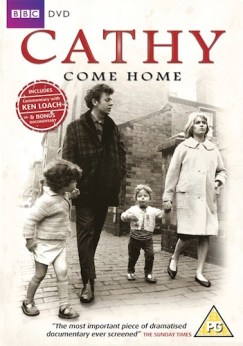 Technically a one-off TV drama from the BBC’s
 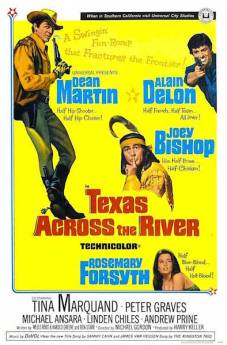 Texas Across the River hardly seems to be a well-remembered film — the only DVD edition available (as far as I can tell) is a legally-produced DVD-R, clearly in the wrong aspect ratio. I only come to see it because a friend happened to have a VHS as a child, enjoyed it back then, and we managed to track down that DVD. [It was later released
 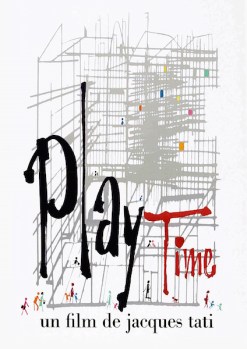 I know some people love the work of Tati, just like there’s always someone who loves everything; personally, I find his films largely dull. His character, Monsieur Hulot, is like Mr Bean but less funny (don’t worry, I know Hulot comes first by a good few decades). There are some laughs to be had in Play Time, but they’re a long way in and not necessarily worth waiting for.
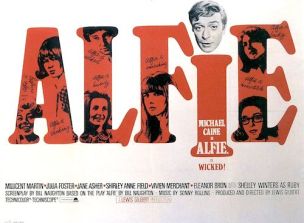 Michael Caine stars as the eponymous London lothario in this ’60s sex-based comedy/drama, which helped bring about a change in British abortion law thanks to its chilling final act.
 “Everything’s free in America,” goes the famous line; but this film is probably more accurately summed up in its following line: “For a small fee in America”.
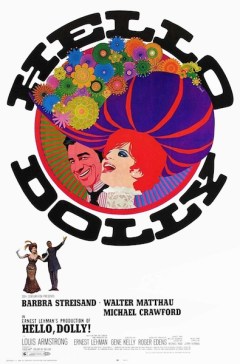 Comedians Walter Matthau and Michael Crawford (yes, Frank Spencer!) star alongside Barbra Streisand in this comedy musical directed by Gene Kelly (yes, the star of many a musical himself!) which flopped at the box office but did well at the Oscars, and has gained in popularity since.
 100Films.co.uk