Brute Force (1947)

2009 #73
Jules Dassin | 94 mins | TV | 12
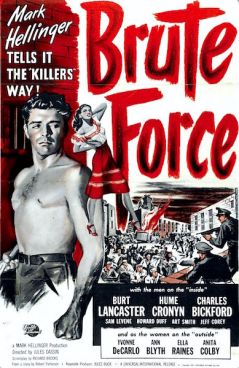
Brute ForceJules Dassin’s prison-set noir concerns a group of inmates trying to escape from the cruel regime of a vicious warden, allowed free reign by an ineffectual governor and target-driven bureaucrats (nothing changes, eh?)

Tonally, it’s varied. Early on it’s quite humourous, with a weak warden, jaunty calypso-singing inmate (who occasionally threatens to tip the whole thing over into a musical) and amusingly drunk doctor. Then there are the flashbacks to the outside world, laden with undercooked romance and awkward dialogue. In the final act it turns decidedly grim: warden Munsey lives up to his lowly reputation, goading one prisoner to suicide and beating another close to death, while the other wardens listen on from outside; one of the good guys betrays his mates, ultimately leading to wholesale slaughter as the escape plan goes awry. A balanced, varied tone is not necessarily a problem, but the flashbacks are almost uniformly unwelcome asides and, by separating the distinctly comical from the resolutely grim by placing them firmly at either end of the film, they don’t quite gel as a whole.

Still, the climactic prison break — including the build-up — is a brilliant extended sequence. Tense, epic and exciting, it concludes with a fantastic action sequence. It also delivers a powerful moral message, underlined by its direct delivery from a prison staff member rather than an inmate. It goes some way to make up for the earlier flaws, like the dialogue that’s occasionally typical of the period’s worst — “I’m just a guy who… explained his entire backstory in one slightly long and unwieldy sentence to someone who already knew it”.

What gets forgotten in all this, perhaps most depressingly, is the fate of those on the outside. We’re told early on that Collins’ love is refusing treatment for her cancer until she sees him again. This seems ready-made to provide justification for a prisoner to escape; indeed, the whole film is skewed this way, as we never discover many of the inmates’ crimes, and those we do hear are either done for good reason or not that bad. But it toes the more obvious moral line by having no one escape, and while the cancer isn’t mentioned again after the slaughter, it leaves what might otherwise seem a morally justifiable cheat (the prisoners are the good guys here — we expect and want them to triumph — but that they don’t is ‘correct’) with a bitter taste.

3 out of 5

Stranger on the Third Floor (1940)

2009 #55
Boris Ingster | 64 mins | TV

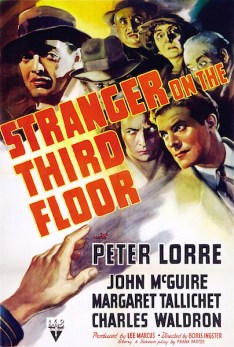
Stranger on the Third FloorDespite being “released the same month as Raoul Walsh’s They Drive By Night, and four months after Alfred Hitchcock’s Gothic Noir Rebecca,” says Paul Duncan in The Pocket Essential Film Noir, “this is often listed as the first Film Noir”. Not often enough to earn the treatment you’d expect such an accolade to afford, it would seem, as I hear it’s rarely screened and only available on DVD in Spain. That’s a shame, because it’s an entertaining — if brief — example of the genre.

The story is a morality tale of sorts. A journalist is the key witness to convict a man of murder, albeit on fairly circumstantial evidence; the journalist’s fiancee disagrees with what he did, though he tries to persuade her round to his way of thinking; but then the journalist finds himself in virtually the same situation, and it’s up to the fiancee to prove his innocence. And that’s most of the plot I’m afraid, though to be frank it’s fairly ancillary anyway.

The screenplay is a little slight and stretches its credibility — would a man really be convicted on such circumstantial evidence, for example? It plays structural tricks too: at one point the lead character is arrested off screen and the focus switches to his fiancee for the remainder of the film. Perhaps they didn’t have the money left for a cell set. Such leaps suggest an underdeveloped story, but on the bright side it certainly keeps things moving.

Despite these faults, many individual scenes are rather good. The journalist spends half the film pacing his room, for example, contemplating whether his irritating neighbour is dead or not, but it remains gripping. When he sleeps he has a nightmare, a showcase not only for the expressionist-influenced cinematography, but also the writing: the opening trial scene features a humourously inattentive judge and sleepy jury, but the exact same elements return to haunt our hero when he dreams he’s in the dock.

The climax is virtually the only scene to feature top-billed Peter Lorre to any significant degree, here fulfilling a couple of days left on his RKO contract with a small role. Nonetheless, in this one scene he out-acts the rest of the cast put together, using just a few lines of backstory to really flesh out his underwritten character. The sequence where the fiancee tries to escape him is suitably sinister. Still, the scene is over quickly and without the fullest logic in its execution — much like the film as a whole.

Stranger on the Third Floor is so imbued with the recognisable calling cards of noir in its cinematography, characters and plot points that it feels more like an entry in a well-established genre than a formative inclusion. At only just over an hour it is, on the one hand, too brief to dig into its characters or complicate its story, but on the other, it rattles past quickly enough that the good bits impress, the weak bits are only briefly registered, and it’s over long before anyone might even consider considering it a waste of time.

4 out of 5

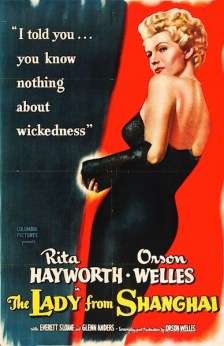
The Lady from Shanghai (1947)

2009 #37
Orson Welles | 84 mins | TV | PG

The Lady from ShanghaiThe Lady from Shanghai is an Orson Welles film… which means his original 155-minute cut was forcibly cut down by over an hour, the studio insisted he include more beauty shots of Rita Hayworth, as well as a song for her to sing, and the temp score he provided to the composer was ignored in favour of something Welles hated. Yet for all that — not to mention Welles’ distractingly atrocious Irish accent — it’s still a highly enjoyable film.
The plot is thoroughly noirish and offers up its fair share of twists along the way, while the performances are able if largely not particularly memorable. The exception to this is Glenn Anders, giving a gloriously unhinged performance as Grisby, drawling his vowels with high-pitched lunacy. Though Welles was heavily criticised for cutting and dying Hayworth’s hair — to the extent that some blamed it for the film’s box office failure — it hardly matters (I thought she looked better anyway), and the enforced beauty shots actually work thematically toward the conclusion.

Even more attractive are the skills Welles brings directorially, on display throughout. Every key sequence provides something genuinely worth looking at while still relating the intricate plot, though the cruise offers many of the best bits — the hot, sweaty foreign climes are conveyed brilliantly, aided by sumptuous location photography, and these sunny scenes contrast nicely with the noir plot. Mention must also be made of the the famous finale in the Hall of Mirrors, a precisely shot sequence that provides a fitting close. Elsewhere, Welles’ sense of humour is pleasingly present, lending the trial scenes in particular a distinctive style that brings some ever-welcome variety.

Brisk (at under an hour-and-a-half) but engagingly complex, and rarely less than beautifully shot, The Lady from Shanghai may be a compromised version of Welles’ intentions, but his undeniable ability (at directing, not accents) means it remains a compelling film noir.

4 out of 5

The Lady from Shanghai is showing on BBC Four at 10pm on Saturday 22nd August as part of a Film Noir Weekend. See this post at From the Cheap Seats for more details.

The Great Dictator (1940)

2009 #31
Charles Chaplin | 120 mins | DVD | PG* / G

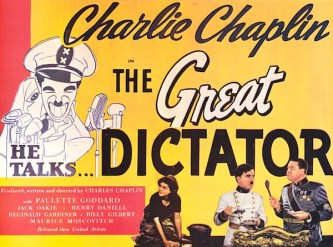
One of the great things about doing 100 Films in a Year has been the number of firsts it’s either led me to or just been there to document: my first time watching films on Blu-ray and via legal download; my first time seeing films from directors as diverse as Woody Allen, Akira Kurosawa, F.W. Murnau and Krzysztof Kieslowski; my first time viewing such notable works as Breathless, Brief Encounter, Chinatown, Taxi Driver, This is Spinal Tap, The Wizard of Oz, and many more — including my first time seeing Citizen Kane. And here’s another for the list: my first ever Charlie Chaplin film.

The Great Dictator is one of Chaplin’s most widely-known films thanks to setting its sights on the Nazi regime and Adolf Hitler in particular. The general perception of silent comedians like Chaplin immediately suggests slapstick, but the real-world targets here make his work (on this film at least) satirical as well. I’m sure this made for great propaganda when it was released just a year into the war, but Chaplin’s skill and accuracy mean it works beyond that: like all good impersonations or spoofs it doesn’t make its objects silly for no reason, but instead takes what’s inherently laughable about them and exploits it. This would age some satirical humour, reliant as it can be on topicality, but the wide awareness even a modern audience has of Hitler means there are no comprehension problems today.

The style of humour can date nonetheless, but The Great Dictator remains funny — arguably the real test of a good comedy. It might not be to everyone’s taste, but that’s a problem comedy faces whenever it’s made. Chaplin loads the film with inventive and timeless routines, like the upside-down-plane, the coin-in-the-pudding, or the classic dance with an inflatable globe. Sometimes with comedy from decades previous, there’s the feeling you’re watching something that was funny at the time but no longer actually makes you laugh, thanks to changed conventions and expectations. For me, at least, there was no such problem here.

Surprisingly, there are some serious scenes too. While it doesn’t outweigh the comedy, there’s a degree of semi-factual drama in the plot that’s been well judged to help the humour cut deeper. The closing speech could come across as overly propagandistic but, again, it’s well pitched and therefore more galvanizing than inappropriately laughable. There are some bits, like this, that are sadly just as applicable to the modern world.

Chaplin allegedly said he wouldn’t have made The Great Dictator if he knew how bad things really were under Hitler, though some dispute this, arguing he knew and made it regardless. Some bits are slightly uncomfortable when one knows the reality, but whether Chaplin knew the truth or not these moments are fleeting. And, either way, Hitler and the Nazis were a worthwhile target: laughing at those who attempt to terrorise and dominate us is one of the most powerful weapons we have against them. That, certainly, is still true today.

5 out of 5

* For reasons known only unto the BBFC, The Great Dictator was classified U until 2003, when film and video reclassifications both made it a PG. ^

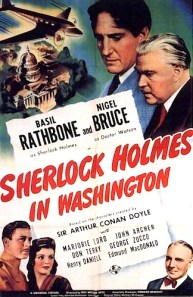
Sherlock Holmes in Washington (1943)

2009 #1
Roy William Neill | 68 mins | DVD | U

Sherlock Holmes in WashingtonThe last of three World War 2-concerned films in the Rathbone/Bruce series (the previous two being The Voice of Terror and The Secret Weapon), and once again more a spy thriller than a traditional detective tale. That’s not to say Holmes’ abilities as a detective aren’t present — in fact, he does a very reasonable amount — but if you switched him for a generic British Intelligence agent the plot would be unlikely to suffer and the dialogue probably wouldn’t need much work.

Certainly, the quality of Holmes’ detection is a bit of a mixed bag. Some scenes do demonstrate his brilliant reasoning, but others stretch credibility to the limit, for example when he manages to work out what’s been transported in a blanket. Another disappointing moment sees Holmes in awe of and “forget” about modern scientific methods, which seems rather at odds with the highly intelligent detective at the forefront of his field that we see in the original tales. It’s more than a little like the filmmakers have taken the character and methods from his 19th Century setting and dropped (rather than adapted) him into the present day. It’s these little inconsistencies that are arguably most bothersome when such a spy thriller claims to be a Holmes film.

Other deduction scenes do work, however, such as when Holmes enjoyably reasons the hiding place of the matchbook, the film’s MacGuffin. Unfortunately, this sequence suffers from a total lack of tension as we already know where it is. This leaves us watching Holmes play catch-up, and there’s no sense of a race-to-the-prize because we don’t see how the villains’ hunt is progressing. Said matchbook is put to good use in another sequence where it is unwittingly passed around at a party. This is perhaps the most simple and obvious thing to do with such a MacGuffin, but at the same time it’s an always-effective idea. On the other hand, when the matchbook ends up back where it started one has to conclude that this sequence is no more than padding.

One of the more striking elements of the film is it being Holmes’ first trip to the States (on screen in this series, at least). It’s highly praiseful of America, of course, and spends a good bit of time on a travelogue-style showcasing of sights, continuing with Watson remarking on US papers, trying out gum, and more. It makes a change of scene for the series, but also feels a bit self-congratulatory on the part of the American production team, which can be more sickening than the British patriotism of the previous two entries. While that may be national bias on my part, it seems a bit unlike Holmes too. There’s also the prerequisite patriotic closing quote, though at least this time it’s from a British character about US-UK relations. Still, intentional or not, Rathbone delivers it with an almost unwilling flatness.

Elsewhere, Watson’s bumbling comedy is occasionally unobtrusive, occasionally grating, but occasionally raises a smile. Best is the scene where Holmes has him play various characters in a reconstruction, although there’s more mileage in that than the film manages. In complete contrast to this, the film’s villains are a particularly brutal bunch, murdering for no real reason and torturing women.

By the time the film limps to a sudden conclusion at an antiques shop, the quality of the film has become reminiscent of the quality of Holmes’ detection: a mixed bag.

3 out of 5

This review was written over three months after seeing the film, based entirely on notes made at the time and my rather poor memory. Apologies if it is therefore a bit unfocussed or, God forbid, inaccurate in the odd minor fact.

Sherlock Holmes and the Secret Weapon (1943)

2008 #75
Roy William Neill | 66 mins | DVD | PG

The name’s Holmes, Sherlock Holmes, as Universal’s loose adaptations of Britain’s Greatest Detective deliver a low-key proto-Bond, 22 years before Goldfinger applied the same tricks to Britain’s Greatest Spy.
“How so?”, you might ask. Well, Holmes has been employed as a spy for His Majesty’s Government; it begins with an ‘end of the previous adventure’ almost-action sequence that would undoubtedly take place before the opening credits now; there’s a war-winning weapon at stake; a bit of globetrotting (albeit just from Switzerland to London); some double-crossing and side-switching; even a surprisingly nasty torture sequence; a nice race-against-time final act; and an equally-matched villain, with a secret lair, who has devised a clever death for our hero. So the lair is just a house with soundproofing and unbreakable glass, but that’s not a bad effort — I don’t think there are many volcanoes to hollow out in the London area. It may be Bond on a World War Two London scale, but the feeling is there.

I discussed the controversy (for a modern audience, at least) of this updated setting in my last Holmes review, and it’s even more abundant here — seeing Baker Street as a victim of the Blitz, and 221B surrounded by sandbags, is very odd indeed — but at least it employs several elements from a variety of Conan Doyle’s plots, and it’s not unreasonable to assume that, given his skills of deduction and disguise, Holmes would’ve been employed as a spy had he been ‘alive’ during the war. In fact, Holmes actually does some detecting this time, whereas in Voice of Terror he seemed to meander around a bit, and employs several disguises, even if some of them are about as much cop as one of those glasses-nose-and-moustache masks. Of course, it would help the mystery if its solution wasn’t revealed before Tobel (the inventor of the titular war-winning weapon) was even kidnapped, but you can’t have everything.

What lets the film down more is Lionel Atwill as a weak Moriarty, supposedly the film’s grand villain. It’s not all his fault — for one example of poor writing, Holmes deduces the final code after an accidental clue from Watson, while Moriarty gets it by clumsily spilling water over a copy, hardly displaying great powers of deduction — but he doesn’t compare to the scheming, cunning Moriarty we saw played by George Zucco in The Adventures of Sherlock Holmes. On the plus side, the ease with each Moriarty outwitted Holmes in that earlier outing made our hero look a bit ridiculous, whereas here Holmes gets to outwit his nemesis a couple of times, including a particularly nice denouement.

As with Voice of Terror, I enjoyed a lot of Secret Weapon in spite of its distinct un-Holmes-ness — it’s another pacey, exciting World War Two spy thriller. It’s better than its immediate predecessor on the whole, though a spot of miscasting nearly persuaded me to remove another star.

4 out of 5

Sherlock Holmes and the Voice of Terror (1942)

2008 #74
John Rawlins | 63 mins | DVD | U

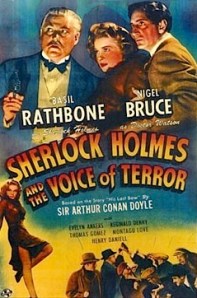
Despite the success of their two Sherlock Holmes films (The Hound of the Baskervilles and The Adventures of Sherlock Holmes, both 1939), Fox decided the character was outdated and resolved not to make any more. Universal clearly disagreed, and the popular pairing of Basil Rathbone and Nigel Bruce reprised their roles three years later for this, the first of twelve Holmes films the studio would make with the duo in just five years.

There’s more change afoot than just the logo at the start, however, as Holmes and Watson are dragged from their typical Victorian setting to London in the midst of World War Two. For a modern audience, who definitively associate Holmes with the Victorian era, this move seems virtually incomprehensible and sacrilegious; but Conan Doyle’s original Holmes stories take him as far as the start of World War One, so bringing the character another 28 years forward is little worse than, say, relocating the 1980 novel The Bourne Identity to 2002. Nonetheless, the filmmakers were aware of the problem even at the time, choosing to open the film with a title card that asserts Holmes to be “immortal… ageless, invincible and unchanging” in the hope that audiences would accept a then-present-day setting.

Whether the setting bothers you or not, the story itself might. The basic concept is a nice idea for a war-set spy-thriller, but not really for a Sherlock Holmes mystery. There are plenty of audience-pleasing applications of his ‘impossible’ deduction skills, such as the moment when Holmes concludes someone dislikes him based on the depth of footprints left in a carpet (never mind that the character huffily ignored Holmes when he came in), but the main plot involves a minimal use of these abilities. It’s also loaded with implausible elements — why would the Nazis waste bombs on empty fields (to disguise one plane going a different route) when they could have used them on genuine targets? Why are recordings shipped to Germany and broadcast back, rather than just broadcast from England? Worst of all, what’s going on with Rathbone’s haircut? The final twist is either genius or ludicrous, I’m not sure which; and the misguided reference to Holmes’ deerstalker (he’s promised not to wear it — why?) is, well, misguided.

It’s not all bad. As mentioned, the basic storyline is a good one, providing decent entertainment once it gets going; Holmes gets plenty of amusing lines, which manage to provide more genuine laughs than Watson’s incompetence; and there’s some lovely shadow-drenched photography — though the film’s even more drenched in patriotism, to the point of propaganda at times.

The consensus seems to be against me, but by the end I was quite enjoying Voice of Terror. It may be a Sherlock Holmes film in name only, but taken instead as a cheap spy thriller it makes for passable entertainment.

3 out of 5

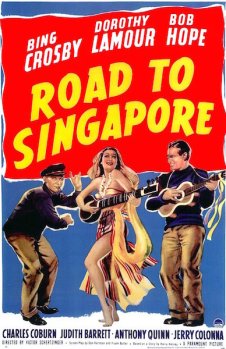
Road to Singapore (1940)

2008 #61
Victor Schertzinger | 85 mins | VHS | U

Road to SingaporeBob Hope and Bing Crosby star as a pair of young(ish) playboy sailors who run away from responsibility and family expectations in this comedy that launched the perennially popular Road to… series, which would spawn six sequels over the next 22 years.

Rather than a “comedy”, Road to Singapore might best be described as a “variety film” — it offers a mix of comedy, excitement, romance and song, a selection of entertainment that is more often provided by a few hours of TV these days. While it’s predominately light-hearted, the overall air is still more serious than that of the one other Road to… film I’ve seen, Road to Morocco: the plot seems to have been the film’s starting point, rather than an afterthought to connect the appropriate set pieces, and a couple of fight scenes are not wholly comedic in their choreography.

Unfortunately, in spite of this, there’s nothing here that’s as memorable as in Morocco. Bob and Bing are a great double act, undoubtedly carrying the film, but while it starts well enough it loses it as it goes on — even at a brief 85 minutes, it begins to drag early in the second half. It’s also worth noting that much of it is incredibly dated now, peppered with things like blacked-up natives (and our heroes blacking up to fit in) and the “good little housewife” routine. This is more an observation than a criticism — it’s very much a film of its time.

It might also be worth noting that, while I found Singapore reasonably entertaining, the friend I was watching with — who has enjoyed several other entries in the series, but had yet to see this — found it lacking. The score, however, is solely my own.

3 out of 5

Henry V (1944)

2008 #28
Laurence Olivier | 131 mins | VHS | U

Henry V (1944)Or The Chronicle History of King Henry the Fift with His Battell Fought at Agincourt in France, as the title card (and therefore IMDb) would have it.

The works of Shakespeare tend to be a love-it-or-hate-it experience for most people, often based on one’s social class and/or experiences at school (obviously not exclusively). Just to be awkward, I’m going to say I have mixed feelings about his plays: on the one hand, I consistently enjoy Macbeth and find Much Ado About Nothing a diverting enough rom-com; on the other, I was bored by Richard III, even when played by Sir Ian McKellen, and never got on with A Midsummer Night’s Dream (to pick just two examples for each side). I imagine most people have their likes and dislikes of course, but I often feel I fall between the the dislike Normal people have for Shakespeare and the love that Cultured people have for him.

This may seem beside the point, but it does lead to Olivier’s Henry V. Simply put, I didn’t much care for it. It failed to engage me, and I’d put this down to Olivier’s infamous staging (literally) of it. The first half hour is a recreation of the play’s first performance in 1600, complete with fluffed sound cues and heckles from the crowd. The goings-on backstage and performer/crowd interactions heavily distract from the actual text being performed, as much as anything because they’re more entertaining. Then, cued by one of the Chorus’s lines, the film moves to showing the story in ‘reality’ — except this is a reality made of painted scenery, primary-coloured landscapes, and cardboard fairy castles. It’s a deliberate effect, designed to emulate pre-Renaissance painting, but it didn’t work for me — it’s over-stylised and distracting, and if you’re not familiar with the play (as I wasn’t) getting distracted is a problem. The concept of transition from performance to reality has potential (as would the idea of presenting the whole thing on stage with crowd interactions, actually, considering I missed them when they went), but I personally feel Olivier executed it poorly. For one thing, it spends too long bedding in the feel of the stage performance before it gets round to the shift to reality.

Stylised productions can work, and excellently, but here the direction and acting are sometimes as flat as the castles. Actors arbitrarily shout some lines, hush others, and put in emphasis of dubious relevance — it’s like Shakespeare-by-numbers, the sort of production that reveres the text so much it doesn’t bother to think about it. It hampers any understanding of what they’re saying, especially for newcomers. Perhaps more fairly, the performance style is incredibly stagey. My degree-related reading suggests this is one of the earliest proper Shakespeare films (previous adaptations being silent or even less complete), so perhaps the idea of a more subdued, screen-acting style had yet to permeate such productions. Things do pick up as the film goes on: the battles are effective, and the proposal scene is more comfortably performed than the pre-war politics. That said, the story seems to be over once Agincourt is won, so by modern structural standards the hasty single-scene romance that follows feels pointlessly tacked on.

Olivier’s Henry V has received plenty of praise in its time, as well as derision, largely for its conception as World War 2 propaganda. The latter is hard to ignore, with grand speeches delivered in a way reminiscent of Churchill’s and scenes removed so that Henry’s character becomes unquestionably good — both aspects that are distinctly less relevant to today’s more complex, war-dubious world. Even leaving the propaganda aside, the performances are outdated, the design several stylised steps too far, and on the whole the production failed to engage or hold my interest. However good it may once have seemed, I think this version has had its day.

2 out of 5

Next I’ll be reviewing Kenneth Branagh’s all-star 1989 version of Henry V, here.

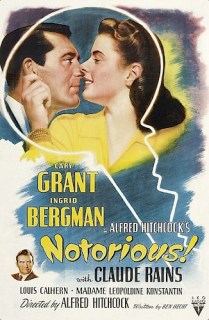
Notorious (1946)

2008 #21
Alfred Hitchcock | 101 mins | TV | U

NotoriousCary Grant, Ingrid Bergman and Claude Rains star in Alfred Hitchcock’s 7th best film (according to the ever-changing IMDb Top 250, where it currently resides at #108). Grant is Devlin, an American spymaster who recruits a Nazi spy’s daughter, Alicia Huberman (Bergman), to infiltrate a group of Nazis in Brazil, via her old acquaintance Sebastian (Rains).

Initially the film focuses on the will-they-won’t-they relationship between Devlin and Alicia. A lesser film would have happily made this last the duration, but Notorious moves on to the question of how far an undercover agent should go in the line of duty. Once it has an answer for that it’s on to what the Nazis are actually plotting, and beyond that to the effects of the spy being uncovered. It’s not that the film is restless or doesn’t deal with any of these threads in depth — indeed, my implication that it drops each to move on to the next is disingenuous, as they overlap and weave around each other — but it doesn’t over-analyse or stretch them out interminably. It’s all the better for it.

The second half is where Notorious really comes into its own. Detailing the relationships and situations in the first half is time well spent to set up the second, which contains a brilliant sequence at a society party and a wonderfully tense climax. Hitchcock’s direction shines here, with swooping crane shots and dramatic close-ups — who’d’ve thought a cup of coffee could be so menacing? The villains’ plans may be under-explained, but no matter, because the focus is on how they’re uncovered rather than how they’re prevented. All in, it makes for a highly effective and entertaining spy thriller with a not insignificant dash of romance.

5 out of 5

Notorious placed 7th on my list of The Ten Best Films I Saw For the First Time in 2008, which can be read in full here.