Archive 5, Vol.10

I have a backlog of 520 unreviewed feature films from my 2018 to 2023 viewing. This is where I give those films their day, five at a time, selected by a random number generator.

Today, we’ve got quite the variety, from Oscar nominees to straightforward action entertainment; from super-timely recent documentaries to pioneering animation from almost a century ago. But they’re all connected by… the fact I wrote some notes after I watched them. Thank goodness, otherwise reviewing some of them years later would be bloomin’ impossible. (That’s not much of a connection, I know, but it was on my mind after In the Mood for Love last time.)

This week’s Archive 5 are…

  • A Star Is Born (2018)
  • Boss Level (2021)
  • Coded Bias (2020)
  • Shadow of a Doubt (1943)
  • The Adventures of Prince Achmed (1926)


    A Star Is Born

    (2018)

    Bradley Cooper | 130 mins | digital HD | 2.39:1 | USA / English | 15 / R

    A Star Is Born

    This is the fourth version of A Star is Born, for whatever reason, but I’ve not seen any of the others so I won’t be making comparisons. I’m sure the story has been modernised (the last version was made in the ’70s, with the previous two in the ’50s and ’30s) without losing its fundamental essence: successful musician (here, Bradley Cooper) uncovers a new talent (Lady Gaga) who comes to outshine him. I guess it’s a timeless tale in the age of celebrity.

    Singers-turned-actors have a mixed history, though casting one in a story such as this is fitting, given how you need to believe they’re a top-drawer musical artist. Fortunately, Gaga actually can act as well as sing, so she’s an unqualified success here. The headline song, Shallow — a duet between the two leads, which attracted even more attention for how they performed it at the Oscars — is… perfectly fine. People went a little too crazy for it at the time, I feel. But it’s given weight by how well it’s used in the film, so I guess that could sway you.

    Also pulling double duty (well, triple if you count the singing) is Cooper, directing for the first time. (With all the talk this past awards season about how desperate Cooper is for an Oscar, it’s easy to forget that Maestro was only his second time behind the camera.) I seem to remember there being some complaints when he wasn’t nominated for direction for this one, but I think that was a fair omission. It’s not bad, but his directorial choices are a little too wavering. Like, in the early scenes, when the camerawork is all a bit documentary-ish, is effective — it undercuts the “glamorous story”, the almost-inherent fakeness of Musical as a genre, by making it feel Real. But later he gives in to glossy stylings too often; and too many of the song performances are captured with a lazily floating camera, lacking focus or decisiveness. It’s how they often shoot musical performances on TV: just kind of nothingy, moving the camera back and forth and side to side for the sake of making it ‘dynamic’. But, when you remember this is his first film, that’s fine — there’s a lot more good than bad about his work behind the camera.

    4 out of 5

    A Star Is Born was #18 in my 100 Films in a Year Challenge 2020.


    Boss Level

    (2021)

    Joe Carnahan | 101 mins | digital HD | 2.39:1 | USA / English | 15

    Boss Level

    For a long time, there was Groundhog Day. And then someone had the bright idea, “what if Groundhog Day but mixed with another genre?” So now we’ve had the sci-fi version (Edge of Tomorrow), and the horror version (Happy Death Day), and the YA version (The Map of Tiny Perfect Things), and the “what if there were two people” version (Palm Springs), and the TV series version (Russian Doll)… Here, we get the action movie version. And it’s pretty much exactly what you’d expect and hope “Groundhog Day as an action movie” would be. That’s praise, not criticism.

    Interestingly, considering the context I’ve chosen to place this in, the film itself acknowledges — you might even say relies on — the fact we’ve all seen time loop movies before. Rather than begin at the obvious beginning (i.e. the hero’s first loop), the story starts dozens of loops in, then fills in the backstory with flashbacks later on. It’s somewhere between a sensible choice (who hasn’t seen Groundhog Day?) and a bold move (what about people who haven’t seen Groundhog Day?) That said, I imagine people in the latter group can still follow it, it just might be what’s going on is mysterious for longer (most of us will instantly get “he’s in a day-long time loop”, they’ll just have to wait for that information to become clear).

    In fact, it’s a pretty economical movie across the board, hitting the ground running and rarely letting up. There’s very little repetition of “the same stuff every day”, instead taking our hero off in different directions. It does lean on voiceover quite a lot to get through some of the exposition, which won’t be to everyone’s taste, but it means it can hurry through the technicalities and get to what we came for — action and gags — so I can let it slide. On the basis of the kind of entertainment it’s designed to deliver, Boss Level succeeds admirably.

    4 out of 5

    Boss Level was #160 in my 100 Films in a Year Challenge 2021.


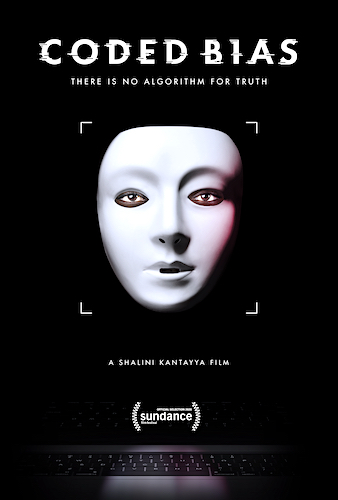
    Coded Bias

    (2020)

    Shalini Kantayya | 86 mins | digital HD | 16:9 | USA, China & UK / English & Chinese | 12
    Coded Bias

    Given the precipitous rise of AI in the past couple of years, I don’t know how relevant this documentary from 2020 still is. Back then, it was ultra-timely, but tech evolves so fast, I have to wonder if it’s already dated. Well, if you want to find out for yourself, it’s on Netflix.

    Not that it’s just about AI. It touches on a lot of interesting tech-related topics, like how facial recognition struggles with non-white people, or how algorithms were increasingly being allowed to control… pretty much everything. It makes a lot of broadly scary declarations about these things, but often lacks the detail to back them up. Not that it’s necessarily wrong, but it doesn’t prove its point; doesn’t clarify what’s scary beyond the gut reaction that this all sounds scary. This is partly because there’s so much to cover — it keeps jumping around between topics in short vignettes — which at least makes clear what a big field this is. There are also signs of hope, with the film offering some solutions (primarily: regulation in law) and highlighting fantastic people (almost all women, incidentally) doing great work to combat these things.

    Ultimately, the areas the film explores are interesting and it’s sometimes informative about them, but it’s also unfocused and disorganised in its structure, which is a shame.

    3 out of 5

    Coded Bias was #243 in my 100 Films in a Year Challenge 2020.


    Shadow of a Doubt

    (1943)

    Alfred Hitchcock | 108 mins | UHD Blu-ray | 1.33:1 | USA / English | PG

    Shadow of a Doubt

    I feel like Shadow of a Doubt sits in a certain tier of Hitchcock film; one where it’s not one of his very best known (Psycho, Vertigo, The Birds, etc), but regarded well enough that it definitely has its fans, for some of whom it probably is Hitchcock’s best film. Hitch himself repeatedly said it was his favourite of his own work, chiefly because he enjoyed how it brought menace into the surface-level perfection of small-town America. One critic has even described it as Hitchcock’s “first indisputable masterpiece”, which I would certainly dispute considering its predated by the likes of The 39 Steps, The Lady Vanishes, and Rebecca. Well, taste is relative.

    Personally, while Shadow of a Doubt definitely has a neat premise and strong moments, overall I felt it lacked any of the truly exceptional elements that mark out Hitch’s real classics. Sure, if most other filmmakers had made it, it’d probably be one of their best; but you’re competing with an incredibly strong body of work if you’re a Hitchcock film and, for me, this one is definitely second-tier. Of course, as I just intimated, being a second-tier Hitchcock film is still some achievement. It’s a shame the relative hype for this one is leading me to focus on the negative. Heck, maybe I’ll like it even more when I rewatch it someday. Until then, I feel it missed the mark of my expectations in places. I even thought it was the kind of movie someone could remake and possibly get something really great out of. (Blasphemy!)

    4 out of 5

    Shadow of a Doubt was #90 in my 100 Films in a Year Challenge 2023. It was viewed as part of “What Do You Mean You Haven’t Seen…?” 2023.


    The Adventures of Prince Achmed

    (1926)

    aka Die Abenteuer des Prinzen Achmed

    Lotte Reiniger | 66 mins | Blu-ray | 1.33:1 | Germany / silent | PG

    The Adventures of Prince Achmed

    The earliest (surviving) animated feature film is an ‘Arabian Nights’ fairytale about… well, the short version is in the title.

    But story schmory, because the real star here is the medium itself: Lotte Reiniger’s animation. There are so many wonderful little bits of work, it’s impossible to list. Consistent throughout, it’s remarkable how much character and personality Reiniger manages to convey through her ‘simple’ cutout silhouette puppets. Then there’s little naturalistic details, like boats bobbing on the water. Some of it even feels surprisingly modern. Not massively so, perhaps, but it doesn’t have that staid, stilted formality you might expect from a hundred-year-old rendition of a fairytale. And that’s not to mention the homosexual subplot. Plus, there’s so much more to the style than just silhouettes on plain backgrounds. There are shades and effects, to add depth or style: the wavy lines of a river; a mountain range fading into the distance; and subtler and clever things, too. It’s a visual feast.

    The restoration could be better, mind. There are a lot of dirt and scratches, which I can live with (there are so many of these, it would have to be manually patched up frame by frame, which would cost a fortune), but more egregious are stability and alignment issues. For example, during one scene, the top part of the next frame keeps appearing at the bottom. Surely that could’ve been fixed?

    Better is the soundtrack. The BFI Blu-ray offers a choice: the original 1926 score by Wolfgang Zeller (recorded in 1999) or an English narration (with effects), based on Reiniger’s own translation of her German text (recorded in 2013). Having watched the film with both, I’d say the narration adds nothing of value to the experience, especially as it sounds like narration from a preschool storybook. Just stick to the original music.

    But however you watch it, minor technical issues can’t distract from the artistry on display. This is truly the work of a master of her craft. Magnificent.

    5 out of 5

    The Adventures of Prince Achmed was #35 in my 100 Films in a Year Challenge 2021.


  • The Return of Archive 5

    Hey, look what else is back! Almost a whole year on from the last instalment in the series, I’ve finally managed to rustle up a new Archive 5. Although, that previous post was also a comeback after a long time off, so I probably shouldn’t celebrate until I mange two in a row.

    Being another year on, the pool of possible reviews has increased — quite significantly, as I’ve so far covered hardly anything from my 2023 viewing. But today’s five were chosen (but not written up, otherwise I’d’ve posted it) back when Vol.6 was published, so they were selected (at random) from the backlog of then-443 unreviewed feature films from my 2018 to 2022 viewing.

    This week’s hideously delayed Archive 5 are…

  • The Mummy (1932)
  • So Dark the Night (1946)
  • The Adventures of Ichabod and Mr. Toad (1949)
  • A Brief History of Time Travel (2018)
  • Misery (1990)


    The Mummy

    (1932)

    Karl Freund | 73 mins | Blu-ray | 1.33:1 | United States / English | PG

    The Mummy

    The third classic Universal Monster film, following Dracula and Frankenstein, The Mummy ditches literary adaptation for a horror based in then-contemporary fears. Nowadays, the notion of digging up of mummies is an Old Thing, but in 1932 they were just a decade on from the discovery of Tutankhamen’s tomb, and it was only in that year that it was finally fully excavated, so that kind of thing — and, of course, the attached curses — were still fresh in the public imagination.

    In the wake of Frankenstein, The Old Dark House, and The Mask of Fu Manchu, Boris Karloff was now the horror star in Hollywood, and so The Mummy was conceived as a starring role for him. Perhaps that explains why, plot wise, it’s a remix of Universal’s take on Dracula: the villain is after the girl, using supernatural tricks to lure her; the dashing young man is in love with her; there’s even a Van Helsing-esque figure with the knowledge to stop the monster. But originality is not the be-all-and-end-all — overall, I much preferred this to Dracula. Karloff is superb as the antagonist; Zita Johann (and her array of skimpy outfits) makes for an appealing (and, perhaps in spite of said clothing, competent) female lead; and there’s some intensely atmospheric direction from Karl Freund. His name may not seem as familiar as Dracula’s Tod Browning or Frankenstein’s James Whale, but he was already an acclaimed cinematographer, who’d shot the likes of Metropolis and, er, Dracula.

    The Mummy presented considerably less bandaged-wrapped foot-dragging living-corpse action than I expected. I guess those clichés come from the sequels (reportedly, their stories are entirely unconnected to this one) or another studio’s efforts (Hammer, perhaps). Instead, it’s quite simply one of my absolute favourites from the initial wave of Universal’s classic monster movies.

    4 out of 5

    The Mummy was #122 in my 100 Films in a Year Challenge 2021.

    So Dark the Night

    (1946)

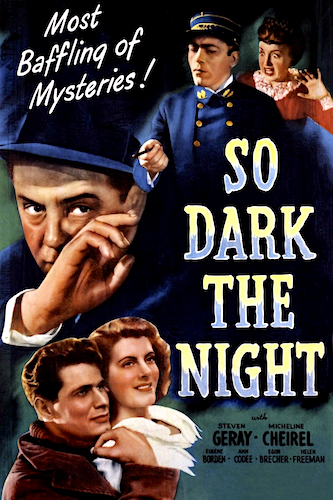
    Joseph H. Lewis | 70 mins | Blu-ray | 1.37:1 | USA / English | PG

    So Dark the Night

    How many serial killer mysteries have you seen that spend their first half being bucolic romances? I can’t think of any others than So Dark the Night. The title and setup don’t prepare you for it, but the first half-hour is more of a genteel country romcom, with only the slightest hint there might be darker turns to come. Half-an-hour isn’t long generally, but it’s almost halfway through a film this short — and that’s when things take an abrupt turn for the murderous.

    The short running time probably works against the film, on the whole. For example, it makes it easy to miss that there are several interesting supporting characters or facets to main characters. Love interest Nanette is sort of depicted as an innocent ingénue, but we first meet her ogling the expensiveness of Henri’s car, and then she and her mother conspire for her to meet Henri and try to elicit a romantic connection, even though she’s already got a long-standing engagement. That’s not exactly upstanding and sweet behaviour, is it? Then there’s the widowed maid, who’s so lonely and desperate to escape that even after she suspects the killer, she pleads to be taken with him.

    Along with a few other factors that are rather spoilersome, this is a film that takes the usual shape of the whodunnit and subverts it to disquieting effect. It’s a film that, on the surface, looks nothing like a noir — it’s set in a pretty French village (created with surprising authenticity on Columbia’s backlot) — but exposes that the darkness and violence of the human condition can exist anywhere. I say “on the surface” because the film’s photography is great, with many interesting shot and lightning choices peppered about, without overwhelming proceedings with unnecessary flourishes.

    4 out of 5

    So Dark the Night was #57 in my 100 Films in a Year Challenge 2020.


    The Adventures of
    Ichabod and Mr. Toad

    (1949)

    James Algar, Clyde Geronimi & Jack Kinney | 69 mins | digital (HD) | 4:3 | USA / English | U / G

    The Adventures of Ichabod and Mr. Toad

    Disney’s canon of animated films goes through a weird blip between Bambi in 1942 and Cinderella in 1950. That’s when the six so-called “package films” were released, bundling together short films into themed features. They’re almost a footnote in the Disney animated canon — I mean, before them you’ve got Snow White, Pinocchio, Fantasia, Dumbo, and Bambi, and after you’ve got Cinderella, Alice in Wonderland, Peter Pan, Lady and the Tramp, Sleeping Beauty, and so on… and on… But it’s not a period of hidden gems: these are films mostly only worth bothering with if you’re a completist. This final one is, perhaps, the exception. At any rate, it’s easily the best of the package films.

    Whereas the others contained multiple short features, here there are just two: adaptations of The Wind in the Willows and The Legend of Sleepy Hollow. There’s barely any faffing about with linking segments, either: a quick intro from Basil Rathbone (who narrates Willows), and an equally speedy transition from Bing Crosby (who narrates Sleepy Hollow), and that’s it. And that’s all it needs, instead spending time and resources on the stories themselves.

    I’ve never been a huge fan of The Wind in the Willows, but this is a fast-paced and fun version, with a particularly entertaining ‘action sequence’ in Toad Hall as the good guys and weasels run around trying to keep hold of the property deed. Then, The Legend of Sleepy Hollow recasts the famous horror story as… a small-town romantic farce. No, seriously. It’s fine if a little dull, but picks up considerably when it reaches Halloween and we get a song about the headless horseman, a highly atmospheric sequence in spooky woods, and an exciting/comical chase between Ichabod and the horseman. It takes a while to get there, but it’s worth it.

    3 out of 5

    The Adventures of Ichabod and Mr. Toad was #176 in my 100 Films in a Year Challenge 2020.


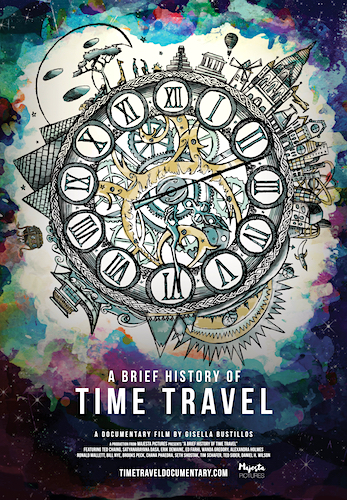
    A Brief History of Time Travel

    (2018)

    Gisella Bustillos | 69 mins | digital (HD) | 16:9 | USA / English

    A Brief History of Time Travel

    It’s a decade this year since I backed this documentary on Kickstarter — how’s that for time travel for you? I mean, technically, “normal and linear”, but also: time flies. It doesn’t feel like Kickstarter’s even been around that long. What the hell is going on with our perception of time (for example, the increasingly widespread observation on social media that everyone’s perception of how long ago things were is stuck somewhere in the early- to mid-2000s) would be an interesting topic for a documentary.

    But anyway, that’s not what this is. This is a wide-ranging overview of the concept of time travel, taking in fiction, science (both real and theoretical), and religion, as well as how those things interrelate and influence each other. It’s probably most interested in the science side, using other angles to illustrate rather than be examined in their own right. For example, it details the significance of H.G. Wells’s The Time Machine (the first story to involve time travel into the future, and one of the first where the travel was achieved via a man-made machine rather than some form of magic), but that’s about the last fictional story it describes. There are clips from Doctor Who and Back to the Future, but no discussion of their influence, nor of the kinds of time travel they present.

    At its best, the film draws interesting links and parallels between the different spheres it’s encompassing. This is at its most poignant when we meet a physicist who got into the field because his father died when he was young and time travel stories offered the idea that he might be able to revisit his dad, which developed into him learning the real science and becoming a physicist. Now, he believes he has a workable theory for how information could be sent into the past. I have no idea if that stands up to scrutiny, mind — the film doesn’t vet it with other interviewees’ opinions.

    Considering it only runs a little over an hour, it’s unsurprising that there’s not room to cover everything in depth. Nonetheless, it’s so blatantly leaving significant amounts of material untouched that you can’t help but feel disappointed. To be kind, it’s a reasonable primer for the uninitiated, with interesting bits of info dropped here and there, but almost every topic covered would merit a deeper, dedicated examination.

    3 out of 5

    A Brief History of Time Travel was #123 in my 100 Films in a Year Challenge 2021.


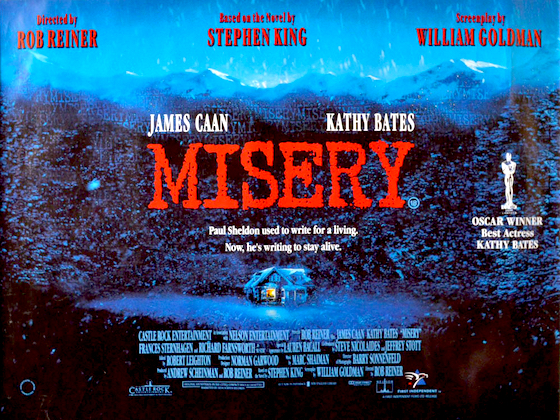
    Misery

    (1990)

    Rob Reiner | 107 mins | digital (HD) | 1.85:1 | USA / English | 15 / R

    Misery

    I feel like Misery is one of those movies that was once very well known in general pop culture, but has since slipped back, if not into obscurity then certainly into a lesser-known status, remembered only when mentioned by people who were there or as one in a list of Stephen King adaptations, that sort of thing. And that also feels fair enough, because it’s very much a movie that’s pretty good but not exceptional. The author whose work it’s taken from, the filmmaker who’s adapted it, and the main players on screen have all been responsible for or involved in even better and more enduring works of cinema, so of course this has become an “and also” note in their careers.

    Perhaps transcending that — and, certainly, by far the most famous thing about Misery — is the ankle-bashing scene, which unfortunately means you spend most of the film waiting for it to turn up, and when it does it’s rather unaffecting. That’s time and infamy for you. The former: it’s not as gruesome as it would be if shot today. The latter: I’d already seen the clip a dozen times. I can see how it was striking on the film’s original release, but familiarity has really blunted it.

    Fortunately, there’s more to the film than one shocking act of violence. Kathy Bates is excellent as Annie Wilkes, making her wild mood swings terrifyingly plausible. Her Oscar was well earned. Then there’s the subplot with the local sheriff and his unceasing investigation, which also introduces a welcome note of comedy via his interactions with his deputy (who’s his wife) and some of the other townsfolk. He’s brought to life with immense likability by Richard Farnsworth, and I’d’ve happily watched a whole movie based around him. On the whole, the film has a somewhat underwhelming “TV movie” feel to its visual (lack of) style, but there are some nicely done bits: the scene where Annie’s coming home while Paul tries to cover up that he’s been out and about; the final fight, which is just the right mix of tense, scrappy, and believably comical.

    4 out of 5

    Misery was #230 in my 100 Films in a Year Challenge 2020.


  • 2022 | Week 35

    When I revived 2007’s weekly(-ish) review compilation format at the start of 2022, the main objective was to write shorter reviews (not necessarily as short as the couple-of-sentences-per-film I wrote back in 2007, but not worrying about trying to do full write-ups for everything), which would help enable me to stay more up-to-date. Well, the former has only been partially successful, and that means the latter has slipped, too: here we are, rapidly heading towards the end of December, and I’m only just posting reviews of films I watched at the end of August / start of September. I’m certainly not going to have 2022 finished before 2023 begins.

    Hey-ho, there’s nothing to be done about it — other than remind myself I was intending to be more concise and more on top of things, and continue to try to push myself in that direction. In the meantime, on we go, with…

  • Mona Lisa (1986)
  • Mirror (1975), aka Zerkalo
  • Clerks (1995)
  • Persuasion (2022)
  • He Walked by Night (1948)


    Mona Lisa

    (1986)

    Neil Jordan | 104 mins | Blu-ray | 1.85:1 | UK / English | 15 / R

    Mona Lisa

    Neo-noir filtered through a British sensibility — which means you get a character study merely garnished with genre thrills, especially when the character in question is played by Bob Hoskins, adding depth and complexity to your could-be-straightforward protagonist.

    Said protagonist is George, a recently-released minor gangster looking for work. He’s an interesting mix of a character: streetwise but also kinda naïve; racist and judgemental, but without really meaning it. It’s like he’s just reciting stuff he’s heard from everyone else, rather than it being stuff he really believes. Well, isn’t that true of so many with horrendous opinions? These days they just get them from YouTube. George’s prejudices are somewhat challenged when he’s assigned to drive around a high-class call girl, Simone, who happens to be black. Although Hoskins took most of the plaudits (including an Oscar nomination and BAFTA win), as Simone, Cathy Tyson breathes an equal amount of life into a character that, similarly, in lesser hands could’ve just been a plot-driving mystery. (She was also nominated for a BAFTA, incidentally.)

    The film’s style is an interesting mishmash, in that it has an element of British grit and groundedness — especially being shot on grainy film, all on location in London, in a world of everyday gangsters and prostitutes — but with fantastical and/or genre flourishes — George’s friend Thomas creates weird art stuff and engages in literary discussions; nighttime London is shot to look like a vision of Hell; and then there’s all the noir stuff in the construction of the story. There’s a version of this film that fully gives in to that genre, but the comedy and ‘fantasy’ dilutes the neo-noir aspects, making the film more unique, and distinctly British.

    The fact Arrow initially released Mona Lisa as the de facto lesser half of a double-bill with earlier Hoskins-starring gangster flick The Long Good Friday does it something of a disservice (though it’s also is the primary reason I had it in my collection to prompt me to watch it, so swings and roundabouts). This is a film more than worthy of standing on its own; and one that, while not poorly regarded or completely forgotten, merits a wider rediscovery.

    4 out of 5

    Mona Lisa is the 53rd film in my 100 Films in a Year Challenge 2022. It was viewed as part of “What Do You Mean You Haven’t Seen…?” 2022. It placed 11th on my list of The Best Films I Saw in 2022.


    Mirror

    (1975)

    aka Zerkalo

    Andrei Tarkovsky | 107 mins | digital (HD) | 1.37:1 | Soviet Union / Russian | U

    Mirror

    Andrei Tarkovsky’s poetic evocation of memory and mid-20th-century Soviet history. If that sounds a bit Arty, just wait ’til you hear Criterion’s blurb, which says it’s “as much a poem composed in images, or a hypnagogic hallucination, as it is a work of cinema.” Oh dear, sounds like Hard Work, right? Well, it is.

    Calling it “visual poetry” might sound like pretentiousness, but it really isn’t — Mirror definitely plays more like that than a traditional narrative film. And, just like most poetry, I didn’t really get it. I must confess that I was tuning out by the end; partly due to tiredness, which is my own fault; but partly that the film gave me nothing to really latch on to; no (clear) narrative or character or anything for me to focus on to keep my wavering attention in the right place. On the bright side, it avoided being a total disaster in my eyes by having some nice-looking bits, and individual scenes or sequences that kinda work. But I absolutely do not “get it” as a whole cohesive piece of art.

    Clearly, this kind of thing works for some people — Sight & Sound’s most recent poll ranked it 31st, and the director’s poll (which I would normally argue errs slightly more mainstream) went even better and placed it 8th. Each to their own. Based on his work that I’ve seen so far, I just don’t think Tarkovsky’s for me.

    2 out of 5

    Mirror is the 54th film in my 100 Films in a Year Challenge 2022. It was viewed as part of Blindspot 2022.


    Clerks

    (1994)

    Kevin Smith | 88 mins | DVD | 1.85:1 | USA / English | 15 / R

    Clerks

    There’s no escaping the fact that Clerks is very much a product of its time, both in itself as a work of art, and in how it became a breakout success. (Can you imagine a film like this launching a career like Kevin Smith had (for a bit) if it was made today? Best you could hope for now is being seen by half-a-dozen festival-goers before the director gets tapped to be Kevin Feige’s puppet on some Marvel content.) That said, for all its ’90s-time-capsule-ness, it holds up pretty well as a piece of entertainment. By which I mean, I laughed multiple times and was never bored.

    The story, such as it is, concerns a pair of convenience store workers hanging out for a day, and the various little dramas and incidents that occur to and around them. Serving as both writer and director, Smith quite cleverly turns bugs into features. No budget? Make that the whole aesthetic, with grainy 16mm photography and an everyday setting in which ‘nothing’ happens. Non-pro actors? Have everyone deliver all their lines mile-a-minute, thus making the whole thing feel kinda heightened and stylised, to the point where you can’t be sure if most of the cast can’t act or it was all a deliberate choice. This is further fed by Smith often letting scenes play out in long takes with no cuts — if these guys can remember all their lines to do a whole scene in a oner, they must be pretty professional, right?

    Impressively for a first-timer behind the camera, Smith doesn’t go overboard with directorial flourishes. There’s the occasional shot or sequence with some extra pizzazz to keep up the visual interest, but he seems to know that less is more; that this is the kind of film that plays best in medium shots. This might sound like basic stuff, but evidence shows that first-time filmmakers with something to prove are regularly tempted to go all-out and make something that feels Directed. That might be nice for a showreel, but for an actual film, restraint goes a long way.

    Technique aside, the content just works. These characters are likeable enough to hang out with for 90 minutes, because that’s effectively all we’re doing. But there’s enough variety in their conversations and situations, and enough genuinely funny lines and moments, that it works and is enjoyable, rather than being a dull or directionless slice-of-life piece.

    4 out of 5

    Clerks is the 55th film in my 100 Films in a Year Challenge 2022.


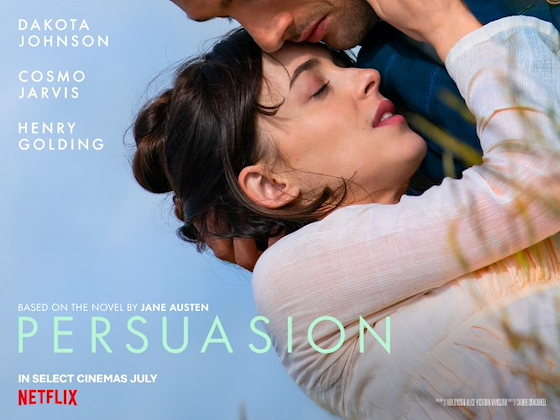
    Persuasion

    (2022)

    Carrie Cracknell | 108 mins | digital (UHD) | 2.00:1 | USA / English | PG / PG

    Persuasion

    Jane Austen adaptations appear to be perennially popular, so it was probably only a matter of time before Netflix attempted one. Here, they’ve retained the original setting but given proceedings a modern-ish wash, apparently influenced by their hit series Bridgerton style (I’ve never seen Bridgerton, so this is based on the trailers and that others have made the same comparison). The result? A trailer that met with a great deal of displeasure from Austen fans, not keen on the apparent irreverence to the source material. I’ve never read Austen, either, so I’ll leave exact comparisons to the more knowledgeable.

    That said, I can’t say the trailer fully won me over, but I thought I’d allow the film its chance. And it’s not terrible — there are lots of nice scenes and moments to be found. Unfortunately, they’re undercut by the bits everyone talked about from the trailer: the clearly-Fleabag-inspired gurns to camera; the banal and misplaced modern-style dialogue. The really sad thing is that there aren’t actually very many of those bits — the ones that were widely cited as “examples” are nearly all of them, in fact — and so there is nearly a very nice film here.

    Dedicated fans of Austen’s original work, and those who prefer their period dramas played straight and faithful, will likely still find those moments off-putting. If you’re prepared to overlook the missteps, this Persuasion is largely likeable.

    3 out of 5

    Persuasion is the 56th film in my 100 Films in a Year Challenge 2022.


    He Walked by Night

    (1948)

    Alfred Werker | 79 mins | digital (HD) | 4:3 | USA / English | PG

    He Walked by Night

    “A film that started as a humble low-budget offering from a second-tier studio, but wound up being one of the most influential films of its era” is how ‘Czar of Noir’ Eddie Muller describes He Walked by Night in his introduction for TCM’s Noir Alley strand. That’s partly because it inspired the radio series Dragnet, which was immensely significant in the development of police procedural series, a genre that remains a bread-and-butter staple of TV entertainment to this day. But also because it was shot by cinematographer John Alton — “the greatest noir stylist of all time”, says Muller, and here he produced “one of the most dramatically photographed film noirs ever”. There’s debate over whether the film was actually helmed by its credited director, Alfred Werker, or if Anthony Mann actually did most of the work. “It doesn’t really matter,” says Muller, “because the picture’s held together by the stunning visual style of its singular cinematographer”.

    Well, I can’t disagree. This is a gorgeously shot film, and a concise exemplar of all we know of film noir style — primarily, abundant shadows. But it’s not just the imagery that makes it work. There are multiple tense suspense sequences, often making great use of silence — this is a film not afraid to be quiet when it’s effective — climaxing with an incredibly atmospheric chase and shootout in the LA storm drain system. We spend a lot of time with the villain, Roy Martin — the film is definitely a howcatchem; no whodunit mystery here — who’s superbly played by Richard Basehart. Coming back to the point about silence, Martin is a loner, so he doesn’t get much dialogue a lot of the time, but Basehart still effectively conveys how smart and cunning he is. Also worthy of note is Whit Bissell as an electronics dealer who unwittingly sold on ‘inventions’ that Martin had in fact stolen. The poor guy is clearly innocent and been duped, but he ends up between a rock and a hard place when the police aren’t sure they believe that.

    The overall style of He Walked by Night is intensely procedural and serious about it, but it still finds room for glimpses of character, both from the cops and the criminals; and there’s humour, too. That helps give it a bit of light and shade, and also genuine reality — you’ll find humorousness everywhere in real life, however serious events may be.

    4 out of 5

    He Walked by Night is the 57th film in my 100 Films in a Year Challenge 2022.


  • 2022 | Week 34

    Skipping week 33 (when I didn’t watch anything), here are all the films I watched in week 34 — which, if anyone’s interested, was back in August. Somehow, I don’t think I’m going to get caught up on my 2022 reviews before the end of the year…

  • The Winter Guest (1997)
  • Repeat Performance (1947)
  • Carousel (1956)


    The Winter Guest

    (1997)

    Alan Rickman | 105 mins | digital (SD) | 16:9 | UK & USA / English | 15 / R

    The Winter Guest

    The writing and directing debut of actor Alan Rickman, The Winter Guest follows four loosely-connected pairs of characters through a day in their lives, all confined to a small Scottish seaside town where the stark winter has turned the sea to ice. It’s the kind of film where nothing happens: the characters hang out with each other and talk, basically, with their issues ranging from bereavement to stereotypical teenage sex obsession (one boy played by a young Sean Biggerstaff wants… a bigger staff, wink wink. Sorry, the pun was too tempting to avoid).

    The confined setting and characters means the end result feels theatrical in both style and content — it’s basically just a series of two-handers, with quite mannered dialogue. And yet its staging isn’t so limited, because Rickman and cinematographer Seamus McGarvey do an excellent of of evoking the chilly surroundings (most of the film is set outside), giving the scenery a painterly feel. That’s probably in part due to using digital matte paintings to convey the frozen ocean, but it extends to the beaches and town buildings, too. Or it could just be an unintended side effect of the smoothing conferred by watching in digitally compressed SD; but as it’s just about my favourite aspect of the film, let’s assume it was intentional and skilfully done.

    3 out of 5


    Repeat Performance

    (1947)

    Alfred Werker | 93 mins | Blu-ray | 1.37:1 | USA / English

    Repeat Performance

    On the eve of 1947, actress Sheila Page (Joan Leslie) shoots dead her husband (original Saint Louis Hayward). She flees, ending up at the home of her producer (second Falcon Tom Conway) in the early hours of New Year’s Day… 1946. Given the chance to re-live the past year, can she make things right?

    Repeat Performance gets classified as film noir, but I feel like it’s one of those films that sits on the periphery of what qualifies for the genre. The opening — in which a woman shoots dead her husband, in New York City at night — yes, very noir. But what unfurls over the next 90 minutes is more of a backstage romantic melodrama by way of Twilight Zone-style fantasy. But that’s the thing with noir: as a movement that wasn’t recognised and codified as a genre until after it was over, what ‘counts’ can be a very broad church.

    Here, the odd combination of styles makes for an unusual and mostly entertaining film. My only real gripe is that we’re given very little idea what went on in the ‘original’ 1946, so it’s hard to tell how much effort Sheila is actually making to change it, or to follow how successful she’s being. This kind of perspective is perhaps the benefit of a further 75 years of development and refinement in the field of fantastical storytelling — Repeat Performance isn’t a Fantasy film in the true genre sense, more a Thriller with a neat inciting twist, a la Sliding Doors (my go-to example of a Fantasy film that doesn’t care it’s a Fantasy film!)

    The plot is bolstered by strong or likeable performances across the board. Some of the lead cast may be better known for starring in B-movie schedule-fillers, but this is proof if proof were needed that to interpret that as a sign of limited skill on their part would be an incorrect conclusion. Which is a rather torturous way of saying “Hayward and Conway were quite good actors, actually”. Hayward is particularly good here, getting to show off his range from loving husband to psychopathic abuser, plus a few other stages in between. Conway is more at the likeable end of the spectrum as Sheila’s kindly producer, while Richard Basehart’s performance (in his movie debut) as queer-coded poet William Williams (in the original novel, the character is a transvestite) was so impressive that the producers gave him more scenes with Leslie and bumped up his billing.

    4 out of 5

    Repeat Performance is the 52nd film in my 100 Films in a Year Challenge 2022.


    Carousel

    (1956)

    Henry King | 123 mins | digital (HD) | 2.55:1 | USA / English | U

    Carousel

    Carousel is a spectacularly odd entry in the Rodgers & Hammerstein canon of musicals. Based on a play called Liliom (which was previously filmed by Frank Borzage in 1930 and Fritz Lang in 1934), it tells the story of a carnival barker (Gordon MacRae) who’s been dead 15 years, but in flashback we learn of how he fell in love and married, and how he died, and why he now gets a chance to go back for a day to make amends. That almost makes the film sound focused. As it plays out, the storyline has a weirdly aimless quality, not helped by songs that are mostly mediocre or bizarre. That’s before we get to the horrendously outdated views on domestic violence, or the fact that it’s not actually got very much to do with the titular fairground attraction.

    The darker material and themes could work in the right setting, but here they clash with the sunny seaside photography and stereotypically cheerful musical numbers. I mean, this is a story about a physically abusive husband and wannabe small-time crook, who can’t even change his ways when the afterlife gives him a second chance, and we have songs about the beauty of summer and the joys of a clambake (the latter may haunt your memories…)

    A strange film, and not in the good way. At least it’s made me curious to see the Borzage and Lang versions — perhaps as a straight drama it will be more obvious why this has merited adaptation so many times.

    2 out of 5


  • 2022 | Week 26

    I’m taking you back over two months here, to the end of June / start of July, for another eclectic batch of films I happened to watch in close proximity to each other…

  • The Flying Deuces (1939)
  • Apollo 10½: A Space Age Childhood (2022)
  • My Name Is Julia Ross (1945)
  • Ambulance (2022)
  • Easy A (2010)


    The Flying Deuces

    (1939)

    A. Edward Sutherland | 68 mins | DVD | 4:3 | USA / English | U

    The Flying Deuces

    I feel like I’m aware of Laurel & Hardy in a way I would say “everyone” is, but I guess that’s probably not true anymore (the kind of stuff I picked up or learnt about by osmosis in my ’80s/’90s childhood is surely very different to what kids got growing up in the ’00s/’10s). But I don’t think I’ve ever actively seen any of their work; certainly none of their feature-length films. The Flying Deuces is “probably their most famous film”, at least according to the blurb on my copy. Certainly, it’s the one you see bandied about the most; but then it’s in the public domain (one of only two Laurel & Hardy films where that’s the case), so it’s inevitably subject to endless cheapo releases. Leaving the quality of the print aside (it was poor; but at least it wasn’t cut, which apparently many are), I can’t say I was too impressed by the quality of the content, either.

    Here’s the rub: it’s a comedy, but it barely made me laugh. The humour operates at a basic level, with gags that are either well-worn or repetitious. “How anyone could be so stupid as to stand there and continually bump their head is beyond me,” one of them says at one point. And yet the other does exactly that, because that’s the level most of the film’s humour operates at. Some might say this is the downside of the duo being popular and their work being old — i.e. it’s been imitated and copied for decades, and we’ve moved on. But I don’t find that to be the case with silent comedians —who were equally, if not even more, popular, and whose work is even older — nor with things like the Road to films — which are far from the height of sophisticated comedy, but tickle my fancy more often.

    Well, there’s your answer, I guess: it’s all a matter of taste. And it seems Laurel and Hardy aren’t to mine.

    2 out of 5

    The Flying Deuces is the 41st film in my 100 Films in a Year Challenge 2022.


    Apollo 10½:
    A Space Age Childhood

    (2022)

    Richard Linklater | 97 mins | digital (HD) | 16:9 | USA / English | 12 / PG-13

    Apollo 10½: A Space Age Childhood

    I guess one of the advantages of being a filmmaker with some degree of clout is you can take your regular-ass childhood and turn it into a movie as if it was somehow special. That’s what the Before trilogy and Boyhood mastermind Richard Linklater has done here, fictionalising his autobiography as the story of ten-year-old Stanley, who lives in Huston, Texas, in the era of the first moon landing. Except, in this version, Stanley is secretly recruited by NASA to secretly train to be a secret astronaut to secretly be the first person on the Moon, in secret. If that sounds like an unusual spin on a traditional nostalgia-driven biopic, don’t get excited: that subplot is moved away from as quickly as it’s introduced, and only pops back up two or three more times, each brief. The film is much more concerned with real memories than imagined ones, and is much less fun for it.

    Often, at Christmas or other such get-togethers, members of my family will end up reminiscing about various childhood recollections. I’m sure many other families do a similar thing. What’s shared on these occasions are the kind of mundane memories that mean the world to us but, if you stopped to think about it, you know no outsider would find of much value. Well, seems Richard Linklater hasn’t stopped to think about it. And I really do mean “mundane”: there’s a sequence about which sibling did which chores and how they made their school lunches. As a commenter on iCM put it, Linklater “name checks every TV show and movie he saw, every game he played, everything in his diary […] for long stretches, it just feels like an itemized list of childhood memories.”

    One part that’s actually rather good is Jack Black’s voiceover narration as the adult Stanley. There’s probably too much of it (again underlining the fact these are nostalgic anecdotes rather than a true narrative), but the actual quality he brings is very nice. It feels calm and understated, neither giving in to Black’s usual mania nor substituting it for the hardcore tweeness you might expect from such a rose-tinted autobiography.

    Maybe Apollo 10½ will be more interesting to young people or future generations, whose technology- and safety-obsessed childhood experiences will be so far removed from what we see here. To them, it’s an historical documentary. I can’t say my childhood was much like this one (especially as it occurred almost 30 years later), but I guess I’ve picked up enough of this kind of nostalgia from other American films and TV series down the years that what Linklater has to share doesn’t feel remarkable enough to be worth sharing.

    3 out of 5

    Apollo 10½: A Space Age Childhood is the 42nd film in my 100 Films in a Year Challenge 2022.


    My Name Is Julia Ross

    (1945)

    Joseph H. Lewis | 65 mins | Blu-ray | 1.37:1 | USA / English | PG

    My Name Is Julia Ross

    Here we have one of those films that commonly gets called a film noir, but isn’t really (or, at least, doesn’t fit well with the standard conception of what noir entails). The blurb for Arrow’s Blu-ray release describes it as a “Gothic-tinged Hitchcockian breakout hit” (apparently it was produced as a B-movie but became so popular they promoted it to “A-feature status”), which struck me as accurate — it’s less standard noir, more a Rebecca-influenced psychological thriller. While it’s clearly no Hitchcock, it’s a very entertaining substitute.

    Nina Foch stars as the eponymous Julia Ross, who takes a job as a live-in secretary for a wealthy widow. But the job is a front: Julia is kidnapped, waking up a prisoner in a Cornish mansion, where the widow (Dame May Whitty) and her son (George Macready) try to convince her she’s actually Marion Hughes, the son’s wife, and she’s having a bit of an episode.

    From the way Arrow described the film, I assumed it was going to play to some degree with the idea that maybe she is actually mad. It would be a neat twist, right? That she is Marion Hughes, and the stuff we saw at the start was part of her delusion. But no, the film doesn’t even vaguely gesture at that route: right after Julia meets her prospective employer, we see that she’s plotting something nefarious — and the film isn’t even seven minutes in. Then, even before we really know that something’s up, Julia’s fancy-man is looking into her disappearance. It’s like the film’s playing all the right notes but in the wrong order.

    But it doesn’t really matter, because the whole thing is suitably entertaining. Rather than relying on the mystery of what’s happening, it’s more about how Julia can get out of the situation. Will she be able to escape her confinement? Can she somehow get out a message for help? Or will the villains succeed in their scheme? Plus, at just 65 minutes, it moves at a whipcrack pace, so you can sit back and enjoy the absurd plot rather than worrying about, well, how absurd it is.

    4 out of 5

    My Name Is Julia Ross is the 43rd film in my 100 Films in a Year Challenge 2022.


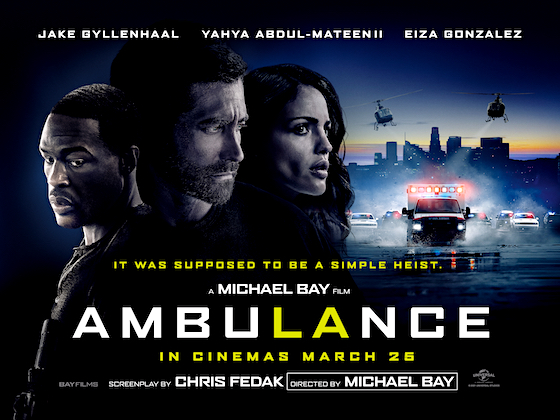
    Ambulance

    (2022)

    Michael Bay | 136 mins | Blu-ray (UHD) | 2.35:1 | USA & Japan / English | 15 / R

    Ambulance

    When their bank heist goes sideways, two brothers (Jake Gyllenhaal and Yahya Abdul-Mateen II) make their getaway in a stolen ambulance — with a policeman they shot and the paramedic working on him (Eiza González) in the back. With the cops immediately on their tail, thus begins an epic car ambulance chase around the streets of LA.

    The setup feels like it should signal the low-/mid-budget debut of a new director showcasing their talents with a 90-minute stripped-back thrill-ride that’s mostly contained to the eponymous setting. But it’s not directed by some newbie — it’s Michael frickin’ Bay, back on the form that gave us action classics like The Rock. And so the 90-minute character-focused thriller is in there (honest it is), but augmented with 40 minutes of big-budget Bayhem.

    Compared to Bay’s other work in the past 15 or so years, Ambulance feels restrained. Compared to almost any other filmmaker, it’s anything but. When I say “restrained”, part of what I mean is the editing. Not that it takes a leisurely approach by any means, but it doesn’t have that “impressionistic jumble of B-roll” style Bay has tended towards on and off ever since Armageddon, and that became his only mode during a couple of the Transformers sequels. Also, I didn’t notice this until I read it on IMDb, but the film contains a literal Chekhov’s gun — that is, a gun that is a “Chekhov’s gun”. That’s so Michael Bay.

    Giving this film 5 stars would be a bit silly… but it was really good. It’s the kind of movie you’d never rate higher than 4, but you love for what it is: magnificent Bayhem.

    4 out of 5

    Ambulance is the 44th film in my 100 Films in a Year Challenge 2022. It placed 9th on my list of The Best Films I Saw in 2022.


    Easy A

    (2010)

    Will Gluck | 92 mins | digital (HD) | 16:9 | USA / English | 15 / PG-13

    Easy A

    When an overheard white lie about losing her virginity makes barely-noticed Olive (Emma Stone) the centre of her high school rumour mill, she decides to manipulate her newfound notoriety for her own amusement.

    As “raunchy teen comedy” plots go, it hits a sweet spot of being neither too prudish nor too lecherous. The dialogue elevates it further in a sharp and witty script by Bert V. Royal (who, it seems, has since only worked on TV shows I’ve never heard of. Shame). In her first lead role, Emma Stone gives a perfectly-pitched, surprisingly nuanced performance. The story really allows her to show off her versatility, believable as both the ‘quiet girl’ and ‘confident slut’. Obviously there’s lots of comedy, but she sells the moments of sincerity too. It’s no wonder she quickly got snapped up for more awards-type work. Plus, there’s Stanley Tucci being what I imagine Stanley Tucci is actually like as a dad, which is perfection.

    The only major downside (and it’s a bit of a spoiler, but also so predictable that it barely counts as a spoiler) is that it would’ve been nice if the guy she eventually ends up with wasn’t so stereotypically hot. We’re meant to buy him as a kinda-goofy sports mascot rather than someone who’d actually be playing The Sport? Yeah right.

    I’m not always a fan of high school movies or teen comedies, but there are definite exceptions, and this is the latest addition to that rarefied list.

    4 out of 5


  • 2022 | Weeks 24–25

    Similar to Week 21 last time, Week 23 only included rewatches, so gets skipped in the title. As for the other two, that brings us fundamentally to the end of June (the 26th, to be precise), and so almost to the halfway point of the year. But I’ll leave such discussion to my monthly reviews.

    Instead, here are the remaining four reviews of films I watched that fortnight…

  • The Ghost Writer (2010)
  • Escape in the Fog (1945)
  • Pretty in Pink (1986)
  • House of Gucci (2021)


    The Ghost Writer

    (2010)

    aka The Ghost

    Roman Polanski | 128 mins | digital (HD) | 2.35:1 | France, Germany & UK / English | 15 / PG-13

    The Ghost

    Originally released as The Ghost in the UK (the same title as the Robert Harris novel on which it’s based), but now on Netflix under its US title, The Ghost Writer, whatever you call this film, it’s an effective thriller about a subject that might not sound thrilling: writing an autobiography. The key is that the person being biographied is a former British Prime Minister (Pierce Brosnan) who was involved in some shady business during his time in office, which is beginning to resurface in the news; plus the fact that his first ghost writer was recently found dead, washed up on a beach on the island the ex-PM is currently calling home. It’s into this maelstrom that our hero, the new ghost writer (Ewan McGregor), is dropped, and soon finds himself more involved than he’d like.

    So, despite the unique setup, it’s a fairly straight-up thriller plot of political intrigue and buried secrets. That’s not a criticism — this is very much my kind of thing. What elevates it is the film’s style and atmosphere. There’s something odd about it all, which makes the viewer feel as unsettled and out-of-place as McGregor’s character quickly becomes. Some contributing factors to this sensation are likely unintentional — the result of things like half the cast having to labour under different accents, or the excessive green screen used to fill in the views of Cape Cod (the film wasn’t shot in the US, but in Germany and Denmark, for “the director’s a criminal wanted in the US” reasons) — but neither of these elements felt glaringly bad to me, just… off.

    As I say, I think such an atmosphere is actually very fitting for a political thriller full of questions about who can be trusted, life-or-death mysteries, and a couple of solid twists. Yes, very much my kind of thing.

    4 out of 5

    The Ghost Writer placed 8th on my list of The Best Films I Saw in 2022.


    Escape in the Fog

    (1945)

    Oscar Boetticher Jr. | 63 mins | Blu-ray | 1.37:1 | USA / English | PG

    Escape in the Fog

    With the fifth (and, it would seem, final) of Indicator’s Columbia Noir box sets then-imminent, and a new series of Universal Noir soon to begin, I thought it was about time I actually started watching them. So here’s the first, both for me and the series (i.e. it’s the oldest film in box set #1). It’s a quickie from director Budd Boetticher (before he started being credited under that name) about a San Fransisco nurse who has an ultra-specific dream about a murder, then meets the victim-to-be in real life. It turns out he’s a spy about to be sent on a top-secret mission, but his only hope of making it alive is her using the details from her dream to prevent his death.

    It’s unfortunate that this 30-film ‘series’ (they’re only connected by the studio that made them and Indicator happening to bundle them together, of course) begins with such a travesty of a film. For starters, it’s barely even a noir, more a melodramatic mildly-fantastical spy thriller. Well, I can enjoy that kind of thing too — goodness knows the number of spy movies I’ve given high scores to, and there’s something to be said for a spot of ridiculous hokum — and Escape in the Fog might have been another such fun example, except it’s been made with a total absence of passion. It’s about as thrilling as a lukewarm cup of milky tea at a cafe that only has outside seating on a drizzly winter afternoon. It’s only redeeming quality is that it’s so daft (though only in places, because it ends up forgetting its own ridiculous conceits) that you can’t help but have a bit of a laugh at it.

    Filler in every sense of the word.

    2 out of 5

    Escape in the Fog is the 38th film in my 100 Films in a Year Challenge 2022.


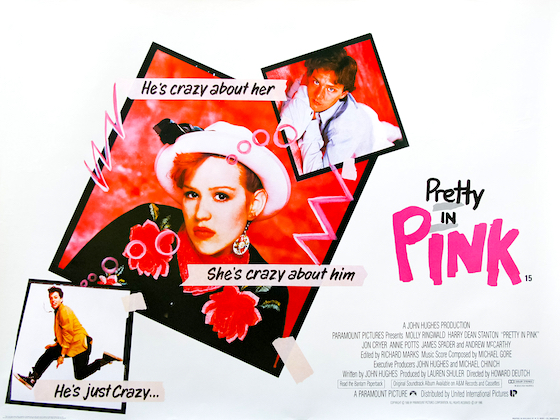
    Pretty in Pink

    (1986)

    Howard Deutch | 97 mins | digital (HD) | 16:9 | USA / English | 15 / PG-13

    Pretty in Pink

    Another John Hughes-penned ’80s teen movie that had passed me by (it’s only in the past few years that I’ve watched The Breakfast Club and Ferris Bueller’s Day Off, and I’ve still not seen Sixteen Candles or Weird Science). This one stars Molly Ringwald as Andie, a non-popular high school girl caught between the affections of her childhood friend (Jon Cryer) and a rich kid who’s suddenly showing an interest in her (Andrew McCarthy).

    No bones about it, plot-wise it’s a pretty standard love triangle romcom; but the devil is in the details, and Pretty in Pink has a lot of likeable ones. For starters, it’s so ’80s. Like, aggressively. Like, if you made a movie set in the ’80s, you wouldn’t make it this much ’80s because people would criticise you for overdoing it. Then there’s the supporting performances. Harry Dean Stanton makes a great ‘movie dad’ — you know, the kind of comforting, supportive father figure you kinda wish were your own. I don’t think I’ve ever seen him in a role like this before. The relationship between him and Ringwald comes across as really sweet and effective without tipping over into saccharine or implausible. Then there’s Annie Potts as Andie’s older best friend, proving she should be known for more than just being screechy and kooky in Ghostbusters. Plus, James Spader makes for a superb villain. It’s only a small role in the grand scheme of the film, but he does smarmy glibness so well.

    Poor Molly Ringwald — she’s fine in the lead, but everyone else is so good they kinda overshadow her in her own movie. Or maybe that’s unfair: Andie is a pretty likeable lead, with a commendable amount of independence and self-worth. Okay, she lets that slip a bit for A Boy, but what teenager hasn’t let such heady new emotions get the better of them? She comes out for the best in the end.

    The only major downside is the rushed third act, which makes the ending feel unearned — a feat that’s almost impressive when the ending is so predictable. It’s actually due to a post-test-screening rewrite and reshoot: in the original version (spoilers!) Andie ends up with Duckie, not Blane. Personally, I don’t think either is right: she should’ve chosen neither of them. As I see it, the film doesn’t really set up her getting back with Blane (presumably because it was a last-minute change), so I don’t buy that; but nor does it do enough to suggest she’d suddenly find Duckie a romantic proposition. They should have settled for being BFFs, and Blane should’ve fucked off. But I guess a romcom where the girl ends up single wasn’t done back then. You’d probably still find it a hard sell today, to be honest.

    4 out of 5

    Pretty in Pink is the 39th film in my 100 Films in a Year Challenge 2022. It was viewed as part of “What Do You Mean You Haven’t Seen…?” 2022.


    House of Gucci

    (2021)

    Ridley Scott | 158 mins | digital (HD) | 2.39:1 | USA & Canada / English, Italian & Arabic | 15 / R

    House of Gucci

    Director Ridley Scott tells the true (ish) story of the behind-the-scenes dramas at Italian fashion house Gucci in the mid 20th century. If you think that sounds like some kind of dull boardroom drama, oh boy, is it not. With the amount of scheming and backstabbing that goes on, it’s more like a variation on The Godfather than a staid piece about people arguing in suits in offices. Oh, those crazy Italians, eh?

    Of course, none of the main cast are Italian. But they are all doing Italian accents. Or what passes for Italian accents in the mind of us anglophones — they sound about as authentic as a Dolmio advert. Or a Mario game. “It’s a-me, Lady Gaga!” Although, once you get over the humour value of that, Gaga is genuinely very good in her Lady Macbeth-esque role as a woman who marries into the family and goads her husband into dominating the business. And then there’s Jared Leto, buried under prosthetics as well as the dodgy accent. Does he know he’s getting laughs with almost every line, or does he think he’s giving a serious dramatic performance? Who knows. Who cares. No one in the rest of the cast is as memorable — even when we’re talking about actors of the calibre of Adam Driver, Salma Hayek, Jeremy Irons, and Al Pacino — but then, I’m not sure there’d be room for that many Big performances. Scott brings his usual pizzazz too, with the well-shot gorgeous locales looking beautiful and elegant. Parts of Italy are just fundamentally beautiful, and you think it would probably be hard to mess up filming them.

    There are plenty of criticisms of the film to be found in pro reviews and viewer comments across the usual sources. Reading them, I don’t necessarily disagree on any particular point. For one thing, it’s definitely too long, and still leaves a load of information to be dumped in the inevitable “what happens next” text at the end. It could also be clearer about what’s going on at times, especially legal stuff, like when they’re suddenly being investigated for financial crimes. That said, it has an energy that often keeps it barrelling along. It’s probably an advantage to not know the real-life events, because it allows the story to unfold without preconceptions about where it’s going, so you’re not waiting for it to get to the bits you know.

    Flaws and all, I had a ball watching it. It may really be a 3-star film in some senses, but I got a 4-star level of enjoyment out of it.

    4 out of 5


  • 2022 | Week 22

    Maybe I should’ve called this post “Weeks 21–22”, to ensure that the titles of these roundups had a complete run of weeks throughout the year. But I didn’t actually watch anything new in Week 21 (my only film that week was the Challenge-qualifying rewatch of On the Town), so it seemed inaccurate to include it.

    Week 22, on the other hand, was moderately busy, with this lot…

  • This Means War (2012)
  • To Be or Not to Be (1942)
  • An Unsuitable Job for a Woman (1982)
  • The Pajama Game (1957)
  • The Contender (2000)


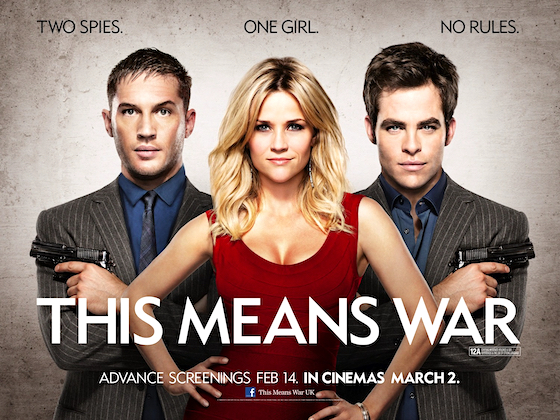
    This Means War

    (2012)

    McG | 98 mins | digital (HD) | 2.35:1 | United States / English | 12 / PG-13

    This Means War

    I bet whoever came up with this thought they were a genius: “spyfi action-adventure + rom-com? It’s the perfect date movie!” Of course, what you actually end up with is a film that struggles to do either part well.

    It stars the unlikely combo of Chris Pratt and Tom Hardy (you definitely can’t imagine Hardy doing a movie like this today) as BFF CIA agents who independently fall for the same woman, played by Reese Witherspoon. Uh-oh. Hilarity ensues as the guys deploy their CIA tricks and tech to influence the relationships. Yeah, it’s the kind of concept that once upon a time sounded like a fun and quirky rom-com, but nowadays seems at best morally dubious, at worst downright creepy. And, indeed, that’s how it plays out, with situation after situation that’s played for laughs but feels a little uncomfortable.

    Of course, the big question is “who ends up with who?” This is one of those films so committed to its storyline, so structured to lead to one correct answer, that… they shot multiple endings so they could decide in post. The one they went with doesn’t feel quite right, but, if you imagine the alternatives, most of them don’t either. Well, I say that: I don’t think it’s really a spoiler to tell you that Witherspoon ends up with one of the guys, when the correct choice would’ve been “neither of them. Run from the stalker-ish CIA agents! Find a normal man!”

    2 out of 5


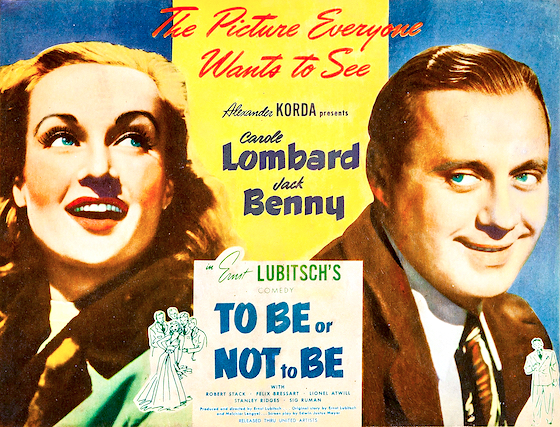
    To Be or Not to Be

    (1942)

    Ernst Lubitsch | 99 mins | digital (HD) | 1.37:1 | USA / English | U

    To Be or Not to Be

    Ernst Lubitsch’s satire concerns an acting troupe in occupied Poland who become mixed up in a soldier’s efforts to capture a German spy before he can undermine the resistance. Made while World War II was still in full force, the film attracted criticism in some quarters for being a comedy about such tragic and ongoing real-life horrors. Lubitsch defended his work, writing to one critic to say, “What I have satirized in this picture are the Nazis and their ridiculous ideology. I have also satirized the attitude of actors who always remain actors regardless how dangerous the situation might be, which I believe is a true observation.” He’s right, of course; at least about the first part. Ridiculously, such debates about whether you can satirise the Nazis persist to this very day — just look at some of the responses to Jojo Rabbit.

    Lubitsch’s film is subtler than Waititi’s, though still undoubtedly a comedy. I mean, with its plucky resistance members taking occupying Nazis for fools, I couldn’t help but think of this as a classier version of ’Allo ’Allo… but I’ve never actually seen a whole episode of that show, so don’t hold my comparison in too high a regard. Whereas that sitcom is famous for its catchphrases and bawdy gags, To Be or Not to Be is less overt, preferring to paint the Nazis as fundamentally incompetent and derive its humour there.

    Despite the distaste some felt, it obviously works for most people, as it appears on several “great movies” lists, not least both the IMDb and Letterboxd Top 250s. To be honest, I feel like I need to give it another spin to digest it more fully, but these thin thoughts will have to suffice for now.

    4 out of 5

    To Be or Not to Be is the 35th film in my 100 Films in a Year Challenge 2022. It was viewed as part of Blindspot 2022.


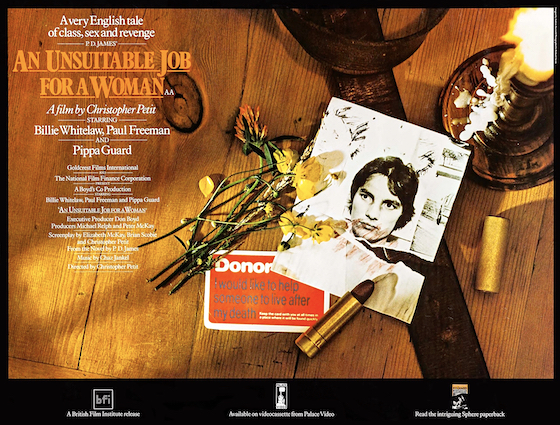
    An Unsuitable Job for a Woman

    (1982)

    Christopher Petit | 94 mins | Blu-ray | 1.85:1 | UK / English | 15

    An Unsuitable Job for a Woman

    I’ve never read the P.D. James novel on which this is based, but I’m assured it’s longer and more complex — the film rather lacks for plausible suspects, making the central murder mystery thoroughly guessable.

    That said, I’m not sure co-writer/director Christopher Petit is all that concerned with producing a true whodunnit. Put another way, I think he’s more interested in the characters, who happen to be involved in a mystery, than in the mystery itself. Which is fine, but I’m also not sure the film does as good a job as it could digging into those characters. I mean, the way the kinda-naïve young investigator becomes obsessed with the deceased subject of her inquiries — almost falling in love with him, it seems, like some kind of gender-flipped riff on Laura — is more nodded at than explored.

    In the end, I felt like I wanted to like the film more than it was actually giving me things I needed to really like it. It’s not bad, but perhaps it could have been great.

    3 out of 5


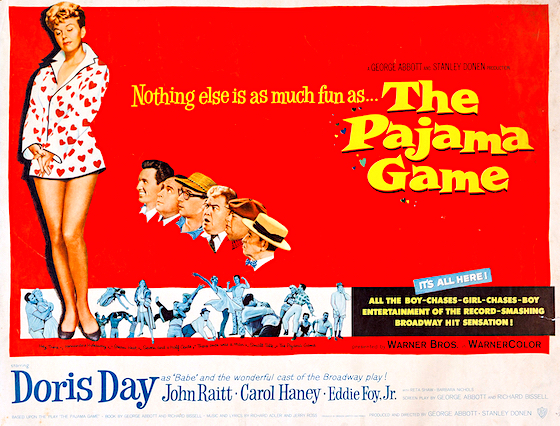
    The Pajama Game

    (1957)

    George Abbott & Stanley Donen | 101 mins | digital (SD) | 4:3 | USA / English | U

    The Pajama Game

    This minor musical is primarily of note for two things: the original Broadway staging featured the choreography debut of one Bob Fosse; and it features the song Hernando’s Hideway — if you don’t recognise the title, I’m sure you’ll recognise the tune. I had no idea this is where it originated.

    The story is about a pay dispute in a pyjama factory (given the current strikes and arguments here in the UK, you might think I watched this deliberately. Nope, total coincidence). On one side there’s the leader of the union’s grievance committee (Doris Day, one of just a handful of replacements made to the original cast when they transferred the stage production to the screen). On the other, the new superintendent (John Raitt, clearly a success on Broadway but less so on film). Of course, they fall for each other, before the pay conflict tears them apart. Can their love overcome such trials? What do you think?

    I saw someone describe The Pajama Game as an overlooked classic, which is taking things a bit far. It’s mostly likeable and quite fun, but rarely transcends that level. The undoubted highlight is Fosse’s choreography, which gives even the lesser numbers a polished dynamism. There are a couple of decent songs, but nothing really stands out, bar the aforementioned. It gets a bit too farcical in places, with some of the storylines ultimately taking a turn into very broad territory that feels misjudged. One primarily for genre fans only.

    3 out of 5


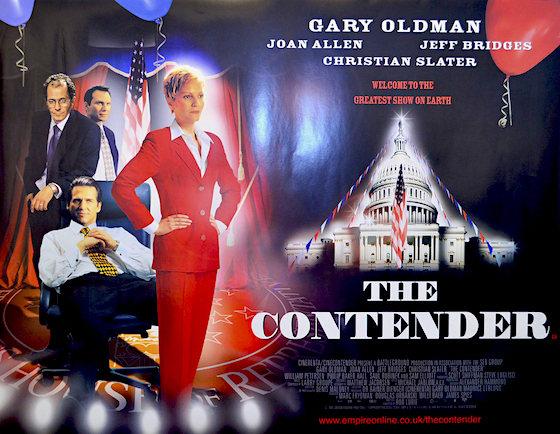
    The Contender

    (2000)

    Rod Lurie | 126 mins | Blu-ray | 16:9 | USA, Germany & UK / English | 15 / R

    The Contender

    I only picked this up on disc because it was part of a bundle of other titles I really wanted, but it also sounded like the kind of thing I’d like. Strange that I’d not heard of it before, then. I guess some films just get lost in movie history, especially when they’re a lesser member of a whole wave of movies. This is a political thriller of the kind they seemed to make quite a few of during the ’90s and into the early ’00s, but don’t really do anymore. I guess they exhausted the well, especially after 156 episodes of The West Wing.

    In this case, the story revolves around Laine Hanson (Joan Allen), the first woman nominated to be Vice President (it only took another two decades for that to happen in real life). There’s the familiar battle between the Democrats to get her confirmed, and the Republicans who’d like to do anything to thwart the Democrats. Amongst the scheming between the two sides, the big revelation is that Laine possibly engaged in a scandalous sex act while in college. She refuses to confirm or deny the rumour — it’s her personal business and shouldn’t affect her appointment. Except, of course, it does.

    Various other allegations come and go throughout the confirmation process, the two sides continuing to go back and forth in their attempts to win. It’s not necessarily the point the film is making, but it’s a reminder that politics is all a game to those involved, even as it can have serious effects on the lives of the rest of us. More overtly, the film tackles the different standards a woman is held to when trying to take public office. Fortunately, it’s not as overbearing with that as it could be. Indeed, all round the film is fairly understated. It’s a solid, unflashy, procedural-based kind of thriller.

    That is until the end, when it throws away the understatement for a grandstanding speech based around a fundamental belief in the greatness and goodness of the American political system. It would be heavy-handed in any circumstance, but the past few years (if not longer) of American politics have shown it for the total lie it always was. It doesn’t wholly undermine what’s gone before, but it does end the film on a sour note.

    4 out of 5


  • Archive 5, Vol.4

    I have a backlog of 432 unreviewed feature films from my 2018 to 2021 viewing. This is where I give those films their day, five at a time, selected by a random number generator.

    Today: singing vicars, grumpy gamers, very nice Kazakhs, and deleted actors.

    This week’s Archive 5 are…

  • Going My Way (1944)
  • The Bells of St. Mary’s (1945)
  • Zero Charisma (2013)
  • Borat (2006)
  • The Thin Red Line (1998)


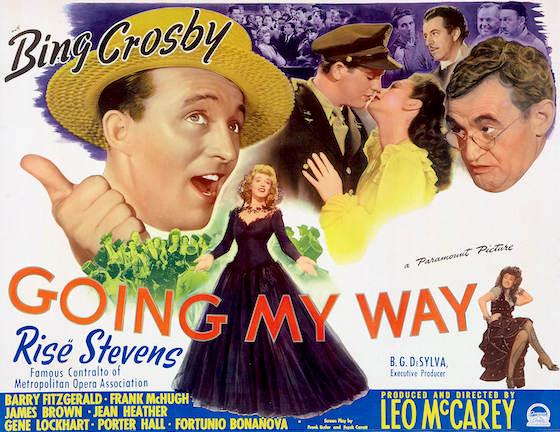
    Going My Way

    (1944)

    Leo McCarey | 126 mins | digital (HD) | 1.33:1 | USA / English | U

    Going My Way

    The Oscars, eh? Every year film fans pay them a load of attention, and every year we seem to be disappointed with the outcome. But this isn’t some new phenomenon: Going My Way hails from the 1940s, but is perhaps the definitive example of a film that managed to sweep the Oscars (it won seven awards from ten nominations) against a bunch of films that have endured to much greater acclaim (films it competed against included Double Indemnity, Laura, Lifeboat, Gaslight, and Meet Me in St. Louis. I think we can agree those are all better-remembered on the whole).

    None of which is to say it’s a bad film. It’s a gently-paced series of vignettes, almost like a collection of short stories, springing from young priest Father O’Malley (Bing Crosby) arriving to take charge of a struggling New York City parish. His modern ways clash with the old-fashioned values of the incumbent Father Fitzgibbon (Barry Fitzgerald), but his worldly knowledge allows him to connect with some of the parish’s disaffected inhabitants. Despite the religious setting, it doesn’t lean too heavily on the wonders of Christianity (you know I’d be the first to rip into it if it did). Overall, it’s perfectly pleasant; an easy afternoon’s viewing.

    Incidentally (and here’s a good bit of trivia that might come in handy for a quiz someday), it was the first Oscar Best Picture winner to have a sequel: The Bells of St. Mary’s, released the very next year… and also the very next review in this roundup…

    3 out of 5

    Going My Way was #93 in my 100 Films in a Year Challenge 2021.

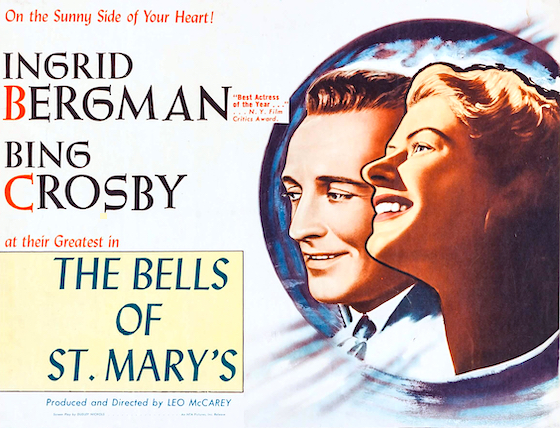
    The Bells of St. Mary’s

    (1945)

    Leo McCary | 126 mins | TV (SD) | 4:3 | USA / English | U

    The Bells of St. Mary's

    This followup to Going My Way was not only the first sequel to an Oscar Best Picture winner, but was also the first sequel to be nominated for the Best Picture Oscar.

    Bing Crosby returns as Father O’Malley, sent to a new locale, ready to solve another series of subplots at a struggling religious institution, this time butting heads (sort of — it’s never as dramatic as that makes it sound) with Ingrid Bergman’s head nun. Like the first one, it’s really a bundle of subplots for Bing to ‘solve’. The low-stakes problems and amiable tone between the two leads, even when they’re disagreeing, makes for a gentle and relaxing kind of film. I’d give it the edge over its Oscar-winning predecessor, thanks primarily to Bergman’s performance, but neither film is likely to set anyone’s world alight.

    As well as their Oscar success, the films were the highest grossing at the US box office for 1945 and ’46, respectively, another first for a film ‘series’. And yet, with six decades distance, they’re little more than also-rans; nicely obscure trivia answers to “films that won/were nominated for Best Picture”. Maybe there’s a lesson in that for anyone obsessed with the current cultural zeitgeist.

    3 out of 5

    The Bells of St. Mary’s was #187 in my 100 Films in a Year Challenge 2021.

    Zero Charisma

    (2013)

    Katie Graham & Andrew Matthews | 88 mins | digital (HD) | 16:9 | USA / English

    Zero Charisma

    I’d nickname this Portrait of a Manbaby on Fire. The manbaby in question is Scott (Sam Eidson), a stereotypical alpha-nerd: he has a neckbeard; he wears black T-shirts that feature elaborate depictions of grim reapers and the like; he lives with his grandma; he paints miniature fantasy figurines; he’s the Game Master of a role-playing group, which he rules with an iron fist. But when into-geeky-stuff hipster Miles (Garrett Graham) joins the group and everyone really likes him, Scott finds his position threatened, and he’s not happy about it.

    As much as geek/nerd culture has transitioned into the mainstream over the past couple of decades, there’s still stuff that remains the preserve of the hardcore; the truly nerdy. That culture clash is part of what Zero Charisma is about, of course, with Scott’s true old-fashioned kind of nerdishness clashing with Miles’s new-school cool. But it’s also a character study of the former. Scott may seem a stereotype — like The Simpsons’ Comic Book Guy rendered in live-action — but I’d wager anyone who’s moved in nerdish circles has known someone at least a bit like him. Stereotypes are stereotypes for a reason. The film exposes and examines those to often amusing effect. Some have said it exaggerates these things, but I don’t think it’s particularly guilty of that. Maybe it generalises them, and lumps all the worst characteristics of the extremely nerdy together into one character, but that doesn’t make it inaccurate, just broad.

    My only real problem was the ending. There’s a scene where everything comes to a head — a climax, if you will — but, in the wake of that, I felt it lacked adequate resolution. Has Scott learnt anything from this experience? Is he a changed man? Maybe a little, but not completely. To be fair, that’s a realistic character arc, because whose personality changes overnight after a single revelation? And yet it also doesn’t feel like the filmmakers quite know how they want to leave things. If they’d been going for a “change takes time and is incremental, but Scott’s started on that road” kinda message, I would have approved. Instead, the film tries to have its cake and eat it by showing Scott as better on the surface, but then secretly GMing a game where he still behaves like an asshole. Maybe it’s trying to say we can never truly change, however much our flaws are highlighted to us, which would be a pretty glum way to end an otherwise likeable comedy.

    3 out of 5

    Zero Charisma was #109 in my 100 Films in a Year Challenge 2020.


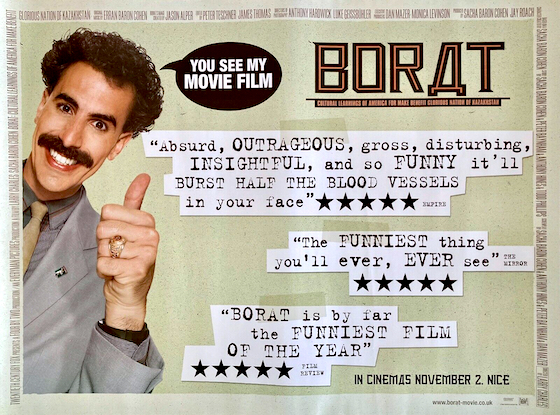
    Borat

    (2006)

    aka Borat: Cultural Learnings of America for Make Benefit Glorious Nation of Kazakhstan

    Larry Charles | 84 mins | digital (HD) | 16:9 | USA & UK / English | 15 / R

    Borat

    Ali G’s Sacha Baron Cohen adopts the persona of a Kazakh journalist to ostensibly interview Americans about their culture, but, unbeknownst to them, he’s of course really looking to expose their ludicrous views (you just know that, ten years later, a lot of these people voted for Trump) and take the piss out of them for our entertainment.

    As with most sketch-based comedy, the end result is a mixed bag. Sometimes it’s very funny; other times, it’s just being gross for the sake of it, like in a naked fight between Borat and his portly producer. A few bits don’t quite land — sometimes you can feel Baron Cohen’s not getting the response he wanted out of his target — and, even though he’s taking the piss out of people who deserve it, it sometimes gets a bit uncomfortable (though that might just be my English reserve/politeness kicking in and making me cringe). Most of the sketches are quite short, which is nice — they generally don’t outstay their welcome, and, if one isn’t working, you can be assured another will be along shortly.

    3 out of 5

    Borat was #220 in my 100 Films in a Year Challenge 2020.


    The Thin Red Line

    (1998)

    Terrence Malick | 171 mins | Blu-ray | 2.35:1 | USA / English | 15 / R

    The Thin Red Line

    An extensive cast of famous actors and recognisable faces star as a battalion of soldiers who spend 2 hours and 51 minutes taking one (1) hill in Terrence Malick’s very Terrence-Malick-y World War 2 movie. I mean, this is a movie about a battle in which the first shots aren’t fired until past the 45 minute mark, but there are plenty of shots showing the minutiae of nature. And there’s a lot of discussion about how there isn’t enough water.

    None of which is necessarily a problem — indeed, there are plenty of people who think this is a great movie, and I’m glad for them. But for everyone who loves it, there’s someone who’d call it “pretentious and self-indulgent, despite gun battles and lush cinematography.” I find myself somewhat stuck in the middle. I mean, if you were expecting a normal combat movie from Terrence Malick, more fool you. And it’s unquestionably beautifully shot — so many gorgeous visuals, but also effective camerawork and editing to convey, say, the chaos of battle. But I also found it to be bitty and episodic. Well, calling them “episodes” might be kind — they’re scenes; sometimes less than scenes; just moments, or even shots. It’s like a really long deleted scenes package pretending to be a movie.

    Of course, the behind-the-scenes stories sort of support that reading. The first cut clocked in at five hours. It took two editors and thirteen months of post-production to get it to a manageable size. Hans Zimmer composed over four hours of music, but only for a few bits of his work made it into the final cut. Billy Bob Thornton recorded narration for the entire film; the released cut has eight different narrators, but none of Thornton’s work is in there. Many actors thought they had significant roles, but found their performances reduced to little more than cameos. Most famously, Adrien Brody thought he was playing the lead role, only to discover at the premiere that he’s in just a couple of shots, and doesn’t even speak until over halfway through (and then it’s just a brief voiceover). And then there are the actors whose work was left on the cutting room floor: Bill Pullman, Gary Oldman, Lukas Haas, Viggo Mortensen, Martin Sheen, Jason Patric, Mickey Rourke… This movie has more great actors whose performances were deleted entirely than most movies have in their entire cast!

    All of which suggests a movie that should be universally recognised as a disaster. That it isn’t — quite the opposite — is testament to something. Maybe someday I’ll rewatch it and find out what.

    3 out of 5

    The Thin Red Line was #77 in my 100 Films in a Year Challenge 2020. It was viewed as an additional film for Blindspot 2020 after I failed to watch it for WDYMYHS 2019.


  • Archive 5, Vol.2

    I have a backlog of 442 unreviewed feature films from my 2018 to 2021 viewing. This is where I give those films their day, five at a time, selected by a random number generator.

    Today: musical comedies from ’41 and ’51; murder mysteries from ’33 and ’73; and an animated film that changed the Oscars.

    This week’s Archive 5 are…

  • Royal Wedding (1951)
  • A Study in Scarlet (1933)
  • Chicken Run (2000)
  • The Last of Sheila (1973)
  • Road to Zanzibar (1941)


    Royal Wedding

    (1951)

    aka Wedding Bells

    Stanley Donen | 93 mins | digital (SD) | 4:3 | USA / English | U

    Royal Wedding

    Cynically, I assumed this US production was designed as a cash-in to a news event, most likely the wedding of Princess Elizabeth (i.e. the Queen) and Philip. Although those are indeed the eponymous nuptials, they actually took place several years earlier, in 1947; and in the UK, for its initial release the film was retitled Wedding Bells so audiences wouldn’t think it was a documentary about the real event. So much for my modern cynicism.

    The actual plot is semi-biographical, inspired by the real-life dance partnership of the film’s star, Fred Astaire, and his sister Adele, and who she went on to marry. Here the sister is played by Jane Powell (almost 30 years Astaire’s younger) as the duo take their successful Broadway show across the ocean to London in time for the royal wedding. Such window dressing aside, the plot that unfurls is run-of-the-mill, with both siblings finding themselves in romantic entanglements, and the songs are unmemorable too. The object of Astaire’s affection is played by Sarah Churchill, daughter of Winston Churchill, which adds a bit of fun trivia, at least.

    There is one noteworthy highlight: a set piece in which Astaire dances up the walls and across the ceiling of his hotel room, an effect that’s achieved seamlessly — there’s no wobble or what have you to give away the trickery, and Astaire’s choreography helps hide the behind-the-scenes technique too. There are one or two other neat bits if you’re a fan of dance-y musicals, but, on the whole, this is a thoroughly middle-of-the-road Astaire musical — not bad, just no more than adequate.

    3 out of 5

    Royal Wedding was #180 in my 100 Films in a Year Challenge 2021.


    A Study in Scarlet

    (1933)

    Edwin L. Marin | 72 mins | Blu-ray | 1.33:1 | USA / English | U

    A Study in Scarlet

    For some reason, cinema has a long history of taking the titles of original Sherlock Holmes stories but then producing an entirely new plot underneath. A Study in Scarlet — the very first of Sir Arthur Conan Doyle’s Holmes works — seems to be a particularly afflicted tale. It features the first meeting of Holmes and his roommate / sidekick / chronicler, Dr Watson, but I think there are two adaptations that actually show this — and, ironically, neither of them are actually called A Study in Scarlet (one is the debut episode of Sherlock, A Study in Pink, and the other is the first episode of the Russian series The Adventures of Sherlock Holmes and Dr. Watson, which is called Acquaintance). According to IMDb, “the Conan Doyle estate quoted the producers a price for the rights to the title and a considerably higher price to use the original story” — perhaps they did that all the time, hence my observed phenomena.

    Obviously, this ‘poverty row’ effort is one such example of title/story mismatch: this so-called adaptation stars Sherlock Holmes and Dr Watson… and that’s where similarities to the novel end. The pair don’t even live at 221b Baker Street — for no apparent reason, it’s been changed to 221a. Did the filmmakers just misremember one of the most famous addresses in literature? Having only paid for the rights to the title, the producers hired director Robert Florey (the Marx Brothers’ The Cocoanuts; Murders in the Rue Morgue) to write a new story, and actor Reginald Owen — who stars as Holmes — wrote the dialogue. Owen hoped this would be the first in a series of Holmes films starring himself. It wasn’t.

    Physically, Owen isn’t anyone’s ideal image of Holmes, but his actual performance is adequate. Much the same can be said of the whole film: it’s an entertaining-enough 70-minute crime romp, with enough incident to create a brisk pace, and a use of the rhyme Ten Little Indians that makes you wonder if Agatha Christie saw this movie before she published And Then There Were None six years later (or is it just a coincidence? The audio commentators spend a good deal of time chewing it over). Given second billing behind Owen is bona fide Chinese-American movie star Anna May Wong, even though she has relatively little screen time. She makes her mark, though, with a role that doesn’t simply conform to racial stereotypes (possibly an unintended side effect of her late casting rather than genuine progressivism by the filmmakers, but sometimes you gotta take what you can get).

    This particular Study in Scarlet is a long way from being a definitive Sherlock Holmes movie, but for fans of ’30s detective flicks, it’s nonetheless a likeable little adventure.

    3 out of 5

    A Study in Scarlet was #206 in my 100 Films in a Year Challenge 2021.


    Chicken Run

    (2000)

    Peter Lord & Nick Park | 84 mins | digital (HD) | 16:9 | UK, USA & France / English | U / G

    Chicken Run

    I’ve always enjoyed Aardman’s work. I grew up watching the Wallace & Gromit shorts on TV, and have seen all of their feature output — except their first. I’m not sure why it’s taken me 20 years to get round to Chicken Run. I guess when it was originally released I had grown out of “kid’s movies” but not yet grown back into them; but since then, to be honest, something about it never particularly appealed to me. It certainly has its fans: it’s still the highest grossing stop motion film ever; there was a push to get it an Oscar Best Picture nomination, the failure of which led to the creation of a category it could’ve won, Best Animated Feature (trust the Academy to shut the door after the horse had bolted); and when Netflix recently announced a sequel, there was much pleasure on social media.

    So, finally getting round to it, would I discover what I’d been missing all along? Unfortunately, no. I thought it was fine. In no way did I dislike it, but nor did it charm me in the way of my favourite Aardman productions. It’s rather dark for U-rated film — it doesn’t mince its words or imagery about the fact the chickens are being killed — and that contributes to some particularly effective sequences, like when our heroes end up inside the pie machine, or a suitably exciting climactic action sequence. There are some reliably decent gags along the way, too.

    I’m sure I’ll watch the sequel. Maybe I’ll like it more. But, I confess, the fact they’ve now announced a new Wallace & Gromit movie for the year after does have me even more excited.

    3 out of 5

    Chicken Run was #148 in my 100 Films in a Year Challenge 2020.


    The Last of Sheila

    (1973)

    Herbert Ross | 120 mins | digital (SD) | 1.85:1 | USA / English | 15* / PG

    The Last of Sheila

    I’d never even heard of this before Rian Johnson mentioned it as an inspiration for Knives Out 2. Co-written by Anthony Perkins (yes, Norman Bates from Psycho) and Stephen Sondheim (yes, the famous musical composer), The Last of Sheila is a murder mystery firmly in the Agatha Christie mould — despite the writers’ pedigree, there are no significant horror elements (even the deaths are, at worst, on the PG/12 borderline) and certainly no song-and-dance numbers (excepting a magnificently inappropriate song over the end credits, sung by Bette Midler). Apparently Perkins and Sondheim used to host elaborate scavenger hunts for their friends in the late ’60s and early ’70s, and they adapted them into a screenplay at the suggestion of a guest, Herbert Ross, who produced and directed the film (seems only fair).

    Further inspiration came from their professional lives and acquaintances, because the potential victims and suspects are all actresses, agents, and the like, gathered for a Mediterranean cruise aboard a producer’s yacht. He proposes they play a game about secrets and gossip — but clearly one of the secrets in play is too big, because someone winds up murdered. A well-constructed mystery is unfurled throughout the film, although its execution is a little variable: a fun, very Christie-esque first half gives way to long talky scenes in the second, as characters stand around and explain the plot to each other. But when that plot is as good as this — with some nice surprises, plus motives dark enough to give it a little edge — it feels churlish to object too strongly.

    4 out of 5

    The Last of Sheila was #186 in my 100 Films in a Year Challenge 2021.

    * IMDb says it was given a 15 on video, but the BBFC say it hasn’t been rated since 1973, when it got an AA. The BBFC site is crap nowadays; IMDb will accept any old junk users submit. You decide. ^

    Road to Zanzibar

    (1941)

    Victor Schertzinger | 87 mins | DVD | 1.33:1 | USA / English | PG

    Road to Zanzibar

    The second in what became the Road To… series — though it was never intended as such. What ended up becoming Road to Zanzibar was initially an original feature, first offered to Fred MacMurray (this before his roles in the likes of Double Indemnity and The Apartment) and George Burns (an actor I’m not particularly familiar with). After they rejected it, apparently someone at Paramount remembered Road to Singapore had done relatively well, and that Bob Hope and Bing Crosby seemed like a good pairing, and so they were offered it.

    As I wrote in my last review of a Road To film (which was over 11 years ago?! Jesus…), if you’ve seen one Road To film then you’ve a fair idea what to expect from any other — essentially, a suitably daft bit of fluff and fun. This one’s a bit thin — on plot, on gags, on everything — but it skates by on the charm of Bob and Bing, joined, as ever, by Dorothy Lamour. The only serious problem is the same as Singapore: dated depictions of African stereotypes. It kind of gets away with it by being a spoof of “African adventure”-type movies, but maybe that’s me being kind with hindsight. Either way, the bit where the tribe’s African dialogue is subtitled with contemporary American vernacular is one of the film’s more amusing gags.

    3 out of 5

    Road to Zanzibar was #110 in my 100 Films in a Year Challenge 2019.


  • 2022 | Weeks 1–3

    Here we go — finally, and somewhat later than anticipated (it’s been a slow start to the year, viewing-wise) — the new review format for 2022!

    …which you’ll have already seen in Archive 5, of course; and is fundamentally similar to what I was doing before in roundups and what-have-you; and which I’ve already ‘broken’, because my review of Flight of the Navigator came out so long that I posted it alone.

    But still, the intention is this is now my regular review format, popping up every week or two (or three) to review everything in a more timely fashion than I have for many, many years. We’ll see how it goes — I feel like I need to relearn how to write short pieces, because longer reviews feel like they should get their own posts, and that’s happened to pieces intended for every one of these roundups so far this year.


    Anyway — to kick things off for 2022, a film with a broadly appropriate title. Because, despite (deliberately misleading) hints to the contrary, I’m carrying on. Get it? Carrying on watching. And “spying” is a synonym of “watching”, right? (Look, there aren’t any Carry On films with more apposite titles, okay?)

    These weeks’ films are…

  • Carry On Spying (1964)
  • Penny Serenade (1941)
  • The Navigator (1924)
  • In the Line of Fire (1993)
  • Barbie as The Princess and the Pauper (2004)
  • Free Guy (2021)


    Carry On Spying

    (1964)

    Gerald Thomas | 84 mins | digital (SD) | 16:9 | UK / English | U

    Carry On Spying

    Believe it or not, I’ve never actually seen a Carry On film before. Maybe that’s not so surprising these days. They were once such a part of British culture that they produced 30 of the things, but I think they were seen as “a bit old fashioned” even before I was born, and by 2022’s standards… oof. But, lest you get the wrong end of the stick (oo-er, etc), this isn’t me intending to finally dive into all of them. Rather, as well as its timely title, I chose to watch Carry On Spying primarily because it’s a James Bond spoof — the first, I believe, seeing as it was released in July 1964, when the Bond series only encompassed Dr. No and From Russia with Love (Goldfinger would follow a couple of months later).

    With Bond not yet even properly into its initial phenomenon phase (the first two films were hits, but it was the next two that skyrocketed its popularity), you might think Spying came too soon, and would be disadvantaged by being produced before the famous Bond formula was fully in place. Instead, it sets its spoofing sights a little wider, including an extended riff on The Third Man. I couldn’t tell you everything it’s drawing on, but its third-act villain’s lair — all sleek metal corridors and little road-train thingies and jump-suited identikit henchpeople — appears to be a take-off of You Only Live Twice, some three years before that film even came out. So I can only presume Spying’s point of reference there is something else, which I can’t quite remember; some other spy fiction that was already doing stuff the Bond franchise would still be pulling off years later. That doesn’t reflect too positively on YOLT, when you think of it, although Bond’s cultural dominance and longevity has come to ensure it’s the one that’s remembered for pioneering all this stuff.

    I don’t know how many Carry On films were genre spoofs, but the series’ reputation is more for smut and innuendo. There’s pleasantly little of that here — some, for sure, mostly based around Barbara Windsor (of course) as a trainee agent; but while it’s all fundamentally juvenile, it’s not as ceaselessly ribald as I was expecting. Satisfyingly, it remains primarily focused on its chosen genre. In that respect, I’ve definitely seen worse spoofs.

    3 out of 5

    Carry On Spying is the 1st film in my 100 Films in a Year Challenge 2022.


    Penny Serenade

    (1941)

    George Stevens | 120 mins | digital (HD) | 4:3 | USA / English | U

    Penny Serenade

    This is the third and final film to pair up stars Irene Dunne and Cary Grant as a married couple (I’ve watched all their collaborations within the past couple of years, but not posted reviews of the first two yet. I thought it was within the last year, but turns out I watched my first in May 2020. These strange days have really messed with my sense of the passage of time!) But where their first two films were screwball romcoms, this is undoubtedly a melodrama, following a couple as they meet, marry, and attempt to start a family.

    Dunne and Grant both make a fair fist of the serious stuff — Grant, in particular, gives an uncommonly sensitive performance at times — although they can’t resist slipping back into a spot of almost-slapstick given half a chance, with various individual sequences playing more like one of their comedies. Those scenes stand at odds with the film’s overall narrative and tone, which goes for full-on weepy. Indeed, if anything, I thought it was overdone, in particular an ending that throws in sudden tragedy followed so quickly by a pat happy ending that it feels almost distasteful.

    The film’s hook is that it begins with Dunne planning to leave, before she discovers a book of records that, as she plays them, take her back through their relationship. Different songs provoking specific memories is a neat narrative device on paper, but doesn’t really come across on screen. Aside from the first track, and maybe a later burst of Happy Birthday (although that could be almost any birthday, surely), the songs don’t seem to have any special relevance to the memories they supposedly call forth. It doesn’t help that, to modern ears, they all sound kinda samey. Plus, that the songs lead everything to unfurl in chronological order, with every major beat of their life story accounted for, is certainly convenient.

    If you can look past such artifice, and just want to revel in an old-fashioned bit of heart-tugging, Penny Serenade is fit to make you shed a tear. Personally, I’d rather the headline duo had given us another bout of screwball tomfoolery.

    3 out of 5

    Penny Serenade is the 3rd film in my 100 Films in a Year Challenge 2022.


    The Navigator

    (1924)

    Donald Crisp & Buster Keaton | 66 mins | Blu-ray | 1.33:1 | USA / silent | U

    The Navigator

    This is my fourth Buster Keaton feature now (I’ve only previously reviewed The General, but Sherlock Jr made it into my 2019 top 3), and he’s established himself as my favourite of the major silent comedians (I rarely enjoy Chaplin’s films as much as I feel I should; and, in fairness to Harold Lloyd, I’ve only seen one of his so far, which I liked a lot). The Navigator was the biggest hit of his career, though is probably my least favourite of his I’ve seen so far — though I don’t want to damn it with false criticism, because it’s still a brisk and entertaining comedy.

    Keaton stars as a spoiled rich kid whose marriage proposal is rejected. He’d already booked the honeymoon tickets, so sets off by himself; but, due to several points of confusion, he ends up adrift at sea on a decommissioned ship, empty but for one other passenger: his would-be fiancée (Kathryn McGuire). It’s up to this pair of brats to get along and survive while they hope for rescue. (Rescue does not come quickly. Considering McGuire’s father is a successful shipping magnate who’s aware of what’s happened, you’d think he’d send a vessel after them; but then, he might have his own problems, owing to a bunch of foreign spies who… look, it’s best not to overthink the logistics and plausibility of the plot.)

    Although Keaton gets the lion’s share of the gags, as well he might, for a stretch in the middle he and McGuire form an effective double act. The two rich kids being hilariously useless at household basics, like making coffee or opening a tin of food, is well observed; a flash-forward to their automated solutions is also fun. While Keaton still gets to show off by himself — particularly in an elaborate underwater diving sequence, naturally saved for the final act — McGuire makes the most of the material she’s given.

    The only outright demerit to the film is that the finale hasn’t aged particularly well: the ship finally drifts near land, but it’s an island with a village-full of black natives, at which McGuire immediately exclaims “cannibals!” That she’s sort of proven right when they start attacking the ship is… well, maybe not even worse, but at least just as bad. Still, by 1920s standards, maybe we can take comfort in the fact that it’s only casual racism…

    More than that, the reason I say it’s my least favourite Keaton so far is simply that it doesn’t have as many comedic highs as his very best work. Nonetheless, his genius regularly shines through in moments and even whole sequences, and there are a couple of individual gags that are all-timers.

    4 out of 5

    The Navigator is the 4th film in my 100 Films in a Year Challenge 2022.


    In the Line of Fire

    (1993)

    Wolfgang Petersen | 129 mins | digital (HD) | 2.39:1 | USA / English | 15 / R

    In the Line of Fire

    Clint Eastwood is a Secret Service agent who failed to stop the JFK assassination, now taunted by John Malkovich’s mysterious wannabe-assassin and his threats to kill the current President. It’s a fundamentally strong idea for a thriller, and works especially well by having the villain constantly phoning the hero for little chats. Malkovich’s always makes for a first-rate antagonist, and his slightly loony personality clashes well with Eastwood’s stoic, dry-witted, old-fashioned tough guy. There are a couple of chase scenes and shoot-outs here and there, but, rather than any elaborate physical action, it’s the verbal sparring that represents the film’s highlights.

    On the downside, the pace is a little on the slow side (perhaps matched to the “too old for this shit” age of Eastwood’s hero — in real life, he’d be a whole decade past the mandatory retirement age) and there are one too many clichés as important plot points (don’t get too attached to the partner who’s always talking about his wife and kids). Plus, there’s a wholly unnecessary romance between 62-year-old Clint and 39-year-old Rene Russo — the film doesn’t need it, even if there wasn’t that age gap. It leads to an (almost) sex scene that’s worthy of the Naked Gun films, which is amusing but tonally misplaced.

    They used to make this kind of political thriller on the regular back in the ’90s, one of those bread-and-butter genres for grownups that have fallen by the wayside in favour of hyper-budgeted kids’-movie spectacle that men of allegedly adult age flock to nowadays. In the Line of Fire may not truly stand out among its brethren of the era, but I do wish they still made ’em like this.

    4 out of 5

    In the Line of Fire is the 6th film in my 100 Films in a Year Challenge 2022.


    Barbie as
    The Princess and the Pauper

    (2004)

    William Lau | 85 mins | digital (SD) | 16:9 | USA & Canada / English | U

    Barbie as The Princess and the Pauper

    One of the many film lists I have my eye on completing is Letterboxd 100: Animation, which lists the highest-rated animated feature films on the site (with a few caveats). There are over 40 titles left that I’ve not seen, and I could’ve chosen to watch almost any of them… but I chose the Barbie one. Well, not the Barbie one, because there are actually two Barbie titles on the list. And that’s not some temporary fluke: they’ve been on there for quite a while now. This merited investigation.

    As you’ve no doubt gathered from the title, this particular Barbie film is a reimagining of Mark Twain’s The Prince and the Pauper. A fairytale-esque story, about a princess, done as a musical? Yep, this is very much a wannabe Disney, but without the production values of that major studio: the computer animation here looks more like a PS2 cutscene. But hiding beneath the cheap animation is a halfway decent musical fairytale. Take the second musical number, How Can I Refuse, for example: it’s every inch in the mould of a “Disney villain’s song”, but is better than some genuine examples, and comes complete with a dance routine by the antagonist and his two henchman. This film has ambition, I’ll give it that.

    Other songs vary in quality. When the eponymous duo first meet, there’s an unintentionally hilarious number in which they sing about how similar they are, the indentured servant and the pampered royal. If you say so, girls. A later track is a typical “you be you” song, but sung to a pet cat who behaves like a dog. That’s a level of barminess I can get on board with.

    I would never have dreamed of watching this if it weren’t on the Letterboxd animation list. Now, I wouldn’t exactly say I’m glad I watched it, but I enjoyed it more than I thought I would — even if sometimes that was due to laughing at it rather than with it.

    3 out of 5

    Barbie as The Princess and the Pauper is the 7th film in my 100 Films Challenge 2022.


    Free Guy

    (2021)

    Shawn Levy | 115 mins | digital (HD) | 2.39:1 | USA / English | 12 / PG-13

    Free Guy

    Ryan Reynolds plays his role again as Guy, a bank worker in city riddled with crime and superheroics. But, it turns out, Guy isn’t real — he’s an NPC in a computer game, programmed to do the same thing over and over and basically be ignored by the real-world players. Until, that is, he spots the woman of his dreams (Jodie Comer) and his programming breaks as Guy becomes self-aware.

    The basic concept sounds like a fun, fresh, and timely idea, right? Video games have never been more popular, AI is ever-improving, and there’s room for both gags and action in the core idea — that’s the winning Marvel formula, right there. Unfortunately, the execution is as if someone found a way to make a new movie by collaging others. Free Guy is just The LEGO Movie + The Truman Show + Wreck-It Ralph + Ready Player One + the PG-13 version of Deadpool 2 — not put in a blender, but cut up and stuck back together side-by-side, with snippets of Groundhog Day, Fortnite, and multiple Disney-owned properties scattered in for good measure.

    That last aspect, the Disney references, has been singled out for particular derision on social media. The film was initially produced by 20th Century Fox, but ended up a Disney title after the buyout, which allows a bunch of stuff they own to pop up in the movie. I know we’re supposed to find this infinitely depressing — a sad reminder that Disney are on course to own all culture, and that’s a bad thing — and it is bad, of course… but the bit with Captain America’s shield still made me laugh. Sorry, not sorry. Yeah, you can be miserable about this stuff, because obviously the total homogenisation of all American media under The Walt Disney Company is not worth that a couple of meta gags; but the homogenisation of all American media under The Walt Disney Company is happening anyway, so we may as well enjoy the gags we get along the way.

    Whether you have that kind of attitude or not will probably dictate how much you enjoy Free Guy. Its originality is surface deep, at best, and at every second it will call to mind some other film that already did the same thing. But, allowing for that, it’s still a fairly entertaining couple of hours of action-comedy.

    3 out of 5

    Free Guy is the 8th film in my 100 Films in a Year Challenge 2022.