The Visit (2015)

2016 #124
M. Night Shyamalan | 90 mins | streaming (HD) | 1.85:1 | USA / English | 15 / PG-13

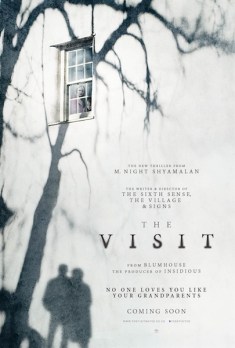
The VisitAfter a sidestep into big-budget director-for-hire movies that brought him even less acclaim than his last couple of self-penned efforts, once-fêted director M. Night Shyamalan goes back to basics with this low-key found-footage horror.

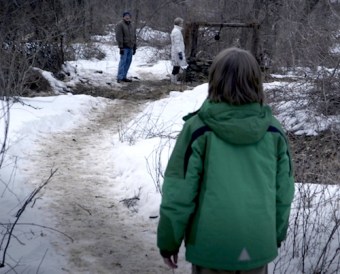
When their mother (Kathryn Hahn) goes on holiday with her new partner, teens Becca (Olivia DeJonge) and Tyler (Ed Oxenbould) go to stay with her parents, who she hasn’t seen or spoken to for years. Nana (Deanna Dunagan) and Pop Pop (Peter McRobbie) seem kindly, but no one will tell the kids what happened years earlier to leave the family estranged. But soon they discover the strange, disturbing behaviour of their grandparents, particularly after dark, leaving them to wonder just what they’ve let themselves in for…

Although Shyamalan has always moved in supernatural circles in his movies, and The Sixth Sense is labelled a horror because it’s about ghosts and has a few jumps, he’s not really directed a proper Horror movie before now. Nonetheless, it’s not surprising that his skill set lends itself to the genre. Although the found-footage format is a little forced at times (isn’t it always?), it’s also used effectively to create some nailbiting sequences, putting you alongside the kids as they fear just what the hell is going in. And some of it is pretty darn freaky. One sequence — a demented game of hide-and-seek underneath the house, where we’re aware of stuff going on behind the kids that they don’t see — is particularly terrifying.

DeJonge and Oxenbould make for naturalistic kids, with the latter’s affinity for rapping providing some necessary levity, while McRobbie and Dunagan (in a particularly bold performance) well negotiate people who can be sweetness and light one moment and blood-chillingly terrifying at another.

Well suspiciousOf course, there’s a big reveal to explain everything that’s been going. People call it a “twist” because it’s a Shyamalan movie, but it’s more of an explanation. I mean, what was going on had to be explained somehow, and the explanation comes at the point where you’d expect the explanation to be. I’m not saying it’s not a twist, because it does change what you think you’ve been seeing, but it’s also not a be-all-and-end-all kind of failed-rug-pull, which Shyamalan’s worst twist-obsessed efforts have been. This one works. Or, it did for me.

The same can be said for the film as a whole. The Visit doesn’t quite represent a full-blown return to form — it’s not got the sophistication of The Sixth Sense or Unbreakable, or even Signs — but it is an immensely effective scarer, which suggests there’s still some hope for Shyamalan’s flatlining career.

4 out of 5

The Survivalist (2015)

2016 #150
Stephen Fingleton | 99 mins | streaming (HD) | 2.35:1 | UK / English | 18

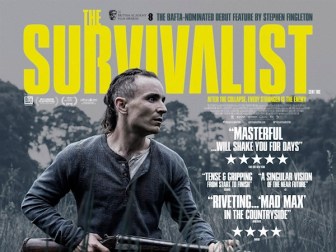
The Survivalist’70s self-sufficiency sitcom The Good Life meets bleak post-apocalypse drama The Road* in this technically-science-fiction dramatic thriller, the BAFTA-nominated debut of writer-director Stephen Fingleton.

A man (Martin McCann) lives in a woodland cabin, farming just enough for himself and fending off raiders. When a woman (Olwen Fouéré) and her daughter (Mia Goth) turn up, they build an uneasy alliance in spite of mutual suspicion.

With a Malickian eye for both nature and pace, it has a grim plausibility about the end of the world and, more than that, the fundamentals of human nature. Depressing but truthful — and, post-Trump, possibly prescient!

4 out of 5

* I’ve still not actually seen The Road so this comparison may be faulty, but it was the first super-grim (so I’ve heard) post-apocalyptic drama that came to mind. ^

Star Wars (1977)

100 Films’ 100 Favourites #88
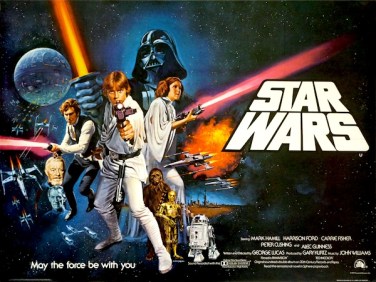
A long time ago
in a galaxy far, far away…

Also Known As: Star Wars: Episode IV – A New Hope

Country: USA
Language: English
Runtime: 121 minutes | 125 minutes (special edition)
BBFC: U
MPAA: PG

Original Release: 25th May 1977 (USA)
UK Release: 27th December 1977
First Seen: VHS, c.1990

Stars
Mark Hamill (Batman: Mask of the Phantasm, Star Wars: Episode VIII)
Harrison Ford (American Graffiti, The Fugitive)
Carrie Fisher (When Harry Met Sally…, Star Wars: The Force Awakens)
Alec Guinness (Kind Hearts and Coronets, The Bridge on the River Kwai)
James Earl Jones (Field of Dreams, The Lion King)

Director
George Lucas (THX 1138, Star Wars: Episode I – The Phantom Menace)

Screenwriter
George Lucas (American Graffiti, Star Wars: Episode II – Attack of the Clones)

The Story
When he discovers a distress call from a beautiful princess, a young farmhand joins forces with an old warrior, a roguish pilot, his bear-like first mate, and a pair of bickering robots to rescue her — which involves taking on the evil galactic Empire, and in particular their chief enforcer: Darth Vader.

Our Heroes
Farm boy Luke Skywalker just wants to go off and join the rebellion, but little does he realise how much that path leads to his destiny. Helping him get there is smuggler Han Solo, who may come from a wretched hive of scum and villainy and is happy to shoot first at the same time as his opponent, but has a heart of gold really. The object of their mission, and both their affections, is the strong-willed Princess Leia.

Our Villains
A man in a black suit with breathing problems might not sound like one of the most effective screen villains of all time, but that’s what you get when you come up with pithy descriptions like that. In fact, Darth Vader is so badass, he’s not above choking members of his own side, the evil Empire — and they’re evil.

Best Supporting Character
R2-D2 is the best supporting character in every Star Wars film, but in this one we are also introduced to Obi-Wan Kenobi. A mysterious old man who inducts Luke into the ways of the Force, Obi-Wan is played by veteran character actor Alec Guinness, meaning he is bestowed with instant awesomeness. Not as handy with a lightsaber as he used to be, mind.

Memorable Quote
Darth Vader: “Your powers are weak, old man.”
Obi-Wan Kenobi: “You can’t win, Darth. If you strike me down, I shall become more powerful than you could possibly imagine.”

Quote Most Likely To Be Used in Everyday Conversation
“I have a very bad feeling about this.” — Luke Skywalker

Memorable Scene
It’s fair to say Star Wars is loaded with memorable scenes, but for pure effectiveness you’d have to go a long way to beat the opening sequence: giant spaceships flying overhead, blasting laser beams at each other; walking, talking robots bickering; a gunfight between men and armoured soldiers; and then Darth Vader, stalking into the movie like a sci-fi vision of Death himself.

Memorable Music
George Lucas wanted a score reminiscent of classic Hollywood movies to help inform audiences about what they were watching — that although it was set on alien worlds with giant spaceships and laser swords, it was a familiar kind of heroic adventure tale. Composer John Williams delivered exactly that, drawing on influences including classical composers, like Stravinsky and Holst, and film composers, like Erich Wolfgang Korngold (King’s Row) and Alfred Newman (How the West Was Won). He produced not only a great soundtrack all round, but arguably the most famous movie theme of all time.

Truly Special Effect
Star Wars did so much to break new ground in special effects, it’s difficult to know where to start. Some of it’s a little skwiffy (the lightsaber effects are notoriously problematic, their colours varying even in recent remastered versions), but the model work — the spaceships and their battles — is fantastic.

Letting the Side Down
Han shot first! *ahem* Yes, A New Hope is definitely the movie where Lucas’ unpopular Special Edition fiddling is it at its least liked, primarily for that bit where Han no longer shoots Greedo in cold blood. What do you have to do to get a merciless good guy these days, eh? Other changes have varying degrees of effectiveness: having extra X-Wings in the Death Star battle looks pretty neat, but the CGI Jabba the Hutt — complete with Han stepping jerkily over his tail — is terrible.

Making of
George Lucas screened an early cut of the film for a group of his director friends, most of whom agreed with him: it was going to be a flop. Brian De Palma even called it “the worst movie ever”. There was one dissenting voice: Steven Spielberg, who predicted it would be a huge hit. As if that man’s entire career wasn’t proof enough that he knows what he’s talking about…

Previously on…
Star Wars’ influences can be clearly traced back to the sci-fi cinema serials of the ’30s and ’40s, like Flash Gordon. In-universe, the saga begins with the Prequel Trilogy, and there’s shedloads of other spin-off media. Most pertinently, this December’s first live-action non-saga Star Wars film, Rogue One, should lead more-or-less directly into the start of A New Hope.

Next time…
Star Wars essentially inspired the next 39 years (and counting) of effects-driven summer blockbusters. It also started a mini-industry all of its own — well, quite a large industry, actually: films, TV series, novels, comic books, computer games, board games, role playing games, toys, clothes, lunch boxes… anything you can imagine, I’d wager. Primarily, the story is directly continued in The Empire Strikes Back and Return of the Jedi, and resumed in The Force Awakens, with more to come in 2017 and 2019.

Awards
7 Oscars (Editing, Score, Sound, Art Direction-Set Decoration, Costume Design, Visual Effects, Special Achievement Award for Sound Effects)
4 Oscar nominations (Picture, Supporting Actor, Director, Original Screenplay)
2 BAFTAs (Music, Sound)
4 BAFTA nominations (Film, Editing, Costume Design, Production Design/Art Direction)
13 Saturn Awards (Science Fiction Film, Supporting Actor (Alec Guinness), Director (tied with Spielberg for Close Encounters), Writing, Music (John Williams tied with himself for Close Encounters), Costumes, Make-Up, Special Effects, Editing, Sound, Art Direction, Set Decoration, Special Award for Outstanding Cinematographer)
4 Saturn nominations (Actor (both Harrison Ford and Mark Hamill), Actress (Carrie Fisher), Supporting Actor (Peter Cushing))
Won the Hugo for Best Dramatic Presentation.

What the Critics Said
“The battles, the duels, the special effects — and what special effects! Swords made of light, blasters shooting laser beams, exploding planets — it goes on and on. All the aging acid-heads who tripped out to Stanley Kubrick’s overrated 2001: A Space Odyssey, will go bananas over Star Wars. Not to mention comic-book freaks, science fiction and fantasy fans, lovers of old westerns, romances, mysteries and movies about the Crusades. In addition to being a slickly produced and highly entertaining adventure suitable for the whole family, Star Wars is richly evocative of a whole range of old film forms and I predict that entire books will be written on the sources, the religious symbolism, the mythological and historical allusions, and so on and so forth that Lucas has incorporated” — Robert Martin, The Globe and Mail (This review from the original release, before it was called Episode IV, also notes that it “opens like Episode 6 of a serial”. Good call, sir.)

Score: 93%

What the Public Say
“To this day, A New Hope is used as a primary example of storytelling. It perfectly establishes a world and introduces audiences to a protagonist that goes on his hero’s journey. There’s a reason that so much pop culture parodies and pays tribute to this film and it’s because of how near perfect it is. You have the Princess in peril still holding her own against what will always be one of the greatest movie villains of all time in Darth Vader. That is also one thing the prequels do that take away from this movie and the two that come after: They soften Vader. Vader is cold, ruthless, robotic, and menacing. Not someone who cries about his girlfriend. […] A New Hope just does everything the right way. When it wants you to be excited, you are. When it wants you to be sad, you are. John Williams contributed to this a great deal with his score; and Lucas’ use of practical effects to tell his story make it a masterpiece.” — Reed, We’re Not Sorry

Elsewhere on 100 Films
I’ve written about the original Star Wars trilogy twice before, both times back in 2007. Of A New Hope’s modified DVD version, I said that “there are a few extremely minor changes from the ’97 version… sadly, though, not to the CGI: Jabba still looks dire, not even as good as the Episode I version — CGI that was five years old by the time of this release.” Then, treating the film as the fourth part of the saga, I wrote that “the biggest change [from the prequel trilogy] is in tone: I to III present an epic fantasy story, full of wizard-like Jedi, intricate galactic politics, and ancient prophecies; by contrast, A New Hope is straight-up action/adventure, far more concerned with gunfights, tricky situations, exciting dogfights, and amusing banter than with whether the President has been granted too much executive power.”

Verdict

In my post on The Empire Strikes Back, I said it wasn’t actually my favourite Star Wars film. For all the popularity the series has as a whole, there’s only really one other possible contender for that crown: the first one. By which I mean this one, not Phantom Menace. Here, Lucas almost instantly conjures up a universe that feels wholly-imagined and genuinely lived-in (which is part of the reason people ended up so disappointed by the made-up-as-they-went-along, fill-in-the-blanks prequel trilogy). Throw in an array of likeable and entertaining characters, plus groundbreaking special effects, and you’re on to a winner. The plot may just be a classical hero narrative, but it’s in space and has laser swords — that counts for a lot.

Next: #89 ! Fuck yeah!

Moneyball (2011)

2016 #163
Bennett Miller | 133 mins | streaming (HD) | 16:9 | USA / English | 12 / PG-13

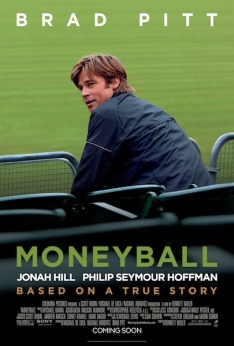
MoneyballBased on a true story, Moneyball concerns the management of baseball team Oakland Athletics during the 2002 season. General manager Billy Beane (Brad Pitt) struggles to put a squad together due to a comparatively low budget for players, which has seen all his best ones drift off to richer contracts elsewhere. Fed up with the traditional scouting system, he recruits Peter Brand (Jonah Hill) to use statistical analysis to select a cheap team of quality players. The rest of his staff despair, including coach Art Howe (Philip Seymour Hoffman), who refuses to play the team as Beane and Brand suggest, which unsurprisingly leads to self-vindicating failure — until they force his hand…

So Moneyball is a movie about sports and statistics — a pair of topics that will bore some people to tears, while still others will enjoy one but not the other. Generally, I couldn’t care less about sport, but statistics? Well, maybe.

Unfortunately, despite what you might’ve heard, Moneyball is more about sport than statistics. Worse, it makes too few concessions to people who know fuck all about baseball. You can follow the general arc, but it’s like turning on a real game of any sport you know nothing about: you can discern some stuff, but the coverage is not being produced for you. At one point it cuts to a match and a caption informs us it’s the “bottom of the 9th”. I’m sure that means something to baseball fans, but I can tell you the rest of us haven’t got the foggiest. Is the “bottom” at the beginning or the end? Or somewhere in the middle? Or is it something to do with score rather than time? The 9th what? And is it the 9th of 9 or the 9th of 10? Or 12? Or 15? Or 18, or 25, or…? Or is it the fact it’s the 9th that’s significant here? Maybe there’s normally only 3 or 4 of whatever it is? For Moneyball as a movie in its own right, rather than some niche special interest thing, this attitude is a drawback.

Brad to batProblems extend beyond the sporting specifics. It’s quite some way into the movie before it gets stuck into the meat of the plan working, and before that it often throws in asides that meander around through Beane’s earlier playing career and current family life. The former has some bearing on the plot, though feels inadequately integrated — as one flashback it might work, but as a series of them it’s not enough to constitute a parallel story. The latter, his family life, provides character texture, but it’s slight, uninformative, and ultimately unnecessary. You could cut it and the film would lose nothing.

Moneyball was going to be directed by Steven Soderbergh, who apparently had some interesting ideas about how to present the wealth of statistical material — ideas that were too interesting for Sony, as it turned out, because they shut down production days before shooting was due to start and kicked Soderbergh out. He was replaced with Bennett Miller, who previously directed Capote, which was fine, and later did Foxcatcher, which I didn’t really like (I gave it 4 stars, but my review reads more like 3 and that’s how I remember it). I’m beginning to dislike the guy. According to IMDb his next project is A Christmas Carol, because we really need another version of that.

On the bright side, Soderbergh’s departure was when Aaron Sorkin came on to write a new version of the screenplay. Swings and roundabouts, eh? But this does not feel like a film written by Aaron Sorkin. Where’s the sparkling dialogue? Where’s the impressive structure? The former is perfunctory and functional; the latter is, if not a mess, then certainly lacking the rigour of his other work. Apparently Sorkin only agreed to do a re-write if previous screenwriter Steven Zaillian kept a credit, because Sorkin felt the script was great “This screenplay's shit.” “Well I didn't write it.”and didn’t need any work, which probably explains why it’s not so Sorkin-y. Zaillian is not a bad writer — his credits include Schindler’s List and Gangs of New York, both of which are in my 100 Favourites, and the US remake of The Girl with the Dragon Tattoo, which I gave full marks — but I wouldn’t say he has a unique voice. Moneyball’s screenplay is fine for what it is, but it doesn’t have that frisson that Sorkin brings.

Baseball doesn’t interest me in the slightest, partly because I’m not interested in much sport, partly because I’m not American. So I watched Moneyball for three reasons: one, because it seemed like it might be more about the stats than a traditional sports movie. It’s not. Second, because it was written by Aaron Sorkin. But the screenplay displays little of his usual verve. And third, because it’s a Best Picture nominee from this millennium and I’m intending to tick all of those off eventually. In that respect, at least, it was a success — of course, it couldn’t fail to be.

3 out of 5

Fantastic Four (2015)

2016 #110
Josh Trank | 96 mins | streaming (HD) | 2.35:1 | USA / English | 12 / PG-13

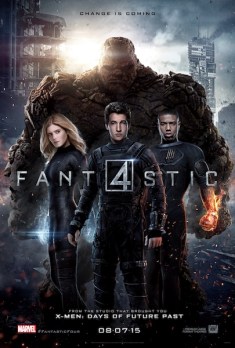
Fantastic FourSometimes you just have to see what all the fuss is about, even if that fuss is overwhelmingly negative. Obviously that’s the case with the most recent attempt to bring Marvel’s popular “first family” to the big screen. The behind-the-scenes stories are already the stuff of movieland legend, so I won’t repeat them here, but what of the film itself? Or the version that ended up available for public consumption, anyway.

Reimagining the group’s origins, the film sees young genius scientist Reed Richards (Miles Teller) recruited to a research institute where he works with Sue Storm (Kate Mara), her adoptive brother Johnny (Michael B. Jordan), and the precocious and rebellious Victor Von Doom (Toby Kebbell) to develop a teleport to another world, Planet Zero. When the device is proven to work, the institute’s supervisor rules astronauts will get to take the maiden voyage. Annoyed, the scientists rope in Reed’s childhood friend Ben (Jamie Bell) to help them use it first. But things go horrendously awry, leaving the gang with new abilities…

That chunk of the story takes most of the first hour. Other than being a little slow getting to the point, considering most viewers know where it’s all going, and perhaps not building the characters’ relationships as thoroughly as it could have, I thought it was shaping up as a pretty decent film. It’s not a mind-blowing masterpiece, and it’s certainly not faithful to the original comic, but as a sci-fi movie? It’s good. Not incredible, but good. Well, aside from one truly terrible reshoot wig.

Then the story suddenly jumps forward a whole year, and things go to pot. From that point the film’s ideas aren’t bad, but it feels like the movie was ripped apart and put back together awkwardly, with parts missing, some out of order, and other bits added to cover gaps Awkwardly assembledand serve as new pieces — like a shattered mug that’s been reassembled with lashings of superglue and using a handle from another vessel, which has inexplicably wound up a slightly different size and shape to how it used to be. Considering the studio got cold feet and insisted on massive reshoots, this is quite possibly exactly what happened.

It climaxes with a rushed action sequence on Planet Zero, which was clearly constructed entirely during reshoots (the constant presence of Reshoot Wig gives that away, if nothing else). The speed with which it’s dispatched makes it feel anticlimactic, despite the alleged world-destroying scale, and mainly leaves you wondering how the film originally ended. When it’s done, the heroes return to Earth and triumphant music swells… as they survey a scene of total devastation. It’s clear this hasn’t been thought through. There are still more signs of a rushed production: the CGI used to realise the Thing is pretty good for most of the film, but an unbearably cheesy final scene looks like a poorly-composited unfinished draft. Allowing such a rushed, underfunded, and heavily reshot final act to be released feels amateurish on Fox’s part.

While the studio are obviously keen to blame director Josh Trank for all the film’s problems, and possibly sink his career in the process, I can’t help but think it’s their own fault. It was they who chose to commission a “dark and serious” take on the Four, at odds with their usual depiction, but then wimp out and not follow through on the directorial vision they’d chosen. Despite what some fans would say, it’s this lack of commitment that’s the actual problem. Even in the face of the success of the lighter-toned Marvel Studios movie universe, Too cool for superhero schoolFox like to keep their superhero movies Serious and Dark — and why not? Before this, it had worked pretty well for them across seven X-Men movies, while their colourful-and-cheery earlier attempts at bringing Marvel’s first family to the big screen met with unwavering derision and diminishing box office. It was not an illogical choice to try something different tonally.
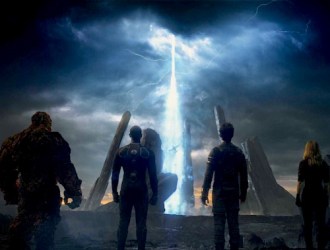
In the end, however, this version crashed and burned even harder than those earlier films, both with fans and at the box office. Meanwhile, the latest X-Men movie was similarly ripped asunder by critics and has only performed acceptably; and concurrently, superhero comedy Deadpool took the world by storm. Perhaps this will create a sea-change in the way Fox approach their superhero properties? Only time will tell — though with Deadpool 2 set to offer more of the same and a Wolverine threequel following in its R-rated footsteps, while another X-Men movie is surely in development but not officially announced and the planned Fantastic Four sequels have been quietly cancelled, perhaps it already is.

Fantastic Four’s real problems are twofold: deviating so heavily from the original comic book, which meant from the outset that an awful lot of fanboys were always going to hate it; and then not having the confidence to see that vision through, titting about with things in post. The latter results in a mess of a second half where the whole thing unravels. It’s not perfect before that, but it’s a decent sci-fi movie. I’d love to see Trank’s original cut — I’m not sure it would be a great film, and I’m damn sure it still wouldn’t properly resemble the Fantastic Four of Marvel’s comics, but I bet it would be a lot more consistent than this, and consequently better.

Beam of blue light shooting into the sky? Never seen that before...What could have been a comfortable 3-star movie, maybe even 4 if it followed through well enough, is dragged down to 2 by studio meddling. Will they never learn? Nonetheless, I actually enjoyed enough of Fantastic Four that, while it won’t be going on the long-list of contenders for the best movies I’ve seen this year, I won’t be putting it on the list for the worst either.
2 out of 5

Spy Game (2001)

100 Films’ 100 Favourites #87

It’s not how you play the game.
It’s how the game plays you.

Country: USA, Germany, Japan & France
Language: English, German, Arabic, French & Cantonese
Runtime: 126 minutes
BBFC: 15
MPAA: R

Original Release: 21st November 2001 (USA)
UK Release: 23rd November 2001
First Seen: DVD, c.2002

Stars
Robert Redford (The Sting, All is Lost)
Brad Pitt (Twelve Monkeys, Ocean’s Eleven)
Catherine McCormack (Braveheart, 28 Weeks Later)
Stephen Dillane (Welcome to Sarajevo, The Hours)

Director
Tony Scott (Crimson Tide, Man on Fire)

Screenwriters
Michael Frost Beckner (Sniper, To Appomattox)
David Arata (Brokedown Palace, Children of Men)

Story by
Michael Frost Beckner (Cutthroat Island, Prince Valiant)

The Story
When a retiring CIA agent’s one-time protégé is captured by the Chinese, he recalls their years training and working together, while battling internal agency politics to free his former friend.

Our Heroes
Nathan Muir is on the cusp of retirement, a former CIA field agent who’s now desk-bound and disregarded by his superiors. Previously, he recruited sniper Tom Bishop into the agency, training him to be a spy with Muir’s own values — which Bishop didn’t necessarily share, and his reaction against has ultimately led him into the hands of the Chinese. But how? Well, that’s what flashbacks are for.

Our Villains
Lots of Johnny Foreigners — but also some factions within the CIA itself…

Best Supporting Character
One of the CIA agents handling Bishop’s capture, and so attempting to handle Muir, is his oleaginous colleague Charles Harker. He’s played by the always-excellent Stephen “Stannis Baratheon” Dillane, who is perfectly snide in the role.

Memorable Quote
Bishop: “You don’t just trade these people like they’re baseball cards! It’s not a fucking game!”
Muir: “Oh, yes it is. It’s exactly what it is. And it’s no kid’s game either. This is a whole other game. And it’s serious and it’s dangerous. And it’s not one you want to lose.”

Memorable Scene
After an asset is killed, Bishop confronts Muir on a rooftop about the morals of what they do and why they do it. See also: Memorable Quote; Making of.

Technical Wizardry
The cinematography and editing haven’t yet reached the crazed heights Tony Scott would later display in Man on Fire and Domino, but it’s not without its affects. The flashbacks occur in a few different eras, so Scott decided to give each period a distinct look to remind the viewer of that time. For example, Vietnam is desaturated to a “strange sepia green”, while the colours in Beirut are heightened to mimic news clips from 1985. Conversely, Scott found the talky scenes within the CIA to be the “most challenging part of the movie” — without all his usual tricks, he had to rely on the quality of his actors to bring the scenes to life.

Making of
For the Berlin rooftop confrontation between Muir and Bishop, Tony Scott asked for more money to rent a helicopter. The producers refused — not unreasonably, when you consider it’s a dialogue scene. But Scott believed it was important and so rented the helicopter with his own money. Robert Redford was reportedly baffled by Scott’s use of a helicopter to film such an intimate conversation, but when he saw the final result he was impressed by how dynamic it made the scene.

What the Critics Said
“beneath the film’s nostalgic veneer and tooth-rattling visual and aural effects lies a mature ambiguity that’s unusual for a holiday blockbuster — and all but unheard of in a Tony Scott movie. […] the portrayal of Muir, Bishop, and their employers as significantly less than moral beacons makes the film surprisingly demanding as a whole. Rather than requiring us to take its desperate heroes and their dubious redemption entirely at face value, Spy Game slips in a refreshing dose of uncertainty with its cinematic jolts.” — Mark Holcomb, The Village Voice

Score: 66%

What the Public Say
“I have seen it three times now, and I still don’t have a full grasp of all the phone calls and cutaways and violent edits. This aspect, rather than being a distraction, is one of the film’s virtues. The idea is that Redford’s Nathan Muir is so smart that he is hoodwinking the CIA. Part of the game that the movie plays is that we the viewers are given just enough of a hint that we can appreciate his cleverness, but even we aren’t intended to fully ‘get it’. Tony Scott’s hectic, pulse-pounding visual style is largely responsible for this mesmerizing and confusing effect. Similar to (but far superior to) Guy Ritchie’s penchant for seemingly random visual tampering, Scott hits more often than he misses in Spy Game” — Ian Kay, Taking a Look

Verdict

Spy Game is not normally considered the pinnacle in the careers of anyone involved, but there’s something about it that really works for me. In part it’s the chemistry between Redford and Pitt, a pair of actors who look like they could be father and son and exude a similar level of connection. The dual timeline structure keeps things rattling along, with Redford entertainingly running rings round the CIA in the present, while the flashbacks consider “the greater good” — how far should they go, and is it ever worth it? Possibly such questions weren’t appreciated on the film’s immediately-after-9/11 initial release, but they’ve since become more relevant than ever.

That’s no moon… it’s #88.

Be Our Guest

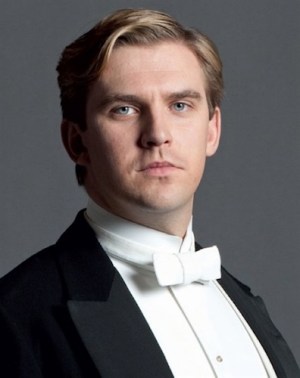
You may remember Dan Stevens from Downton Abbey, when he looked like this:

Pudgy.

Pudgy.

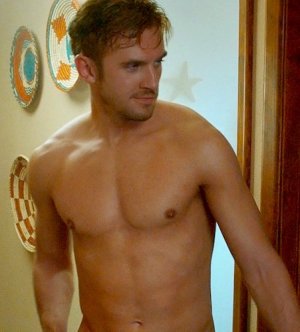
Then he starred in The Guest, where he looks like this:

Phwoar.

Phwoar.

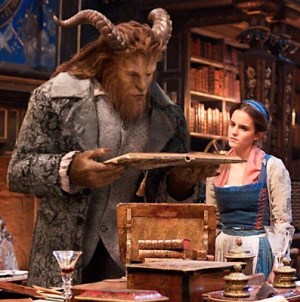
And this week saw the release of the first images from his new role, as the titular chap in Disney’s live-action remake of Beauty and the Beast, where he looks like this:

Phurry.

Phurry.

As if by design (but more likely by coincidence), the UK TV premiere of The Guest is tonight at 9pm on Film4. It was one of my favourite films I saw last year, so I heartily recommend it. Indeed, here’s a link to my full ★★★★★ review:

The Guest

Reblog: Doctor Strange (2016)

For various reasons I wanted to test what exactly happens when I reblog one of my own posts. In need of a test subject, what better than Marvel’s latest, because it’s out in the US imminently but I reviewed it when it came out in the UK, like, aaaaaages ago.

Anyway, I expect I’ll delete this once I’ve seen what I wanted to see. But until then…

badblokebob's avatar100Films.co.uk


Scott Derrickson | 115 mins | cinema | 2.35:1 | USA / English | 12A / PG-13

Doctor StrangeThe latest from Marvel (or Marvel Studios, as they’re now branded, presumably in a bid to differentiate themselves from the properties owned by other studios that have been only too keen to use the Marvel logo and blur the line for the casual moviegoer) opens the door on a new facet of their shared cinematic universe, though does so in a movie whose plot follows the familiar “superhero origin story” rulebook. On the bright side, Doctor Strange has several other qualities to recommend it.
It’s the story of Dr Stephen Strange (Benedict Cumberbatch), a brilliant but cocky New York neurosurgeon, whose hands are ruined in an accident, taking his career — the sole focus of his life — with them. In search of groundbreaking healing, he travels to Nepal, where he meets the…

View original post 1,188 more words

Cool World (1992)

2016 #70
Ralph Bakshi | 102 mins | streaming (HD) | 16:9 | USA / English | 15 / PG-13

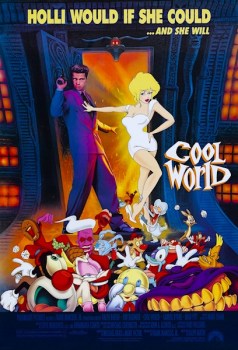
Cool WorldSometime recently, I said I was making more of an effort to avoid watching movies I know are going to be bad — when there’s so much good stuff to see, why knowingly waste time on bad stuff? But then sometimes something just catches your attention and you have to see for yourself. It sounds as if no one had anything good to say about Cool World when it came out back in 1992, and no one’s had anything good to say about it since either, but after spotting it on Netflix (I’m not sure I’d even heard of it before that) my curiosity was piqued.
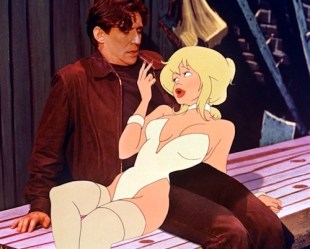
Directed by Ralph Bakshi, who’s probably best known for the animated Lord of the Rings, it’s the story of cartoonist Jack Deebs (Gabriel Byrne) who’s created the zany, surreal ‘Cool World’. But Cool World is actually a real place (a real cartoon place, as it were), which Jack ends up getting transported to. He meets femme fatale Holli Would (voiced by Kim Basinger) who wants to escape to the real world, but is being prevented from doing so by Frank (Brad Pitt), another real human who was transported to Cool World decades earlier.

If this all sounds a bit of a mess, it is. It’s not a fundamentally bad story at a conceptual level, but its execution is a jumble, and the twisted Cool World is an unpleasant place to have to spend time. The darkness of the story is actually toned down from Bakshi’s original concept (which had an underground cartoonist fathering a half-real / half-cartoon daughter who tries to kill him), but only so much: it’s still full of sex, references to sex, Holli Would, and she willand general depraved behaviour. It’s clear it got caught in the crossfire between a creator/director who wanted to make a hard-R adults-only animated/live-action movie, and a star and producer who wanted to make something they could show to sick kiddies in hospital. The end result surely satisfies neither, because it pulls some punches to not get that R, but there’s no way this is kid-friendly.

It came out a few years after Who Framed Roger Rabbit, and suffers from the comparison. It’s not just that Cool World is a less successful riff on the same concept, or that its storytelling is more muddled, but it’s less technically proficient too. The animation and live-action elements never gel as well as in Roger Rabbit, with plenty of lazy eye-lines and actions not quite lining up. This probably explains why Byrne and Pitt both give lacklustre performances, not that Basinger fares any better.

There’s some interesting stuff in Cool World, which is why I haven’t sunk it to the irredeemable depths of a single star, but the merits are slight and not worth the effort. Apparently it does have something of a cult following, though, so the adventurous may still feel it’s worth a visit.

2 out of 5

Cool World featured on my list of The Five Worst Films I Saw in 2016, which can be read in full here.

Spider-Man 2 (2004)

100 Films’ 100 Favourites #86

A man will face his destiny.
A hero will be revealed.

Country: USA
Language: English
Runtime: 127 minutes | 135 minutes (2.1 extended cut)
BBFC: PG (cut, 2004) | 12A (2004) | PG (uncut, 2009)
MPAA: PG-13

Original Release: 25th June 2004 (Lithuania)
US Release: 30th June 2004
UK Release: 16th July 2004
First Seen: cinema, July 2004

Stars
Tobey Maguire (Pleasantville, The Great Gatsby)
Kirsten Dunst (Interview with the Vampire, Melancholia)
James Franco (City by the Sea, 127 Hours)
Alfred Molina (Frida, An Education)

Director
Sam Raimi (The Evil Dead, Drag Me to Hell)

Screenwriter
Alvin Sargent (Gambit, Ordinary People)

Story by
Alfred Gough (Lethal Weapon 4, The Mummy: Tomb of the Dragon Emperor)
Miles Millar (Shanghai Noon, Herbie Fully Loaded)
Michael Chabon (John Carter)

Based on
Spider-Man, a comic book superhero created by Stan Lee and Steve Ditko; in particular the story Spider-Man No More! by Stan Lee and John Romita, Sr.

The Story
Peter Parker battles problems in his personal life while his superhero alter ego Spider-Man battles the machinations of evil scientist Dr Otto Octavius.

Our Hero
Spider-Man! Spider-Man does whatever a spider can — spins a web any size, catches thieves just like flies. Is he strong? Listen bud, he’s got genetically-modified blood. Wealth and fame he’s ignored, action is his reward… though he’s having doubts about if it’s worth it. With great power comes great responsibility, and neither sit well with a kid who wants a normal life.

Our Villain
Doc Ock! Guy named Otto Octavius winds up with eight limbs, four mechanical arms welded right onto his body — what are the odds?

Best Supporting Character
Before he won an Oscar for Whiplash, or posted photos of his insanely ripped body on social media, J.K. Simmons brought himself to everyone’s attention as the hilariously irascible editor of The Daily Bugle newspaper, J. Jonah Jameson. He was so good, they haven’t even bothered to recast the character for any of the three live-action Spidey films that have come since the first reboot.

Memorable Quote
“So here I am, standing in your doorway. I have always been standing in your doorway.” — Mary Jane

Quote Most Likely To Be Used in Everyday Conversation
“With great power comes great responsibility.” — Uncle Ben may be dead, but they manage to have him say it in this one too.

Memorable Scene
The elevated train fight between Spidey and Doc Ock. It was the first major sequence filmed, before the screenplay was completed, but Raimi had dreamt it up personally. It was shot in Chicago because New York no longer has an elevated railway, but Raimi was seeking to create an idealised version of the city.

Technical Wizardry
The sound effects for Doc Ock’s tentacles were created using motorcycle chains and piano wires, while the sound of him ripping open the bank vault was a hubcap scraping along the floor. The designers consciously didn’t include the noise of servomotors, to enhance the idea that the tentacles have become a part of Ock’s body.

Truly Special Effect
Doc Ock’s tentacles were built practically. Each one was 13ft long, made up of 76 pieces, fully articulated, and controlled by four people. Obviously some of their appearances are CGI, especially when Ock’s using them to move around, but every scene was first filmed using the real props to see if CGI was truly necessary

Making of
Tobey Maguire injured his back before filming began, to the extent that Jake Gyllenhaal (at the time only really known for Donnie Darko) was tapped to replace him, and even began preparing for the shoot. Ultimately Maguire recovered enough to participate (obviously). A couple of years later Gyllenhaal was one of the final contenders for Batman in Batman Begins, but didn’t get to do that either. I’m sure Marvel will find a superhero for him eventually — they do for most people.

Previously on…
Ignoring the many and various animated series and failed attempts to bring Spidey to the screen, there was the first Sam Raimi-directed Spider-Man, which was the first film to gross over $100 million on its opening weekend. Also, MTV animated series Spider-Man: The New Animated Series is technically set after Spider-Man and therefore before Spider-Man 2, but I don’t think anyone remembers it…

Next time…
Spider-Man 3 concluded the trilogy with a whimper thanks to behind-the-scenes clashes, which also scuppered plans for Spider-Man 4. The series was rebooted with the unpopular The Amazing Spider-Man, which was followed by the even-more-unpopular The Amazing Spider-Man 2, leading to the character being rebooted again and integrated into the Marvel Cinematic Universe. The latest version debuted in Captain America: Civil War before starring in a solo movie, Spider-Man: Homecoming, next summer.

Awards
1 Oscar (Visual Effects)
2 Oscar nominations (Sound Mixing, Sound Editing)
2 BAFTA nominations (Sound, Visual Effects)
5 Saturn Awards (Fantasy Film, Actor (Tobey Maguire), Director, Writer, Special Effects)
3 Saturn nominations (Supporting Actor (Alfred Molina), Music, DVD Special Edition Release)
Nominated for the Hugo for Best Dramatic Presentation Long Form
1 World Stunt Award (Best Overall Stunt by a Stunt Man (Peter Parker falling into clothes lines))
2 World Stunt Awards nominations (Best Work with a Vehicle, Best Speciality Stunt (Doc Ock waking up))

What the Critics Said Then
“a sequel that not only outstrips its predecessor but has a perversity and quick-wittedness that hardly seem to belong in a comic-book movie. […] It’s unusual and gratifying to find a multimillion dollar movie that’s been put together with some thoughtfulness, that doesn’t neglect subtlety in between delivering the smash-bang-wallop. […] It’s the interest in human fallibility that sets this movie apart. The superhero who bridles at his own responsibility may not sound an especially gripping prospect, but his dilemma is explored with a conviction that, within the fantasy genre, feels almost groundbreaking.” — Anthony Quinn, The Independent

Score: 93%

What the Critics Say Now
On placing the film in his top ten for BBC Culture’s 100 Greatest Films of the 21st Century: “First of all, the 21st century is the century of superheroes. To approach the history of this era without acknowledging that is to miss the story. Many of my peers opted to make The Dark Knight the film that represented superheroes for them, but while I like that movie it’s a crime film in superhero drag. Spider-Man 2 is an unabashedly comic book superhero movie, a film that is pulsing with the vibrant four color life of the best comic book panels and that is soaked in the sudsy soap opera of the best comic book word balloons. It’s a movie that is a perfect fusion between filmmaker and material, and it is, without a doubt, the best example of superhero filmmaking ever attempted.” — Devin Faraci, Birth. Movies. Death.

What the Public Say
“The most interesting relationship that gets explored in Spider-Man 2, however, is with Spider-Man himself. In the first Spider-Man, Peter basically became Spider-Man the instant he decided to live his life by Uncle Ben’s last few words and donned on the Spidey suit, and that was that. Here, Peter Parker basically breaks up with Spider-Man and with Uncle Ben, as he says he is “Spider-Man, no more,” and has to start over and re-bond with the hero inside of him. [The] movie makes use of this psychological relationship to refine its definition of a hero as established in the first film. It isn’t just about responsibility. It argues that the hero is inherently sacrificial. They give up even their dreams to salvage yours. This definition is much more mature and sophisticated […] It goes to show that a big budget doesn’t have to translate into senselessness. Spider-Man 2 is the intellectual experience I was looking for in a Spider-Man film with all the action that I always imagined was possible.” — Kevin Tae, Taestful Reviews

Elsewhere on 100 Films
Just before Spider-Man 3 came out they released an extended cut of the first sequel on DVD, dubbed Spider-Man 2.1 (remember when they briefly called extended cuts things like that?) At the time I concluded “it’s still a 5-star film because it doesn’t ruin the original — but it’s not at all essential”, though I later added a postscript to note that “I probably should have rated this lower. It may still be a good film, but the fact is the original cut’s better — even if just for the superior version of The Lift Scene. I rather doubt I’ll ever watch it again.”

Verdict

In a simpler time before every superhero movie was connected to every other superhero movie, filmmakers were free to only have to tell one story and develop the ongoing life of their lead characters (rather than juggle everyone else’s lead characters for cameos, too). Spider-Man 2 is a pinnacle of this. It takes the seeds sown by the first movie and nurtures them into more interesting and complex emotional dilemmas, without losing sight of the fact it’s a movie based on a comic book about a man who swings around the city in a red-and-blue onesie fighting crime. Nonetheless, it’s as memorable for Peter and MJ’s up-and-down relationship as it is for the stunning action sequences, which become icing on the cake rather than the raison d’être.

#87 is… no kid’s game.