
Gabriele Salvatores | 89 mins | TV | R
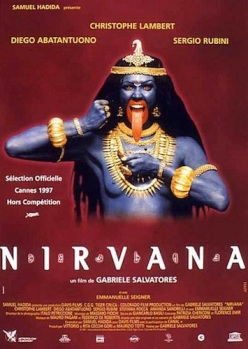 The Radio Times film section may be steadily going down the drain, but when anyone describes something as “one of the best science-fiction films ever made” it’s worth paying attention. “Yet few people outside Italy have seen it,” they add. Indeed, despite screening at Cannes (albeit out of competition), this Italian movie has never been classified by the BBFC, so I presume it’s never been released here (though this was its third showing on the BBC). It’s been released in America though… by Miramax. They did their usual foreign film job, chopping out 17 minutes, changing the music and adding an English dub. This is the version shown by the BBC (at the time of posting, also available on iPlayer) and reviewed here.
Most sci-fi we see is of the American variety — partly due to the fact most of any cinema and the vast majority of imported TV we get is from there, partly due to that being where the money is for special effects and what have you — and that tends to mean tonnes of CGI, a fast pace and action sequences up to the eyeballs. Nirvana is more stereotypically European, however: it’s clearly a Deep and Meaningful film, though unlike many examples of Thoughtful cinema it at least has a slightly thriller-ish plot and a hefty dose of cyberpunk styling for us plebs to pick up on.
Sometime in the future (I read 2005 in one review, but best to ignore that now), Christopher Lambert is a computer game designer working on a new title for Christmas. Somehow a virus invades his system, in the process making his lead character, Solo, fully sentient. Unable to escape the game, Solo wishes to be deleted, but Lambert can’t because the final software is owned by some giant corporation and will be released in just three days… so he has just three days to get into their computer system and delete the file, before Solo is condemned to never-ending life stuck in the game.
 The most obvious point of reference for Nirvana is Blade Runner, which I’d wager was a hefty inspiration. Writer/director Salvatores introduces themes of what it means to be human and a lead character one might like to decide isn’t after all, and sets it in a perma-night, dystopian, multi-cultural future. It doesn’t quite have Ridley Scott’s consistency of vision, though: while he just rendered an Asian-American future L.A., Salvatores takes globalisation to the max, running us through locations named after Marrakech and Bombay City, which may or may not be part of the same sprawling metropolis, and which all exhibit appropriately specific cultural stylings. These aren’t just pretty backgrounds, but in some ways reflect the film’s use of video games — in which you can, of course, constantly re-spawn your character — as a metaphor for reincarnation.
In aid of this, while Lambert is collecting the plot pieces needed to attack that corporation — at the same time as following a subplot about a missing girlfriend — we get to witness Solo’s experiences inside the game, frequently dying and re-living the same story with a group of characters who aren’t aware in the way he is. To be blunt, the in-game stuff is a bit odd. It doesn’t really go anywhere, and builds to a lacklustre climax — indeed, the word climax is a bit strong. But perhaps this is part of the point: as the only character in the game capable of independent thought, Solo is stuck in a loop of story and fellow characters who just re-enact what they were programmed to re-enact. Literally, he can’t go anywhere.
This part of the film calls to mind eXistenZ, David Cronenberg’s film about a virtual reality game that blurs the line between reality and the game. It’s rather a surface similarity though — Lambert barely spends any time in his game,  interacting with Solo merely though a series of screens on his journeys (and, one presumes, a series of microphones too). Cronenberg’s film was made a couple of years after this, so commending it for not doing the same thing would obviously be a bit rich. It is to be commended for not descending into a needlessly twist-strewn third act though, which I had thought was coming — there’s plenty of bits along the way that could be used to build a ‘surprise’ or two. There’s some ambiguity in the ending, but not too blatantly (unlike later versions of Blade Runner, for instance), and Emmanuelle Seigner’s ex-girlfriend character is never quite used in the way I expected.
For all its intellectualising, Nirvana can still be a fun film, and not just because Lambert’s accent is always set to provoke a giggle. That sounds horribly xenophobic written down, but it’s all Highlander’s fault: there’s no reason he shouldn’t sound European here (and he has dubbed himself), but the memory of that accent supposedly being Scottish does linger. (And, just so we’re clear, I love Highlander.) But no, there are proper dashes of humour, scattered here and there to provide some subtle texture. And there are action sequences too, and dated ’90s music (presumably thanks to Miramax), and even some boobies. To be honest, though, if you just want humour, action, dated music and boobies, there are dozens of films that will serve you better. At least they stop it becoming too dry, and give you a chance to let what’s going on sink in, helping prevent total confusion every time the film threatens to become incomprehensible (maybe it’s just me, but it took a little while to work out what Lambert was actually getting up to in the main plot).
I’d quite like to see the original version. Who knows what changes Miramax have wrought with their fiddling (that woman on the poster certainly isn’t in this version, at least),  and I imagine subtitles could be easier to follow than this dubbed version, in which everyone’s covered by either the original actors straining with English (based on the accents) or the typically bad voice actors employed for such dubs. The Italian DVD is reportedly English-friendly and very good quality, so perhaps I’ll get hold of that (expect another review if/when I do… well, eventually).
Apparently Nirvana “has achieved something of a cult status, especially in Europe”, and I think I can see why: there’s a few themes that might be worth a ponder, and enough splashes of style and action to keep one’s attention… most of the time. It might not be as stylistically delineated as either of the films it brought to mind, but then Blade Runner is perhaps the pinnacle of screen SF and eXistenZ… well, now I really want to see that again. I don’t know if this is “one of the best science-fiction films ever made” — especially not in this Americanised version — but it certainly has a few things going for it.

Nirvana is available to UK viewers on the BBC iPlayer until 3AM on Saturday 3rd September (i.e. Friday night).
 Once, a few years ago, SFX published an anime special (it was their first, I think) with a rundown of the Best Ever Anime Films. You’d expect it to be topped by something regularly cited and, considering the source magazine, science-fiction/fantasy-y —
 It’s not scary in the slightest (well, maybe in the slightest, for some kids, but note the U and G ratings), but in terms of how it balances real-life dramas with the fantasy element. Only in both the real and fantasy worlds it’s a lot nicer, friendlier and cheerier than del Toro’s acclaimed fantasy-horror. To put it more succinctly, they share a similar structure and balance, but a completely different tone.
 The English-friendly version has advantages too: I love any subtitles which use semicolons. It’s not inundated with them, but there was at least one. Semicolons are so underused. I love a good semicolon.

 The second directorial outing from BAFTA-winning Brit Duncan Jones (after
 because Source Code is hardly groundbreaking. It’s certainly a solid, dual-pronged, science-fiction mystery — dual-pronged because not only is Stevens working to find the bomber, but also fighting amnesia to discover what the source code is and how he wound up there — but not an especially deep or complex work. There’s nothing wrong with something being little more than an exciting, engrossing thriller, it’s just not revelatory.
 The other side of the plot is not only where the heart is, but also where the real twists and mysteries lie — I guessed the bomber the first time I saw the character; even if you don’t, it ultimately matters little. Vital to the finale are the subplots like Stevens’ relationship with his father and his growing affection for the passenger his alter ego was travelling with — but who he can’t save, of course, because the source code isn’t time travel.
 Did he create a new parallel world every time he entered the source code, or only the last time? I’m not sure that’s relevant. This is, though: at the end, he seems to remain in Sean’s body. So if he’s in a parallel world, he’s just stolen another man’s life? And Stevens — at least, the Stevens of that reality — is still lying, mutilated, half dead, in some government research facility? Hardly a cheery resolution.
 Still, problems aside, Source Code remains an exciting, taut, puzzling sci-fi thriller. On a train — there’s a whole long line of movies and connections to be explored there. Many reviews have noted the Hitchcock connection and I’m sure that’s an interesting route to look down, so maybe there is a bit more to Source Code after all… but even if there isn’t, it’s a fun ride.
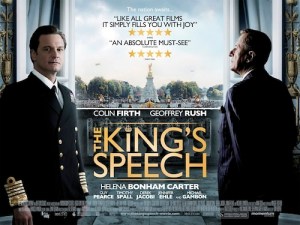 Britain seems to be having a grand time of it at the Oscars of late — following
 And if the authors of the book missed out on an on-screen credit, at least they’ve had plenty of tie-in promotion (including a featurette on the Blu-ray).
 but Firth presents a much more convincing stammerer than you usually see (I have this on good authority from someone who knows several stammerers). It’s not just the Oscar bait element he nails though, as he also brings truth and gravitas to the rest of the role. It’s a complex part — he’s a man who has the throne unexpectedly thrust upon him, at a transitional time for the monarchy, as the nation is launched into one of its most difficult periods.
 Guy Pearce as the youthful, playboy-ish David / King Edward VIII; Timothy Spall doing a decent Churchill impersonation, which sparks one nice moment just before the titular speech; plus
 It looks odd, and to be honest I’m struggling to place my finger on what exactly is odd about it, but it’s slightly off-normal, slightly stylised, and I quite like it… but considering Momentum seem to have ballsed up the transfer to at least some degree, I’m not sure how much the oddness is a choice of Hooper and DoP Danny Cohen and how much a dodgy transfer/compression. Screen-grabs of the US release (which is at least 1080p, but not wholly praised in other areas, it seems) don’t help much. But as I said, I’m no real expert on Blu-ray quality, so don’t take my word as gospel by any means.
 Anyway — here’s this month’s measly foursome… none of which I’ve posted reviews of yet. [Except I have now, by 2015, of course.]
 Catfish is a documentary (probably — we’ll come to that) in which 20-something Nev falls in love with a girl somewhere else in America over the internet. He and his friends become suspicious that she’s not who she claims and set off to find out The Truth.
 Before I get spoilersome, then, let me say this: you will probably guess where it’s going. Even if you’ve not had it in some way revealed (however little of it) before you watch, early scenes will lead to the obvious conclusion: why am I being shown this if it doesn’t go somewhere? And what’s the obvious place it’s going to go? I think most viewers must guess. But I think many — probably even most — will not guess precisely where it ends up; the exact nature of the truth it finds. So this is not as much of a Thriller as it’s been sold in some quarters. It has suspense, certainly, and it has mysteries that have answers… but there’s not some dark secret at the heart of it all; instead, there’s a painful emotional situation. Already I’m saying too much.
 and/or satire, I still think most people fundamentally believe what they see in a documentary (or they read in a newspaper) to be the truth.
 The allegation that it can’t be real because they happened to film everything that happened is nonsense.
 (it’s still on track as the best film I’ve seen in 2011), Catfish probably has more to say about the actual impact of Facebook on our lives than Fincher/Sorkin’s biopic does.
 There doesn’t seem to be much love in the world for Easy Virtue, a witty adaptation of Noel Coward’s play (previously filmed
 possibly in the soundtrack CD’s liner notes — that the following was Elliott’s idea.) Standards from the era are present and correct, but Cole Porter-styled reinterpretations of modern songs like Car Wash and Sex Bomb raise a smile whenever they turn up unexpectedly. It’s fabulously cheeky.
 It’s still not a big part, nor a showy one, but those little closing tweaks left him standing out for me.
 #60
 Law Abiding Citizen is a revenge movie with a (slight) difference: wronged man Gerard Butler isn’t just going after the two criminals who invaded his home and murdered his wife and daughter — he’s going after the legal system that let one of the men walk free.
 He attends the execution of the aforementioned criminal, but something goes wrong — instead of going to sleep with a lethal injection, the attacker suffers an agonising and horrific death. Someone must have swapped the chemicals. The prosecutors’ thoughts leap to the other criminal, but I’m sure we’ve all guessed who’s really behind this. And so Butler’s sprawling revenge mission begins…
 On the issue of who the film thinks is good and who it thinks is bad,
 It is a little far-fetched, granted, but it’s not so outside the rules the film sets up for itself that I find it unacceptable.
 As an action-thriller that actually has something to think about wrapped up in it, I considered being a bit lenient in my score (much as I was to


