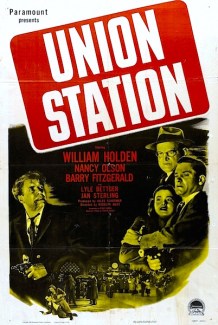
Union Station (1950)

2014 #19
Rudolph Maté | 77 mins | TV | 4:3 | USA / English

Union StationOften noted merely for being filmed in Los Angeles’ busy train station, there are some spirited defences of Union Station to be found. For my money, that’s nearer the truth: this isn’t some noir-era single-location-thriller, but a kidnap procedural with a significant role for trains and their locales. The best sequence isn’t even in the station: cops tail a suspect, get noticed, and the ensuing chase reaches a memorably grisly end.

Also in the mix are morally grey cops (“make it look like an accident”), one-step-ahead villains, and a blind girl in peril. The concoction produces an undervalued classic noir.

4 out of 5

In the interests of completing my ever-growing backlog, I decided to post ‘drabble reviews’ of some films. For those unfamiliar with the concept, a drabble is a complete piece of writing exactly 100 words long. You’ve just read one.

The Green Hornet (2011)

2014 #117
Michel Gondry | 119 mins | Blu-ray | 2.40:1 | USA / English | 12 / PG-13

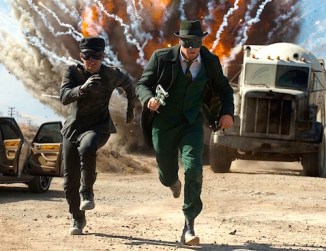
The Green HornetBased on a radio serial that spawned film serials, a famous TV series, and, eventually, comic books, The Green Hornet is a ‘superhero’ saga with a difference. For one thing, technically he’s just a vigilante — no superpowers here — and for another, as noted, it didn’t originate as a comic book. But that’s the milieu the character slots into these days, and so this attempted revival plays in that ballpark.

In this version, rich-kid playboy Britt Reid (Seth Rogen) used to want to be a hero, until his domineering newspaper-magnate father (Tom Wilkinson) crushed his spirit. After daddy dearest drops dead, Britt and chaffeur/coffeemaker Kato (Jay Chou) accidentally save a couple from a mugging and decide to fight crime, using Britt’s newly-inherited newspaper, in particular the research skills of secretary Lenore (Cameron Diaz), to help their cause. But LA crime kingpin Chudnofsky (Christoph Waltz) is not impressed with this new threat…

Produced, co-written by and starring Rogen, and directed by quirky Frenchman Michel Gondry, anyone familiar with their CVs will find “a superhero movie made by Seth Rogen and Michel Gondry” to be a pretty adequate summation of The Green Hornet. To clarify, it’s pretty comical, sometimes in that man-child frat-boy way, sometimes with a leftfield quirkiness. The combination makes it unique in the world of superhero movies, but hasn’t gone down well with critics or many viewers.

Run away!Well, screw them — The Green Hornet is brilliant. If you’re after the po-faced angsty worthiness of Christopher Nolan’s Bat-trilogy or the Spider-Man reboot, or even the X-Men films, then you need not apply. This has more in common, tonally, with Kick-Ass, or even Iron Man with the comedy bits dialled up further. That said, those two films were quite popular, so why isn’t this one?

For one, apparently Seth Rogen is doing his usual Seth Rogen schtick. That may be the case, but I’ve never actually seen a Rogen film, so I’m not over-familiar with his MO. His style isn’t top of my list of “how to do good comedy”, but it’s diluted enough here that it largely didn’t bother me. A couple of sections indulge it a little too much, but c’est la vie — it doesn’t ruin the whole film.

Another may be the film’s irreverence. That’s not to say something like Kick-Ass doesn’t have its share of genre disrespect, but while it allows its heroes to be comical it takes its villain seriously (so too Iron Man, actually). In The Green Hornet, everyone’s somewhere on the comic spectrum: Waltz’s villain is obsessed with being perceived as scary, in the end re-christening himself “Bloodnofsky”, dressing in red leather and coming up with an elaborate catchphrase to reel off before killing people. Waltz is, depending on your point of view, subtly ridiculous or phoning it in. It’s not as memorable a creation as his Inglourious Basterds Nazi, but you can rely on Waltz for a quality comic adversary.

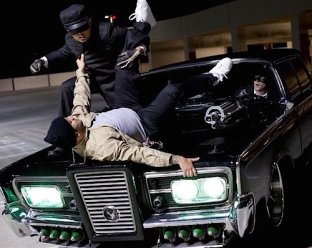
The car's the starThen there’s Gondry’s direction, which is often as idiosyncratic as you’d expect. He’s at his peak during the action sequences, which explode in an array of effects and slow-motion to create multiple memorably unique fights and chases. Highlights are the first time Kato unveils his martial arts prowess, and the crazy car-driven climax. Chou and the tricked-out car, Black Beauty, are undoubtedly the stars of these bits — indeed, the film has an overall good line in making Kato the brains behind the operation. I imagine this is subverting the depiction of the Asian sidekick from previous versions, considering when they were made, but as I’ve never seen any I can’t comment fairly.

I imagine those who are enamoured of previous versions were also less keen on this one. There’s probably too much Rogen-esque comedy and Gondry-esque oddness for anyone used to a classic character from a previous era. I can’t blame them for being less-than-pleased by someone trampling all over something they love. For those of us without a previous attachment to the characters, however — and, crucially, with an open enough mind to accept a ‘superhero’ movie that brings a different perspective and style to an arguably-overworked sub-genre — this incarnation of The Green Hornet is a fine piece of entertainment. In fact, I’m tempted to say it’s one of the best superhero movies of the current generation.

4 out of 5

The UK TV premiere of The Green Hornet is on Channel 5 tonight at 9pm.

It merited an honourable mention on my list of The Best Films I Saw For the First Time in 2014, which can be read in full here.

Mad City (1997)

2014 #94
Costa-Gavras | 110 mins | TV | 16:9 | USA / English | 12* / PG-13

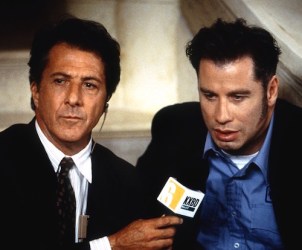
Mad CityDisgraced national TV journo Dustin Hoffman is slumming it on a local network, covering dull stories like something-or-other going on at the local museum… until a recently-fired security guard from said museum (John Travolta) turns up with a shotgun, accidentally shoots the other security guard, and takes a party of schoolchildren hostage. Suddenly Hoffman finds himself with the inside scoop — literally — as the eyes of the national news turn on the unfolding situation.

So Mad City proceeds with, essentially, a dual-pronged narrative: the hostage situation itself, and the tactics employed by the media when covering it. Unfortunately, it seems unsure of its own point or purpose thanks to a mismatched tone, with the fairly-straight hostage drama rubbing up against some very broad media satire. I think the latter is really what it wants to be, though if the filmmakers felt they were making a serious point about the behaviour of the media then some of the film’s wilder elements have other ideas. Plus, I don’t know how original “the media are part of the problem” was as a viewpoint in 1997, but, getting on for 20 years later, it’s become a played-out truism.

Despite such faults, the film is an absorbing enough whole. This is mainly thanks to a solid leading-man turn from Hoffman and, even more so, a surprisingly nuanced performance from Travolta. Sam's the manHe plays against type as Sam, the nervous, naïve, childlike, and easily-manipulated hostage taker. It’s Travolta’s performance that makes Sam someone you care about, even if you don’t exactly root for him, so that the outcome — which, unusually for this kind of film, remains completely uncertain right until it’s happened — is something you’re fully invested in. There are many better-regarded films than this that don’t achieve that.

There are other films that satirise the media more humorously, and other films that expose their true nature more effectively, and still other films that feature more thrilling hostage situations. Mad City has a solid stab at its constituent elements, even if it winds up more average than remarkable. At least the worth-seeing performance from Travolta adds value.

3 out of 5

* In 1997, the BBFC classified Mad City as 15 for cinema release. In 1998, it was again classified a 15 for video… but one week later, and one second shorter, it was a 12. Six months on from that, the ‘longer’ version was also classified 12… and two months on again, the ‘shorter’ version got a 12, again. It’s from the ’90s so explanations for this kerfuffle are in short supply, but it seems to hinge on one use of strong language. ^

Local Hero (1983)

2014 #75
Bill Forsyth | 111 mins | download | 1.85:1 | UK / English | PG / PG

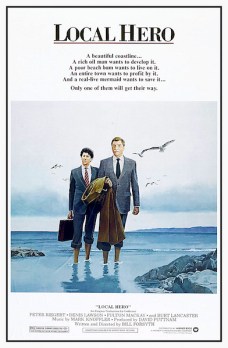
Local HeroGentle comedy in which Peter Riegert’s middle-management American oil exec has to persuade the residents of a Scottish village to sell up, unaware that they’re only too keen — for the right price. One of Quentin Tarantino’s Coolest Movies of All Time (seriously).

It’s a funny one, lacking some structural focus and, being independently produced, able to eschew expected endings and pat resolutions. The cast make it, particularly Denis Lawson as the town’s publican/hotelier/solicitor/leader and Burt Lancaster as a beleaguered CEO.

A more acquired taste than you might expect, Local Hero is lightly, loosely likeable. But cool? Hm.

4 out of 5

In the interests of completing my ever-growing backlog, I decided to post ‘drabble reviews’ of some films. For those unfamiliar with the concept, a drabble is a complete piece of writing exactly 100 words long. You’ve just read one.

Flirting with Disaster (1996)

2014 #112
David O. Russell | 88 mins | TV | 1.85:1 | USA / English | 15 / R

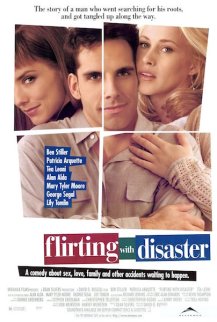
Flirting with DisasterDavid O. Russell’s second feature sees adoptee Ben Stiller go on a kerazee road trip to find his birth parents, accompanied by dissatisfied wife Patricia Arquette and kooky adoption agency psychologist Téa Leoni, along the way bumping into Arquette’s high school crush (Josh Brolin) and his husband (Richard Jenkins). Cue an almost-PG-13 sex comedy told among sketch-like encounters with quirky people who turn out to not be Stiller’s folks.

Despite a bitty structure, it’s a pretty amusing farce, with a few genuine laugh-out-loud moments. Now merely a footnote in the filmographies of everyone involved, it deserves a degree of rediscovery.

4 out of 5

In the interests of completing my ever-growing backlog, I decided to post ‘drabble reviews’ of some films. For those unfamiliar with the concept, a drabble is a complete piece of writing exactly 100 words long. You’ve just read one.

The Hunger Games: Catching Fire (2013)

2014 #15
Francis Lawrence | 146 mins | Blu-ray | 2.40:1 + 1.78:1 | USA / English | 12 / PG-13

The Hunger Games: Catching FireJennifer Lawrence (who, depending on your mileage, is either “the most charming young movie star in, like, forever” or “actually kind of a little bit irritating”) returns as the totally-plausibly-named Katniss Everdeen in this super-successful follow-up to the super-successful kids’ young adult novel adaptation that’s kinda like the new Twilight only actually quite good.*

Having struck a PR blow to the ruling elite by forcing their hand at the end of the previous Hunger Games, joint winners Katniss and Peeta (pronounced “Peter” (Josh Hutcherson)) are back home. But not for long, because in an attempt to reassert control it’s decided the forthcoming 75th Hunger Games will feature previous combatants — and Katniss and Peeta are their District’s only choice. Cue an almost-rehash of the first film, but with different burgeoning political undertones, and the added twist of the competitors all being previous winners. There are much bigger twists than that coming, though…

Indeed, perhaps the most striking part of Catching Fire is its ending. That’s not to say the rest of the film isn’t entertaining — it really is, but it’s a variation on a theme; that theme being “the first one again”, even if this is arguably a superior version. The ending, however, suggests things are about to be launched off in a radically new direction, as well as casting a new light on the film we’ve just watched. These closing moments most literally remind me of The Matrix Reloaded: following a surprise world-changing development, our hero lies recuperating on a spaceship with new-found allies among the resistance, while outside in the rest of the world a final showdown brews…

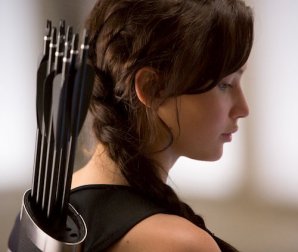
Katniss' backTonally, however, it’s more similar to The Empire Strikes Back** — indeed, the Star Wars comparison applies to both Hunger Games films and their relationship to each other: the first is the story of an unwitting small-town kid becoming a hero and landing a decisive blow against the evil ruling body in a standalone adventure; but our heroes have only won the battle, not the war, and the evil empire rolls on… Cue Film #2, in which we get a wider view of the world, the bad guys seek our heroes more directly, and everything comes to a head in a blatant “to be continued” cliffhanger that unavoidably draws us on to the next instalment.

On The Dissolve, Tasha Robinson goes so far as to assert that, not only are they alike, but “Catching Fire’s ending is the most daring “to be continued” since Empire Strikes Back”. She argues that they are executed in a style which none of the multitudinous other cliffhanger-ending-ed films made since (including everything from Back to the Future to The Lord of the Rings) can claim to have achieved in quite the same way. To take her final sentences: “Most serial films end by spelling out exactly how the characters are headed into disaster, and in some cases, exactly what they plan to do about it. Empire and Catching Fire closes [sic] with a sense not just of something continuing, but potentially, even more thrillingly, of something new beginning.” Her whole piece is worth a read.

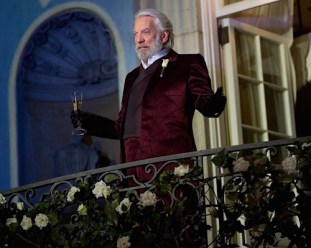
The Emperor, or somethingOf course, to an extent the tone of this ending comes from it being an adaptation: the filmmakers haven’t looked at the history of movie cliffhangers and chosen which to emulate, but instead brought someone else’s ending to the screen. Adapting doesn’t mean you have to take the original work faithfully, mind — you could go the Game of Thrones route and rearrange exactly where one book ends and the next begins; or the James Bond / Jason Bourne route of doing just whatever the hell you want. I haven’t read Suzanne Collins’ original novels, but I get the impression the films are pretty faithful.

Indeed, perhaps the real strength of Catching Fire being an adaptation of a novel is that it’s bedded in one author’s voice. My point being: it wasn’t written and constructed by committee, meaning we’re not subjected to the over-familiar beats of an action-adventure movie. There aren’t regularly-spaced action sequences of ever-increasing scale throughout, for instance — it’s not until halfway through that we end up in the arena, and up to that point it’s all story, the only action being ‘events’ rather than your traditional Action Sequence. This is no bad thing. If it’s adaptations of young adult novels that we need to save us from predictability, to deliver us a story rather than a thin excuse for the delivery of evenly-spaced action sequences, then so be it.

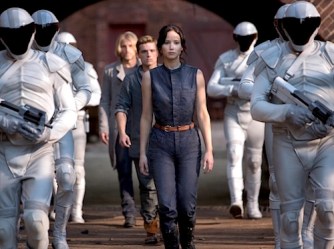
When the Games do arrive, director Francis Lawrence makes the most of it: as Katniss finally rises into the arena, the aspect ratio subtly shifts from filmic 2.40:1 to IMAX-derived 1.78:1. It’s remarkable how much impact this has even on a TV screen; nothing like what it must have in a proper IMAX theatre, but striking nonetheless — it really feels like things have just gotten bigger, both in terms of events depicted and the cinematography, Not Stormtroopers, nopewhich seems richer, more detailed, despite no genuine increase in resolution. I guess it’s true what they say: if you start with a higher quality source, it filters all the way down. The “bigger screen” effect probably wouldn’t work for a film entirely shot on IMAX — it’d just fill your TV from the start — but, after an hour-or-so of black bars, it really feels like the screen has grown.

Last year was one of mixed fortunes for the blockbuster, when films that one might deem well-received actually had an equal number of detractors; but Catching Fire stands apart as an engrossing, entertaining, intelligent and invigorating success. I guess it too must have its detractors, but I suspect not as many, and not as deservedly.

5 out of 5

The first Hunger Games is on Film4 tonight at 9pm. The next (and penultimate) instalment, Mockingjay: Part 1, is in UK cinemas from this Thursday, 20th November.


* I’ve still not seen any of the Twilight films, but I remain confident that, when I do, I’m not going to like them. ^

** I’m certainly not the first person to notice this: Googling “Catching Fire Empire Strikes Back comparison” brings up about 66,000 results — it used to be more, and obviously it misses anyone who’s making the comparison without using the world “comparison”. ^

Chronicle: Extended Edition (2012)

aka Chronicle: Extended Director’s Cut

2014 #115
Josh Trank | 90 mins | Blu-ray | 1.85:1 | USA / English | 15*
ChronicleThe birth of the “found footage” sub-genre and the resurgence of the superhero movie began around the same time, the former with The Blair Witch Project in 1999 and the latter with X-Men in 2000. They both arguably came of age towards the end of the noughties, with the box office success of Paranormal Activity in 2009 and the start of the Marvel Cinematic Universe in 2008’s Iron Man. It was inevitable, really, that someone would eventually combine these coincidentally-linked post-millennial cinematic obsessions, and that someone was director Josh Trank, who became one of (if not the) youngest directors to open a movie in the #1 spot at the US box office with this, his debut feature.

The obvious route for a found-footage superhero movie is surely in the Kick-Ass/Super mould: a wannabe dressing up in a funny costume and setting out to fight crime, in the real world. Trank and screenwriter Max Landis have grander ambitions, however, setting their sights on characters who develop Superman-esque powers. It means the movie isn’t as low-budget and independently-produced as you might have expected (although clearly not high-budget, it’s full of special effects, and was released by 20th Century Fox), but it does retain a more subversive element — for one, that great responsibility doesn’t necessarily follow great power.
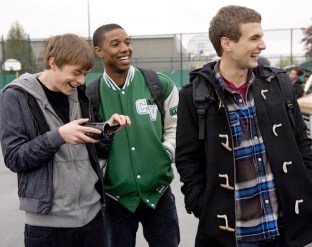
Boys will be boysThe story sees high school senior Andrew (Dane DeHaan) decide to start filming everything in his life, thanks to his borderline-abusive alcoholic father (Michael Kelly) and terminally ill mother (Bo Petersen). The same day (what a coincidence!), his cousin and only friend, Matt (Alex Russell), takes him to a party where, along with most-popular-kid-in-school Steve (Michael B. Jordan), they discover a hole in the woods with mysteries inside… Days later, all three begin to develop telekinetic powers, which they learn they can levy in various incredible ways — those ways being super, but largely without the heroic…

Which, in case you misread me, is not to say the boys become supervillains. Rather, they do what a lot of teenage lads would do: throw balls at each other with their mind; eat Pringles without having to pick up the can; use a leaf blower on a girl’s skirt; and so on. Using the found-footage style naturally, the friends experiment with their abilities, gradually increasing them, and bonding in the process. The story isn’t short of action or incident (some might disagree), but is equally character-focused, presenting individuals who are more rounded and believable people than your average superhero characters.

Rooftop bondingThis is even more pronounced in the extended version (“extended director’s cut” in the US), which includes over five minutes of extra bits that, in my opinion, make it a superior edit. Some are minor in impact, true, but there are a couple of short sequences with Andrew and Steve that deepen their relationship further, which enriches events at the end of act two. There’s also a moment that subtly prefigures the climax, and an extra bit in said finale that seems nigh-on essential to me. Considering the film still runs (just under) 90 minutes even with these additions, it’s difficult to see why they were cut in the first place. “Pace” is usually the rational for that, but if this is indeed a Director’s Cut then clearly Trank didn’t think they were an issue; equally, I can’t see why Fox would have objected. Still, they’re here to enjoy on Blu-ray…. though not on DVD… and I guess they’re not in TV screenings… Tsk.

Some accuse the film of being clichéd and predictable, which I don’t hold much truck with. It’s not twist-filled, but I felt the characters and their interactions grew naturally — if you can see where it’s going, it’s because it’s well-constructed, not because it’s how every movie does it. The time invested in growing our relationship with all three lead characters pays off increasingly as the movie rolls on, too, so that the climax is about more than just spectacle.
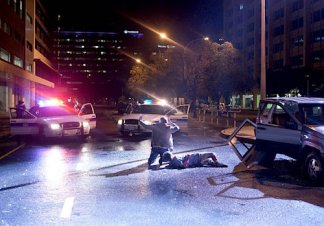
Spectacular climaxThat said, spectacle it has. You wouldn’t expect that from a $12 million found-footage movie, but an epic duel through the streets of Seattle is one of the strongest climaxes to any superhero movie I can remember. It’s kind of like Man of Steel’s, only released a year earlier and executed a thousand times better (the lack of mass destruction and associated innocent-bystander massacre is a bonus). The finale is undoubtedly the high point of the film’s visual extravagance, but numerous other sections are striking too, not least thanks to Andrew’s mastery of controlling the camera with his mind, letting it float gently around as he films himself and others.

The qualities of the climax could be seen as a microcosm for the entire film, actually: a stylistic gimmick that works so well you forget many people consider it a gimmick; a scale grander than you might expect from both that gimmick and the movie’s budget; a largely-innovative treatment of a much-trod genre; and, similarly, characters who are multi-dimensional and better-realsied than your average, thanks both to Landis’ writing and a team of top-notch performances, particularly from DeHaan and Jordan — there’s a reason they’ve both gone on to bigger things.

One to watch out forIn the hands of many a desperate-to-get-noticed filmmaker, a found-footage superhero movie would likely have been a straight-to-DVD affair that could at best be described as “mediocre”. In Chronicle, however, Trank and co have crafted one of the best movies produced in either sub-genre. Most of the people involved — as well as the film they’ve all come from — can be classed as “one to watch”.

5 out of 5

The network TV premiere of Chronicle is on Channel 4 tonight at 10pm.

It placed 6th on my list of The Ten Best Films I Saw For the First Time in 2014, which can be read in full here.

* Right: Chronicle was released in UK cinemas as a 12A, but with a couple of cuts for violence. On DVD/Blu-ray, it’s an uncut 15. Meanwhile, in the US, the theatrical version is PG-13, while the extended cut is technically Unrated. However, most of the additions are character scenes, so it’s surely still a PG-13. ^


Backfire (1950)

2014 #43
Vincent Sherman | 87 mins | TV | 4:3 | USA / English

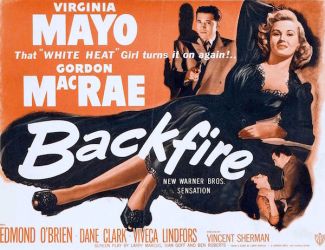
BackfireBefore he was the romantic male lead in musicals like Tea for Two, Oklahoma! and Carousel, Gordon MacRae starred as a war veteran out to prove his friend’s innocence in this underrated film noir.

MacRae is Bob Corey, our hero, whose hospital bed is visited by a woman (Viveca Lindfors) who tells him his army buddy Steve (Edmond O’Brien) has been in a horrible accident. The staff dismiss his story as an hallucination, but when he gets out, Bob and his new love, nurse Julie (Virginia Mayo), set out to find out what’s happened to Steve — who, it turns out, is wanted for murder — and find themselves negotiating a complex web of past events and future dangers….

Backfire doesn’t seem to be very well regarded on the whole (though, in spite of that, there’s a surprising amount of production detail on Wikipedia). This may be because at times it feels more like an Agatha Christie mystery than a film noir: a pair of clean-cut amateur sleuths bumble their way through a string of clues, learning more and more about the plot thanks to other characters’ flashbacks. I like a good Christie mystery though, so the pairing of styles isn’t a problem for me.

Friend or foe?Besides, even if the film seems to forgo the usual gritty noir trappings for a pleasant “English murder mystery”-type tale at first, it actually has its fair share of dark elements and noir-ish features, which only increase as it goes on: secretive gangsters, nightclub singers, revenge shootings… Then there’s the photography which, again, transitions from a fairly ‘regular’ (for want of a better word) style early on, to a world of rain-slicked streets and high-contrast lighting.
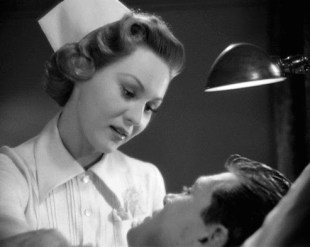
The story is reportedly “lifted from other, many times better, films”, which may well be true, but clearly I’ve not seen them. It all builds to a twist that I didn’t see coming, which is always good in my book; plus a final shoot-out featuring something that never seems to happen in films: the villain loses because he runs out of bullets! Along the way, the movie challenges the audience to keep up with which flashback is taking place when and how they’re connected to each other — indeed, the really attentive viewer might be able to use that to correctly guess the ultimate reveal.

MacRae is perfectly decent as the perfectly decent chap, who somehow manages to be a much better detective than any of the detectives. He’s aided by a sterling supporting cast, from the club singer’s tag-along roommate (Sheila Stephens — later Sheila MacRae) to the ex-army buddy mortician (Dane Clark), from the slightly creepy hotel desk clerk (who isn’t adequately credited) to the wisecracking police chief (Ed Begley).

That White Heat girl turning it on againIt’s in the latter’s case that the writing gets a chance to shine, too: the chief’s flashback is littered with snappy dialogue that feels kinda like he’s telling you the story himself, not just a matter-of-fact “here’s what happened earlier” objective account. Other flashbacks retain a degree of subjectivity — we only see events the characters could have witnessed, and in some cases the way they witnessed them (like the cleaning lady who only sees customers’ feet, before spying through a keyhole in a shot complete with keyhole matte) — but there’s an idea there, briefly glimpsed in that detective’s flashback, that would’ve made for an even more interesting film.

As it stands, Backfire isn’t all it could be, but I think it’s good for more than the consensus allows.

4 out of 5

Backfire is on TCM (UK) tomorrow, Saturday 15th November 2014, at 1:15pm.

La Belle et la Bête (1946)

aka Beauty and the Beast

2014 #104
Jean Cocteau | 94 mins | Blu-ray | 1.33:1 | France / French | PG

When it comes to “fairy-tale movies” — if such a genre exists as something other than a profit center for the Disney corporation — there is Cocteau’s Beauty and the Beast and then there is everything else.

La Belle et la BêteSo states Geoffrey O’Brien in his essay “Dark Magic” (included in the booklet for Criterion’s Blu-ray release of La Belle et la Bête, and available online here). Despite the varied list of titles people have selected to cover for the Fairy Tale Blogathon, I feel it’s a pretty accurate statement — ask most people to name a film based on a fairy tale and they’re going to come out with a Disney; ask a cinephile and I suspect, as a rule, Cocteau’s acclaimed film would come to mind ahead of most others. After all, it’s on a variety of well-regarded best-ever lists, including both the cineastic (TSPDT, Sight & Sound, Cahiers du cinéma) and the mainstream (the Empire 500, IMDb Top 50s for Fantasy and 1940s). It’s a film considered almost without peer in its now-animation-dominated sub-genre.

I imagine you know the story — it’s a tale as old as time, after all — but let’s recap anyway: in lieu of her father, Belle (Josette Day) goes to be the ‘guest’ of the animal-like Beast (Jean Marais) in his castle. Initially repulsed by him, Belle comes to realise there’s something there that wasn’t there before as she grows attracted to her captor. Meanwhile, Belle’s would-be suitor (Marais again) resolves to kill the Beast…

As if I haven’t made it explicit enough with my shoehorning of song titles and lyrics, the elephant in the room when discussing La Belle et la Bête today is Disney’s 1991 adaptation of the same story. It may have come 45 years later and I’m sure is less kindly looked upon by cineastes, but there’s no doubting its popularity — and acclaim, in fact, notably being the first animated movie to be nominated for a Best Picture Oscar. Simply put, Cocteau’s film is less accessible than the Disney version. That might sound like it goes without saying, but even allowing for the differences in production style (slick colourful animation with catchy Broadway-style tunes vs. black-and-white French poetic realism), Beast and the Beautyhere the characters’ relationships are more complex and ambiguous, particularly at the climax. It isn’t a simple “see the true beauty behind the ugly exterior” moral fable; indeed, if anything, Marais’ Beast is more beautiful than the man he becomes.

There are several reasons for that. One is the visual: Marcel Escoffier’s resplendent costuming, Henri Alekan’s gorgeous cinematography (more on that later), and, primarily, Hagop Arakelian’s make-up. Taking five hours to apply every day, the look of the Beast is in no way a dated ’40s special effect, but a marvellous, expressive, essential part of the character. Nonetheless, as O’Brien notes,

[The Beast says,] “You mustn’t look into my eyes.” It is, of course, his eyes that we look at, glistening from within the multilayered makeup… makeup so expressive that Marais’ real face seems a blank by comparison.

As is alluded to there, it’s not just the stuck-on fur that makes the man a Beast, but Marais’ performance. The eyes may indeed be the window to the soul, for it’s through them that we can see he’s a man underneath the beastly visage. But even in that sphere the character is a man transformed — his manner, his voice, and the steely look that often lies behind those eyes. In her essay named after the film in the BFI’s Gothic – The Dark Heart of Film compendium, Marina Warner summarises the cumulative effect of the numerous filmmaking disciplines that created the character:

[Cocteau] imagined a beast who has no rival for hideous fascination among fairytale beasts before or since: Jean Marais’s growling, slowed, incantatory delivery, his sweeping, elaborately princely magnificence of apparel, his thick pelt curling out exuberantly from his lace collar and fine linen as he springs and lopes, and, above all, his staring pale eyes in the great leonine and brindled mask of his face with the two sharp incisors defining his mouth, has never been matched for erotic power. He captures a perfect and irresistible synthesis of repulsiveness and attractiveness.

Wink wink nudge nudgeThat final idea, of the erotic or sexual in the film, seems a favourite theme for critics: O’Brien reckons “the magic is sexual throughout — a fantastic… sex magic”, and I think we’ll skip Warner’s lengthy discussion of the feelings the film elicits in her. How prevalent such undercurrents are is surely in the eye of the beholder — O’Brien notes that “it is so chaste that no censor could have ever assailed it”, and I suspect many a viewer would feel the same. That said, the soft-lensed scene in which the Beast gently laps water from Belle’s delicately cupped hands may make viewers with a particularly-disposed mind think of certain other acts.

A more defining feature of the film’s depiction of magic, I think, is its groundedness. O’Brien sums it up most succinctly when he says that “if this is magic, it is a shaggy, palpable sort of magic… we sense at each moment that we are caught up in a process governed by laws”. We rarely know what these laws are, in fact, but there’s a sense that there’s some governing order to what occurs, that some things are possible and others not — there’s clearly no love potion to solve the Beast’s problem, for instance. Many uses of magic in the film come with associated “how to use it” guides from one character or another; not presented in some kind of deconstructionist technical-manual style, but neither are they a hand-wavy “it’ll do whatever we need it to when we need it to”. To quote O’Brien again:

Cocteau was able to realize the fantastic not as an escape from the real but as an extension of it… He approaches the paraphernalia of the fairy tale — those enchanted mirrors, keys, gloves — with a technician’s dispassion, no more taken aback by their existence than by the existence of trees or streams or horses or rose gardens.

Smoking hotCocteau was trying to move away from a wishy-washy kind of fantasy — indeed, he says as much in the press book for the film’s US premiere (a piece entitled “Once Upon a Time” and also included in Criterion’s booklet): “To fairyland, as people usually see it, I would bring a kind of realism to banish the vague and misty nonsense now so completely outworn.” In these respects you could probably draw a line from Cocteau to something like Peter Jackson’s films of the Lord of the Rings trilogy, where a not-real world with magical qualities is rendered with the precision of historical drama, and even Game of Thrones, which you could certainly mistake for a real-life medieval epic (until the dragons turn up). Cocteau’s vision feels a little more storybook than either of those, but everything’s a step on a journey.

Plus, unlike either of those examples, Cocteau’s film needs to draw a line between the everyday world and the fantastical one. Much as with the Beast, this is achieved with a synthesis of production elements. The farmhouse of Belle’s family is shot on location, providing inescapable realism, and with relatively straightforward photography from Alekan. It’s not that these section are unimaginative, just that they present a world that is ‘normal’. The Beast’s castle, on the other hand, is heightened and expressionistic. Christian Bérard’s production design offers sets with lots of black emptiness in place of floors and walls, with decorations and dressings that shine, gleam and glow in Alekan’s lighting — not to mention the candelabras with self-lighting candles, held by moving arms; or the faces set in the fireplace, whose roving eyes follow the action; or the hand protruding bizarrely from the tabletop, there purely to pour the wine.

HandyIt’s in the Beast’s castle that the most enduring images of the film are played out, most famous among them being Belle’s father’s arrival, with the candles igniting themselves and the hands pointing the way, and Belle’s own arrival, a slow-motion run with billowing dress and curtains — if you haven’t seen the original, you’ve surely seen an advert inspired by it. For all the groundedness Cocteau and co may be bringing to the fantastical, it’s still a strange realm; one rendered with loving beauty in its design and photography, but with an unsettling effect. Right on the money, then.

And if we’re talking about “unsettling beauty”, we’ve surely come back round to the Beast himself, and in particular his role in the ending. You know how that turns out: having been able to see the true goodness beneath the ugly exterior, Belle is rewarded when the Beast is transformed back into a handsome prince. Hurrah — she gets a hubby who is both nice and pretty! But is it such a victory after all? Not if Cocteau gets his way:

My story would concern itself mainly with the unconscious obstinacy with which women pursue the same type of man, and expose the naïveté of the old fairy tales that would have us believe that this type reaches its ideal in conventional good looks. My aim would be to make the Beast so human, so sympathetic, so superior to men that his transformation into Prince Charming would come as a terrible blow to Beauty, condemning her to a humdrum marriage.

Pretty boyGood moral message, but isn’t the “superior” Beast the same fella as Prince Charming? The way a felled Avenant is transformed into the Beast at the same time as Charming is unveiled as a more-perfect duplicate of Avenant (it’s Marais in all three roles, of course) suggests some kind of parallel should be drawn. Warner wonders, “Has the Beast taken on [Avenant’s] appearance because [Belle] admitted to him that she was fond of Avenant?” Could be, but isn’t that a bit simple? She has another theory: “does Cocteau want to suggest that a ne’er-do-well like Avenant can also be transformed by love?” Could it be Avenant is about to get a lesson in how to be a better person, as Charming has already endured?

These are all attempts to find a positive reading of the ending, I think — one where love conquers all, and what it hasn’t conquered is a mission for the future. O’Brien is a bit more pessimistic, concluding the film is “a story more full of suffering than of wish fulfillment”. Oh dear. He believes that “even as Belle and her prince (the Beast transformed into the double of the unreliable Avenant) soar in the sky, she seems already to realize that this is not exactly what she wanted.” It’s certainly true that every character in the film goes through some misery, be it small (Belle’s sisters being snubbed from social engagements) or big (the family’s destitution), and by the end very few of these are resolved. If Belle thought she was getting an honourable Beast and instead has to suffer a preened Avenant for her foreseeable future, then she’s lost out too. Indeed, the only one who got what he wanted was the Beast: transformed back into a man, and with a lovely new wife to boot.

Beauty and the BeastThere’s a cheery message to end on. But then, this is “a fairytale for grownups” — a quote from Warner, but, to an extent, it would seem Cocteau agreed (by implication, with his statement at the start of the film urging the audience to embrace child-like acceptance of the story they are about to see) — and the resolutions of grownup stories are rarely “happy ever after”.

5 out of 5

This review is part of the Fairy Tale Blogathon. Be sure to check out the many other fascinating articles collated at Movies Silently, including my review of fairytale-inspired miniseries The 10th Kingdom.

The 10th Kingdom (2000)

2014 #104a
David Carson & Herbert Wise | 416 mins* | DVD | 4:3 | USA, UK & Germany / English | 15**

The 10th KingdomCreated by British screenwriter Simon Moore (writer of Traffik, the Channel 4 miniseries that went on to inspire Steven Soderbergh’s Oscar-winning film, and the first Dinotopia miniseries, which could not-too-inaccurately be described as “The 10th Kingdom with dinosaurs”), The 10th Kingdom is a miniseries that I seem to remember Sky made quite a fuss about when they aired it over here, nearly 15 years ago. Sadly it flopped on NBC in its native America, so we haven’t been treated to the mooted sequel(s), but that doesn’t mean it isn’t worth investigating now: unlike the abundance of Lost-inspired rolling TV narratives that are ruined when (almost inevitably) they’re cut short, The 10th Kingdom tells a complete self-contained story.

Said story takes place in both present-day (well, turn-of-the-millennium) New York and the fantasy world of the Nine Kingdoms — unlike the depiction in the title sequence, New York doesn’t mutate into a fantasy kingdom. Although it may not be storyline-accurate, I don’t think it’s an exaggeration to say that’s one of the greatest title sequences of all time. In just a couple of minutes it conveys the style and theme of the show with effective, striking imagery. OK, the CGI is a little dated now, looking kinda rough around the edges, but it’s not so bad that it diminishes the sequence’s impact. It won an Emmy for Outstanding Main Title Design, and it was well deserved.

ManhattanitesAnyway, the Nine Kingdoms is the place all our fairytales come from — the part of the narrative set there takes place “almost 200 years” after the “Golden Age”, when the events we know from stories actually happened. We’re led into this world by Virginia (Kimberly Williams) and her dad, Tony (John Larroquette), after indolent monarch-to-be Prince Wendell (Daniel Lapaine) flees to our world while escaping the Evil Queen (Dianne Wiest) and winds up taking the two New Yorkers back to his world. Along with Wolf (Scott Cohen), a chap with animalistic tendencies, the quartet try to stop the Evil Queen’s evil machinations.

So it’s a quest narrative, the staple of fantasy storytelling; but, in this case, that allows Moore to explore a fair chunk of the world he’s created. It goes about that at its own, somewhat literary, speed. Published alongside the miniseries’ airing was an epically-sized novelisation by Kathryn Wesley (a pen name for couple Kristine Kathryn Rusch and Dean Wesley Smith), which is how I first got into the programme. Unlike the innumerable sub-par novelisations published in the history of moviedom, this one was very good (and well-reviewed, if I recall, so it’s not just me). It’s ironic to me, then, that the series itself feels like a page-for-page adaptation of a novel. It’s something to do with the pace and style — the amount of time it’s prepared to devote to certain scenes or story elements, the way big twists and developments aren’t perfectly timed for episode endings (for example, our Manhattanite heroes enter the Nine Kingdoms just before the one hour mark — right in the middle of the first episode as originally aired, somewhere early in episode two of the ten-part version). Mummy dearestIt also means the way it’s been edited into one long movie on DVD feels quite natural: it’s one long story with arbitrary breaks, not a series of finite episodes. (If you’re thinking, “of course it’s one story, it’s a miniseries”, plenty of single-narrative series and miniseries still function as discrete episodes that build to a whole.)

Like a certain recent TV programme, the Nine Kingdoms is a world stitched together from numerous familiar stories; but, unlike that programme (the less said about which the better, in my opinion), it isn’t a land of po-faced ‘adventure’. Instead, it’s loaded with wry humour — after all, “fairytales are real and all took place in the same place” is a pretty silly concept, so why not mine it for laughs? As one character informs us, “things have gone down hill a bit since [the Golden Age] — happy ever after didn’t last as long as we’d hoped”. Rather than that meaning things are Serious and Troubling (and, based on how Once Upon a Time turned out, inadvertently laughable), things have gone to pot in a way that is amusingly reminiscent of our own world. This is mainly through a witty appropriation of real-world tropes: it begins at Snow White Memorial Prison, for example, with a worldmap that features a large arrow proclaiming “you are imprisoned here”; when some trolls believe they’ve been trapped in a witch’s pocket, they hope that if they behave they’ll be let out after serving only half the spell; later, there’s a cocktail bar that serves “A Long Slow Spell Against the Wall”; and so on (I don’t want to spoil them all!)

Wolf for the chopThis gives the whole thing a heightened comedy tone, emphasised by many of the performances. A gaggle of troll siblings are irritatingly over-played, but Cohen’s meat-obsessed Wolf is a hammy delight (pun very much intended). The entertainment value means we quickly warm to the characters, so that when more perilous aspects of their quest do come into play later on, we care what happens. Plus, like most of the original fairytales (as opposed to Disney-style sanitised re-tellings), there’s the odd darker undercurrent. For instance, you may think the story of Snow White ends with a kiss and “happily ever after”, but here we’re told how the stepmother who poisoned Snow White was made to wear fire-heated iron shoes and ‘dance’ at the wedding until her feet were burnt raw, before being thrown out into the snow. Very dark and grim (and possibly from the original tale, for all I know).

In the main, however, The 10th Kingdom takes fairytales, not for their grimness, but for the chance to subvert, play with, or expand on them. So, for example, when Wolf and Tony come across a woodchopper who’ll tell them what they want to know if only they can guess his name — and if they get it wrong, he’ll chop off one of their heads — Tony signs them up without a second thought: he knows this one. With Wolf’s head on the block, he declares “Rumpelstiltskin!” The woodchopper replies, “wrong!” Uh-oh. This feeds into Tony’s growing annoyance with why people in this world can’t just tell you things, or exchange money for services, but instead always pose riddles — real-world logic clashing with the fairytale tradition. And it has a funny pay-off, too.

My precious...Little details in this vein abound: an apple tree has grown by Snow White’s cottage (don’t eat those apples!); the site of her glass coffin is now a tourist attraction; if you break a mirror, you genuinely get seven years’ bad luck… There’s also a pair of golden shoes that can turn you invisible, but the more you wear them the more you desire to use them all the time — what a precious idea (wink wink nudge nudge). These subversions also manifest in a strain of pleasant practicality; for instance, the abundant magic mirrors aren’t “just there”, but instead have been manufactured by dwarves. It lends the feel of a fully-conceived and rule-bound world, rather than an “anything can happen”, “just because” environment.

Even with all this, there remain a few major fairytales that aren’t touched upon. The Little Mermaid is one; another obvious omission is Beauty and the Beast — except there is a version of that included: the romance between Virginia and Wolf. The comparison isn’t drawn out in the text, particularly as Wolf isn’t an ugly hairy monster (though he does have a tail), but the similarities are there: his first encounter is actually with her father; he pursues Virginia even though the attraction isn’t mutual; she gradually comes around to him; there’s a third-act complication (spoilers!), before they eventually end up together (surprise!) It doesn’t have the same thematic heft as a proper retelling of Beauty and the Beast because it doesn’t have the whole “seeing the true beauty inside” thing — Wolf may give in to his urges once or twice, most notably in a storyline set in a town dominated by the Peep (as in Little Bo) family, where prejudice comes to the fore and Virginia has to defend him, but he’s never a full-on monster. There are elements of the tale’s other subtext, about a woman having power and control (or not) over her future, but, again, not in quite the same way: Wolf is besotted with Virginia and she doesn’t (initially) reciprocate his numerous advances — Animal attractiona world away from being locked in a castle until you change your mind. If this sounds like criticism, it isn’t. I’m not arguing the love story element of the series is unsuccessful — I’m sure it engages plenty of fans as the series’ primary attraction, even — but, on reflection, I’m not sure reading it as a Beauty and the Beast variation is actually that illuminating.

That’s fine, because the value of The 10th Kingdom lies not in how it retells its fairytale inspirations, but how it takes their familiar symbols and tropes and then reconfigures and expands on them, how it follows their implications through with real-world-logic, or mashes them up against the banalities of our world, often to comical effect. It’s a series that requires a basic knowledge of the tales used as its basis — not in an academic way, but in the way most of us have, thanks to exposure through childhood story-time or endless Disney movies. By playing on such ingrained knowledge, the pay-offs can be huge. Put those amusing subversions alongside likeable characters and a story that is at once world-endangering and deeply personal for our heroes, and you have top-drawer entertainment.

5 out of 5

This review is part of the Fairy Tale Blogathon. Be sure to check out the many other fascinating articles collated at Movies Silently, and come back here on Tuesday for my second contribution, a review of Jean Cocteau’s 1946 adaptation of La Belle et la Bête.


* That’s just under seven hours to you and me. Most DVD releases present that as a non-stop movie, however in the US it was originally aired as five two-hours (which is reportedly how it’s presented on the 2013 DVD re-release), and in other regions (including the UK) as ten one-hours. ^

** Yes, it really is a 15. That must be thanks to some kind of technicality (use of knives, imitable violent techniques, etc), because it feels completely unwarranted. ^