2016 #62
Steven Spielberg | 151 mins | Blu-ray | 2.40:1 | USA & India / English | 12 / PG-13
 2013 Academy Awards
12 nominations — 2 wins
Winner: Best Actor, Best Production Design.
Nominated: Best Picture, Best Supporting Actor, Best Supporting Actress, Best Director, Best Adapted Screenplay, Best Film Editing, Best Cinematography, Best Costume Design, Best Score, Best Sound Mixing.
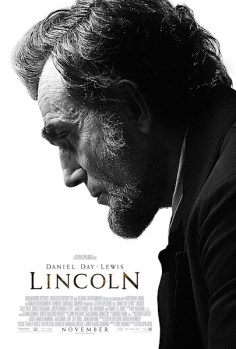 Daniel Day-Lewis allegedly stars in this account of the final months of President Abraham Lincoln’s life, which might more pertinently be called The 13th Amendment due to where its focus lies. I say “allegedly” because I’m not convinced they didn’t find a way to resurrect Lincoln to appear as himself, then just pretended it was Day-Lewis acting.
Although this project started life as a traditional biopic of the 16th President of the United States, as director-producer Steven Spielberg developed it over several years, it was eventually whittled down to what we have here. Most reviews and the like describe it as being about the final four months of Lincoln’s life, and in a literal sense that’s true because the last couple of months are covered at the tail-end of the movie. However, it’s really about one month: January 1865.
With the American Civil War not yet over, though clearly in its final stages, and an election recently reaffirming Lincoln’s presidency but bringing changes in the House of Representatives — changes that, importantly, don’t take effect for a few more weeks — the president decides now is the time to push through the unpopular 13th Amendment to the Constitution, which will abolish slavery. He wants it passed because it’s the right thing to do, though there is far from consensus on this point. However, the passing of the amendment would likely bring about the end of the war, which leads some to back it even though they don’t agree with the amendment in and of itself; and the forthcoming changes in the House mean there are a raft of senators soon to be looking for new jobs, whose votes might be bought with the promise of a cushty position in the near future.
If that all sounds very political, it is. I wouldn’t be the first to observe that Lincoln plays like a period version of The West Wing, but it bears repeating because it’s true. If the idea of men standing (and sitting) in rooms debating political manoeuvres — 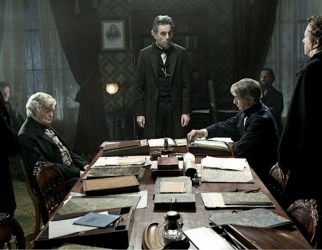 who might be persuaded to vote which way, and how they might be persuaded, and what they will want in return, and what deals need to be struck, and so on and so forth — sounds like it might make for an engrossing movie, then there’s a fair chance Lincoln will be your cup of tea. A not-insignificant proportion of viewers protest that it is boring, however, and while I in no way agree with them, your mileage may vary.
From a filmmaking perspective, this is first-class work. Spielberg shows a more restrained side to his proclivities than in the similarly-themed Amistad, but exhibits perhaps a little more flair than in his next film, Bridge of Spies. Much like that latter movie, his sentimental streak only really manifests itself in one short scene right near the end… though historians who contest the commonly-taught history of Lincoln as an upstanding man (a view this film clearly maintains) may argue the whole film gives in to this aspect of the director’s work. Either way, the film is a visual triumph, its production design award well-earned. Even more so, however, is the work of Spielberg’s regular DP, Janusz Kaminski, whose candle-and-gaslight photography of interiors is breathtakingly good. The whole picture exhibits a richness and a sharpness that, perhaps for the first time, made me wonder if 4K might be a really worthwhile idea after all.
The real meat of the film comes in the performances — not the actual political debate, because we all know how that should go, but the men performing said debate. Of course the title performance dominates the movie, but Day-Lewis does not. As I alluded to at the start, it’s hard to see the actor’s presence in the role — it’s not a performer, it is Abraham Lincoln. 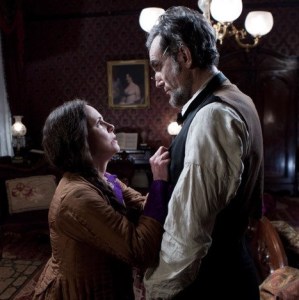 Not to do anyone else in the film — or, indeed, any other performance in any film ever — a disservice, but Day-Lewis embodies the President in a way few other actors have ever embodied a role. It’s quite remarkable.
It’s a real testament to the rest of the cast, then, that in the face of this powerhouse performance they all do such sterling work. Sally Field tackles a complex, potentially thankless role with aplomb. The movie is about the titular man, so her scenes are really about illuminating the President’s psyche and so creating the biopic side of the movie (i.e. the reason why it isn’t actually called The 13th Amendment), but that doesn’t mean she doesn’t make Molly a believable human being in her own right. Tommy Lee Jones also stands out as hardline abolitionist Thaddeus Stevens. Stevens doesn’t get on with Lincoln and thinks the 13th Amendment doesn’t go far enough, but will he concede it’s better than nothing in a social climate where many think the opposite? And then there’s James Spader as behind-the-scenes political persuader W.N. Bilbo (yes, like the Hobbit). When he first tumbles onto the screen he looks like a misplaced comedy creation, and he does bring some much needed levity to the film, but in a measured way that doesn’t tip the scales too far. It makes the whole better because of it.
They’re still the tip of the iceberg, however, because in the film’s expansive two-and-a-half-hour running time there’s space for accomplished performances from David Strathairn, Joseph Gordon-Levitt, Hal Holbrook, Jackie Earle Haley, Jared Harris, Lee Pace, Peter McRobbie, David Oyelowo, Adam Driver… I’m just naming them in the order they are in the cast listing. Some of them are only in one scene. I still think I’ve missed some people.
 For me, there are few black marks (unfortunate choice of phrase…) to be held against Lincoln. Does it give in to Spielberg’s sentimentality? Yeah, a little — but it’s a long, long way from the worst case of that, and I think you’d be nitpicky (or have a different opinion on history, which, you know, is a matter of opinion) to criticise the film too harshly for that. As to whether it’s boring, that’s entirely a matter of preference. If you think The West Wing is boring, people who write lists of “the greatest TV shows ever” will disagree with you, and you also likely won’t like Lincoln. I like The West Wing, though.
Lincoln is going to be remembered for Daniel Day-Lewis’ performance, and in many respects that’s fine, because (as I’ve said a couple of times now) it is an astonishing piece of acting. Fortunately for the viewer seeking out that performance, there’s an awful lot more to Spielberg’s polished political drama.
The UK network TV premiere of Lincoln is on Film4 tomorrow at 9pm.
It placed 13th on my list of The 20 Best Films I Saw For the First Time in 2016, which can be read in full here.

 I’ve observed before that the ’80s seem to be everywhere in film these days, and here’s another example: Turbo Kid is in every respect an homage to low-budget ’80s genre fare.
 Then there’s the score, which is of course all ’80s synths, in a similar style to the score of The Guest. Unfortunately, the score is often indiscriminately applied, like someone composed a generic ’80s score and then slapped it on with minimal regard to what was occurring on screen, meaning some moments fly past without the requisite emphasis. But perhaps this was deliberate — I can well believe that’s what cheapo efforts of the era did, and doing it here is a deliberate reference. This is a bit of a problem with the whole film: points where you can’t be sure if it’s being deliberately wonky or poorly-done as part of the homage, or if there’s some tweaking required. The pace could certainly do with some attention, especially early on. It’s only 93 minutes long, but it would be even better if it was only 85.

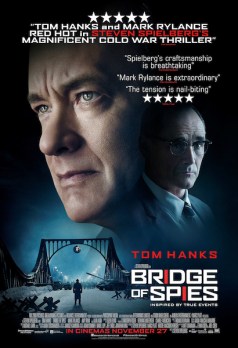 Steven Spielberg’s true-story Cold War drama stars Tom Hanks as insurance lawyer James B. Donovan, who is tapped to defend captured Soviet spy Rudolf Abel (Mark Rylance). After Donovan insists on doing his job properly, he manages to spare Abel the death penalty — which comes in handy when the Soviets capture spy-plane pilot Francis Gary Powers (Austin Stowell) and a prisoner exchange is suggested, which the Russians want Donovan to negotiate.
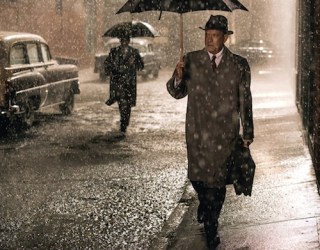 If we’re talking storytelling oddities, another is the manner in which Powers’ backstory is integrated. As Donovan continues to defend Abel, the film suddenly becomes subjected to scattered interjections, in which we see pilots being selected and then trained to fly secret reconnaissance missions in a new kind of plane. Any viewer who has read the blurb will know where this is going, but it’s so disconnected to the rest of the narrative that it felt misplaced, at least to me. The same is true when we suddenly meet Frederic Pryor (Will Rogers), an American student in Berlin who’s mistaken for a spy and arrested by the East. It turns out we need to know about him because Donovan attempts to use his negotiations to get a two-for-one deal, exchanging Abel for both Powers and Pryor. Knowing the stories of the men Donovan will be negotiating for is not a bad point, but I can’t help but feel there was a smoother way to integrate them into the film’s overall narrative.
 hints at emotions under the surface rather than declaiming them. A lesser film would’ve made a point of this — would’ve had Hanks’ lawyer struggling to understand and relate to his client’s low-key nature — but, instead, Donovan is a man who can identify with this mode of being, at least to an extent. There’s a reason they talk a couple of times about the ‘stoikiy muzhik’.
 allows the whole film to be equally as subtle, even as it remains gripping and entertaining. However, the storytelling quirks are a mixed success, the pace they sometimes lend offset by the almost non sequitur style of the captured Americans’ backstories. Nonetheless, this is a classy but still enjoyable dramatic thriller, which takes a seat among Spielberg’s better works.
 After martial arts student Fang Cheng is killed protecting his master, the latter takes in Cheng’s infant son, Fang Kang, as his student. Years later, Fang Kang is bullied by his aristocratic classmates and treated as a servant by the master’s daughter, Pei, though he’s a better student than any of them. Eventually goaded into leaving, his fellows corner him, challenge him, accidentally lop off his sword arm, and leave him for dead. Kids, eh? Fortunately, Kang is found by orphan Xiao Man, who nurses him back to health. With the help of an old textbook, he learns to fight left-handed, which is handy because there’s a conspiracy underway to kill all of his master’s former pupils…
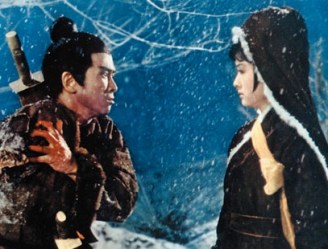 However, for me the film also worked very well as a drama, and even sometimes as a romantic drama. Fang Kang is an interesting protagonist. His lifestyle is torn from him, and rather than simplistically train to regain it or give up entirely, he battles with that decision. He returns to that way of life only to defend himself and his rescuer, and then out of a sense of loyalty to the master who raised him, but he’s also prepared to abandon the martial life to be a farmer… when the job is done, naturally. Jimmy Wang Yu, in a star-making turn, sells this character arc as well as anyone in a kung fu picture ever has. He’s also (somewhat) torn between two women, the kindly and supportive Xiao Man, and brat-with-a-heart Pei. While no one could truthfully call this a romantic picture, the love-triangle aspect also functions surprisingly well.
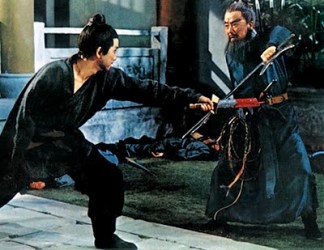 I disagree with that. Perhaps those lists are based on the abundance of action in these films, by which metric this probably has too much drama — though, as I said, it’s not devoid of fisticuffs and swordplay. Combine that with a solid story, engaging characters, and a brisk pace (even with its near-two-hour running time), and you have one of my favourite Shaw Brothers movies I’ve yet seen.
 After the success of
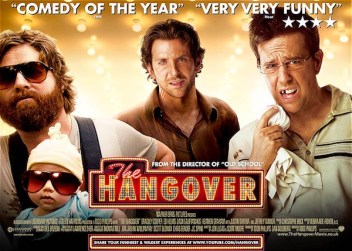 I confess, I only watched The Hangover to see what the fuss was about, and to get the tick on
  Oh (Jim Parsons) is a Boov, a race of friendly aliens looking for a new home planet to escape their enemies. When they arrive on Earth, Oh tries to invite everyone to a party, but accidentally alerts their enemies to their new home. Outcast, he bumps into Tip (Rihanna), a girl accidentally left behind when the rest of mankind was relocated by the Boov. Desperate for friendship, Oh agrees to help her find her mother.
 but the entire universe, including our enemies”? Why is there no option to cancel such a transmission that is going to take 40 hours to reach said enemies? I mean, that last one’s a stupid question, because why is there even a way to message the enemies?
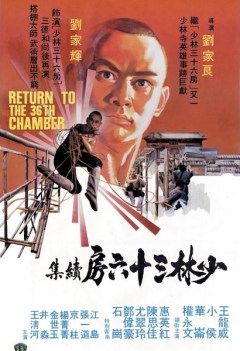 Con man Gordon Liu poses as San Te (Liu’s character from
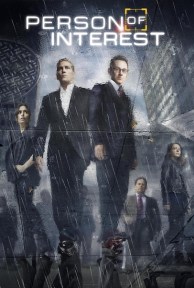 I have very mixed feelings about Person of Interest, whose fourth season has only made it to UK TV in the past few weeks (the belated fifth starts in the US in May, they announced yesterday). When it works, it’s a good quality vigilante/procedural action show; but its array of arc plots are as unrewarding as they are never-ending, and are consequently unsatisfying to a fault (literally). However, now that I’m so deep into it, and with cancellation finally confirmed (the foreshortened and delayed fifth season will indeed be its last, as was also finally announced yesterday), I feel like I’m in ’til the bitter end. The makers just bloody better have had the notice to get a proper ending into that now-final episode…
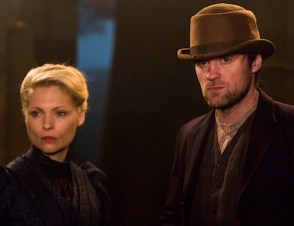 When Amazon picked up Ripper Street after the success of the third series, it was for a fourth and fifth season totalling 13 episodes. The show’s writers seem to have taken the double recommission to heart and crafted an arc plot to last throughout those two seasons, meaning this first half ends on a big surprise and with all sorts of things left up in the air. And now we have to wait. Still, it’ll be fascinating to see how there are six or seven more episodes left, considering the predicament they’ve put the characters in.
 I think I sounded a little more dismissive of Shetland than I’d intended in
  The quality of this revival has certainly been all over the place. I was wary of episode three, Mulder & Scully Meet the Were-Monster, because comedy always seems at odds with The X Files’ grand conspiracy storylines, but I thought it was hilarious and deserving of its acclaim as the best episode of the season. Home Again felt like solid standard X Files fodder, and Babylon was clearly trying to be zeitgeisty but perhaps wasn’t fully thought-through. As for the much-maligned finale, My Struggle II… well, it was a mess, and over-ambitious, and a stupid idea to end it on a cliffhanger when no one knew how well the revival would go down. Let’s hope Chris Carter is right that there’ll definitely be more.
 This month, I have mostly been missing The Night Manager. The critically-acclaimed ratings hit is, as you likely know, a spy thriller adapted from a John le Carré novel, which not only means it has pedigree, but that its star — Tumblr-beloved Marvel villain Tom Hiddleston — is now being tipped to take over as Bond. I wouldn’t know, I’ve not seen it yet.
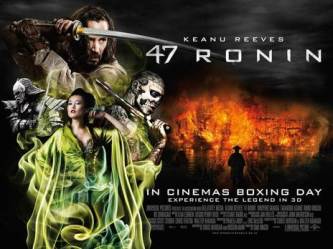 Blighted by behind-the-scenes difficulties, 47 Ronin wound up among
  100Films.co.uk