2016 #109
Danny Boyle | 122 mins | streaming (HD) | 2.35:1 | UK & USA / English | 15 / R
 Written by Aaron Sorkin and directed by Danny Boyle, with a name cast and plenty of awards buzz, this biopic of the eponymous tech genius was an inexplicable box office flop on its release last year — proof if proof were needed that box office does not equal quality, because I thought it was thoroughly excellent.
Rather than taking the usual route of telling a whole life story, Sorkin’s screenplay drops in on Jobs (Michael Fassbender) at three key product launches: the original Apple Macintosh in 1984, the NeXT Computer in 1988, and the iMac in 1998. At each one he battles personal and professional issues while surrounded by the same group of people, including marketing exec and Jobs’ right-hand-woman Joanna Hoffman (Kate Winslet); sidelined Apple co-founder Steve Wozniak (Seth Rogen); Jobs’ mentor turned friend turned nemesis, Apple CEO John Sculley (Jeff Daniels); and the mother of Jobs’ alleged child, Chrisann Brennan (Katherine Waterston).
First off, I don’t know how historically accurate it is. Some say it demonises Jobs; some say it lets Sculley off for his crimes. Whatever the truth, this presentation makes for a damn good story. It’s both inherently cinematic and easy to imagine as a stageplay — quite some feat! In the latter camp, it takes place in a handful of locations with a limited, recurring cast. A few costume and make-up changes and you feel most of it could be reconfigured for the stage relatively easily. However, in favour of the former camp, the way Boyle has mounted the production is filmic to the hilt. This is especially discernible in the montages that help guide us from one time period to the next, or the cleverly-edited flashback-strewn confrontation between Jobs and Sculley at the end of act two. Sequences like that help define Steve Jobs’ greatness — it is a hair-raisingly good scene, with the writing, acting, directing, editing, score, everything, coming to a magnificent crescendo of sheer cinema.
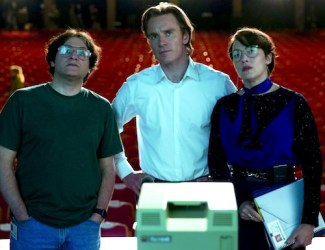 Boyle’s decision to use different film formats for each section — 16mm, then 35mm, then digital HD — helps delineate the eras and, in a way, reflect the products being launched (though I’ll instantly concede that last point may be a bit of a stretch). I imagine it’s too technical a concern to be noticed by your average filmgoer, but I’m sure it must have a subtle effect; and for those of us who are so minded to spot the change, it’s kinda fun and effective. Shot by Alwin H. Küchler, each section has its own charm, from the warm fuzziness of 16mm, to the gloss of 35mm, to the precision of digital. This is a mighty fine looking film, and while modern tech meant the 1080p Amazon Video stream I was watching looked darn near Blu-ray quality, I’m still miffed I didn’t just go straight for the disc, because now I’m going to have to pay for it again at some point.
Throughout, Sorkin’s writing is awe-inducing, especially to anyone who’s ever dabbled in or dreamed of being a writer. The construction of it all, at every level — from line to line, from scene to scene, from act to act, across the whole piece… And this is a particularly magnificent construction, so precisely structured, rife with mirroring and repetition, and yet done so well that it doesn’t feel locked in to or constrained by an unwavering structure. I’d wager some viewers might not even notice how precise it is — I’m thinking, for example, of the order Steve has his primary meeting with each major supporting character in each of the three acts. There is an order, but it doesn’t feel like the film is bending over backwards to slavishly adhere to it — as I said, I’d wager many wouldn’t even notice.
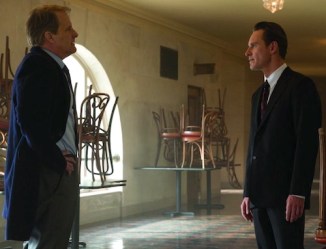 The dialogue they’re delivering is so Sorkin. Rearrange character names and you could drop this into The West Wing or The Newsroom without batting an eyelid. That’s not to say Sorkin’s writing is samey, but he has a very specific style. I guess if you don’t like it then it must make his works a chore, but if you do, it can help elevate things that are in other ways wobbly (by which I mean swathes of The Newsroom, not Steve Jobs). It requires a cast that are up to the task, too, and he certainly has that here. Fassbender is the obvious stand-out, and Winslet is too often overshadowed by her variable accent, but even Rogen holds his own against the heavyweights around him. Daniels and Waterston may seem to have comparatively small roles, but they help carry much of the true dramatic weight opposite Fassbender.
It did cross my mind that perhaps I liked the film more than average because I’m a little bit of an Apple fan. I mean, I’m not a proper hardcore Apple fanboy, although my household does have in regular usage an iMac, a Macbook Air, an iPhone, two iPads, and two iPods… but the iPads are hand-me-downs, and I discarded a similarly-acquired Apple TV in favour of an Amazon Fire stick, and I certainly don’t upgrade that iPhone every year (in the device’s entire lifespan I’ve owned two). My point is: yes, I like Apple stuff, but I concluded that had no bearing on my opinion of the film. It’s not good because it’s about The God Of Apple or something; it’s good because the people who made it made a good film. It could be about Jeeve Sobs, co-founder of Banana and inventor of the Banana Wellington and the iWelly, and it would be… well, it would be silly if it used those names, but hopefully you get my point.
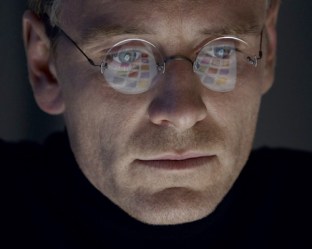 In a similar vein, I suspect it would make a great companion piece to The Social Network. I guess that’s an obvious point — they’re both biographical dramas written by Aaron Sorkin about tech geniuses with social problems who end up in legal disputes with former friends about their companies — but sometimes obvious companion pieces are obvious for a reason. What deeper things do they say about each other, or the wider world, especially our modern tech-obsessed age, when paired up? I don’t know; watch them back to back and find out.
Steve Jobs may fit the Sorkin template of “people stood in rooms and walking down corridors talking to each other very quickly and cleverly”, but when he’s firing on all cylinders it doesn’t matter that you can pigeonhole it if you must. Besides, with Danny Boyle’s hand on the directorial tiller and a quality cast to bring out the dramatic arcs between the posturing, the whole may not have added up to box office gold, but it is worth even more than the considerable sum of its parts.
Steve Jobs premieres on Sky Cinema tonight and is available on demand now.
It placed 3rd on my list of The 20 Best Films I Saw For the First Time in 2016, which can be read in full here.

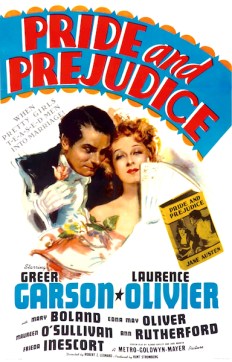 The first adaptation of Jane Austen’s ever-popular novel, MGM’s film is a compromised endeavour: by executives softening dialogue and rewriting characters; by changing its setting to permit grander costumes; by Gone with the Wind using all the Technicolor stock, forcing the lavish production to shoot in black-and-white.
 The third English-language screen adaptation of Agatha Christie’s famed mystery, one of the best-selling novels of all time, relocates the action to the middle of a desert but is otherwise a word-for-word remake of
 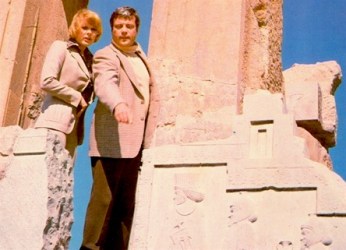 As a précis of the storyline, with some nicely photographed locations (the Iranian hotel they filmed in looks fairly stunning), this isn’t half bad. However, there are at least two better screen adaptations of the novel, and if what I’ve heard of

 In this lesser sequel to
 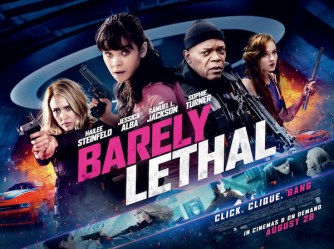 Hailee Steinfeld stars as a teenage girl raised from childhood by a top-secret government organisation to be an expert agent, but who has always longed for a more normal experience. When the organisation thinks she’s died on a mission, she uses it as a chance to have that normal life. Researching the high school experience from teen movies, she heads off to a typical US high school… and finds life isn’t quite like the movies. Though it is a bit, but it’s allowed to be so long as you keep referencing the movies you’re riffing off… right? Oh, and of course her old life keeps intruding, in the form of people wanting to kill her ‘n’ all that.
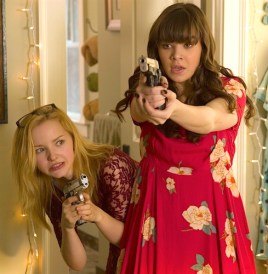 then I think there’s a fair chance you’d find it to be a frequently amusing, occasionally very funny, and sometimes quite sweet high school comedy — with added doses of action comedy for good measure. There’s even one great scene (which is more than many a “very good” film can claim); the kind of scene that, when it happens, is so right it feels like kind of an obvious idea, but I’ve never seen it done before (it kinda requires a premise like this to even work) and is pretty faultlessly executed.
 1960 Academy Awards
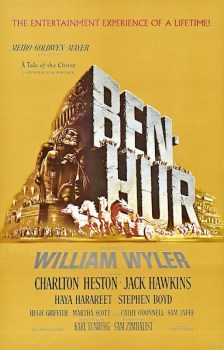 So claims Ben-Hur’s 1961 trailer. They were cocky back then, weren’t they?
 but was so invested that I stuck with it regardless. There are things that have aged poorly, be that the model effects in the sea battle or using a white actor in heavy make-up to portray an Arab, but I think you have to take these things with a certain element of the spirit of the era — I’m sure no offence was intended (see also:
 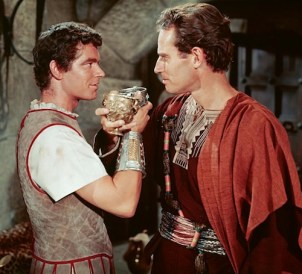 This Christian aspect contrasts sharply with the other subtext I alluded to earlier: the possibility that Judah and Messala were once lovers. The claim originates with screenwriter Gore Vidal, who may or may not have written some or all of the screenplay that was used for shooting. According to Vidal, he and Stephen Boyd discussed the idea before shooting began, and then Boyd played the scenes with it in mind. However, it was kept hidden from Charlton Heston because he’d never agree to it, and when the notion was put to him later he naturally denied there was any homosexual subtext. Whether this tale is true in the literal sense of that subtext being written into the screenplay and Boyd choosing to incorporate it into his performance, I don’t know, but the content of the film makes it easy to believe — the scenes between Messala and Judah, especially when they’re first reunited, absolutely play like there’s a romantic history between them. Bear that in mind and it seems to reoccur later, too: when the story returns to Jerusalem after several years, Messala seems particularly close to his deputy; and there are a couple of shots of Judah being chummy towards a random stableboy (I mean, they’re not much, but if you watch it with the assumption that Judah is gay or bi…) What does this signify? Perhaps not a great deal. I’m sure you can choose to completely ignore it. I imagine some would passionately deny even the possibility it’s there. Personally, I think it adds something to the characters’ relationship.
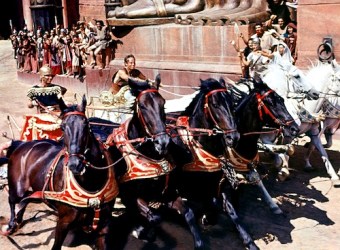 the technical awards the film scooped up are certainly merited. The cinematography is fantastic, with the landscape shots making particularly excellent use of the extra-wide frame. As for the chariot race, it stands up as an incredible action sequence even today, driven by thrilling camerawork and editing, and showcasing some daring stunt work.
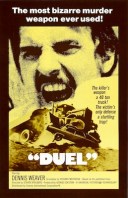


 Favourite Film of the Month




























 15 years before flop comedy
 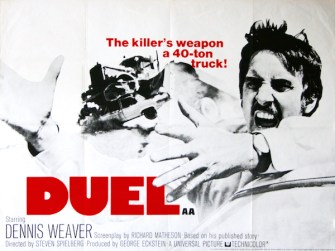 As far as Americans are concerned, Steven Spielberg’s debut feature film was
  (the one time he disembarks from his cab, we only see his boots as he paces on the far side of his vehicle). Never revealing the trucker’s face was Matheson’s idea, but Spielberg leapt on it wholeheartedly, because the scariest monsters are the ones you never see. Couple that with a specially-chosen truck (of the seven Spielberg ‘auditioned’, it was the one whose front most resembled a face) and you have a genuinely threatening presence.
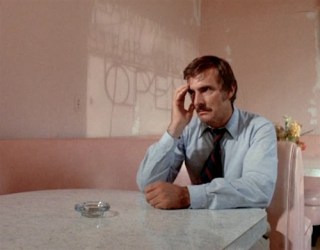 Weaver is excellent, plausibly charting a course from bland normality to apologetic paranoia, on to hopeless despair, ending in desperate lunacy. At one point he pauses at a roadside cafe to get a breather, but has reason to suspect one of his fellow patrons is his tormenter. As he tries to subtly surveil them, attempting to figure out what he can do to defuse the situation, Mann’s thoughts are narrated on the soundtrack; but we barely need it, because Weaver physically conveys all of his uncertainty, his fear, his wannabe-bravado. Sequences like this also demonstrate how Spielberg was already a master of camerawork and editing, guiding us as to where Mann is looking, shifting angles high and low, the constant changes in perspective not disorientating our sense of space but nonetheless keeping it off kilter.
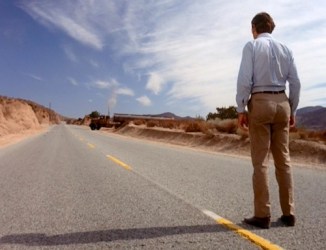 Speaking of which, why has no one ever done a “TV work of Steven Spielberg” box set? There’s a short featurette on the Duel DVD (and Blu-ray) about the other TV productions he directed, and while I’m sure it can’t be his greatest work, he’s clearly not totally ashamed of it, and the clips shown suggest it’d be worth a watch. For one thing, being able to see the original TV edit of Duel would be interesting, for two reasons. First, it would solve the aspect ratio dilemma. The DVD is presented in 4:3, as it was originally shot for TV, even though it’s the movie cut. The more recent Blu-ray follows the cinematic framing of 1.85:1; however, it’s not just cropped and it’s not just widened: when they reviewed the footage to create the movie version, Spielberg discovered he could see himself sat in the back seat giving direction — so the final print is both widened slightly and cropped slightly. I guess which is ‘right’ is now a matter of personal preference, though the Blu-ray undoubtedly looks tonnes better in every other respect.
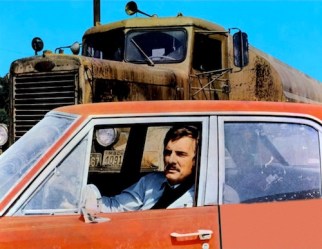 Nitpicks and “what if”s aside, Duel is a fantastic calling card from a director who has gone on to become arguably the most significant and influential filmmaker of the ensuing 45 years. To say it stands in contention to still be regarded among his finest films does no disservice to the body of work he’s produced since, but rather indicates just how assuredly he hit the ground running.
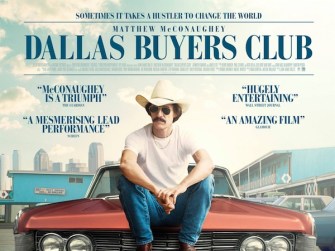 Every time I see a trailer for Dallas Buyers Club at the start of another Blu-ray I think, “that looks really good; I should watch it”. Then every time I get near watching it I think, “that sounds quite worthy and/or grim; maybe not right now”. So I guess kudos is due to Amazon UK for removing it from Prime Video
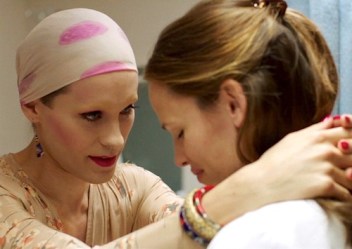 That’s just some of what’s going on, anyway, because there’s also Ron’s growing acceptance of the community he finds himself a part of, especially after he’s ostracised from his former friends who assume he’s gay; there’s his business partner, trans woman Rayon (an also-Oscar-winning Jared Leto), who has drugs and familial problems of her own; and the doctor (Jennifer Garner) who battles her conscience over the drug trials and Ron’s less-than-scientific but effective methods. If this makes Dallas Buyers Club sound unfocused, it’s more that it’s got a lot of different aspects to examine. It’s not just about narrating what really happened, either, because Leto and Garner’s characters are fictional.
 McConaughey is very good as Ron, though I’d wager he won the Oscar as much for his extreme weight loss as his actual acting. He was up the same year as Chiwetel Ejiofor for
 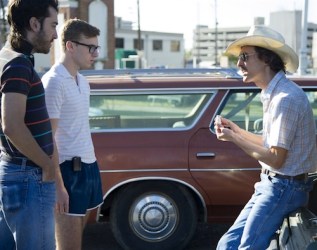 For all the heaviness of the topics it touches on, the film isn’t without the humour that made its trailer so attractive. That said, if you’ve seen the trailer you’ve seen most of that material, and in a more condensed and highlighted form, too. It almost makes it look like a heist movie — how this clever chappy pulled the wool over the authorities’ eyes with his vicar costumes and amusing way of filling out forms — but that’s just a small part of the film; and, actually, those tricks often go wrong or flat out don’t work, which is not the heist movie way.
  100Films.co.uk