
Tomm Moore | 94 mins | Blu-ray | 1.85:1 | Ireland, Denmark, Belgium, Luxembourg & France / English | PG / PG
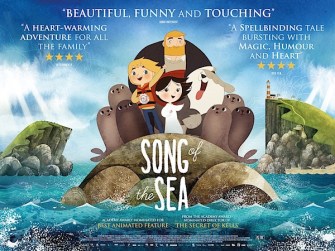 The second feature from director Tomm Moore and his pan-European team of animators (after the excellent, Oscar-nominated The Secret of Kells) sees ten-year-old Ben (voiced by Moone Boy’s David Rawle) growing up in a lighthouse off the coast of Ireland, with just his dad (Brendan Gleeson), his dog and best friend Cú, and his mute little sister Saoirse, after their mother disappeared on the night Saoirse was born. When Saoirse discovers a coat that turns her into a seal (as you do — this doesn’t come as out-of-the-blue in the film as I’ve made it here) and she washes up on the beach, their visiting grandmother (Fionnula Flanagan) insists she takes the kids to Dublin for a better life. Less than impressed at having to desert his father, his home, and most especially his dog, Ben escapes and, with Saoirse in tow, sets off to find his way home. However, it soon becomes apparent that Saoirse’s new-found transformative skills are of greater importance, and the survival of the entirety of Irish folkloric creatures depends on her getting home in time. Unfortunately, the witch Macha and her owl minions have other ideas…
There are quite a few different elements in the mix with Song of the Sea, as you can probably tell from that overlong plot description. On the surface, it’s an adventure story, as Ben and Saoirse — soon joined by Cú, too — trek across Ireland encountering various creatures and obstacles. It’s also a fantasy, thanks to said creatures, reconfiguring folk legends into a modern context where they exist on the periphery of the world, visible if only people would look. That’s one subtext. Other prominent ones include issues of grief and family: Ben has a realistically fractious sibling relationship with his sister, 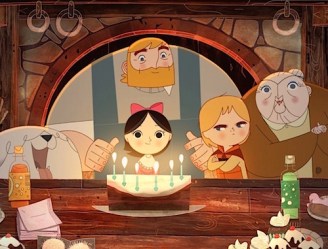 but the motivator for that is clearly resentment towards her for appearing the night his beloved mother left. Their father, too, is hamstrung by his grief, struggling to move on from his wife’s disappearance and fully engage with the world. His kids are his only connection, Saoirse in particular, but his mother makes him realise that clinging to them is damaging their lives too… or is it?
This depth of emotion and, if you like, thematic consideration probably marks Song of the Sea out over The Secret of Kells in some respects. Certainly, there seems to be a broad understanding that this is the better film, if only by a half-step; a more mature, complex work. I’ll be the dissenting voice, though, because while I did like Song of the Sea, I didn’t think it was as strong an overall experience as Kells. The problem perhaps lies in its episodic structure, which pings us from encounter to encounter. They’re connected but also self-contained, and at times it feels like there’s another one before we can get to the climax. For me, a bit of added speed would have helped things: kicking into gear faster (the first act goes on a little too long), trimming back each episode; overall, managing to speed the film up by maybe ten minutes would be to its benefit.
Maybe I’m wrong, though. There’s nothing specific that needs to be lost, no one scene that drags, just a sense that things could get a wriggle on. Perhaps in this respect the film would better reward repeated viewings? The realistic, thoughtful depiction of the main characters; the well-imagined, history-dense world; the weighty themes that are handled with a gentle touch —  all are factors that can, and do, elevate the film. Don’t get me wrong: this is a cut above your average animated adventure. I just didn’t enjoy it as much as The Secret of Kells.
Talking of thematic depth, however, this interview with Moore from The Telegraph is a must-read. To pull a particular highlight:
Moore wanted to stay true to the melancholic selkie myths. In the end, a series of test-screenings with his primary schoolteacher wife’s class helped him find the sweet spot.
“Those kids are way more intelligent than adult audiences,” he explains. The notes that older viewers gave him, he says, all tried to pinpoint flaws in the film’s dream logic: “They thought they could outwit the story, rather than go along with it.”
Moore’s young test audience, on the other hand, was more concerned with the relationships, and as a result of their feedback – they thought an exchange in which Ben tells his sister he hates her overstepped the mark, for instance – he dialled certain scenes down a bit. That’s a preteen audience asking for more subtlety.
Lesson: we train viewers to be less-intelligent film-viewing adults with dumbed-down kids’ movies. Anyway:
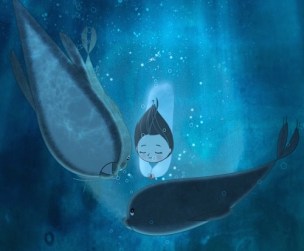
 For more positives, Song of the Sea’s animation and design is at least as strong as it was in Moore’s previous film. There’s the ‘house style’ flattened, animated storybook look; a description which could sound like criticism but absolutely is not. Some very beautiful scenes are evoked, meaning that at the very least there’s always imagery to tide you over. I’d list some favourites, but we’d be talking about most of the film. That said, the depiction of a run-down, smoggy Dublin stands out as something different from the countryside idylls of Kells and the rest of the locales in Song of the Sea, but it’s not exactly “beautiful”. Rather, look to the island home of our heroes, a tall rock surrounded by the blue sea; the home of the glowing-eyed long-haired Seanachai (the moment when it suddenly turns around in the montage after Saoirse uses her coat for the first time is my favourite shot in the film, a little sliver of fantasy imagery that magnificently teases what’s to come); or the small sanctuary surrounded by a field of stinging nettles — again, a kind of gentle, on-the-edge-of-the-real-world fantasy that quite appeals to me. The fact the countryside is littered with half-hidden stone figures, which we know to be frozen magical begins, is another nice touch; especially as they’re often surrounded by human litter, the analogy (as I see it) being both that people exist around them but don’t even see them, and also that, presumably through our modern disbelief, we’ve thrown these legends out with our trash.
 Even as I write, I’m talking myself round to liking Song of the Sea even more than I did on first viewing — and that was quite a lot, albeit coloured by my perception that I didn’t like it as much as The Secret of Kells. If you enjoyed Moore’s earlier film, this unquestionably merits seeking out (if you haven’t already, of course; I mean, I did). If you haven’t seen Kells, well, you’ve so far missed a treat; and now you’re missing two.

Song of the Sea is in UK cinemas from today.
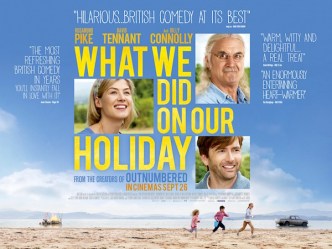 “
“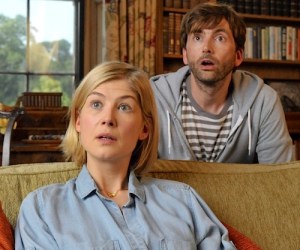 For some, the shift may scupper things. For me, it only makes it better: the story’s pathos and emotion are brought into focus, and the humour becomes all the funnier for punching in as tonal relief. It often seems to me that movies struggle to stay amusing for a full feature running time (there’s surely a reason all TV comedy comes in 30 minute chunks), but this story allows Hamilton and Jenkin to spread the laughs out a little without them feeling few or far between.
 including the likes of Ben Miller, Amelia Bullmore (getting the best subplot), Annette Crosbie and Celia Imrie. The real grown-up star, however, is Connolly. You get the sense he’s as scriptless as the kids are, improvising away with a mischievous twinkle in his eye, like some kind of idealised fun granddad. The scenes with just him and the kids are certainly one of the highlights, among the most amusing and the most affecting.
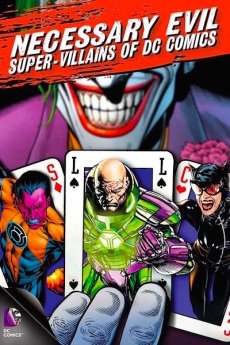 Christopher Lee narrates as a bunch of talking heads (writers, actors, psychologists) discuss the titular. The topics are quite universal — the psychological underpinnings apply not just to DC, not even just to comics, but to all fiction. Side effect: DC’s villains don’t always look so special.
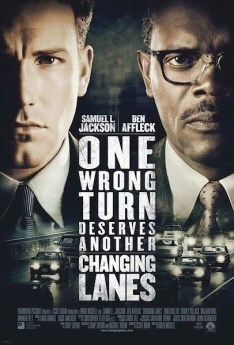 Hot-shot lawyer Ben Affleck and down-on-his-luck Samuel L. Jackson are involved in what Americans like to assonantly call a fender bender, making the latter miss a custody hearing and the former lose an important document worth millions… which Jackson happens to pick up. Cue a game of tit-for-tat retaliation, as Affleck tries to recover the file by ruining Jackson’s life further, and an increasingly-desperate Jackson enacts increasingly-violent revenge.
 I don’t know why they bothered). The worst offender is David Arnold’s score — all turn-of-the-millennium club-y electronic-drum-kit-y beats, for a character-driven drama/thriller? Ugh.
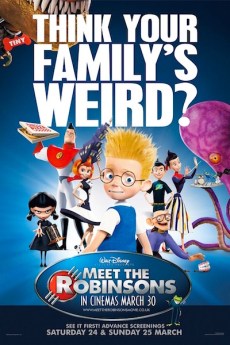 Disney’s 47th Animated Classic comes from their weak ’00s period, after the end of the so-called Renaissance and before what’s apparently been dubbed the neo-Renaissance (presumably no one could think of a synonym). This hails from the tail end of that lamentable era, though, so there are signs of recovery: Meet the Robinsons isn’t bad, just mediocre.
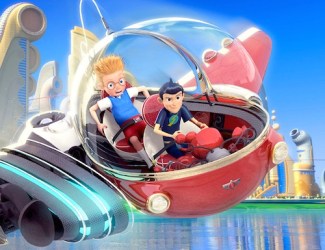 The time travel element of the plot is weakly thought-through. It’s not the point of the film, which is more about family ‘n’ stuff, but it’s central enough that it robs the already-underpowered climax of much weight — you’re too busy thinking “wait, does that make sense?” to be invested in events. Finally, the animation style has aged badly, now looking plain and under-detailed.
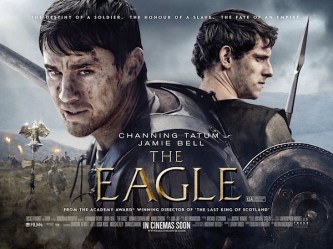 Channing Tatum is a brave Roman general whose father lost his company’s standard, the titular eagle, north of Hadrian’s Wall (a real historic event, coincidentally depicted in
 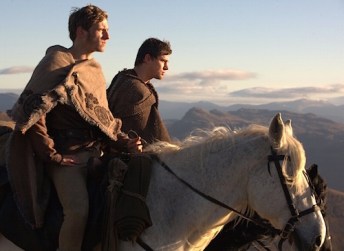 quality to the setting, characters, and imagery that’s quite striking.
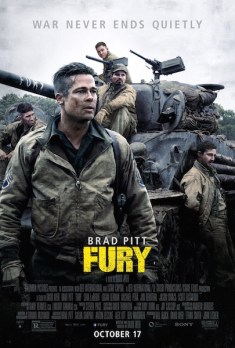 I don’t believe there are very many movies about tanks — there’s
 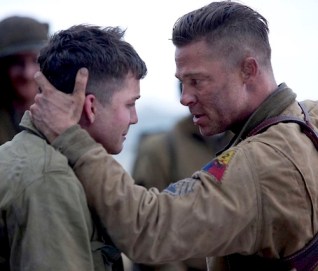 Most of the characters exist in a moral grey area, something which some reviewers seem to struggle with. From the off, our ostensible heroes are not shown in a particularly pleasant light, committing or encouraging acts we would view as unconscionable. As the film goes on, it seems like we’re being invited to bond with them, to respect or admire them. I’m not sure that’s a wholly accurate reading of it, though. I think we’re being shown different sides to them — much as Norman is, in fact. At first you see the depths they have reached; then, as you get to know them, you see a little more of their true (or at least their pre-corrupted-by-war) characters. Does this redeem them or excuse their actions? Well, that’s your decision. I don’t think the film is predicated on you coming round to their way of thinking. Without meaning to spoil anything, it’s not as if the meta/karmic world of plot construction lets them off scot-free by the end. Of course, whether we need our focus characters to be clean-cut heroes or whether complex morally-grey/black characters are preferable is another debate.
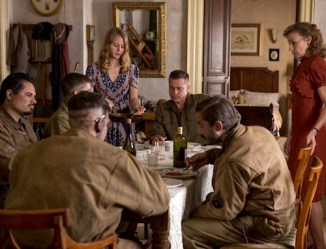 This is a scene most reviews seem to single out, I’ve since realised, but that’s for good reason: even watching it cold, the powerful writing, direction and performances mark it out as a sequence that transcends the movie it’s in. Again, it’s the unpredictability of what these men might do; the grey area of the guys we’re meant to think are the heroes not always being heroic.
 I think Fury is a rather rewarding movie for those that can, though. The fact it provokes debate is no bad thing — I think it’s a misinterpretation to read the film, as some online commenters clearly have, as “these guys do horrible things, but they’re the main characters and the not-Nazis, so I must be meant to like them, so the film is bad”. Well, I suppose it’s not news that some people struggle with cognitive dissonance. On the flipside, I don’t think you’re meant to outright hate them — there’s an element of “the Allies did bad things too, y’know” about the film, but that’s not its sole aim. I think it’s more complicated than that, and, naturally, all the better for it. Even on a more surface level, though, there’s adrenaline-pumping excitement to be had from the well-realised action scenes. It’s a combination that worked very well indeed for me, and if my score errs on the side of generosity then, well, consider it redressing the balance.



 #75 Changing Lanes (2002)
 #83 Rush (2013)



 So named because what I watch in any given month is pretty arbitrary, so the pool of contenders is a total whim rather than a genuine competition. Plus, each month two of the five categories are going to be arbitrarily chosen, just to compound the point. You’ll get the idea as we go along.


























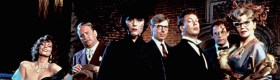






















 Diddly-dum diddly-dum diddly-dum ooo-weee-ooo… For generations of British children, that’s the sound of Saturday night adventure. I guess to some people it’s just a children’s TV theme, but they’re wrong: it was a genuinely pioneering, important example of burgeoning electronic music (
 Dooo-dooo dododo-dooodo dododo-dooodo dododo-doo… You could probably fill this list twice over with John Williams compositions — Indiana Jones, Jaws, Superman, Jurassic Park, more recently Hedwig’s Theme from Harry Potter, and so on — but undoubtedly the most iconic of them all is his
 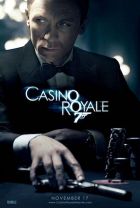 Dang da-dang-dang da-da-da dang da-dangdang da-da-da daa-daa da-da-daa… A 53-year-old surf rock tune should by all rights be horribly dated, but I guess true cool endures. While the version used in the films has barely changed, there are an abundance of variations for trailers, etc. My personal favourite is
  Dooo-dooo dododooo, do-do-doo do-do-doo do-do-doo do do doo… The only one here that isn’t a title theme, but it’s indelibly part of the Lord of the Rings franchise — it has no reason to appear in The Hobbit trilogy, but I spent most of those eight hours missing it. It reoccurs throughout the trilogy (of course it does), but perhaps the purest version can be found in
 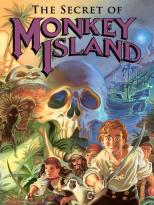 Doo-doo dodododo-doo do-do-do-doo… I’m certain this will be less familiar than any of the above to most people but, honestly, to me (and, I think, many other people who played the LucasArts games) it’s as iconic as anything else I’ve mentioned, including all of those other John Williams ones. The original was rendered in the style of its era — a digital MIDI thing — but it endured throughout the series and was transformed into some lusher orchestral versions. Try
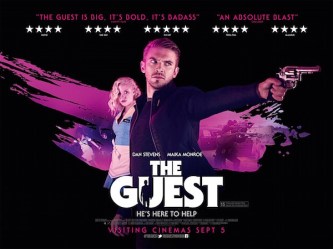 The writing-directing team behind
  The days of chubby Matthew Crawley long since banished, a buff Dan Stevens (there’s a reason his topless scene was also all over the marketing) is entirely convincing as the seemingly-nice-but-possibly-creepy army man who inveigles his way into the Petersons’ lives with pure charm before gradually revealing, both to them and (especially) us, that there’s a lot more to him than a nice guy who happened to kill people in the Middle East. For my money, he’s the best anti-hero in a long time. Occasional flashes of dry humour — a line here, a look there — make him likeable to the audience, more than the charm that persuades the other characters does, so that by the final act we’re still pretty much on his side, whatever else happens.
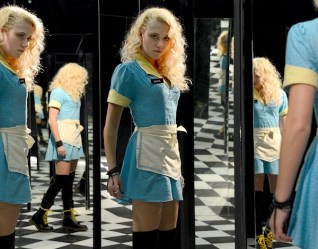 but I know I’m not the only reviewer to feel it. Wingard evokes that era and the feel of those movies, without slipping into parody and without merely ripping-off familiar flicks. I think this especially comes to the fore in the final act — it’s arguably even most distilled in the very final scene — but, again, it’s a feeling, a sensation, a familiarity, not a blatant, I dunno, “look, now we’re in the ’80s!”-ness.
 Not everyone loves it — some people outright hate it, even. I suppose it’s a little bit idiosyncratic, in a similar way to something like
 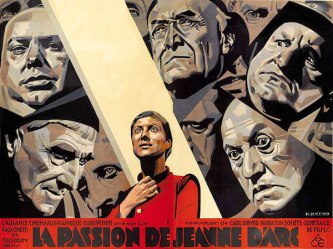 Widely regarded as one of the greatest movies of all time (look at
  Dreyer based his telling on the written records of Joan’s trial. Although that’s grand for claims of historical accuracy, it’s hard to deny that silent cinema is ill-suited to thoroughly portraying something dialogue-heavy. There are many things silent film can — and, in this case, does — do very well indeed, but representing extensive verbal debate isn’t one of them. Bits where the judges argue amongst themselves — in silence, as far as the viewer is concerned — leave you longing to know what it is they’re so het up about. Sometimes it becomes clear from how events transpire; other times, not so much.
 neutral costumes on sparsely-decorated sets, and are almost entirely shot in close-ups — all elements that avoid the usual grandiosity of historical movies, both in the silent era and since. What we perceive as being ‘grand’ changes over time (things that were once “epic” can become small scale in the face of increasing budgets, for instance); pure simplicity, however, does not age much.
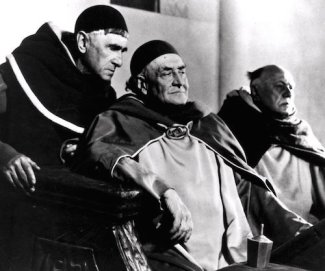 The actors playing the judges may be less individually memorable than Joan, but it’s their conflict — the personal battle between Joan and these men, as Dreyer saw it — that drives the film. Dreyer believed the judges felt genuine sympathy for Joan; that they did what they did not because of politics (they represented England, and she had led several successful campaigns against the Brits) but because of their devout belief in religious dogma. Dreyer says he tried to show this in the film, though it strikes me the judges still aren’t portrayed too kindly: they regularly seem contemptuous of Joan, and are outright duplicitous at times. Maybe that’s just religion for you.
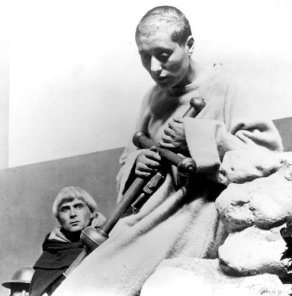 however, so I have no opinion. Instead, they offer two alternatives. On the correct-speed 20fps version, there’s a piano score by silent film composer Mie Yanashita. Apparently this is the only existing score set to 20fps, and Masters of Cinema spent so much restoring the picture that there was no money left to commission an original score. Personally, I don’t think they needed to. Yanashita’s is classically styled, which works best for the style of the film, and it heightens the mood of some sequences without being overly intrusive, by and large. Compared to Dreyer’s preferred viewing method, of course it affects the viewing experience — how could it not, when it marks out scenes (with pauses or a change of tone) and emphasises the feel of sequences (with changes in tempo, for instance). That’s what film music is for, really, so obviously that’s what it does. Would the film be purer in silence? Maybe. Better? That’s a matter of taste. This particular score is very good, though.
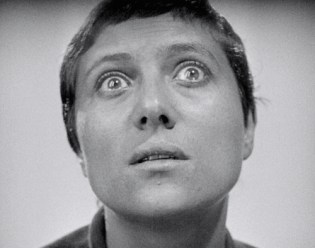 Some viewers describe how they’ve found The Passion of Joan of Arc to be moving, affecting, or life-changing on a par with a religious experience. I wouldn’t go that far, but then I’m not religious so perhaps not so easily swayed. As a dramatic, emotional, film-viewing experience, however, it is highly effective. As Dreyer wrote in 1950, “my film on Joan of Arc has incorrectly been called an avant-garde film, and it absolutely is not. It is not a film just for theoreticians of film, but a film of general interest for everyone and with a message for every open-minded human being.” A feat of visual storytelling unique to cinema, it struck me as an incredible movie, surprisingly accessible, and, nearly 90 years after it was made, timeless.
 100Films.co.uk