I hope you’ve got time for a long read (I know you do — you’re stuck at home too, right?) because there’s a tonne of stuff to witter about in this month’s update.
So, settle down with some of the stuff you’ve stockpiled (well, okay, you shouldn’t really need pasta or loo roll to get through this post… I hope…) and while away your isolation with my self-centred lists and stats.

#31 The Karate Kid Part II (1986)
#32 Won’t You Be My Neighbor? (2018)
#33 The LEGO Movie 2: The Second Part 3D (2019)
#34 Harakiri (1962), aka Seppuku
#35 Showman: The Life of John Nathan-Turner (2019)
#36 Judgment at Nuremberg (1961)
#37 The Invisible Guest (2016), aka Contratiempo
#38 Godzilla: King of the Monsters 3D (2019)
#39 Hustlers (2019)
#40 Fast & Furious: Hobbs & Shaw (2019)
#41 Last Chance Harvey (2008)
#42 Red Joan (2018)
#43 Late Night (2019)
#44 Quartet (2012)
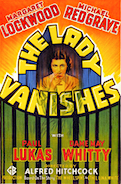
#45 The Lady Vanishes (1938)
#46 Ice Age: Dawn of the Dinosaurs 3D (2009)
#47 The Platform (2019), aka El hoyo
#48 The Battle of Algiers (1966), aka La battaglia di Algeri
#49 Spider-Man: Far from Home 3D (2019)
#49a Peter’s To-Do List (2019)
#50 The Mad Magician 3D (1954)
#50a Spooks! 3D (1953)
#50b Pardon My Backfire 3D (1953)
#51 A Man for All Seasons (1966)
#52 The Viking Queen (1967)
#53 Aladdin 3D (2019)
#54 One Cut of the Dead, aka Kamera wo tomeruna! (2017)
#55 Knives Out (2019)
#56 The Breakfast Club (1985)
#57 So Dark the Night (1946)
#58 Missing Link (2019)
.

- I watched 28 new feature films in March. Boy, does that give me a lot to talk about…
So, let’s break it up a bit. First, some stats…
- That’s my biggest month since July 2018, which also had 28 films. They’re now tied as my 4th best months ever.
- Talking of all-time numbers, it’s my best March ever, with a total that’s double the month’s previous average of 14.4. In fact, it single-handedly pulls that average up by over one whole film, to 15.5.
- Talking of averages, it also surpasses and increases both my rolling average of the last 12 months (previously 12.75, now 13.3) and my average for 2020 to date (previously 15.0, now 19.3).
- Talking of numbers that are almost 20, it’s my 20th month ever to have 20+ films, and my first 20+ month since last May.
- Talking of months with 20+ films, March is the month where I have the greatest consistency at reaching a total of 20+. I’ve done it every year since 2016 — that’s five years in a row now. It means March makes up fully 25% of all months with 20+ films. For comparison, there’s no other month where I’ve done it for more than two years in a row.
- Another milestone: I reached (and passed) #50, i.e. halfway. Except I’m aiming for at least 120 nowadays, so halfway is another couple of films away yet.
- Nonetheless, this is the second-furthest I’ve ever reached by the end of March, just ahead of #57 in 2018, but reasonably far behind 2016’s #67. What does this tell us about how the rest of the year might pan out? Bugger all. In 2018 I ended up reaching #261, whereas in 2016 I ‘only’ got to #195. And for another point of reference, March 2015 ended at #44, over 20 behind 2016, but ended the year five ahead, at #200. So, y’know, it’s all meaningless.
- I also had a really good month for my Rewatchathon (see further down this post for more about that). I really should go back and produce a full set of numbers for every month so I can include that in comparisons too…
Talking of my Rewatchathon, what of my other viewing challenges…
- This month’s Blindspot films: influential guerrilla war movie The Battle of Algiers; plus, I watched the first of what I’m calling my ‘overflow’ films (unseen leftovers from previous Blindspot challenges), seminal ’80s teen comedy The Breakfast Club. Also Harakiri, which merited a mention in my Blindspot post this year about why it wasn’t included (I’d forgotten about that when I randomly chose to watch it anyway!)
- From last month’s “failures” I watched Fast & Furious: Hobbs & Shaw, Hustlers, The Karate Kid Part II, and Late Night.
Finally, some observations about the other films…
- It’s fundamentally meaningless, but this month I watched my first feature films of the years whose titles begin with nine letters of the alphabet: F, G, H, I, K, O, Q, V, and W. That’s 35% of the alphabet covered in one month — only slightly more than the seven / 27% in January and eight / 31% in February, but then this task gets harder as the year goes on (January has a massive advantage, for hopefully-obvious reasons, whereas the most any of the remaining nine months would now be able to manage is two / 8%).
- Another first: The Viking Queen was the first film I’ve watched on DVD this year.
- Talking of DVDs, I watched Judgment at Nuremberg on the BFI’s recent Blu-ray release, which I bought even though I’d only bought the DVD a little while ago. Well, when I fished out that DVD to put on my “to sell” pile, I found it still had the dispatch receipt inside, which showed I bought it in… 2010. A whole decade ago! Sometimes I worry about my sense of the passage of time…
- As you can tell (as if you didn’t already know), picture quality is important to me. So I could probably write an entire post about the weirdness I’ve been experiencing with Netflix’s PQ of late. I started streaming The Platform, but after it maintained a speed of just 0.57 Mbps — and looked terrible because of it — I gave up and, er, sourced it elsewhere. I’ve tried it again several times since, at different times of the day and night, and it’s always 0.57 Mbps. The same thing happened with Missing Link, although that was 1.21 Mbps so was somewhat more watchable (I still went and got a better copy from somewhere else, though). That led me to try about a dozen more titles, all of which came through at completely different rates, some reasonable, some not. It doesn’t seem to be connected to them needing different amounts of data or needing some time to get up to speed, either — it appears to be totally random. And it doesn’t seem to waver. I had decided to just cancel my Netflix subscription until all this is over (because I presume it’s connected to the speed-limiting they’re reported to be doing in Europe) — after all, it’s not as if I don’t have enough else to watch… but there’s loads of stuff I really do want to see on Netflix, and some of it is still streaming at a reasonable quality. So, I’m undecided.
- As you can tell from the lack of blue text in the listing above, I haven’t reviewed a single film from this month’s viewing. I thought this might be the first time that’s happened, so I trawled back through all 118 monthly updates to check, and I can confirm… it’s not. In fact, it last happened less than a year ago, in July 2019. You have to go back over five more years, to May 2014, to find the time it happened previous to that; but it happened once in 2013 and three times in 2012, too. So, yeah, not really news.
- I feel like the only person in the world who hasn’t (re)watched Contagion this month. If you’re interested, my quickie review from when I did watch it is here.
 The 58th Monthly Arbitrary Awards
 Favourite Film of the Month
I saw quite a few great films this month, and usually that would make this choice very hard, but I fell head over heels for Alfred Hitchcock’s The Lady Vanishes. I don’t think it comes up too often as one of his very best, but it’s definitely one of my favourites from his whole filmography.
Least Favourite Film of the Month
I know it’s an acclaimed classic, but the film I least enjoyed actually watching this month was The Battle of Algiers.
Best 3D of the Month
I watched six new feature films and two shorts in 3D this month (plus four more features in the Rewatchathon), which I expect is a personal best. Setting aside the quality of the film itself, the one with the very best 3D was The Mad Magician. It’s in black & white, which was a bit weird at first (not sure I’ve ever seen a black & white film in 3D before), but because it’s from the ’50s it was actually shot in 3D, not post-converted, and while post-conversions are often very good nowadays, there’s so much extra subtle detail you get when something’s been shot in stereo for real.
Best Twist of the Month
Who doesn’t enjoy a twist? Filmmakers certainly do, and so they abound this month — even The LEGO Movie 2 has one (kinda). Prime examples include Harakiri (which keeps you on your toes with constantly shifting information), Knives Out (which has more up its sleeve than simply whodunnit), and So Dark the Night (that is a whodunnit, but if you watch it, try to read as little as possible first). But the winner this month is The Invisible Guest, because it managed to get almost as far as the reveal before I guessed what was really going on, in part by peppering plenty of about-turns along the way. Nicely done.
The Audience Award for Most-Viewed New Post of the Month
It’s a long-standing observations that TV-related posts do well in this category, especially when they’re given plenty of time to amass hits. So, as I posted my 56th TV column way back on the 8th, it’s no surprise to see it win out easily. (The highest film post was The Lion King.)


As I mentioned in this month’s viewing notes, I didn’t rewatch Contagion; but that aside, my Rewatchathon is going rather well this year, racing ahead of target. Mainly, I’ve been revisiting in 3D films I’d previously only seen in 2D.
#9 The LEGO Movie 3D (2014)
#10 The Lion King 3D (2019)
#11 Godzilla 3D (2014)
#12 Sherlock Holmes and the Secret Weapon (1942)
#13 Sherlock Holmes in Washington (1943)
#14 Mission: Impossible – Fallout 3D (2018)
Starting with the 3D, then, that Fallout link takes you to my full review of it in 3D, so no need to repeat myself. My Lion King review isn’t expressly about the 3D, but, as I do discuss in the review, I was impressed by it, and it led me to even enjoy the film a little more. As with most computer animated films, The LEGO Movie looks awesome in 3D. Indeed, the skilful way the filmmakers emulated the scale of LEGO is only emphasised by the use of depth here. Despite the fact I already owned the (2D-only) Special Special Edition, I bought another copy in 3D on the strength of the 3D presentations of the LEGO Batman and Ninjago movies, and I wasn’t disappointed. (Now I just ought to watch some of the SSE-exclusive bonus features to justify that purchase…)
Godzilla’s 3D didn’t generate much comment from me, which is a shame because you’d think the scale would lend itself. It’s not bad, just not special. The film itself is not perfect either, but it’s a darn sight better than most people give it credit for. One thing that’s often criticised is how sparingly Godzilla is actually in it, but I think writer-director Gareth Edwards paced it just right — when the big guy finally turns up, it’s an electric moment.
I totally forgot that I’d randomly rewatched Sherlock Holmes and the Secret Weapon in December 2017, but colourised. This time was the original black & white version, as part of my rewatch of the whole Basil Rathbone Sherlock Holmes series on Blu-ray. I more or less stand by my original review, which I also stood by in 2017 (though I’m back to being less keen on Lionel Atwill’s Moriarty again), so I guess my opinion on this one is fairly certain. However, I liked Sherlock Holmes in Washington more than I’d remembered; though my original review (linked above, obv) isn’t that damning, so clearly its poorness had self-inflated in my memory. That said, I do still think it’s one of the series’ weakest outings.

I normally begin this section by looking at the stuff I failed to see on the big screen last month, but, well, that’s dried up, hasn’t it? However, though it may feel like Coronavirus has been denying us social experiences for, like, ever, it’s actually only been a couple of weeks — before everything went completely self-isolating-tastic, cinemas were full of Onward, Military Wives, Misbehaviour, Bloodshot, Fantasy Island, and Dark Waters. Even My Spy actually came out over here (in the US it was pushed back into Bond’s vacated release slot. Presumably they’ll be abandoning that now too).
Now, of course, you have these “direct from the cinema” rentals popping up, including Emma (which I’ve seen), The Hunt, and The Invisible Man, plus Bloodshot and Military Wives from the previous list (no Onward this side of the pond). They mostly cost £15.99 for a 48-hour rental (though Bloodshot has gone straight to £13.99 to own, suggesting they don’t expect anyone will want to). At that price, it isn’t worth it to me. For comparison, a ticket at my local cinema is £5.75 — I’m interested in seeing most of those films, but not almost-three-times-what-it-would’ve-cost-me-at-the-cinema interested. I’ll wait ’til they drop to a sensible price and/or hit disc.
Some digital rentals have drawn me in, though — the cut-price ones Amazon offer as a perk of being a Prime member. For either 99p or £1.99 a pop I’ve got Aniara, End of the Century, It: Chapter Two, Rambo: Last Blood, and Ready or Not all ticking down to expiry dates throughout April.
I have less compunction about splurging money on disc purchases. Last month I mentioned that “I got a bit carried away with Blu-ray purchases”, with 16 films on disc among my failures. This month puts that in the shade, with a ridiculous 40 films added to my Blu-ray collection (and I actually watched some new stuff I bought, so the true total acquired this month is even higher). Specific splurges include an Arrow sale (mostly noirs, like The Big Clock, Nightfall, and Phantom Lady, plus the Sister Street Fighter collection); an Indicator sale (their seven-film Samuel Fuller box set, plus A Dandy in Aspic, Footsteps in the Fog, The Legacy, and No Orchids for Miss Blandish — none of which I’d even heard of before Indicator released them, but they do make things sound so good); and a bunch of 3D discs of films I’d already seen and enjoyed to some degree (Bolt, Tangled, Pan, Journey to the Center of the Earth, and Noah, which is available from Germany in a well-reviewed 3D conversion). Talking of Germany, I also just discovered they’ve had Steven Soderbergh’s Solaris on Blu-ray for a couple of years, so I imported that too (for a very reasonable price, I must say, from Amazon UK). I also bought Criterion’s release of The Blob at an offer price from them, and Bong Joon Ho’s The Host at an offer price from HMV. While trying to fill out a different multi-buy offer I upgraded my old DVD of the X Files movie to Blu, which I knew would put me on track to upgrade the whole series eventually… and it did, just a week or two later, getting it for a good price secondhand on eBay… and then I upgraded I Want to Believe, just to complete the set. I also upgraded The League of Extraordinary Gentlemen — yeah, I know, but I actually quite liked it back in the day, and I saw this article on Twitter that swayed me. And that’s not even everything, but dear God, it’ll do.
Back to streaming, then, and the big names have been trotting out plenty of content this month, only spurred on by everyone being stuck at home right now — and by the launch of a major new competitor in Disney+. I haven’t subscribed, nor taken the free trial (yet), so I don’t really know what’s on there besides what everyone’s been talking about, i.e. a months-late release of Star Wars TV series The Mandalorian (which they’re sticking to releasing weekly, even though it’s all been out in the US — and on piracy sites — for months), and the live-action remake of Lady and the Tramp.
Over at the usual suspects, Netflix had their second back of Studio Ghibli films, which for me means Arrietty (though I own it on Blu-ray), The Cat Returns, and My Neighbours the Yamadas. I also want to rewatch Spirited Away, and as I only own it on DVD, HD on Netflix is tempting. Most of their original additions this month seemed to be TV series, although there was Mark Wahlberg in Spenser Confidential, but it was so poorly reviewed that I don’t intend to bother. From the back catalogue, they just recently added The Death of Mr Lazarescu. I remember that getting recommended a lot back when it came out. I never really knew what it was about, but the Netflix blurb begins: “Amid a pandemic”, so I can see why they’ve acquired it now.
As for Amazon, they could offer up recent stuff like The Aeronauts (one of their own, so I think it even bypassed disc), Blinded by the Light, and Midsommar. Other additions catching my eye included sci-fi drama Marjorie Prime (I heard about this somewhere only recently, but I forget the context other than it was a recommendation); The Immigrant (Marion Cotillard, Joaquin Phoenix, and Jeremy Renner in a film from the director of Ad Astra); Antiviral (a sci-fi-horror-thriller written & directed by Brandon “son of David” Cronenberg); and Intacto (a film I’d completely forgotten all about, but the poster image struck a deep memory of something that had once been highly recommended and I really wanted to see, probably right back when it first came out, 18 years ago(!) Well, now it’s on my watchlist again).
Both of those added a lot more than I’m bothering to list here, so if you’re a subscriber to either, do be sure to keep an eye on sites like New on Netflix UK or this Amazon equivalent.
Finally, I went to cancel my Now TV Sky Cinema subscription at the start of the month, but they offered me a great deal: three monthscompletely free. You can’t turn that down, can you? Even if I only watched one film on there during those three months, the cost-benefit ratio would be fine. They add a new premiere every day, plus a handful of other titles now and then, but, despite that, only a couple of newcomers were worthy of note to me: The Goonies (yep, never seen that), Her Smell (people seem to keep recommending it), Robert the Bruce (the unofficial sort-of-sequel to Braveheart), and The Secret Life of Pets 2 (the first one was alright, so why not?)
(Whew, this section is getting damn long nowadays — and that’s without the further 50 films I had on my long-list but decided not to mention. Maybe I should start doing it as a standalone post — this month it’s over 1,000 words, which is about the same length as one of my longer film reviews!)

Right now who knows what next week will bring, never mind next month? Though if things carry on as they are (and it looks like the will for a good while yet), perhaps it’ll be a record-breaking month. Or perhaps not. Who knows!





 The 13th iteration of Red Dwarf eschews the normal episodic format for a single 90-minute special, in turn ditching the expected Red Dwarf XIII moniker for a subtitle. Well, the show has form in this: for its 21st anniversary revival we got Red Dwarf: Back to Earth instead of Red Dwarf IX, which wasn’t a whole series but instead a 90-minute single story (in that case split into three half-hours, but still).
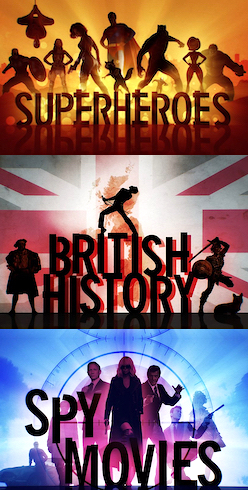 Mark Kermode’s insightful deconstruction of cinematic genres returns for a full second series (following a few occasional specials last year). I say “full” — three episodes. Whereas
  For
For 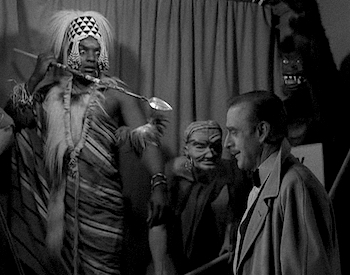 The worst episode according to Buzzfeed is The Jungle, which comes 148th overall. It’s about an American engineer who’s just returned from a trip to Africa where his company is planning to build a hydroelectric dam, and he may’ve been cursed by natives opposed to the project. As you’ve probably guessed, the episode’s biggest problem is some old-fashioned kinda-racist stereotypes about Africa and its people. I mean, the episode doesn’t even bother to say which country he’s been to, it’s just “Africa”. It’s not overtly racist, I don’t think, but it’s certainly tone deaf. There’s a scene where our hero discusses the project with the board of directors that juxtaposes the idea of witchcraft, which they all laugh at, with the irrational superstitions they all practice (not walking under ladders, etc), which is kinda neat, basically saying that “you laugh at their beliefs because you think of them as simple folk, but it’s no worse than our superstitions,” which is truthful and borderline enlightened. But that’s about all the episode has going for it. By the time he’s travelling home through the implausibly empty nighttime streets of New York City and being haunted by jungle sounds, it all seems pretty silly; and then his cab driver just drops dead, and a tramp appears and disappears out of thin air, and you wonder what all that’s got to do with anything. The only moral the episode can offer is “maybe some superstitions are right”, which is poppycock.
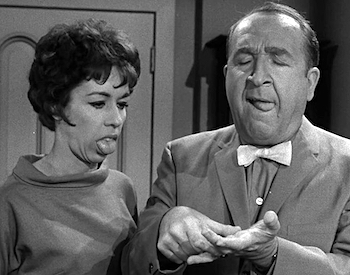
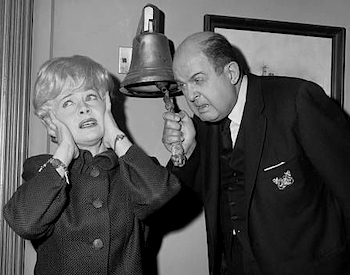 Finally, we end as we began, with an episode voted on by the public: at the bottom of Ranker’s list, and last on average too, is Sounds and Silences. It’s about an excessively-loud, domineering blowhard who gets some measure of comeuppance when he begins to be bothered by everyday sounds like a dripping tap or ticking clock. And then it goes the other way and he can’t hear loud noises at all. It’s poorly written and terribly performed — in the lead role, John McGiver is overacting something rotten. Some criticise the undercurrent of misogyny in the storyline, but I don’t know about that. He blames his mother and his wife for all his problems, but he’s an unlikeable sod so surely any misogyny is his rather than the episode’s — we’re not being asked to agree with him. The character’s ironic fate may be some form of poetic justice, but it’s too long coming to be entertaining, and too obvious to be satisfying. Whether I disliked this or Cavender is Coming more, I’m not sure, but they both merit their places at the bottom.
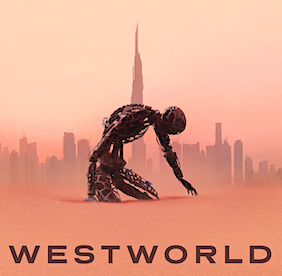 This month, I have mostly been missing Westworld season 3, which is now four or five episodes in. I’ve not seen anyone talking about it on social media, so I’ve no idea if it’s good or bad, but I am inferring that not as many people are talking about it anymore, which is its own kind of criticism. One show I have heard mentioned is Tales from the Loop, Amazon’s new anthology sci-fi series. That’s been picking up good notices, and I thought it looked interesting anyhow, so I must make time for it.
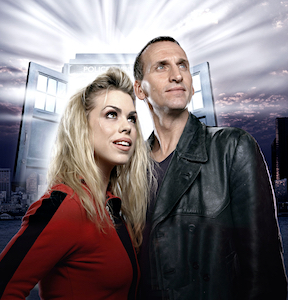 If you’re active (or looking in the right places) on social media, you may have noticed that there have been a bunch of Doctor Who watchalongs happening recently — you know, where people from around the world all watch the same thing at the same time and tweet about it. Organised by Doctor Who Magazine’s Emily Cook to provide something nice for Whovians in these trying times, they’ve been rather a big success — they’re always all over the trending topics on Twitter, and big names from the show have been persuaded to sign up and join in. The most recent one, to mark the 10th anniversary of Matt Smith’s debut episode, saw all three of its stars (Smith, Karen Gillan, and Arthur Darvill), plus writer/showrunner Steven Moffat and director Adam Smith, sharing thoughts and memories during the episode. Plus some of them have been accompanied by new fiction or stuff dug out from the archive.
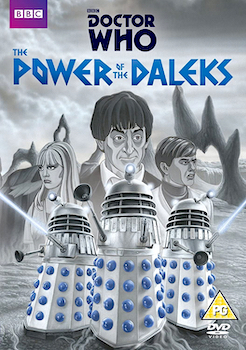 The first of the current wave of animations was The Power of the Daleks — a good place to start anyhow because it’s Patrick Troughton’s debut serial in the lead role. As he was just the second (canonical) Doctor, that makes the serial significant for the ground it was breaking — it’s the first time we’re introduced to a new actor taking over the series, something that’s become a staple of the programme (to the extent that the major plot lines and revelations of the most recent series were about the Doctor’s ability to regenerate). Sensibly, the production team paired their new leading man with the thing that had ensured the series’ popularity: the Daleks. And while the Doctor is dealing with a change of face and attitude, so are his enemies: these Daleks are keen to act as subservient aids to a human colony who have discovered their long-buried space capsule. Surely the evil fiends can’t’ve turned good?! (Spoiler alert: of course they haven’t.)
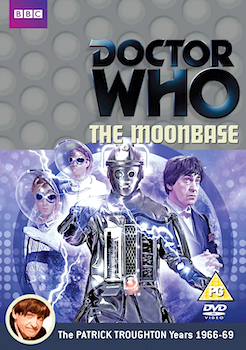 Next up by the series’ original chronology is The Moonbase — in terms of animation, Power was released in 2016 while The Moonbase was done in 2013; and half the serial survives, so it’s only half animated. It’s actually this older effort that looks better, the animation feeling much smoother and more realistic than Power, and making that look even more stilted and Flash-y by comparison. Apparently production on Power was incredibly rushed, and obviously they had to complete six episodes vs just two for The Moonbase, but the visual style is also slightly different; less obviously cartoonish.
 Much more successful in that department is The Macra Terror. No full episodes survive of this serial, so it’s back to 100% animation, and once again we have a change in style. It’s in widescreen, and it’s in colour, and the locations are bigger and more varied than they would’ve been on ‘60s TV, and the audio is so clean and clear it could’ve been recorded yesterday. It makes for a surreal viewing experience at first — are we sure this is a genuine Second Doctor story from over 50 years ago, not some recreation with perfect impressionists? After the previous animations tried to emulate the style of the original episodes, it’s a definite change of pace, but why not? It certainly brings some added dynamism to a few of the scenes — like Power, there are some all-but-silent sections; unlike Power, many of them now have some interesting visuals, which is most welcome. They had to make some trims here and there, I think for budget reasons (stuff that is inessential to the main narrative and would’ve been time consuming to animate), which is a shame (it would’ve been particularly fun to see the whole TARDIS crew dance a jig to escape at the end), but it is what it is.












 100Films.co.uk