Unknown's avatar

About badblokebob

Aiming to watch at least 100 films in a year. Hence why I called my blog that. http://100films.co.uk

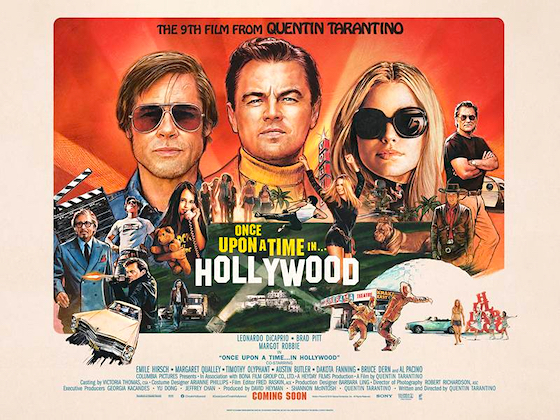
Once Upon a Time… in Hollywood (2019)

2019 #120
Quentin Tarantino | 161 mins | cinema | 2.39:1 | USA, UK & China / English | 18 / R

Once Upon a Time in Hollywood

The 9th film by Quentin Tarantino follows the fortunes of struggling actor Rick Dalton (Leonardo DiCaprio) and his stuntman and best mate Cliff Booth (an Oscar-winning Brad Pitt) over a couple of days in Los Angeles, 1969, when they were next-door neighbours to one Sharon Tate (Margot Robbie)…

I haven’t reviewed Once Upon a Time until now because I didn’t have much to say about it (even my Letterboxd ‘review’ was just a comment on its variable title presentation). Even after reflecting on it, and reading other’s critical reactions, then reflecting on it some more (for over eight months at this point), I didn’t have much to contribute. Why was that? And I’ve kind of realised it’s because the film didn’t make me feel very much.

Sure, there are moments where it did. There are plenty of scenes that are amusing, to varying degrees. The tension as Cliff explores the house of an old friend that’s been occupied by a bunch of hippies. The catharsis and humour of the ultra-violent climax, and the attendant cognitive dissonance of whether we should be revelling so in this historically-revisionist execution of real people — not to mention the factors that further complicate that (you know what they are by now).

And overall I didn’t dislike the film. I wasn’t bored, despite the length; if anything, that helps suck you into the world of 1969. You can certainly feel Tarantino’s love for the era, his desire to recreate — and, indeed, improve — it. (It’s also clear that he really wants to make another Western. The excerpted scenes from Rick’s TV pilot go on for ages, ultimately contributing nothing to the overall story, other than getting to hang out in a ’60s TV Western.) The three main performances are all very good, DiCaprio and Pitt great both as a double act and in their own storylines, and Robbie off in her own little world in a role that arguably offers little on the page but she breathes so much life into.

“Don’t cry, man. It’s only one blogger's opinion.”

It’s all these successes that mean I do consider Once Upon a Time to be a very good film. But at the same time, I didn’t leave the cinema feeling moved or wowed. I expected the history-changing ending ever since the film’s plot was announced, that expectation only cemented further as I learnt of Tarantino’s love for Tate, so I certainly didn’t leave feeling surprised. It ended, and that was that, and I went home.

Tarantino has talked in the past about how Jackie Brown is a “hangout movie”, where the point is not the story but spending time with the characters, and getting to re-spend that time when you watch the movie again, so that you enjoy it more and more with each viewing. I didn’t really get that feeling from Jackie Brown (I didn’t dislike it, but I was underwhelmed and in no rush to revisit it), but I wonder if that’s how Once Upon a Time will work best. The way it wanders through its loose narrative, before arriving at a climax that is, really, only tangentially related to everything else we’ve been watching, does suggest that’s the goal Tarantino had in mind. I can certainly believe he would like to just hang out in the world of Hollywood, 1969. I suspect that’s the driving factor behind why he even made this movie — getting to imagine an alternate history and career for his characters (I’ve seen interviews where he fills in way more backstory than is actually in the film), and using his clout to literally recreate that time and place in real-life rather than through CGI fill-ins.

So, it’s a movie I’ll surely revisit at some point, which is more than can be said for many a film. Perhaps then I’ll have something to say about it.

5 out of 5

Once Upon a Time in Hollywood is available on Sky Cinema and Now TV from this weekend.

The Locked Down Monthly Review of April 2020

In 2002, Blue got the city on lockdown.
In 2020, Boris Johnson got the country on lockdown.
Your move, noughties boy bands.

One thing this stressful time has been good for is my film viewing. After a 2019 that saw some of my lowest months in years — indeed, ever — I’m pleased to say that April 2020 is a record breaker:

100 Films has a new Best. Month. Ever!


#59 Rang De Basanti (2006)
#60 The Kid (1921/1971)
#61 The Three Caballeros (1944)
#62 Stop Making Sense (1984)
#63 Burning (2018), aka Beoning
#64 The Karate Kid Part III (1989)
#65 Aniara (2018)
#66 The Man Who Shot Liberty Valance (1962)
#67 The Diamond Arm (1969), aka Brilliantovaya ruka
#68 I Am a Fugitive from a Chain Gang (1932)
#68a The Devil’s Harmony (2019)
#69 The Next Karate Kid (1994)
#70 Never Too Young to Die (1986)
#71 It Chapter Two (2019)
#72 Andrei Rublev (1966)
#73 Dune: The Alternative Edition Redux (1984/2012)
#74 Rambo: Last Blood (2019)
#75 K-19: The Widowmaker (2002)
#76 Near Dark (1987)
#77 The Thin Red Line (1998)
#78 Jumanji: The Next Level (2019)
#79 Superman IV: The Quest for Peace (1987)
#80 6 Underground (2019)
#81 The Secret Life of Pets 2 3D (2019)
#82 Look, Up in the Sky! The Amazing Story of Superman (2006)
#83 Long Day’s Journey into Night 3D (2018), aka Di Qiu Zui Hou De Ye Wan
#84 End of the Century (2019), aka Fin de siglo
#85 Men in Black: International (2019)
#86 The Sheik (1921)
#87 The Son of the Sheik (1926)
#88 Extraction (2020)
#89 The Wedding Guest (2018)
#89a The Escape (2016)
#90 Ready or Not (2019)
#91 Bill & Ted’s Excellent Adventure (1989)
#92 The Two Popes (2019)
#93 Ice Age: Continental Drift 3D (2012)
#94 The Lunchbox (2013)
#95 Zatoichi in Desperation (1972), aka Shin Zatôichi monogatari: Oreta tsue
#96 Bill & Ted’s Bogus Journey (1991)
Aniara

I Am a Fugitive from a Chain Gang

Dune: The Alternative Edition Redux

Jumanji: The Next Level

Ready or Not

The Lunchbox

.


  • I watched 38 new feature films in April.
  • As I said at the start, that’s my most ever in a single month, beating the previous record holder (May 2018) by four films. That’s noteworthy because May 2018 is only one film ahead of the month that’s now in 3rd, which is only two films ahead of the month now in 4th, which is only three films ahead of the months now in =5th. So, four is a pretty healthy margin.
  • Obviously, as my best month ever, April is going to smash any comparisons I care to make. So let’s start with the only thing it wasn’t guaranteed to do, but it has done nonetheless: #96 is the furthest I’ve reached by the end of April (next best is #90 in 2018).
  • Averages: it increases April’s average by two whole films, from 12.8 to 14.8; increases the rolling average of the last 12 months from 13.3 to 14.8; and increases the average for 2020 to date from 19.3 to 24.0. If I maintained that average until December, 2020 would become my biggest year ever (but things never work out like that).
  • It’s my 21st month with 20+ films, and my 4th month with 30+ films.

Alright, now some notes on the films within those 38…

  • Back in February, I noted that I’d somehow never seen a film from 1932. That’s now changed, thanks to I Am a Fugitive from a Chain Gang. Now, since the year of the first feature films being produced in the UK and USA (1912), there are only four years from which I’ve not seen at least one feature-length film: 1912, 1914, 1915, and 1923. I have at least one title picked out from each of those years that I could use to settle this matter, so I ought to get on with them…
  • I’ve seen David Lynch’s Dune before, but it was over 20 years ago and it was the theatrical cut. The fan edit I watched adds material from a longer TV cut and deleted scenes, plus generally rearranges and rejigs stuff, so I figure it must be substantially different enough to count as new.
  • Having watched 92% of the alphabet in January, February, and March, only X and Z remained — with the latter now claimed by Zatoichi in Desperation. X will go whenever I get round to watching Dark Phoenix — I think that’s literally the only X film I have in my collection or on Netflix/Amazon/etc.
  • This month’s Blindspot films: Andrei Tarkovsky’s biopic of 15th century religious icon painter Andrei Rublev. I found it as dry as that sounds. Also, from my ‘overflow’ list, Terrence Malick’s The Thin Red Line, which I was also underwhelmed by. I knew it would be more Malickian than your typical war movie, but still, something about it didn’t connect with me.
  • From last month’s “failures” I watched Aniara, End of the Century, It Chapter Two, Rambo: Last Blood, Ready or Not, and The Secret Life of Pets 2, plus The League of Extraordinary Gentlemen (see Rewatchathon). That’s a record haul, besting the five failures I watched last April. It was driven by most of those being time-limited Amazon rentals.


The 59th Monthly Arbitrary Awards

Favourite Film of the Month
How to define “favourite”? On the one hand you’ve got something like I Am a Fugitive from a Chain Gang, which is a weighty and still-pertinent condemnation of the American justice system. On the other, something such as Jumanji: The Next Level, which is just a whole lot of fun. More tickling my fancy in the former camp is Aniara, about the psychological strain of being stranded in space with little hope of ever returning home, some of which feels very pertinent to our current world situation (I know we’re all at home rather than far from it, but the cooped up with no hope of escape… yeah). And in the latter camp, Ready or Not is a deliciously gonzo horror-comedy, which didn’t quite push as many buttons as I’d hoped but is still massively entertaining. On balance, bearing in mind its unexpected timeliness, Aniara takes it.

Least Favourite Film of the Month
This is a more straightforward category… although, personally, I included Andrei Rublev on my shortlist, which is a Highly Acclaimed Movie (just check out how many Greatest Ever lists it’s on), but it bored me senseless. Still, it did have some parts I admired — I’m not sure I can say the same about Superman IV: The Quest for Peace. Actually, that’s not strictly true: Christopher Reeve was always perfect as Superman; but the film definitely lets him down.

Best Musical Discovery of the Month
I’d never consciously listened to Talking Heads before I watched Stop Making Sense. I recognised exactly two of the songs during that concert movie, and one of those I know best from a cover version. While I wouldn’t exactly call myself a convert to their music, I liked most of it well enough, with opening number Psycho Killer my favourite. In fact, I preferred the live version in the film to the original recording. Maybe it’s just because I heard that take first, I dunno.

Best Audition to Be James Bond of the Month
It never even crossed my mind that the skinny kid from Slumdog Millionaire could ever be considered for Bond, and I bet it didn’t yours either. It was David Ehrlich’s Letterboxd review of The Wedding Guest that first flagged up the idea for me, and, having seen the film, I can see what he means. Dev Patel as James Bond… it’d certainly be different.

The Audience Award for Most-Viewed New Post of the Month
The second half of last month’s TV review sat pretty atop the chart for most of the month (the Doctor Who half, meanwhile, wasn’t even close), but then Extraction came barrelling through my stats like Tyler Rake through an overcrowded Indian apartment block. Five older TV posts topped it overall, but it was by far my most-viewed new post.


The name’s Connery, Sean Connery.

Yes, there’s a distinct theme to this month’s rewatches. It wasn’t deliberate… well, not at first. Once I noticed it, obviously I had to maintain it.

#15 Diamonds Are Forever (1971)
#16 The Avengers (1998)
#17 The Rock (1996)
#18 The League of Extraordinary Gentlemen (2003)

…and, if you want to take it further, you could argue they’re all movies where Connery returned to the role of James Bond. Sure, Diamonds Are Forever is the only one where that’s literally true, but there’s long been a fan theory that Connery’s character in The Rock is Bond under a pseudonym, and in The Avengers he plays an innuendo-spewing former British secret agent turned villain. As for LXG… yeah, okay, the idea runs out there.

When I included The Rock in my 100 Favourites, I only rated it 4 stars. Now I feel like a fool — it’s easily a 5. Some thoughts as to why on Letterboxd. Mind you, that kind of thing cuts both ways: when I finally got round to rewatching Face/Off 18 months ago, I discovered I didn’t enjoy it as much as I used to, and if I’d done that before publishing 100 Favourites then I might’ve dropped it from the list entirely. I intend to update my favourites list someday, but I think I need to do a good deal more rewatching before then.

My rewatch of LXG was prompted by this defence of the film. While I wouldn’t call the movie a masterpiece, I do generally agree with that article — the film has its moments (many of them thanks to Dorian Gray), and it’s certainly no worse than many other ’90s/’00s Hollywood blockbusters. Quite why it provokes such vitriol from anyone but fans of the book is beyond me. (Book fans have every right to be disappointed, because the film sanitises and Hollywoodises the concept. That said, as a fan of the books myself, I’m happy to take both forms as differing executions of the same idea.)


This may be the biggest month in 100 Films history, but there was still plenty of stuff I failed to watch. Nothing in cinemas, obviously (though Trolls World Tour did get released direct to premium streaming, and consequently looks like it might change the world), but the other avenues for film viewing offered more than enough alternatives.

For starters, Netflix completed their Studio Ghibli lineup with Howl’s Moving Castle (the only one I’d seen), From Up on Poppy Hill (which I own on Blu-ray), Ponyo (also on Blu-ray), When Marnie Was There (also on Blu-ray, jeez!), Pom Poko, Whisper of the Heart, and The Wind Rises. On the new films front there was CG animation The Willoughbys, which looks vaguely interesting, and for (relatively) recent releases they mustered the remake of Child’s Play. They also added the second Maze Runner film, The Scorch Trials. One day the whole trilogy will be available somewhere and I’ll give them a shot.
Amazon actually had more to offer in terms of recent acquisitions, though the quality level is dubious — I’m talking of films like Angel Has Fallen (the second sequel to the less-good “Die Hard in the White House” movie), Playmobil: The Movie (a rip-off of The LEGO Movie that wasn’t as well received), 21 Bridges (which received middling notices), and The Current War (presumably in its director’s cut form, for which the most positive comment Rotten Tomatoes can muster is “a significant improvement over previous versions”). Additions from the archive include a handful of Hong Kong actioners, led by the appropriately-titled Police Story: Lockdown (the sixth film, and second reboot, in the Jackie Chan action franchise), plus unofficial prequel The Legend is Born: Ip Man (I believe Ip Man 4 is also now available to rent over here), and Donnie Yen in Legend of the Fist (a version of the story from Bruce Lee’s Fist of Fury and Jet Li’s Fist of Legend).

Also new to Amazon was medical disaster movie Outbreak, which was already on Netflix; and they both added Contagion, after everyone was talking about it last month. I noticed it still made it into Netflix’s UK top ten, though.

Over on Now TV, sequel-cum-reimagining Four Kids and It caught my eye because I remember enjoying the BBC’s 1991 adaptation of the original book when I was a kid, but this new one didn’t seem to go down terribly well (though the British critics collated by Rotten Tomatoes have got it to 61%, which counts as ‘fresh’). Other recent films now on Sky include Ma and Tolkien.

Finally, I went a bit potty in Blu-ray sales again, this time mostly at Arrow, picking up a couple of Vincent Price horrors, Tales of Terror and Tower of London; a couple of artier titles from Second Run, Valerie and Her Week of Wonders and Ikarie XB 1; Third Window’s double-bill of The Whispering Star and The Sion Sono; and some Westerns and noirs and noir-Westerns that include The Ox-Bow Incident, My Name is Julia Ross, and Terror in a Texas Town. The latter pair were directed by Joseph H. Lewis, whose So Dark the Night I enjoyed last month, so I also bought his Gun Crazy in its HMV-exclusive edition, paired with their edition of Out of the Past in their 2-for-£25 offer. Meanwhile, Eureka tempted me with new releases, namely Zu: Warriors from the Magic Mountain and Masters of Cinema titles Rio Grande, Kwaidan, and their second box set of Buster Keaton features, which includes The Navigator, Seven Chances, and Battling Butler. International travel may be closed to humans, but it isn’t to Blu-rays, as evidenced by my imports of 3-D Rarities Volume II (which includes Mexico’s only 3D film, swashbuckler El Corazón y la Espada) and A Boy and His Dog (which I look forward to rewatching in good quality, unlike the print I saw on Prime Video a few years ago). I tried to resist the UHD upgrade of The Elephant Man, but then I saw the PQ comparisons and the limited-edition pop-up packaging (damn my love of a cardboard gimmick!) and caved.

And, inevitably, I did purchase The Rise of Skywalker, in 3D. You know, I’ve never got round to rewatching The Last Jedi. The idea of pairing them up as a double bill should be the most natural thing in the world, but instead it feels like a bold experiment in combining chalk and cheese. Still, I might try it sometime.


Barring any unforeseen circumstances (though, at the minute, who can accurately foresee anything?), I should definitely pass #100 early next month. As for my new-goal-I-keep-half-forgetting of #120, well, that’s within reach too. And then…

In my final monthly review of 2019, I mentioned that “it’s entirely possible [2020 will] be the year I reach #2000”. Now, it’s all but certain that it will (unforeseen circumstances, remember). If May gets to 35 films (which, before this month, would’ve been a record for biggest month ever), that’ll be 100 Films’ #2000! Is it likely I’ll achieve two such huge months in a row? Funnily enough, the last couple of times I’ve set a new “best month ever” it’s been immediately beaten by the very next month: September then October in 2015; April then May in 2018.

No pressure, May 2020…

The Lunchbox (2013)

2020 #94
Ritesh Batra | 99 mins | download (HD) | 2.35:1 | India, France, Germany & USA / Hindi & English | PG / PG

The Lunchbox

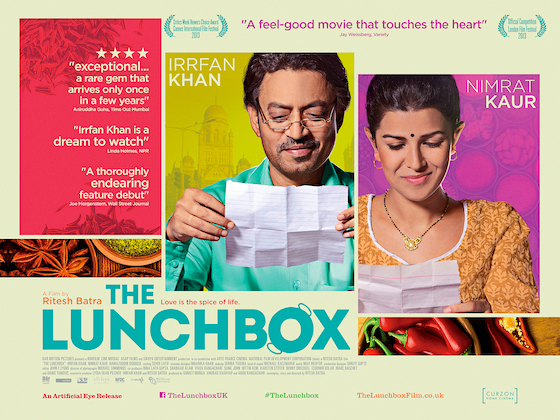
Yesterday the world heard the sad news that the actor Irrfan Khan had passed away aged just 53. An award-winning film star in India, Khan also had a noteworthy presence as a supporting actor in Western films — the police inspector in Slumdog Millionaire; the owner of the eponymous park in Jurassic World; the adult version of the main character in Life of Pi; not to mention The Darjeeling Limited, The Amazing Spider-Man, Inferno, and more. I’d seen all of those films and noted Khan’s presence — he’s the kind of actor who turns up and elevates the film almost just by being there, bringing a depth and interest to even the smallest roles. But I’d never seen any of the many films (he has 151 acting credits on IMDb) in which he played the lead, so it seemed appropriate to turn to one of the most internationally acclaimed of his films, The Lunchbox, in tribute.

Khan plays Saajan, an office worker who receives his lunch every day via the dabbawala service. It’s a remarkable network that delivers 200,000 lunches daily across Mumbai with unerring accuracy. Indeed, their precision is so famed that one of the major criticisms of this film in some quarters was that its premise is too far-fetched — that being that, due to a continued mixup, Saajan begins to receive the lunches Ila (Nimrat Kaur) has prepared for her husband, rather than the ones he ordered from a local restaurant. He’s so impressed with the quality of the food, when the lunchbox is returned Ila observes that it looks to have been licked clean. This is good news, because she was trying to up the quality of her lunches as a way to reignite her stagnant marriage; but when her husband returns home still disinterested, with only thin praise for something she hadn’t even included in his lunch, she realises the delivery mistake immediately. But politeness compels her to send lunch again, this time with a note explaining the mixup. After a rocky start, soon Saajan and Ila are in daily communication through short letters passed back and forth in the lunchbox.

Saajan

Both are characters desperately in need of that connection. Ila’s loveless marriage, and young daughter who spends most of the day at school, means her primary human contact comes in shouted conversations with her upstairs neighbour. Saajan, meanwhile, is taking early retirement, but first must train Shaikh (Nawazuddin Siddiqui), the overeager new recruit appointed to replace him. He tries to duck even this level of interaction; at home, he tells off kids for playing in the road outside his house, refusing to return their ball. We could infer Saajan is a misanthrope, and the impression is given that his colleagues do (they share a story that he once kicked a cat in front of a bus then casually walked away), but the film affords us more insight than that, primarily through Khan’s performance. It’s the underlying sadness in his eyes that first give the clue to his true loneliness, and the way his demeanour begins to brighten as the relationship with Ila brings a spark back into his life.

Lest you think this is all somewhat dour, the way it plays is uplifting. Saajan and Ila may be miserable at the start, and continue to confront problems in their lives throughout the film, but their connection injects a measure of happiness into both their lives, the mutual support helping them through. Plus there’s a strong vein of humour, at first from the faltering beginnings of our leads’ relationship, then from the antics of Siddiqui’s junior employee. This isn’t the kind of broad comedy you might expect from a Bollywood movie, but something more grounded and closer to reality. At first Shaikh seems as irritating to us as he is to Saajan, but soon the latter’s growing empathy leads him to become a father figure to the younger man, and we too begin to see the truth underneath his cheery facade.

Ila

While that subplot is a bonus, the film really comes down to Saajan and Ila, and consequently the performances of Khan and Kaur. That’s particularly important because so much of the story occurs in the form of letters, and so the characters’ true reactions come across in doleful expressions, or changes in posture or behaviour; subtle, human indicators that leave us in no doubt what they’re feeling, and only strengthen our own connection to and investment in these characters. This pair of deeply-felt performances carefully steer The Lunchbox into being a heartfelt, quietly affecting film.

5 out of 5

Zatoichi at Large (1972)

aka Zatôichi goyôtabi

2019 #118
Kazuo Mori | 88 mins | Blu-ray | 2.35:1 | Japan / Japanese | 15

Zatoichi at Large

I never thought doing a good deed for someone would end up making me a demon.

The 23rd film in the Zatoichi series is also the worst according to Letterboxd users, who rate it below even the ’00s spinoff, Ichi. But as with all things in this crazy, mixed-up world of ours, there are those who disagree: The Digital Bits give it a B+, which puts it in the series’ top half (to be precise, it makes it =7th, but with seven other films). You can add me to that (very short) list. It’s not an exceptional Zatoichi film by any means, but it is a middle-of-the-range entry, and a long way from the worst the series has to offer.

Between how reviled it is by Letterboxd users and the cartoonish art Criterion chose for it, I assumed this was going to be another woeful attempt at comedy like Doomed Man (which is, in my opinion, by far one of the series’ worst films). It’s quite the opposite: a tragic film, where good and bad alike are faced with impossible choices, or misinterpret evidence that leads them to make rash, fatal decisions. At one point Ichi is captured, tied up, teased and beaten until he’s bruised and bloody — it’s very unpleasant. If the unpleasantness was why it was so disliked then I could see where people were coming from, but criticism seems to hinge mainly on the familiarity of the plot.

Well, it begins with Ichi stumbling across a dying pregnant woman. He delivers her baby, and her dying wish is that he takes the child to her husband in a nearby village. Naturally, Ichi complies, followed all the way by a young boy who won’t stop throwing stones at him. With the help of the village’s old but honourable constable, Tobei, he locates the baby’s aunt, Oyae. But then the yakuza arrive, demanding taxes from local performers and threatening to force Oyae into prostitution, and once again it’s up to Ichi to save the day.

Saving the day

Yes, anyone familiar with Ichi’s adventures can see how that’s a pretty standard storyline. The devil is in the detail, and At Large offers a few interesting characters and subplots. For starters, there’s Tobei — a non-corrupt official is a rarity in this series, but that doesn’t make him dull. He gains depth from both how he treats Ichi (when he finds out the truth about our hero’s past, he doesn’t arrest him) and his relationship with his wayward son, who’s a conman. Their relationship is quite poignant. It’s only when his father finally hits him that the son realises he cares, which makes him happy… but then things take a turn for the worse, leading the former good-for-nothing to set out as an avenger of honour.

As the villain, yakuza boss Tetsugoro, there’s an interesting performance by Rentarô Mikuni (who previously appeared in Zatoichi the Outlaw, and is also great in the samurai classic Harakiri). He choose to play Tetsugoro as constantly bored, or world-weary, barely interested by or caring about what’s going. For example, he’s been paying everyone 1 ryo to kill Ichi, but when someone demands 50 ryo he does no more than hand-wave his approval. All of which might sound like a criticism, but it’s a surprisingly effective portrayal of disinterested everyday evil. Nothing he does brings him pleasure; nothing that happens causes frustration or surprise — he just exists, doing the only things he knows. Well, that is until he observes Ichi being tortured — then he smiles and laughs. And when he finally kills Tobei — the most moral man around — then he laughs again. Ooh, he’s a nasty piece of work and no mistake!

Zatoichi tortured

There are various other bits and pieces that work nicely. Ichi gets to show off, as usual, but it’s always fun. The filmmaking gets a bit of ’70s verve, with a score that is at times very contemporary-pop, and supplementing the series’ normal visual style with some handheld closeup stuff. And the final one-on-one duel is not the usual big showpiece: oddly exposed, almost silent, flash-edited, and over in seconds, with a hard cut to a “the end” card. Depending on your point of view, this is either “almost comically tacked on” (DVD Talk) or “one of the most badass final thirty seconds of any film in this series” (The Digital Bits). I don’t know if I’d go as far as the latter, but it’s certainly a change of pace.

Zatoichi at Large may just be a remix of various plot bits we’ve seen before, but they’re done with a seriousness and darkness that works. There’s a bit of comedic stuff early on that’s a nonstarter, but once that’s out the way it’s a decent, if fundamentally unoriginal, adventure for Ichi. Indeed, it’s that lack of originality that hurts it most. In itself it’s a perfectly good Zatoichi movie, but we’ve seen almost all of it before. At Large (re)does it all solidly, but it doesn’t do much to improve on previous versions. If more people watched the films out of sequence and came to this earlier, perhaps it would be better liked.

4 out of 5

The Elephant Man (1980)

2018 #187
David Lynch | 124 mins | Blu-ray | 2.35:1 | USA & UK / English | PG / PG

The Elephant Man

This biopic of Joseph Merrick — better known as ‘the Elephant Man’, a Victorian circus sideshow ‘freak’ who became a star of London society during his stay at the London Hospital — is noteworthy not only for its documentation of a key figure in Victorian life, who perhaps transformed people’s views of what it meant to be human, but also because it’s a film directed by David Lynch.

The Elephant Man is sometimes placed alongside Dune and The Straight Story as anomalies in Lynch’s filmography, which is more often characterised for its horror-inducing oddness and sometimes-incomprehensible plotting. Of course, upon proper examination, all three of these movies exhibit Lynchian touches, perhaps none more so than The Elephant Man. It’s there in the avant-garde opening; the dream sequence; the sound design, for which he’s co-credited; the focus on industrial machinery. The film can certainly be read as a Victorian melodrama, but in execution it’s far from a Merchant Ivory movie.

It’s also a very human and humane film, perhaps more so than you might expect from Lynch. But then again, look to The Straight Story, which in my review I described as “understatedly human and kind of heartwarming”; or Fire Walk with Me, which is about exposing the tragic injustices inflicted upon Laura Palmer. He may not come at it from the most obvious angles, but I think Lynch is consistently a compassionate filmmaker. Indeed, some critics even accused the film of “excessive sentiment”, probably due to being partly based on the memoirs of Merrick’s friend and physician, Frederick Treves. I disagree because, even if it is pretty sentimental, I think it hits the sweet spot — the point is that we should care.

Treves and Merrick

A significant boost to our emotional connection is the absolutely superb performances from Anthony Hopkins as Treves and John Hurt as Merrick. The latter earnt a BAFTA win and an Oscar nomination (losing to Robert De Niro in Raging Bull) in what became a truly iconic performance, but it’s a wonder Hopkins wasn’t similarly recognised. One of the themes the film tackles is the dichotomy of Treves being Merrick’s friend but also, to an extent, exploiting him to further his career, and finding the truth in that balance is down to Hopkins. They also both contribute enormously to the graceful beauty found throughout the film, not least in close-ups where a single tear can convey so much complex emotion, or the understated but moving final scene.

So too the gorgeous black-and-white photography by Freddie Francis. As Tom Huddleston writes in his essay accompanying the film’s StudioCanal Blu-ray releases, “imagine the film in colour, how fleshy and grotesque the makeup would have appeared, how gaudy and nauseating the carnival sequences.” It doesn’t bear thinking about. Instead, the monochrome visuals mix “gothic horror with documentary realism, lush drawing-room drama with mist-shrouded flights of fantasy”, to create a film that feels realist and historical, but also timeless and fantastical.

5 out of 5

The Elephant Man is on BBC One tonight at 10:30pm (11pm in Scotland).

It was viewed as part of my What Do You Mean You Haven’t Seen…? 2018 project.

Extraction (2020)

2020 #88
Sam Hargrave | 116 mins | streaming (UHD) | 2.35:1 | USA / English, Hindi & Bengali | 18 / R

Extraction

Chris “Thor” Hemsworth stars in this action-thriller masterminded by the Russo brothers (directors of Avengers: Infinity War and Endgame) and directed by Sam Hargrave, who has dozens of stunt coordinating credits to his name, including three Hunger Games, Atomic Blonde, and work on six Marvel Studios movies. But don’t take all those MCU connections to heart — this is not a Marvel-style PG-13 action-comedy. Oh no.

We first meet mercenary Tyler Rake (Hemsworth) engaged in a gunfight on a bridge. He’s covered in wounds, spitting up blood, looks like he’s about to die. Cut to two days earlier! No, really, it’s one of those openings. They just won’t bloody die. Never mind “skip titles” or “watch credits”, Netflix needs to add a “skip pointless in media res prologue” button. It would improve almost any film/TV episode where it was featured.

Anyway, two days earlier we’re introduced to Ovi (Rudhraksh Jaiswal). Just an ordinary, well-to-do schoolboy in India… except his dad’s an imprisoned drug kingpin, and when Ovi slips out to a club one evening he’s kidnapped by goons from the competition, run by the thoroughly ruthless Amir Asif (Priyanshu Painyuli). With daddy behind bars, it falls to Saju (Randeep Hooda) to get the kid back, for which he hires some organisation, I guess — the film is incredibly light on specifics here. Basically, it involves Nik (Golshifteh Farahani) sending in Mr Rake and a support team to extract the kid. Naturally the mission goes sideways, leaving it up to Rake alone to get Ovi and himself out of a city crawling with henchman and corrupt cops who are all out to get them.

School's out

Of course, Rake has issues in his backstory, and rescuing the kid becomes more than just a job, etc, etc. The “Man on Fire Lite” plot is as predictable as this sentence ending with a simile. When David Harbour turns up halfway through as an old mate of Rake’s who lives in the city and agrees to help him out, I’ll be surprised if you can’t guess what inevitably happens a couple of scenes later. Though it is amusingly bold of the film to try to make us believe David “dad bod” Harbour could hold his own in a fight against Chris “literally a Norse God” Hemsworth.

That minor brawl aside, the action sequences are great, more than making up for the lightweight plot mechanics. Letting stunt coordinators move into full-on directing has been the saviour of the action movie genre in recent years, working wonders for the John Wick series in particular, but also several other movies that have followed suit. Hargrave is the latest to suggest he might have a bright career ahead of him on the basis of his ability to stage electrifyingly choreographed combat scenes. The action is fast and hard-hitting; not unnecessarily horror-movie gory like it was in fellow Netflix actioner 6 Underground, but certainly not PG-13 material either. Clearly Netflix don’t force the makers of their expensive movies to hit that PG-13, presumably tied to not having to worry about box office takings. One advantage of going direct to streaming.

The highlight of the film is undoubtedly an already-much-discussed 11½-minute single-take action sequence. We’ve seen plenty of these trick shots in the past few years (Atomic Blonde and, obviously, 1917 particularly come to mind), but Extraction offers another belter. It starts as a full-blown car chase, which transitions into a game of cat-and-mouse around a warren-like apartment block, then tumbles into a mano-a-mano knife duel on a busy street, before ending in a second car chase. Obviously there are myriad hidden cuts in there, but that’s almost beside the point: it’s not physically doing it in one long shot that’s impressive, it’s the design and choreography and planning and execution to make it feel like one. It pays off handsomely.

Street fighter

You wonder if Netflix might look to turn Extraction into a franchise — in many non-English-speaking countries it’s been titled Tyler Rake, which might suggest that’s what they’re thinking. But then, they could’ve retitled it that in English if they wanted, so maybe not. It’s not the most sophisticated thriller ever made, and it doesn’t reach the giddy heights of John Wick in the action department, but it’s nonetheless entertaining at what it sets out to achieve. If they do decide to make more, I’ll definitely be there.

4 out of 5

Extraction is available on Netflix now.

Men in Black: International (2019)

2020 #85
F. Gary Gray | 115 mins | Blu-ray | 2.00:1 | USA & China / English | 12 / PG-13

Men in Black: International

When Men in Black: International* hit cinemas last summer, many, many, many critics used a neuralyzer-related pun prominently in their review. (Someone did a Twitter thread compiling all the near-identical jokes. It reached 120 examples.**) For those unfamiliar with the MIB franchise, the neuralyzer is a small device that can wipe people’s memories, used by the MIB to keep their activities secret. The repetitive and inevitable joke was that International is so bad you’ll want to be neuralzyed afterwards. Now, I swear the film itself is trying to get in on the gag: the only photo printed on its disc is of a neuralyzer, as if the Blu-ray itself is going to wipe your memory when you take it out of your player. If only it did…

International is essentially a spin-off from the previous trilogy of MIB movies: whereas they followed Agents J and K (Will Smith and Tommy Lee Jones) on adventures in New York, this time we follow newbie Agent M (Tessa Thompson) as she’s relocated to London and paired with hot-shot-agent-gone-off-the-boil H (Chris Hemsworth) on a globetrotting adventure to unearth a mole in MIB.

Reinvigorating the franchise with new blood isn’t a bad idea. The third film was a marked improvement on the second, but neither recaptured the glories of the first, and K and J’s story was pretty well played out. Hemsworth and Thompson are good picks for the leads, too, given he displayed noteworthy comedic chops in the Ghostbusters reboot and the pair had clear chemistry in the well-liked Thor: Ragnarok.

Back in black

But clear-eyed plans alone don’t make a good movie, as Men in Black: International proves. It’s not that the movie is bad per se, it’s just mediocre; bland; uninspired. It’s devoid of wit or charm — which, considering the cast, is kind of remarkable. I mean, it’s not just Hemsworth and Thompson — two appealing, capable leads. There’s also Liam Neeson and Emma Thompson, and Rebecca Ferguson pops up (I didn’t even know she was in it ’til she did), and there’s Rafe Spall (limited by having to be a blatant red herring), and the voice of Kumail Nanjiani. Whoever’s your favourite out of that talented cast, they’re wasted. Neeson is a particular bit of miscasting. Calling the head of London branch “High T” is a perfectly adequate joke, playing on Britishness and poshness… until you cast a guy with a pronounced Northern Irish accent, which just kills the gag dead. Nanjiani fares best as the voice of a little CGI creature, who’s probably meant to be cute but errs more towards annoying, though I didn’t hate him.

Of course I didn’t hate him — nothing in this movie is emotive enough to be hate-worthy. But by being so bland, it becomes objectionable. MIB2 wasn’t great, but at least it was kind of entertaining in its poorness. International is playing it so safe that you can’t even groan at it, or be delighted when something half-decent emerges from the mire, or be amused by it in spite of itself.

I guess this is what happens when you hire a primarily action director to helm a movie that should primarily be a comedy. F. Gary Gray did start off his career with a comedy, Friday, but that was 25 years ago. He’s better known for the likes of The Negotiator, the Italian Job remake, Law Abiding Citizen, and The Fate of the Furious. He hasn’t turned this into a straight-up action movie — it does still try to be amusing — but it’s clear the focus is in a different place to before. It’s partly because it’s far too long and lacking in pace. It’s always stuck in my mind that the director of the previous MIBs, Barry Sonnenfeld, once said he’s the only director whose Director’s Cut would be shorter than the original film because he’s always looking to strip things back. I suspect that may be part of why the previous movies worked, and it feels like International could really benefit from the same approach.

Cute and/or annoying CGI creature? Check

It certainly seemed to me like it was several more drafts away from completion. The twist is so obvious you can guess it just from looking at the cast list, underscored by a prologue that fades to white before it resolves and so may as well scream “what happened next is not what you’ll think”. More vitally, why is M a rookie agent? You’d think it would give an obvious and easy character arc, but that’s not really played. Instead, there are loads of times throughout the film where she Knows Stuff, so they have to explain it with “it says it in the handbook” or something similarly hand-wavy. The fact she managed to find the MIB, rather than them choosing to recruit her, is a cute origin but then has nothing to do with anything. It would’ve been better if she was a desk jockey forced out onto her first field assignment. Sure, that’s a tired characterisation too, but at least it’d be something a bit different for the franchise, and a bit more in keeping with how the movie wants to use her.

At one point it was mooted that this would be an MIB / Jump Street crossover movie, which was a barmy idea; but with MIB in need of a fresh start and Jump Street already being pretty immune to the fourth wall, it could’ve been great. At least it would’ve been different — even if it hadn’t’ve worked, they’d’ve tried something bold. Instead, they went for the much safer option of a straightforward soft reboot, and everything about International screams “safe”. Earlier I said it wasn’t bad, but by being so dull, well, it kinda is.

2 out of 5

Men in Black: International is available on Sky Cinema from today.

* Don’t get me started on that colon in the title. I could practically write an essay just about that choice. ^
** Most of the critics took it well, apparently. ^

Review Roundup: Superman Sequels

Superman: The Movie is one of the greatest superhero movies ever made, perhaps even the greatest. Its sequels… not so much.

It took three movies to get there, but through them you’ll believe a franchise can die…

Superman II
(1980)

2018 #128
Richard Lester | 127 mins | Blu-ray | 2.40:1 | USA, UK & Canada / English | PG / PG

Superman II

I feel like I must’ve seen Superman II as a kid — I know I saw Superman and enjoyed it, so why wouldn’t I have seen the sequel? But all the things people go on about from it (“kneel before Zod!”) I only know because other people go on about them, not from any memory of my own, so maybe I never saw it? Well, sitting down to watch it now, I didn’t remember any part of it. But that doesn’t mean I definitely didn’t see it because, frankly, I didn’t find Superman II particularly worthy of being remembered. I know some people love it — heck, James Gunn even included it in a list of “sequels that are better than the original” the other day. But James Gunn is wrong.

For me, the film breaks down into a few simple and distinct sections. First, it begins with an eight-and-a-half-minute recap of the first movie. That’s… long. And largely unnecessary. I mean, when it bothers to include the telephone booth gag but omits the turning-the-world-backwards climax of the movie, you get the impression it’s not there to get you properly up to speed on the plot.

Next, Lois and Clark spend most of the first hour titting about at Niagara Falls investigating a honeymoon hotel scam (a what now?!), while evil Kryptonian General Zod and his gang veeery slooowly make their way to somewhere significant. Then there’s half-an-hour of Lois and Clark being too self-absorbed to notice Zod take over the world. Not-so-super, Superman. Then, finally, the all-action last half-hour actually gives us some Superman stuff. Hurrah!

Who's kneeling now, bitch?

The humour quotient is waaay upped from the first movie. Based on his previous work, I guess much of that was the influence of replacement director Richard Lester. He wasn’t a good choice all round: Margot Kidder disliked working with him; Gene Hackman didn’t return (all his scenes are either footage previously shot or done with a lookalike and impersonator); John Williams walked off the film after seeing Lester’s footage. He reshot a bunch of stuff original director Richard Donner had already filmed, partly to get a sole director credit, partly because he didn’t approve of the epic visual style Donner had chosen. Instead, Lester aimed for a visually flat “comic book” style. Ugh.

25 years after Superman II’s release, Warner Bros relented and let Donner complete his original cut of the movie, released in 2006 as The Richard Donner Cut. Maybe that version’s better — I haven’t watched it yet, but it does have a much higher score on IMDb. But how anyone could genuinely love the originally-released version, I don’t understand. It’s not outright bad, it’s just mediocre, and not a patch on its predecessor.

3 out of 5

Superman III
(1983)

2018 #161
Richard Lester | 125 mins | Blu-ray | 2.40:1 | UK & USA / English | PG / PG

Superman III

If you said “imagine a Superman film by a director who won the Palme d’Or”, you wouldn’t picture Superman: The Slapstick Comedy… and yet here we are.

The director in question is Richard Lester, returning after Superman II, a movie he inherited, so I guess it’s only here that he’s really allowed to show what he thinks a comic book movie ought to be. Turns out, that’s more like Airplane or a Jacques Tati film than the David Lean influence he felt Richard Donner was aiming for on Superman: The Movie. He even lets the title card appear over the epic superhero imagery of… three phone boxes that have been knocked over dominoes-style by a hot dog cart. Wow.

Ironically, almost all of the film is humour-focused apart from the scenes starring comedian Richard Pryor (who thought the screenplay was terrible, but did like the $5 million salary). Concurrently, the technological and scientific parts of the plot make absolutely no sense. Like, a weather monitoring satellite can be accessed from a small-town wheat firm and then be reprogrammed to control the weather. And that same satellite can then use its lasers to analyse rocks millions of miles away to find out what elements make up another element, which just… Ugh. It so doesn’t make sense that it’s too much effort to explain why it doesn’t make sense.

With Gene Hackman presumably only too happy to be rid of this franchise, the villain is now Robert Vaughn, who has an entourage that feels like a blatant attempt to emulate Lex Luther & co from the previous films. There’s also an all-powerful supercomputer, which Superman defeats with what appears to be a bubbling-over pot of strawberry jam.

That's Larry Lamb on the left, would you believe

The story also involves Superman going bad — you can tell because he’s grown a five o’clock shadow, developed bags under his eyes, and started wearing a suit with a colour scheme more suited to a Zack Snyder interpretation of the character. And he begins to do really terrible things, like… straightening the leaning tower of Pisa, and… blowing out the Olympic flame. Ooh, edgy. Why does he do it? God, I don’t know. There’s no logic in this. There’s a fight between good Superman and bad Superman, which some think is brilliant; “a highlight of the series”, said one comment I read. Maybe it’s just because Evil Superman is so damn cartoonish, but I didn’t particularly care for it.

It did inspire the original title of the movie, though, which was Superman vs. Superman, and that in turn led to a bit of trivia more batshit insane than anything in the film itself: that original title was dropped after legal action was threatened by… the producers of Kramer vs. Kramer. What in the fucking what now?! I know America is famed for spurious lawsuits, but c’mon!

Of course, if you take the whole film at the face value of its tone, it doesn’t really matter — it’s just a daft comedy. But it shouldn’t be, should it? This isn’t the Superman the first film promised us.

2 out of 5

Superman IV:
The Quest for Peace

(1987)

2020 #79
Sidney J. Furie | 90 mins | Blu-ray | 2.35:1 | UK & USA / English | PG / PG

Superman IV: The Quest for Peace

At one point in this movie, a young character calls Superman “the Dude of Steel”. Yeah, we’re down with the kids now! Superman (okay, Clark Kent) even does aerobics. Hip and happening!

After Superman III tried its damnedest to turn Superman into a comedy, Superman IV swings the other way and turns it into a polemic. It’s like an 8-year-old was asked to write an anti-nuclear weapons essay and chose to do it in the form of a Superman story. It seems like a mercy that it only runs 90 minutes, although that’s part of the problem: the original final cut was 134 minutes, but the producers chopped out 45 minutes of material. No wonder it grows increasingly nonsensical as it goes on. But then so did Superman III and they had no such excuse, so there’s no saying the longer cut would’ve been better.

Indeed, on the evidence of what’s left, I think we can assume it wouldn’t have been. Gene Hackman’s Lex Luthor is back (goodness knows how they talked him into it), but his plan involves creating a physical adversary for Superman: Nuclear Man! Nuclear Man has many of Supes’ powers and strengths, but none of his brains, as he stomps around just roaring at people. He flies around the world basically just being a vandal, and Superman follows along to clean up after him, like some kind of super-powered babysitter. Then he punches Supes once and… he loses all his powers? And then Nuclear Man sees a woman on a cover of a newspaper and suddenly getting her is his only motivation; and Superman’s back, thanks to a magic crystal, and he somehow knows exactly what/who Nuclear Man is after; and so Superman defeats him by… tricking him into an elevator… which he drops off on the Moon; but not the dark side, so the sun’s rays revitalise Nuclear Man… when the sun rises. On the Moon. Jesus wept.

The Moon isn't made of cheese, but this film...

There are some good ideas in Superman IV. As co-writer Mark Rosenthal discusses on his audio commentary, the idea had been to explore the age-old question of “if God is all-good and all-powerful, why is there still suffering” — because, with all his powers, Superman is basically a mythological God; so why doesn’t he just get rid of all those nasty nukes? The answer, of course, is that he’s not real. And so in the fictional world of the fictional film, the fictional hero gets rid of the nukes, which is nice for the fictional people but not so much use to the rest of us.

Because Lois Lane is in love with Superman but not so much Clark Kent, they decided to give Clark a love interest, which I’m not sure quite understands the characters or their dynamic properly, but whatever. It did inspire one fun idea, though: a double date between Superman & Lois and Clark & new-lady. The idea was for a quick-paced farce of a scene, with Clark and Supes coming and going at speed, like something out of a Cary Grant screwball romantic comedy. I guess no one told the director, because the scene as filmed lacks the fast pace needed to make it work. You can have all the great ideas in the world, but if you don’t have the skills to execute them properly, it’s worthless.

Apparently it was really Christopher Reeve who fought to make the movie happen, and everyone involved had good intentions and didn’t want to let him down. Well, they did. The returning cast are the only people who emerge unscathed from this mess — Reeve is as wonderful as ever as Superman; just perfect. His chemistry with Margot Kidder is great, and Gene Hackman is still managing to have fun as Lex. But why suffer through the rest of this terrible movie for those scant bright spots when you could just watch the first Superman instead?

1 out of 5

Superman IV featured on my list of The Worst Films I Saw in 2020.

19 years later, after a couple of decades relegated to various TV incarnations, they attempted to return the Man of Steel to the silver screen in big-budget style with Superman Returns, which was conceived as a continuation of the Christopher Reeve series. My original review of that movie is here.

The Avengers (1998)

The 100 Films Guide to…

The Avengers

Saving the World in Style.

Also Known As:
Chapeau melon et bottes de cuir (France — Bowler Hat and Leather Boots)
Mit Schirm, Charme und Melone (Germany — With Umbrella, Charm and Bowler Hat)

Country: USA
Language: English
Runtime: 89 minutes
BBFC: 12
MPAA: PG-13

Original Release: 13th August 1998 (Israel)
UK Release: 14th August 1998
Budget: $60 million
Worldwide Gross: $48.6 million

Stars
Ralph Fiennes (Schindler’s List, Harry Potter)
Uma Thurman (Batman & Robin, Kill Bill: Vol. 1)
Sean Connery (Goldfinger, The League of Extraordinary Gentlemen)

Director
Jeremiah Chechik (National Lampoon’s Christmas Vacation, Benny & Joon)

Screenwriter
Don MacPherson (Absolute Beginners, The Gunman)

Based on
The Avengers, a ’60s British TV series created by Sydney Newman.


The Story
After the UK’s weather control project is destroyed, apparently by one of its own scientists, Ministry agent John Steed is assigned to investigate. Teaming up with that scientist, Mrs Emma Peel, they uncover a plot to hold the world’s governments to ransom…

Our Heroes
Extraordinary crimes against the people and the state must be avenged by agents extraordinary: John Steed: traditional, stylish, reserved, lethal. Emma Peel: doctor, atomic scientist, poet, meteorologist, physicist, marksman.

Our Villain
A former agent of the Ministry, Sir August de Wynter is now head of BROLLY, the British Royal Organization for Lasting Liquid Years, who have developed the technology to control the weather and now seek to put it to nefarious ends.

Best Supporting Character
Machine-gun firing granny Alice. Eileen Atkins was offered the role of the Ministry’s deputy leader, Father, but thought the part of Alice sounded more fun, so they re-wrote to enlarge it for her.

Memorable Quote
“Now is the winter of your discontent!” — Sir August de Wynter

Memorable Scene
Instructed to meet Steed at his gentleman’s club, Mrs Peel waltzes into the place, despite the objections of the receptionist. She marches through the building, shocking the patrons, until she finds Steed in the steam room — naked but for the newspaper he’s reading. “Please, don’t get up.” “I was about to throw in the towel.”

Memorable Music
Michael Kamen was originally hired to score the film, but eventually quit after being constantly given revised cuts of the movie to work with. His replacement, Joel McNeely, had to turn something round in short notice, and I’ve seen his score described as clearly rushed, dull and uninspired. But at least the TV series’ classic theme is in there, and fairly well used — once right at the start (although there’s an ever-so-’90s X-Files-y number over the main credits), and then again perfectly as a farewell over the final scene. Rumour has it Kamen’s score was darker and more atmospheric, with a greater and more interesting use of the original theme. Given the general disregard for the movie, I don’t imagine it’ll ever be unearthed for us to find out for ourselves.

Letting the Side Down
The teddy-bear meeting, where the participants are kept anonymous by wearing giant teddy-bear costumes. It’s an attempt at emulating the whimsy of the TV series, but an empty one — as the series’ regular writer Brian Clemens once commented, if the plot’s about controlling the weather then the meeting should’ve been weather-themed somehow.

Some people would say there’s a lot more wrong with the film than just that one scene, but there’s more to it than that…

Making of
When Warner Bros execs saw the first cut of the movie, it was not what they were expecting. I don’t know what they were expecting, but I guess not something so tongue-in-cheek, whimsical, and camp. Apparently the first test screening in Phoenix, Arizona, was to a “largely Spanish-speaking, working class” audience — hardly the film’s target market, and unsurprisingly they hated it. The studio forced cuts and reshoots, taking the movie from 115 minutes to a sprightly 89, sacrificing plot coherence for the sake of speed. And so a true disaster was born.

Previously on…
This is a reboot rather than continuation of the original TV series — it shows how Steed and Mrs Peel met for the first time. I don’t know if the TV series actually covered that (I really should watch it all one of these days), but I don’t imagine it went like this.

Next time…
The Avengers ultimately became a massively successful multi-film franchise under the auspices of Marvel Studios. Oh, no, wait, that’s some other thing. No, after suffering atrocious reviews (it’s sometimes cited as one of the worst movies of all time), the ’98 Avengers slinked off into relative obscurity (it’s probably better remembered here than in the US thanks to the TV series connection, but Marvel’s super-friends are gradually replacing it in the consciousness, sadly). Still, the world of the TV series lives on in occasional comic books and audio dramas.

Awards
1 Razzie (Worst Remake or Sequel (tied with Godzilla and Psycho))
8 Razzie nominations (Worst Picture, Actor (Ralph Fiennes), Actress (Uma Thurman), Screen Couple (Fiennes & Thurman), Supporting Actor (Sean Connery), Director, Screenplay, Original Song (Storm by Grace Jones))

Verdict

I was one of the half-dozen people who actually saw The Avengers at the cinema in 1998. I don’t remember disliking it, but then I was all of 12 so what would I have known? Its poor reputation has only grown in the intervening decades, so I wasn’t expecting to think much of it as a more critically sophisticated adult. But, much to my surprise, I kind of loved it.

I guess in ’98 people were expecting some kind of serious-minded thriller, probably in the Bond mould — this was just after GoldenEye and Tomorrow Never Dies had relaunched that series to much acclaim and box office success, of course, and The Avengers was another hallmark of ’60s British spy-fi. But The Avengers and Bond were never the same tonally, and the film embraces the mannered, quirky tone of the TV series, then turns it up to eleven. Personally I think it’s a tonne of fun, with arch performances, ripe dialogue, and a deliciously camp air.

If it wasn’t for WB’s post-production fiddling, which has left the plot feeling a bit janky and spasmodic, I reckon this would be a cult classic by now. They really ought to have a bad reputation for that kind of fiddling at this point — Batman Forever, Suicide Squad, and Justice League come to mind. But never mind the Snyder cut, I want them to #ReleaseTheChechikCut. Sadly, it’ll never happen.

The 100-Week Roundup II

I had a nice little introduction written for this post when T2 3D was going to be part of it, but then that got too long and I posted it separately. So, anyway, here are three other films I watched almost two years ago but haven’t reviewed yet…

Laura
(1944)

2018 #93
Otto Preminger | 85 mins | download (HD) | 4:3 | USA / English | U

Laura

This classic film noir stars Dana Andrews as a New York detective investigating the murder of an advertising exec and society girl played by Gene Tierney, the eponymous Laura. And there’s a good twist halfway through that completely turns the film on its head, so I’ll keep this vague. (We can debate the merits or otherwise of openly discussing plot points from 75-year-old films another time. Heck, go on Twitter — I’m sure someone’ll be ranting about it from one side or the other right now.)

As a murder investigation, Laura is a decent little mystery — there aren’t a huge number of suspects, but enough to keep you guessing; though I did eventually wonder if it actually hangs together 100% as a case. But that doesn’t matter when everything else about the film plays out so well. For starters, it’s noticeably well directed by Otto Preminger, with some nice shot construction and editing. Then the screenplay (based on a novel by Vera Caspary, and penned by three credited writers and one uncredited, as per the interweb) boasts lots of great dialogue. It’s rarely show-off-ily snappy, but it is effective and sometimes witty. That’s only appropriate considering one of the characters (Clifton Webb’s Waldo Lydecker) has a rep as a wordsmith — that wouldn’t fly if he didn’t have plenty of bons mots to offer.

The rest of the cast are similarly noteworthy. Tierney is very plausible as the kind of gal everyone would fall in love with, and Andrews is equally so as the solid copper. A key supporting role is filled by a young-ish Vincent Price. (Can we call 33 “young”? As someone who was born in 1986, I’m going to go with “yes”.) It’s an accident of history how effective his casting is — not that his performance is bad in and of itself, but his later reputation brings certain expectations about how things might pan out. Is that warranted? Well, you’ll have to watch it to see…

5 out of 5

Jigsaw
(2017)

2018 #104
The Spierig Brothers | 92 mins | streaming (HD) | 2.35:1 | USA & Canada / English | 18 / R

Jigsaw

After seven films between 2004 and 2010, the Saw series seemed well and truly done. But nothing once-popular can stay dead for long in Hollywood, and so 2017 saw this revival (and this year will see another, pandemic permitting). It seemed to go down quite poorly, and I’m curious as to why. It’s a Saw film through and through — if you don’t like the series, there’s no reason you should like this — so, I mean, why would you want or expect a Saw film to not be a Saw film? Maybe it’s just people who don’t actually liking Saw films all that much but chose to watch an eighth one anyway? Well, it’s up to them how they choose to spend their time…

Anyhow, as a Saw film, I thought it was one of the better ones. Not the very best (that’s still the first), but definitely top end. I liked the final reveal, which is a big part of these films’ appeal — what twist they’re going to pull in the final moments. Sure, I’d guessed part of it well in advance, but it still had some neat aspects. (I do wonder how many people were fooled into thinking Jigsaw was still alive, somehow? He died many, many films ago; he’s not coming back.) In terms of the whole series, it does raise a load of questions — but digging into them is really getting navel-gazing about the series’ continuity. I’m not sure it’s worth worrying about.

3 out of 5

Inferno
(1953)

2018 #107
Roy Baker | 84 mins | Blu-ray (3D) | 1.37:1 | USA / English | PG

Inferno

3D and film noir aren’t things you readily associate with each other, but there are a couple of them — see here for a few. Some might count Hitchcock’s Dial M for Murder, too. Inferno here is another borderline case. The plot definitely has a whiff of noir — a husband left for dead by his wife and her lover, which cause her moral quandaries but him not so much — but the telling is more of an Adventure movie, some might even say a Western, with the husband struggling through an arid wilderness. Plus it’s all shot in brightly-lit Technicolor.

Whether you count it as noir or not, it’s most noteworthy for its 3D. It was one of the last films made in the format during the fleeting ’50s experiment, especially as its studio, Fox, were backing CinemaScope as a TV-beater instead (well, I guess they were right). It doesn’t make blatant use of its 3D — there’s no stuff poking at the camera (until the punch-up finale) — but it often brings a nice sense of depth often, including to the wide-open desert vistas. It was well received, too, with the New York Times saying it was where “3-D comes of age”, and others comparing it favourably to other movies of the era, which treated 3D as no more than a gimmick and squandered its potential. All of that said, a climactic fight does indulge in all the in-your-face aspects we associate with classic 3D movies — but it was a late addition forced on the film by studio head Darryl F. Zanuck, who wanted to see more overt 3D action. In summary up, director Roy Ward Baker commented, “the critics gave it unanimous applause, largely because it has a good story to which the process contributed greatly, as opposed to the usual stereo films which were simply exploitation stunts. However, we did include a few of the cliches, at the behest of DFZ. I guess he was right at that.”

It is a pretty good tale. Baker wanted to make a film in which “the leading character spends long periods alone on the screen, where the interest would be in what he does, rather than what he says.” Nonetheless, we’re given a voiceover narration from the hero, which gets a bit twee, albeit with an enjoyable dry wit now and then, and an interesting pragmatism about his situation. There’s some neat editing to juxtapose his situation with that of his condemners, too: when he’s starving it cuts to wifey enjoying a lavish meal; as he digs in the desperate hope of water it cuts to her lover casually fixing himself a drink. Said wifey is played by Rhonda Fleming, who apparently was known as “the Queen of Technicolor” because of her complexion and vibrant red hair. Everyone in the film is in love with her — even the cops who’ve just met her comment on it — and, yeah, I buy that. There’s an amusing bit where her lover is desperate to throw caution to the wind and visit her room that night simply because it’s “been four days”, wink wink nudge nudge. Men, eh?

4 out of 5