Unknown's avatar

About badblokebob

Aiming to watch at least 100 films in a year. Hence why I called my blog that. http://100films.co.uk

What About Bob? (1991)

2010 #15
Frank Oz | 95 mins | TV | PG / PG

What About Bob is a comedy about mental health. As such, it feels primed for misunderstanding and inappropriateness. And it is indeed a little worrying early on: Bill Murray’s performance is, from the off, superbly believable, but it’s undercut by bad ‘this is a comedy’ music that suggests we’re meant to laugh at his impairments rather than feel sympathy. And maybe that’s what the screenplay, direction and performance were actually aiming at, but, personally, I don’t find laughing at the mentally disabled all that funny, even in a film nearly 20 years old. At one point, people clap as Bob gets off a bus he struggled to even get on — perhaps this is meant to indicate “thank God he got off!”, but I choose to take it as them celebrating his achievement, because, if not, it’s just attacking the disabled again.

Fortunately, after these troubling moments in the film’s early minutes, the tone becomes more settled. Once Bob’s made it to New Hampshire, inappropriately on the trail of his new therapist Dr Leo Marvin (Richard Dreyfuss), and begins to get to know Dr Marvin’s family, the film really lifts off. From here out we get a nice array of, essentially, related sketches. That does them something of a disservice: each is linked and they build in a well-structured fashion as Bob finds himself accepted as part of Dr Marvin’s all-important family, leading to the turning point of a Good Morning America interview, where love for Bob spreads out into (to all intents and purposes) the whole world; and then Dr Marvin’s last potential safe haven of sanity, his fellow therapists, are won round too.
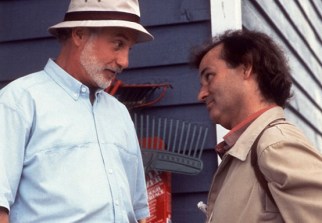
The film hinges entirely on Murray and Dreyfuss, and both are excellent in their respective roles. Murray portrays Bob’s mental health struggles early on in a way that would garner wider praise for accuracy if this were a drama, showing the potential he’s only unleashed in more recent years to play straight roles. But he’s equally good as the film becomes a clear-cut comedy: Bob doesn’t suddenly become a caricature, but is revealed as a good-natured, child-like, fun-loving person who, perhaps, just needs some care and love from others to help his conditions. Dreyfuss, meanwhile, is slickly believable as the uncaring fame-minded therapist, whose true nature — and problems — begin to unravel the more he’s confronted with Bob.

What we see here is that the apparently-afflicted patient is actually in a pretty good place (almost), while the apparently-perfect doctor is actually on the verge of a complete collapse (which, of course, he ultimately has). If it feels a little like a stereotyped plot arc, I’m not entirely certain why; and What About Bob? plays it out with enough truthfulness and humour to make it entirely palatable.

Believe it or not, some side with the psychotherapist, viewing Bob as a damnable annoyance that no one but Dr Marvin can see. It’s an interesting way to view the film, certainly, but I suspect whether you ‘side’ with Bob or Dr Marvin says more about you as a person than it does about the film, the characters or the performances. It seems starkly obvious to me that Bob is the ‘good guy’, a nice but troubled chap who just wants to get by and have a good time, while Dr Marvin is a control freak with a raft of suppressed problems that are gradually unveiled throughout the film until they ultimately overwhelm him. He’s not a bad chap per se, but he is in the wrong.
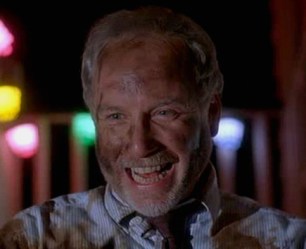
What About Bob? seems to have been forgotten — I’d never even heard of it until it was on TV at the tail end of last year — but that’s unfair. I can only assume it stems from those people who seem to have misinterpreted it, because such a misinterpretation must make it quite an awkward experience. Seen correctly, however, What About Bob? is a funny, heartening, feel-good comedy that deserves to be better remembered.

4 out of 5

Anatomy of a Murder (1959)

2010 #11
Otto Preminger | 154 mins | TV | 12

Anatomy of a Murder is a courtroom drama, adapted from a novel by a real-life defence attorney (“defense attorney”, I suppose), who in turn based his fiction on a real case. This background not only adds to the veracity of what we see, but likely explains the film’s style and structure.
The story is intensely procedural: we meet the lead character, defence attorney Paul Biegler (James Stewart), moments before he first learns of the case; leave the story almost immediately after the verdict; and in between, every single scene is bent to Biegler’s research and the trial itself. It’s so thorough, accurate and real that it is (reportedly) still used as a working example in law education. The complete lack of flashbacks or definitive truth is a perfectly judged part of this: we only know what Biegler would; only hear what would come up in trial; can only be as certain as he and the jury are of the motives and testimonies of all involved.

By the end we have a verdict from the trial, but Preminger leaves what happened slightly ambiguous. We know what everyone claims happened and the facts of what little evidence there is, but there’s still room for interpretation. Despite this, Preminger, Stewart and screenwriter Wendell Mayes have us rooting for the murderer and his attorney by the end: Biegler’s case may be dubious, the man he’s defending likely guilty, but the moment he casually hands over the law book that contains the case-turning precedent is almost victorious; and the moment where the final witness is cross-examined had me literally sitting forward in my seat (this, I should point out, is not a regular occurrence), just waiting for the irritatingly slick and cocksure A.D.A. to ask that one question, fatal to his prosecution… and when he finally does, and receives the answer that we know is inevitable — and, crucially and brilliantly, so does a suddenly-unobjecting Biegler — is triumphant. It’s a perfectly constructed climax to a perfectly constructed tale.

A lot of this support is down to Stewart’s performance — it feels wrong to be cheering the defence counsel of a murderer, even if he had a justifiable motive (which, remember, he may not have) — but we’d probably cheer Stewart on if he was the murderer. His Biegler is always in control, from investigation to courtroom, even when by rights he should be completely out of it. He manipulates the judge, the prosecution, the jury and the crowd to perfection; the viewer sits by his side — we know he’s playing them so we can revel in it — but, in turn, he manipulates us too, tempting us to his team — to laugh at his jokes, to support his case, to loathe the prosecution, even though they might be right. It’s a stellar lead performance.
But in the face of this no one drops a trick — the cast are without exception fabulous. Lee Remick is stunning as Laura Manion, a case of truly faultless casting as she plays every femme fatale-esque beat to perfection. From forthright temptress to harassed and frightened under the glare of cross examination, she is never less than wholly believable. Her performance is second only to Stewart’s by default. Then there’s George C. Scott as that A.D.A., pitched exactly right between slimy and righteous, quiet and controlled at all times, apparently aware that Biegler is playing everyone but unable to prevent it — and most certainly not above using equally underhand tactics.

I could just as well go on to praise Ben Gazzara, Arthur O’Connell, Eve Arden, Brooks West, even the smaller roles occupied by Kathryn Grant, Orson Bean, Murray Hamilton and others. Some criticise Joseph N. Welch’s judge, and it’s perhaps true that his performance is a little less refined than the others, but as a slightly eccentric judge he comes off fine. And to round things off, there’s an incredibly cute dog. Mayes’ screenplay is a gift to them all, finding room for character even within the ceaselessly procedural structure, using small dashes of dialogue or passing moments to reveal and deepen each one.
There are police and legal procedurals on TV all the time these days, but that doesn’t detract from the powerful screenplay, acting and direction here. Perhaps it’s the realism, perhaps it’s a collection of filmmakers at the top of their game, but even after innumerable 45- to 90-minute chunks of this kind of thing being served up several times a week, Preminger and co can keep it thoroughly engrossing for a full 160. I can’t think of a current TV show that could manage the same feat. Absolutely brilliant.

5 out of 5

Anatomy of a Murder placed 4th on my list of The Ten Best Films I Saw For the First Time in 2010, which can be read in full here.

And the Oscar for Best Picture… of 2007…

You may’ve noticed that it’s the 2010 Oscars this Sunday (technically Monday over here), finally bringing an end to the tale of movies from 2009 (Empire have their awards a while later, which is pushing into the pointless — OK, they’re never going to become an Oscar-predictor by moving up in the schedule, like the BAFTAs aimed for with their pre-Oscar move; but how many people still care about last year by the time we’re a quarter through the next?)

It seems appropriate timing, then, to finally publish this group of reviews for (most of) 2007’s Best Picture nominees (a ‘feature’ I’ve had in the planning for well over a year — oops). Yes, it’s two ceremonies ago, but it’s the best I’ve got.

So, in alphabetical order… with the exception of the winner… which, by coincidence, puts them in reverse viewing order for me… Anyway, here are the reviews:

2010 #25
Juno

“There’s underage sex, swearing, numerous displays of teen independence, divorce, love of rock music and horror films… All that’s missing from a Middle American Mom’s worst nightmare is drugs (there’s no violence either, but we know them there yankees love a bit of that).” Read more…

2009 #87
Michael Clayton

“The obvious point of comparison is Damages, the excellent TV series that also concerns such high-profile big-business lawsuits, but… Damages sustains it for over 9 hours, replete with cliffhangers and plot twists so far beyond what Clayton’s straightforward story has to offer that Gilroy isn’t even dreaming of being that good.” Read more…

2009 #7
There Will Be Blood

“not to say it’s a bad film, but it is at times a baffling one… I can’t help but wonder if I missed something crucial along the way because, even after two and a half hours, I had no real idea what the film was about.” Read more…

And the winner, of course, was…

2009 #5
No Country for Old Men

“it’s really about Fate, randomness, chance. Some clearly think this brilliant; I remain unconvinced. It lacks satisfaction. Maybe that’s real life — no, that is real life: random and lacking closure and satisfaction. But this isn’t real life, it’s a movie” Read more…


Of the five Best Picture nominees from 2007, the only one I gave five stars was Atonement. As the only one I watched around the time, such a score may’ve been boosted by BAFTA hype and its Britishness, while perhaps the likes of No Country have, conversely, been ruined by their extended hype.
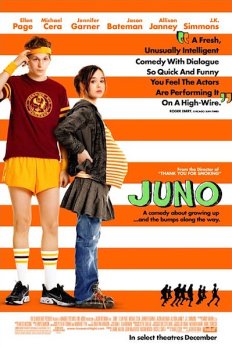
On balance, the film I most enjoyed from the line up was Juno; but does that make it best? Depends what you’re looking for, I suppose.

Juno (2007)

2010 #25
Jason Reitman | 92 mins | DVD | 12 / PG-13

This review contains minor spoilers.

Juno followed in the footsteps of films like Sideways and Little Miss Sunshine to be the token Little Indie That Could among 2008’s Best Picture nominees. It was also the highest-grossing film on the list, no doubt thanks to America’s abundant Christians thinking it was all about an anti-abortion message. I’m sure these conflicting facts (the indie-ness and top-grosser, not the Christian thing) say more about the Oscars’ nominating form in the past decade than they do about Juno.
Fortunately, there’s enough to Juno to allow it stand up for itself. The most discussed aspect is Diablo Cody’s screenplay, with its idiosyncratic slang-laden dialogue and accusations that every character speaks the same. The first is true, the latter is rubbish, and one has to wonder if whoever thinks it watched beyond the first ten minutes. Most of the film’s teenage characters speak similarly… in that they use the same bits of slang, have similar speech patterns, employ a similar sense of humour — you know, like groups of teenagers tend to. Their related adults speak broadly similarly, but also differently; the higher-class couple Juno chooses to adopt her baby to speak differently again — but none are pathetically “I am trying to sound different”-different like you can find in weak writing. It’s just natural. I struggle to see how anyone can honestly say that all the characters “speak the same” in a way that isn’t true to life. Perhaps Cody has generously made Juno and her fellow teens wittier and quicker than the real-life majority, but this is a scripted drama and that’s what happens to your hero characters.

Cody’s dialogue, and what the cast do with it, are the film’s standout aspects. It’s quite a wordy screenplay, so it’s good that it’s a joy to listen to. The realistic overuse of slang by some characters occasionally greats, but the plentiful laugh-out-loud beats more than make up for it. The “I wish I’d say that” quality in some of Juno’s responses to familiar situations quickly make her an identifiable, memorable and loveable character, expertly played by Ellen Page — lead roles like this and Hard Candy show she’s one to watch, and add another mark against X-Men 3 for wasting her talents on such an insignificant (in the film) part.

Every supporting part is equally pitch-perfect: J.K. Simmons’ endlessly supportive father; Allison Janney’s stepmom, granted a gift of a rant at an ultrasound operator; Jennifer Garner’s earnest, desperate wannabe-mother; Olivia Thirlby’s teacher-loving best friend. Jason Bateman redeems himself in my eyes from his not-Marc-Warren turn in State of Play, while my pre-judgement of Michael Cera (Superbad? Year One? They sound dreadful) is half erased by being good as an appropriate-but-still-niggling character (Mr MacGuff and Leah summarise it best: “I didn’t think he had it in him.” “I know, right?”)

The film’s success in America is slightly baffling, which is why I merrily attribute it to Juno considering an abortion and then turning away. There’s underage sex, swearing, numerous displays of teen independence, divorce, love of rock music and horror films… All that’s missing from a Middle American Mom’s worst nightmare is drugs (there’s no violence either, but we know them there yankees love a bit of that). The whole thing worries the boundaries of its 12 certificate, I’m sure (being a recent film, the BBFC explain/justify), not that such things affect its quality as a film.

The backlash against Cody’s screenplay had me all prepared to find Juno a samey, wannabe-cool and lacking experience, but it isn’t. It’s consistently funny, occasionally moving, and only infrequently irritating (usually when it comes across as stereotypically indie). As the comedy-indie entry in the Academy’s 2008 choices, its worthy of its predecessors, and I consider that praise indeed.

4 out of 5

The Man Who Sued God (2001)

2010 #3
Mark Joffe | 97 mins | TV | 15

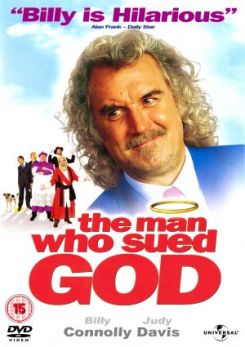
The Man Who Sued GodI always assumed this was British, probably because it stars Billy Connolly and has a suitably quirky premise — one can see it fitting in with the school of British comedy that’s brought us The Full Monty, Saving Grace, Kinky Boots and the like. But no: it’s actually very much Australian, which, considering its suitably quirky premise and that it stars Billy Connolly, isn’t that surprising either. And director Mark Joffe’s best-known/most-seen other work must be the first 10 episodes (ever) of Neighbours, which just cements the Anglo-Antipodean relation.

Country-of-origin is immaterial though, and what’s important is that The Man Who Sued God is funny, and righteous, and silly, and fantastical — in an “oh, if only it were true!” way — because in reality any such case would likely be laughed out of court and the insurance companies allowed to continue with their sorry and disreputable business. And some of these things which meant I loved it — the “only in a film” moral victories, the sillification of the church(es), and so on — will mean others hate it, or at least view it as a mediocre effort.

There’s a place for realist films — those that remind us of the constant victory of big nasty corporations, or obey the likelihood of the unjust justice system, and so on — but there’s also a place for the more life-affirming, the stories where the impossible happens and the ‘little man’ with a good point to make happens to encounter a like-minded system that means he can ultimately win through.

And putting the church in a position where their only sensible defence is to prove God doesn’t exist is always going to make for a good story.

4 out of 5

His Girl Friday (1940)

2010 #2
Howard Hawks | 88 mins | TV | U

His Girl Friday is an acknowledged classic — 19th on the AFI’s 100 Years… 100 Laughs, 58th on Empire’s 500 Greatest, 106th on They Shoot Pictures’ 1,000 Greatest, 245th on IMDb’s Top 250, preserved by the US’s National Film Registry, and countless other such accolades — so you probably don’t need me to tell you why it’s so good. But it really, really is.

The dialogue flies at phenomenal speed, dragging an ever-changing plot along with it, the funny lines at times literally on top of each other as they tumble to get out. No modern comedy would dare move so fast. It’s clever and witty, the characters apparently in on the joke too, and despite some black plot points it’s always hilarious and, somehow, never disrespectful.

If you ever meet anyone who claims all old black & white films are slow, simple and boring, show them this. And if you ever meet anyone who hasn’t seen this, show them it; and if you haven’t seen it, watch it; because it’s brilliant, and, despite being on so many lists, one wonders if some rate it too lowly.

5 out of 5

His Girl Friday placed 7th on my list of The Ten Best Films I Saw For the First Time in 2010, which can be read in full here.

A ¼ through 2010

I’ve probably overdone this ‘gag’ already (either that or it’s on course to be A Grand Tradition), but I’m going to allow myself a bit of self congratulation on this occasion.

After only just scraping to 100 films in 2008, and falling notably short last year, it’s good to find things finally going well: as the title may’ve led you to guess (considering we’re about 31 days away from genuinely being a quarter of the way through the year), I’ve already made it to 25 new films seen this year. Hurrah!

Number-wise, I should’ve made it to just 16 by now (“should’ve” meaning “if I wanted to hit 100 on New Year’s Eve moving at a regular rate”). Last year I’d reached a pathetic 7 at this point — 9 short, where this year I’m currently 9 ahead. It’s like some kind of symmetry. In 2008 I was still short at 12, while in the first year — which ultimately totalled 129 — I’d made it 21. Hopefully, this bodes well.

(To put it in a different context, in other years I reached 25 in mid March 2007, early May 2008 and mid May 2009.)

Pat on the back over, it’s back to actually watching films. 25 in two months — 150 by the end of December? Well, we’ll see..

Exiled (2006)

aka Fong juk

2009 #68
Johnnie To | 104 mins | TV* | 15 / R

ExiledThere are times when one feels under-qualified to review a film in a way that gives it its due. This happens particularly frequently when one’s blog covers first-time viewings of films that are often classics/significant/beloved/etc. My appreciation for Exiled has been increased by two other, more qualified, reviews: one from DVD Times, the other from Heroes of the East.
Having never seen a Johnnie To film and not being sure quite what to expect — either from the director or from what appeared to be a gangster/action film being shown on arts-centric BBC Four — my first reactions to Exiled were a little muddled. Having pointed you in the direction of those other reviews — which I should say I agree with, in the sense that they’ve changed my perspective on the film and leave me with a desire to see it again in light of their comments — I’ve decided that, instead of my own review that tries to conglomerate my initial thoughts with the additional perspective I’ve since gained (and which is best presented in those other articles), I’ll once again turn my notes into sentences and offer it up for your consideration.

The length of the sentences and clauses in the above paragraph suggest I’ve read too many academic essays in the last 24 hours, so I’ll just clarify: What follows are, essentially, my notes after first viewing. I’m not wholly in agreement with some of it anymore; with the exception, of course, of the score.

Exiled features several impressive action scenes. They’re Leone-like in the way there’s often an extended pause, the threat of violence hanging in the air — then a sudden burst, over quickly. But within this style there’s a lot of visual flair — unlike Leone, slow motion makes the moments last minutes, underlined by the entire climatic shoot-out taking place in the time it takes for a can of Red Bull to be kicked in the air and drop back down. As many a teenage boy watching would no doubt say, “cool!”

Elsewhere in the coolness stakes, Anthony Wong owns the sunglasses-and-trenchcoat look, appearing as a cross between a middle-aged businessman and a stylish hitman. Francis Ng looks equally cool, but in a more ‘traditional’ way. Quite what the ‘cool’ aesthetic does for the film/story/characters I’m not sure, other than increase its accessibility.

Dialogue is kept to a minimum, appropriately. Whole character arcs and motivations pass by without a word of explanation, allowing the viewer to fill in the gaps. It works just fine — there’s no need to spell them out, and they’re not so obscured as to be baffling. There’s an audacious twist around halfway through, which removes the apparent point of the plot and suggests it’s all really about something other than the obvious. [This in itself should be a sign that a lot of what follows in my comments is rubbish…]

Is the story just an excuse to link the spectacle of action? [This, I think, is where my notes really lose the plot.] Yes and no. The story is hardly revelatory, nor is there a great deal of character exploration (or any, in most cases) to suggest To is aiming for a different angle on a familiar tale. But while the action set pieces are exciting and visually engaging, they’re not so unusual as to suggest someone conceived of them and then a story to connect the dots. Is it style over substance? [No.] Again, to an extent. I suppose there’s not a great deal of substance, and there is quite a bit of style; though, again, the latter isn’t as show-off-y as style-over-substance films usually are.

Alternatively, I suppose the plot is quite shallow [it isn’t really]: even things that suggest stories and development — such as Boss Fay weighing in on Boss Keung’s territory — don’t really develop into much, instead becoming a backdrop for who’s shooting at who when.

Whatever it is, it’s entertaining. Especially if you like people shooting at each other in cool ways and gangster-based thrillersome plots.

Note the dramatic device of the photos [which, I think, in themselves disprove my ponderings that the film lacks depth]: the first shows the characters when young, at the beginning of their ‘career’; the second is at the start of this story, effectively being the midpoint/bulk of said ‘career’; and the last one is at death, the end of this ‘career’ — though it’s the same group in each, they’ve all changed between every photo, even the last two taken just days apart. It’s a relatively subtle but effective motif.

So much for my unadulterated notes. Anyway:

4 out of 5

Director Johnnie To’s 2012 film Drug War is on Film4 tonight, Thursday 15th January 2015, at 1:15am.


* BBC Four showed this in 16:9, but the OAR is 2.35:1 — and it showed, with compositions often looking cropped. Shame. ^

Deja Vu (2006)

2010 #24
Tony Scott | 121 mins | DVD | 12 / PG-13

This review contains spoilers.

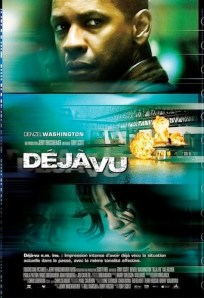
Deja VuDenzel Washington and Tony Scott have now served as star and director (respectively, as if you didn’t know) on four films, with a fifth on the way. As director-star relationships go it’s hardly Scorsese-De Niro or Burton-Depp, but I’m quite a fan of Man on Fire and I remember Crimson Tide being pretty good, so one can’t complain. (This whole “regular director-star relationship” thing had higher significance in my head. Anyway…)

Deja Vu is about a terrorist attack that Washington’s character, an official from the Bureau of Alcohol, Tobacco, Firearms and Explosives (a natural combination only in America; known as the semi-logical AFT for short), isn’t really investigating. But he is a bit, because otherwise the story wouldn’t get started. Once it does, he gets recruited by Val Kilmer to the FBI team that are actually investigating the disaster, and they reveal a mysterious bit of kit to him… which some other review has probably already spoiled for you, so I will too: they can see precisely 4 days and 6 hours into the past.

How can they do this? Well, somewhat surprisingly, screenwriters Bill Marsilii and Terry Rossio (and, one must suspect by extension, Ted Elliott) have bothered to string together a selection of scientific concepts you may have heard of in order to explain it. Essentially, it’s an accidentally-created wormhole. It has loads of rules. I won’t explain them. The most significant is, you can’t send stuff back through it; you can’t change the past. And by “rule” I mean “thing set up to add dramatic tension when it comes time to contradict it in the third act”.

Deja Vu’s timey-wimey plot is quite fun, in some ways. Massively over-complicated — no one will blame you for switching off as the “how it’s done” technobabble washes over you; if you just accept this is all possible within the confines of the movie’s universe, there’s enough investigative thrills to sustain proceedings — but, if one does pay attention, a lot of it makes sense. Well, enough sense. It becomes a bit unravelled toward the end, unless you choose to believe this even more complicated theory, which uses a scant array of clues from the film — plus the desire/need to explain the plot logically — to come up with a cohesive theory that covers all kinds of stuff happening before the film even begins.

…so, I was meant to be explaining why it’s fun. Well, there’s a car ‘chase’ that takes place in both the past and present simultaneously, allowing Scott to indulge in some of his usual cars-flipping-for-no-reason show-off-y-ness (who doesn’t love a car flipping? Especially if it then explodes!) There’s also lots of narrative hoop-jumping, with plenty of clues littered through the first two acts that are paid off in the third. One of the film’s saving graces is that Scott, Marsilii and Rossio don’t spell most of these out for us — Washington doesn’t get up and say, “oh, that explains how the ambulance got here and then the building exploded and he must’ve cut your fingers off because you scratched him and [so on through numerous other minor semi-relevant clues]”; the audience are allowed to think all of this for themselves. Which is nice, because it’s obvious, but blockbusters too often just state the obvious these days. But I suppose when your central conceit needs explaining several times in lengthy dialogue scenes you assume the audience will be paying enough attention to catch the regular complications of standard film-narrative construction.

Deja Vu is kinda nonsense, then, albeit nonsense that some people have put a lot of thought into trying to explain. In spite of this, I quite enjoyed it — Washington is always likeable, the rest of the cast are up to the task of arranging themselves around him, and the connect-the-dots narrative is suitably engrossing. Factor in that Scott has toned down the visual trickery he pushed to eyeball-melting extremes in Man on Fire and Domino, and you find a half-decent sci-fi-ish thriller-blockbuster

It’s also the second film I watched in as many days featuring Friends’ Adam Goldberg playing the character he always plays in a story decisively set in New Orleans. Déjà vu indeed.

4 out of 5

BBC One have the UK TV premiere of Deja Vu tonight at 10:35pm.

Despite the sustained objections of my spellchecker, this film is not called Déjà Vu (on screen). I know, I’m a pedant.

Frankenstein (2004)

aka Dean Koontz’s Frankenstein

2010 #22
Marcus Nispel | 84 mins | DVD | 18

FrankensteinFirst, a little note on that aka: technically — and, I believe, legally — no such title is attached to this project. However, the initial idea was developed by Koontz and, after he left the project, adapted into his Dean Koontz’s Frankenstein series of novels. Despite the ‘creative disagreement’ (or whatever they chose to call it) that led him to walk away, the film retains significant similarities to the first book. More on these in a moment.

So, this version of Frankenstein is a made-for-TV movie/series pilot (that’s taken six years to find its way to British TV, apparently — in case you didn’t know, the series wasn’t picked up). According to the blurb on my DVD, it’s a “contemporary retelling of Mary Shelley’s gothic horror classic”. I guess no one in the publicity department actually watched it. In actuality it’s more a sequel to Shelley’s novel: Dr Frankenstein has somehow survived to the modern day and emigrated to New Orleans, where he continues his experiments, while his original monster, now going by the name Deucalion, has tracked him down in the name of justice. Or something. Maybe they should’ve just started from scratch… then again, look how that worked out.

Thanks to Koontz leaving the project midway through its conception, it’s difficult to accurately explain the relationship between the novel and the film. This isn’t an adaptation, certainly, but nor is the novel a mere novelization. Most of the official comment on the novel/film relationship is along the lines of this, taken from the current iteration of the book series’ Wikipedia entry: “Koontz withdrew from the project over creative differences with the network, and the production continued in a different direction with similar characters and a modified plot.” Perhaps this is what Koontz would like viewers/readers to believe: that the novels are his undiluted vision, while the film most certainly is not. Well, don’t believe him.

Watching the film having read the book (a couple of years ago), this feels like a faithful adaptation. It comes with the usual caveats of condensing a c.400-page novel into a sub-90-minute film — certain elements are foreshortened, others tweaked, others abandoned — but in terms of the primary plot, the characters and their actions, it’s all incredibly close to the series’ first novel. I hesitate to say “exactly the same” when I’ve not read it for years, but it wouldn’t surprise me if whole scenes and dialogue exchanges match perfectly.

What this also means is that the film suffers from some of the novel’s flaws, when taken as a standalone work. Dr Frankenstein — now Dr Helios, for what it’s worth — is introduced but remains a background figure, only peripherally connected to this episode’s serial killer plot. In this its intentions as a pilot couldn’t be clearer, and with an ending that’s part cliffhanger, part “the story continues”, it’s as clear as in the novel that this is far from over. Other than there not being a TV series or any sequels, that is. (Though if you want to know what happens, there are already two further novels — and three more planned — that continue the story.)

The film itself isn’t badly produced. Marcus Nispel’s direction seems heavily influenced by Se7en, all dark and grainy and very, very brown. Even the title sequence, with its juddery extreme close-ups and pulsating grungy soundtrack, feels borrowed from Fincher’s masterpiece. The cast are fine: Michael Madsen and Adam Goldberg play the same parts they always play, Parkey Posey leads well enough, and as Deucalion, Vincent Perez is… adequate. Thomas Kretschmann’s Helios is the closest the film comes to an outstanding performance; knowing the events of books two and three, one almost longs for sequels to see Kretschmann’s cooly dominant Helios disintegrate as Everything Goes Wrong.

All things considered, Frankenstein is probably best viewed as a compromised curiosity. It’s certainly not a wholly satisfying experience in itself, but those interested in Koontz’s series may find it a nice way to test the waters without having to plough through a whole novel, while those who have read the novel may find it interesting to see one part of the story committed to film. Or, of course, they may find it irritating that it’s not how they imagined. I fall into that middle category; those with no interest in the books or who hold them too dearly may wish to knock a star off this score.

3 out of 5

Five have the UK TV premiere of Frankenstein tonight at 11:25pm.