2011 #30
Matt Reeves | 116 mins | Blu-ray | 15 / R
This review contains major spoilers.
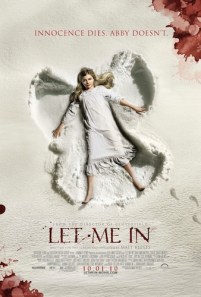 Owen is a 12-year-old loner in New Mexico in 1983, spending his days at school being bullied and filling his evenings spying on his neighbours. Then a girl, Abby, and her father move in next door and it looks like he might finally make a friend.
Doesn’t sound like the setup for a vampire movie, does it? Unless you’ve seen Let the Right One In, in which case it’s very much the-same-but-different. Indeed, it’s so much the same that one’s thoughts naturally gravitate to the occasions where it does differ. This may be doing the film a disservice, but I’m tempted to say “serves them right” for remaking it so damn fast and making it so damn similar. Some have asserted that it’s the same film for those who can’t handle reading subtitles. It’s not that bad, but you can see where they’re coming from.
Writer-director Reeves establishes that this isn’t exactly the same from the start: we get a title card to inform us it’s 1983, whereas the original left the era almost incidental as background detail; and then it begins halfway through the story. This is presumably because it’s a recently-made American/Hollywood low-key genre film and that’s one of their rules. It also introduces a new character, a detective who will play a larger role in the film that follows. Not that large, though; fore-fronting him in this way draws attention that he might not garner otherwise. Is it deserved? Debate among yourselves.
 The nighttime scenes are bathed in the orange glow of street-lighting, a nice choice of colour scheme as it’s evocative of the real world, especially as it’s not unnaturally overdone: the colour is abundant where there is such lighting, but more natural tones are used in forests, etc. It also provides a very different feel to the original, where a more white, snow-emphasising light was adopted throughout. Despite its realism, though, such a solidly orange palette does make the US one feel more visually stylised. Ironic.
Secondary adult characters are pared back (with the exception of that police officer). Owen’s parents are all but removed — you never really see his mum’s face and only hear his dad down the phone — and they all seem to have roles (teacher, neighbour, etc) rather than names. The fact that some key characters are stripped of their names — most notably, Abby’s ‘dad’ — while others retain theirs (as per the credits, at least) makes it seem like a thematic point that wound up half-arsed. Reeves makes minor additions to the story elsewhere. We visit the pool earlier, for instance, where Owen doesn’t swim, which makes the climactic pay-off even sweeter.
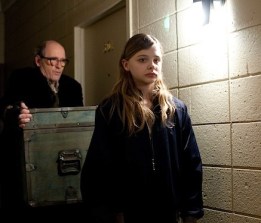 Despite it being easier to spot omissions than additions, Reeves’ film runs the same length as the original and feels faster moving. This may just be because I knew the story well, watching both versions just 24 hours apart, but some things are quantifiable: as well as far fewer scenes with the neighbours — in the original, characters; here, victim-extras — there’s also fewer arty shots of scenery, which helped give the original its sedate arthouse tone. What’s taken the place of all these things? Scenes from the novel, you might think, but from what I’ve read it’s faithful to the film more than novel — stuff I’ve read about being in the novel but not the Swedish film hasn’t been reinstated here either.
There are some notable changes to significant traits of the main characters: Owen finding very old photos of Abby with another boy suggests this is definitely her helper-finding MO; Owen is no longer obsessed with death (no file of newspaper clippings) and doesn’t carry his knife as much — for instance, when the policeman finds Abby asleep in the bath, instead of threatening him with the knife Owen just says “wait!” Minor tweaks? Maybe, but I think it removes some nice nuance, complexity and ambiguity.
Another notable change is the sexual element. It factors even earlier, with Owen voyeuristically observing it all around him — spying on neighbours as they begin to get it on, watching a young couple kissing in the shop, etc. 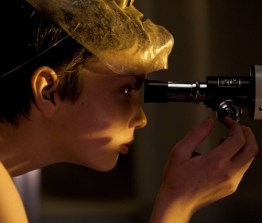 It seems he isn’t innocent in the same way Oskar was, that Reeves is building up his awareness of sexuality… but then he asks Abby to go steady and he still considers it to mean you don’t “do anything special”. What? Also, if she says “I’m not a girl”, surely the logical response is “you’re a boy?!”, not “what are you?” — especially if the only answer she’ll give is “I’m nothing”. But she’s not a boy — probably. It’s not explicit, but she seems much girlier, and of course it would remove any dangerous homosexual element. Or possibly they just wanted to make damn sure they didn’t need to include The Crotch Shot. Considering they’ve changed the bully’s teasing of Owen from “piggy” to “little girl”, it seems even more obvious a shame to have stripped Abby of her androgyny. Unless that’s the point? They tease Owen about being a little girl, before getting their asses kicked — or, rather, bodies ripped apart — by one.
The worst thing about Let Me In, though, is that any time there’s a scene that’s a direct lift from the original, it feels less well played, by the director, by the cast and sometimes, despite the faithfulness, by the screenplay. The aforementioned swimming pool climax is a case in point: the original version is perfect, but directly copying it would be a no no, so instead Reeves jazzes it up… and, unsurprisingly, it doesn’t work half as well. You can’t improve on perfection.
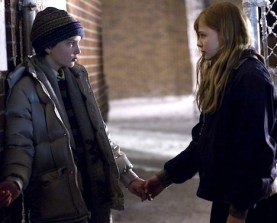 Similarly, the CGI is overdone throughout. It’s not bad per se, just used too overtly. Whereas the original remained grounded and (perhaps surprisingly) plausible, Reeves occasionally indulges in more stereotypical horror movie excess — take Abby’s first attack in the underpass, for instance: superficially similar, but in this version a computer-aided Abby flies all over the place. It draws attention to its has-to-be-fakery and is therefore a less effective sequence.
As I mentioned in my other review, choices for cuts to the novel for the original adaptation were partly about getting it past censors but also about making the story work as a film, and all were made by the original author. This is probably why Let Me In reproduces the film version so faithfully, rather than re-adding bits from the novel: when the original author has already approved cuts, why re-do the job? The answer might be “to offer something different” — a valid consideration, I think, when you’re remaking a work so soon after the original — but you can see why Reeves didn’t. Of course, being American, it censors the tale further (losing any potential homosexual undercurrent, references (visual or otherwise) to castration, etc).
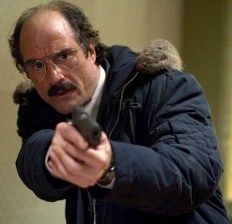 It’s probably unfair to judge Let Me In by watching it so close to the Swedish version. I expect it benefits from a bit of distance. It’s still a well-made film, still an unusual take on a familiar genre. But it is — obviously — not as original or innovative. It’s also not as well acted, not as nuanced, not as beautifully made — the images Reeves conjures up do not burn themselves into your mind in the way so many from the original do.
If you’ve not seen the original, I’d wager it comes across a lot better. But do yourself a favour and watch the original first — you wouldn’t want the inferior version to ruin any of its surprises, would you.
See also my comparison of this and the Swedish original, Let the Right One In, here.
Let Me In is out on UK DVD and Blu-ray today.
The UK TV premiere of Let Me In is on BBC Two tonight, Sunday 11th January 2014, at 10pm.


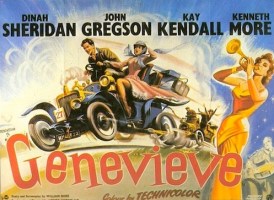 The further behind one gets on reviews, the easier it becomes to forget a film. Or not so much forget the film itself, but when one watched it. Or, to put it another way, I was a little surprised when I looked back over the 20 films I had left to review and saw Genevieve still there. At least I had a hundred or so words of notes for this one.
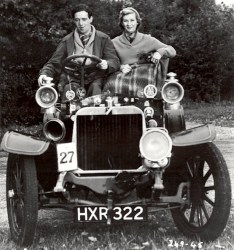 heightened by an evening of irritations and revelations, tipping the second half’s journey-back into an out-and-out race. It’s the second half that contains the more overt comedy as the rivals compete to scupper each other’s chances. That’s not to do down the more gentle style of the opening half, which has its moments. That said, depending on one’s perspective, the realistic sparring of the married couple during the opening scenes might be seen to give the film a bit of an edge of reality, making it not just the staged, (relatively) high-concept comedy it could have been.
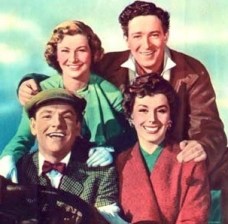 Director Henry Cornelius was vetoed on most of his first [casting] choices… and he was forced to make it at studios he didn’t want to work at. Cornelius’ displeasure was acutely felt by cast and crew as he didn’t hide how unhappy he was. He was also seemingly highly lecherous. Consequently both Dinah Sheridan and Kay Kendall carried whistles on them at all times… Olive Dodds, Rank’s head of contract artists, later testified that every leading cast member came to her at one point and said they wanted off the film.”
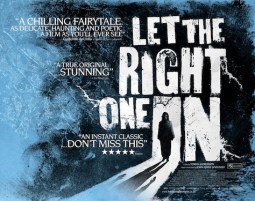 The most recent example of this speedy-remake phenomenon is Swedish vampire drama

 in fact, the director is keen to point out (in a surprisingly unpretentious fashion) that he doesn’t aim his work to slot into any particular genre — while Reeves set out to make a horror movie first and a young-love drama second. Though don’t go expecting out-and-out vampire thrills and gore from Let Me In, because it retains enough of the original’s DNA to make it still a pleasantly unusual genre entry.
 Oskar is a 12-year-old loner in Sweden in 1982, spending his days at school being bullied and filling his evenings with fantasies of revenge. Then a girl, Eli, and her father move in next door and it looks like he might finally make a friend.
 For instance, when the usual skills do crop up, they’re presented in a very grounded way — any CGI required is used subtly and incredibly effectively — or kept off screen. They’re at the best when used to slightly emphasise Eli’s weirdness — the way she drops ever so slightly slower than is natural from the climbing frame when she first meets Oskar, or to shape and manipulate her face almost imperceptibly at times.
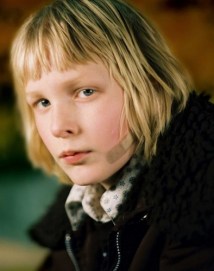 The story’s central relationships — mainly, Eli/Oskar and Eli/Håkan, he being the ‘dad’ figure who helps Eli survive — can be read various ways. The author/screenwriter, John Ajvide Lindqvist, has one interpretation — indeed, based on what I’ve read, the novel is quite clear on these points — but the film leaves many facts ambiguous. Is Håkan related to Eli? Does he love her? In what way? Does she love him? Does she even like him? Is he just a facilitator? Was he once in Oskar’s position? If he was, is she just manipulating Oskar? Or is it really love? Or is it just friendship? The joy of such well-placed ambiguities in a story is that each viewer can bring their own interpretation, without anyone being clearly right or wrong and without undermining the quality of the story being told. I think I know what I think; but, just as much, I enjoy the fact there are numerous possibilities. (Of course, equally valid is the argument that there are no ambiguities because most if not all have been cleared up Lindqvist and/or Alfredson in interviews. But where’s the fun in that?)
 Though most of Let the Right One In’s irregular take on vampires seems genuinely unique, one of those unusual elements — a 12-year-old girl being a vampire — immediately draws comparison to
 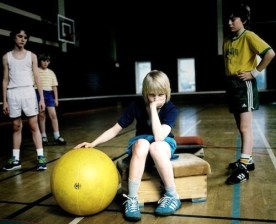 if they’d filmed some of the stuff in the novel, the filmmakers would’ve gone to prison — but also about refocussing the story to be a two-hour film instead of a novel. I’m not sure, therefore, how faithful the climax is, but it’s a sequence that seems made for the screen. I shan’t say much more on this point, just in case you’ve not seen the film and still read this far (tsk tsk), but it seems having a vampire for a best friend is a great way to deal with bullies.
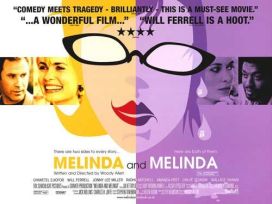 Despite the city being as associated with him as jam is with donuts, Melinda and Melinda was Woody Allen’s last New York-set film before he began his current European phase with London-set thriller
  If it wasn’t for the framing device that clearly tells us not only the thematic point of the film but also which bit is the comedy and which the tragedy, I don’t think it would be immediately possible to tell which was which. Indeed, one might think that was Allen’s point: life is neither tragedy nor comedy, but both at the same time, so of course you can’t tell the difference. But as it goes on the comedy does introduce a couple more laughs, but even more so a general niceness that leads to the predictable rom-com ending. Concurrently, the tragedy introduces darker elements and refuses to provide a neat, conclusive or satisfying ending, which is both thematically sound (I suppose) and also dramatically frustrating.
 and then they’ve crafted them completely independently. So that is to say, for instance, that the same restaurant may appear in both tellings, but at different points and with a different scene taking place; or in one storyline the director-character is an outsider who holds the husband’s future in his hands, while in the other the director-character is the wife and a different outsider holds her future in his hands. If that makes sense.
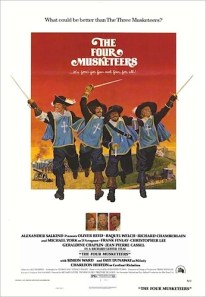 Richard Lester’s Four Musketeers was shot at the same time as the previous year’s
  the murder of Constance; the cold-blooded execution of Milady; and ending up with Richelieu still in power too — none of it sits well with the jolly swashbuckling tone that still dominates. There are some good action sequences nonetheless — for instance, the ice-covered lake; breakfast/siege in the ruined fort; and the burning-building finale — which go some way to make up for the shortcomings.
 I like a good swashbuckler. I don’t know exactly what it is about sword fights, but they’re probably my most favourite kind of action sequence. The 1973 Three Musketeers, then, is a film I’m slightly amazed I’ve not seen before. Especially as I absolutely loved it.
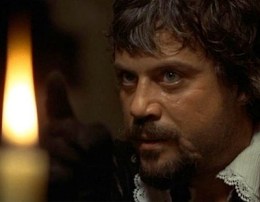
 Thanks to this most of the fights aren’t strictly sword fights, I suppose. Indeed, Oliver Reed seems to dispense with his blade at the earliest opportunity and turn instead to sticks, wet towels, whatever else happens to be at hand. It lends a certain kind of organised chaos to proceedings; the kind that elevates a technically proficient duel into a funny, exciting, memorable segment of cinema. I would list standouts, but instead may I recommend you watch the film and, every time an action sequence starts, count it as one I mentioned. But particularly the one in the laundry and d’Artagnan and Rochefort’s lightbox-lit nighttime duel. And also— Now, this is why I said I wasn’t going to list any.
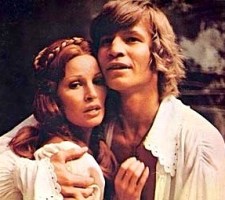 Constance and Faye Dunaway as the conniving Milady de Winter. York earns his place as the lead amongst such company, though, making a d’Artagnan who is by turns athletic, clumsy, hot-headed, loyal, and funny. As I said, everyone pitches the lightness just right, but York perhaps most of all — he doesn’t send up the youngest musketeer, doesn’t make him a pun-dispensing action hero, but finds all the humour in his actions and dialogue.
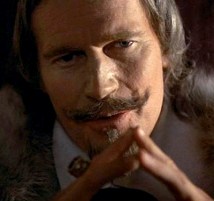 It also means the film ends with a sort of “Next Time” trailer, which feels very bizarre indeed, but is also a tantalising glimpse of what’s still to come.
 #13
#13  #18
#18  I expect you know the setup for The Invention of Lying: in a world very much like our own — except for the crucial difference that people can’t lie — Ricky Gervais invents lying. It sounds a simple, strong concept. I like it.
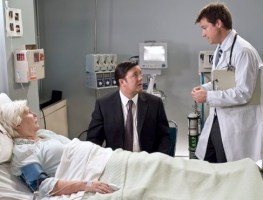 how religion is just a lie we tell ourselves to make us feel happy — and it says this quite explicitly! In an American film!
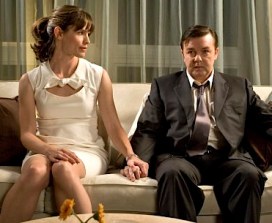 but that would miss the part where Gervais’ character helps her to grow as a person, to see beyond the surface gloss to the real people and situations underneath. OK, it’s not a groundbreaking message, but it suffices.
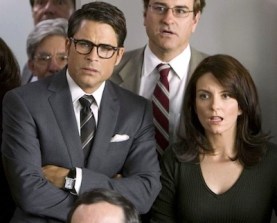 They’re all fine, though the “oh, look who it is!” factor occasionally overwhelms the story briefly. (In the case of Merchant and Barry it’s more “oh, should’ve guessed they’d turn up”.)
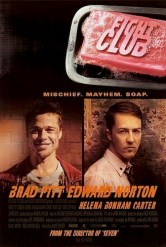
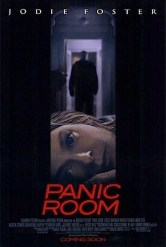
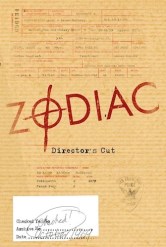
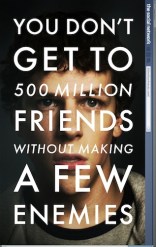
 One thing this week has achieved is re-confirming that Fincher is one of my favourite directors. Another is to remind me that I’ve not seen a single one of his films at the cinema.


 100Films.co.uk