Unknown's avatar

About badblokebob

Aiming to watch at least 100 films in a year. Hence why I called my blog that. http://100films.co.uk

Monsters (2010)

2011 #40
Gareth Edwards | 94 mins | Blu-ray | 12 / R

Six years ago… NASA discovered the possibility of alien life within our solar system.

A space probe was launched to collect samples but broke up during re-entry over Mexico.

Soon after new life forms began to appear and half the country was quarantined as an INFECTED ZONE.

Today… The Mexican & US military still struggle to contain ‘the creatures’…

MonstersSo begins Monsters. Expecting an epic SF-action movie where soldiers kitted out with futuristic weaponry battle an alien menace? You might be disappointed. Indeed, the relatively low IMDb rating suggests people have been. Monsters isn’t an action movie. It’s barely a sci-fi movie. And that’s not a bad thing.

It is a science-fiction movie — it’s set in the near future (about 2017, it would seem) and there is an alien presence on our planet — but this is a science-fiction film that transcends the sci-fi genre. It’s got more in common with Lost in Translation or Before Sunrise than it does with Independence Day or Battle: Los Angeles. This probably explains its low rating on IMDb: I imagine most viewers are SF fans in search of an action/horror experience, something this film resolutely does not provide. It also doesn’t deal particularly with SF concepts, so I can see the more intellectual SF fan being disappointed too.

What it has instead is a real-world aesthetic and a human story. It’s certainly science-fiction, because it’s set in the future and the titular monsters are extraterrestrials, but the story is rooted in humanity: it’s about two twenty-somethings trying to get home and having a very grounded ‘adventure’, learning about each other and the world and all that. Two twentysomethingsOnly without being as worthy or on-the-nose as that makes it sound, I promise. As writer-director, Edwards has made a film that’s relatively Arty (for want of a better word), with lingering shots and wordless scenes. It tells the story visually quite often, letting the Infected Zone signposts or candlelit shrines to dead children or stunning scenery do the talking when dialogue isn’t necessary.
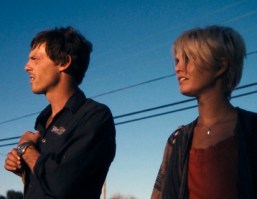
There’s a slight documentary aesthetic to the whole thing, and not only because Edwards (also acting as cinematographer) has shot it handheld — that’s everywhere these days and when it’s unnecessary it pisses me off, but here it fits. Rather, it’s like one of those films which don’t hide the fact the main story and characters are fictional, but has been shot in the real locations and has used real people for extras. Take, for instance, a sequence where Kaulder and Sam (our two twenty-somethings) are in the jungle spending the night with their Mexican escorts. The men talk about what it’s like to live in these conditions, prompted by questions from their American charges, and it plays for all the world like real people really living in this situation telling their stories; like the bit with the fascists in It Happened Here, say. Obviously it’s all fake — we’re not in 2017 and we don’t really have aliens roaming across Mexico (just in case you forgot) — but it plays as real, and that grounds the whole film.

It says 2011 in the filmThe CGI is virtually faultless, which is doubly impressive as the vast majority of it is on shaky handheld shots, not nice clean plates. And Edwards created it all by himself I believe. Writer, director, cinematographer, single-handed visual effects unit — it’s no wonder much of the focus on Monsters has been on the clearly considerable skill of its creator. Much of the CGI would, I imagine, pass the casual viewer by: everyone knows the aliens are CG, but the film is littered with signposts and other such set and scenery extensions. It’s the kind of thing a bigger budgeted film would simply have created physically, but, working with next-to-no money, Edwards has managed to paint flawless versions of everything from simple road signs up to border checkpoints with his computer (and even bigger things, but they’d be CG’d in a big-budget movie too, so… well, hopefully you see my point). There’s the odd thing that doesn’t sit with complete realism, but even that depends how hard you’re looking. I’d say they’re the exception rather than the rule and very easy to forgive — nothing ruins its own shot, never mind the whole film.

Mural

The next paragraph is spoilersome. Not wholly spoilersome — I’m protecting you from yourself a bit, gentle reader — but if you want to go in knowing nothing of the ending, please skip it.

The ending of Monsters is at the beginning. Normally this irritates the hell out of me, as regular readers may have noticed, but Edwards uses the trope to a slightly different effect. For starters, the line is blurred: the film starts with green night-vision footage of a military strike on a creature, before jumping into full-colour ‘the film proper’ with a scene of devastation and the dead remains of an alien — Maskedit’s easy to think what we saw in the night-vision sequence has led to this. But it hasn’t, because the military were Americans and we’re in Mexico. I’d wager this passes some viewers by, and perhaps it’s meant to, but there’s another clue: one of the soldiers whistling the Ride of the Valkyries; and when we get to the end of the film, as a pair of humvees trundle out to retrieve our heroes (by this point stranded in an evacuation zone just inside the US border), we hear the same soldier whistling again. And here’s where the change comes: rather than reaching the bit we’ve already seen and going beyond it, Edwards cuts off before he even reaches it. To put it another way, the chronological end of events is only at the beginning. It’s quite clever, and it also obscures what happens to the characters (how I shan’t say). That’ll irritate some, especially as even when you piece it back together it’s inconclusive. I’ll leave it to others to argue whether that’s the point and whether it matters. The final shot is clever though: instead of closing on the characters’ finally kissing, it ends on them being pulled apart. Technically their separation is only temporary — they’re both going with the military after all — but, as we saw at the beginning, one of them might not survive the journey home; a more permanent pulling apart. Nice metaphorical linking, Edwards.
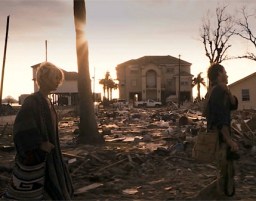
DevastationAnother review I read somewhere commented that it’s a shame the title Aliens was already taken because it would suit this film down to the ground. And they’re right. Damn you, James Cameron! It has to be said, as simple and iconic as “Monsters” is, it doesn’t really describe the film. Perhaps if this was like Spielberg’s War of the Worlds, with every human a bastard out for themselves — “are the aliens the monsters or is it us? gasp!” and all that kind of fairly obvious palaver — it would fit, but Edwards’ film is a bit above that and perhaps deserves a more reflective title. It might also have led to less people being misled — it’s certainly not the kind of film I thought it was going to be when I first heard about it and saw the first trailers. Perhaps the title belonged to an earlier concept of the film, one with less heart; or perhaps there are human monsters in the film after all — the US presence, for instance, is entirely militaristic; we see even less of it than the creatures and it’s arguably more brutal and devastating, and therefore more monstrous and/or alien.

But the issue of the title and expectations are an aside, really, because taken on its own terms — as all films should be — Monsters is a triumph. The word visionary is overused in trailers these days (mainly, Zack Snyder trailers), but with filmmakers like Edwards, Duncan Jones* and Niell Blomkamp** Photoemerging with their low-budget, story/concept-driven genre films, not to mention Chris Nolan being allowed to do more or less what he likes in the big budget sphere, it’s easy to see why this is a very exciting time to be a lover of proper science-fiction. If they all continue to make films like this, we can look forward to an astounding future.

5 out of 5

Monsters is out on DVD and Blu-ray next Monday in the UK. The US Blu-ray is region free, has more extras, and is barely more expensive even with international shipping. Just sayin’.

Monsters placed 6th on my list of The Ten Best Films I Saw For the First Time in 2011, which can be read in full here.

* not that I’ve seen Moon, still. ^
** or District 9. I’m a bad bad fanboy. ^

Cloak and Dagger (1946)

2011 #27
Fritz Lang | 106 mins | TV | PG

Cloak and DaggerA World War II espionage thriller about the OSS — spies, basically, and the forerunner to the CIA. Despite all the thrills this should elicit, especially when directed by Fritz Lang, I wasn’t particularly impressed.

The film has its moments. A fight between star Gary Cooper and a Nazi security chap towards the end is quite good — rather brutal, scrappy and realistic for the period — and the final shoot out is effective too, even if it precedes a bluntly curtailed ending. I don’t know if Lang’s preferred (but rejected by the studio), longer original ending would be any better, but it might not feel so abrupt. There’s also some nice details of how the OSS operated, feeling quite realistic and grounded in truth. No cloaks or daggers hereThis is probably the benefit of being based on a non-fiction book.

A needless love story slows down the middle, however. Nothing wrong with a love story, but this one’s a bit dull. Aside from that and the few flashes of goodness, the rest was a bit pedestrian and lacklustre; certainly not up to the other Langs I’ve seen from his time in Hollywood.

3 out of 5

Cloak and Dagger featured on my list of The Five Worst Films I Saw in 2011, which can be read in full here.

Monkey Business (1952)

2011 #15
Howard Hawks | 93 mins | TV | U

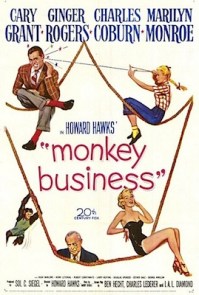
Monkey BusinessMonkey Business came recommended in the Radio Times as a forgotten gem from the ’50s. Hm. And on DVD it’s branded as a Marilyn Monroe film. Hm.

Let’s take the second first: Monroe has a small supporting role. That’s fine, but it makes for some mighty misleading DVD packaging. Luckily that wasn’t why I watched the film. Why I watched the film was the first thing, the Radio Times recommendation. I’m not an expert on ’50s comedies, but I wasn’t convinced this was a “forgotten gem” so much as a decent-enough effort. Comedy-wise it’s daft and silly. That can work, obviously, but it didn’t work successfully enough in this instance, at least for my taste. It’s funny in places but not consistent enough.

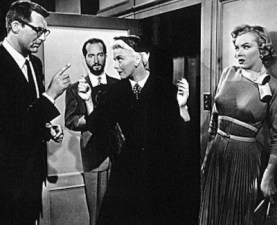
It isn’t helped by the non-existent story arc. The plot sees a married couple accidentally take a youth serum the husband has been developing, causing them to inexplicably start acting younger — much younger. But in terms of the story, we see a happily married couple wind up happily married having been through no real strain. Maybe if they’d been having some differences and their childhood regressions had reminded them how much they really love each other or something, then it would’ve felt a bit more worthwhile. Or if the regressions had forced them apart — in a real way, rather than the brief and vague way it does once or twice — only for them to come back together via whatever means, maybe then it would have felt more coherent. Instead, the story consists of “Cary Grant behaves like a college boy” followed by “Ginger Rogers behaves like a stroppy newlywed” Getting up to... yeahfollowed by “Cary Grant and Ginger Rogers behave like 6-year-olds”.
There are good moments nonetheless — particularly the very meta opening titles — but not enough for my liking. It could do with a bit more speed too — compared to something like His Girl Friday it’s positively sluggish. Though I suppose it’s unfair to try comparing the average to the exceptional.

3 out of 5

Monkey Business featured on my list of The Five Worst Films I Saw in 2011, which can be read in full here.

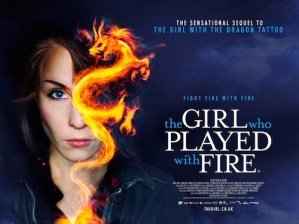
The Girl Who Played with Fire (2009)

aka Flickan som lekte med elden

2011 #39
Daniel Alfredson | 130 mins | Blu-ray | 15 / R

The Girl Who Played with FireCreating any kind of sequel is hard — the endless array of failed attempts is testament to that — but I think creating a direct sequel to a successful crime thriller may be the hardest.

With action movies or superheroes or what have you, the same formula can be rehashed; it’s better if the concept or story is pushed forward, of course, but as most movies in those genres have the same plot regardless of the hero, it stands to reason the sequels can survive it too. With a straight drama you can continue the lives of the characters, throw some new, plausible (preferably), dramatic hurdle in their path and show how it affects their lives. But with a crime thriller…

Almost by definition a good portion of your cast are wiped out: if you didn’t kill them for the sake of a twist, they’re gone because they were tied to the first case. Drag every survivor back at your peril: their mystery’s been solved, and the chance of them all being involved in a new one is too improbable to consider. So you’re left with only the one or two or three investigators, Blomkvist. Mikael Blomkvist.and they need a brand new case to become embroiled in. And it’s got to be as good as the last one, but it can’t be the same because we’ve had that mystery solved. You could have a different solution, of course; you could change some of the details, naturally; but police dramas on TV vary their types of murders every week for a reason. So in your new tale, the new characters have to be just as interesting as the first batch, the new mystery has to be just as intriguing too, and it really ought to be a notably different crime being investigated.

Stieg Larsson’s Millennium trilogy has an advantage here: with Lisbeth Salander as a break-out character, you can take a certain degree of the drama tactic and just throw something new in her path. Plus there’s the only story thread left hanging from The Girl with the Dragon Tattoo, the handful of hints at Lisbeth’s past, to feed off as well. On the other hand, there’s the problem of having sent Salander off to a new rich life at the end of the first book/film. Not only do you have to get her back, you have to re-team her with the investigative driving force of the first tale, journalist Mikael Blomkvist. Unlike a cop and his partner, say, these two have no shorthand way they would have to be reunited. There are other ways — the fact they had developed some kind of sex-based intimacy for starters — though for goodness knows what reason that’s ignored here in favour of some plot-engineered improbabilities of fate.

Salander. Lisbeth Salander.One solution to the sequel problem is to “make it personal”, and that’s exactly what we get in The Girl Who Played with Fire. A journalist and his girlfriend working for Mikael are murdered and Lisbeth is suspected of the crime. It’s somewhere around here that the coincidences begin to pile up. It makes perfect sense as a plot in itself, but in bringing Mikael and Lisbeth back together it doesn’t work — it’s not related to their previous encounter, so it’s entirely coincidental. Coincidence is a dangerous thing in fiction; it asks your audience to accept something that doesn’t fit our logic of how stories work. It happens all the time in real life of course, but in real life a flipped coin with a 50/50 chance of being heads or tails could turn up heads twenty times in a row, but a person asked to estimate twenty results of a flipped coin will never put more than two or three of one side in a row (unless they know to subvert it… look, this isn’t the point).
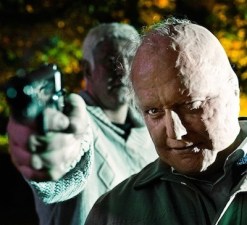
That said, if you want to be kind (and why not?), time has passed since they last met — it’s not as if Mikael ran into Lisbeth while pursuing his very next article. (We’ll overlook that the time passed is the nice round period of a year.)

What about the case itself, then? Sadly it’s not as engrossing or unique as the one in Dragon Tattoo. It seems based in sex trafficking, but that’s just window dressing: Villainous villainsit’s never seriously looked into and, consequently, other dramas have tackled the issue with greater depth, sensitivity and insight. What Mikael and Lisbeth are actually looking into is a conspiracy of sorts around some murders. The way the trail is followed isn’t as clever as it was in Dragon Tattoo and, consequently, isn’t as interesting. The two protagonists go about their investigations independently. This is a long-held technique in novel writing — multiple strands allows the author to alternate which is followed from chapter to chapter, almost by itself providing momentum and the must-keep-reading factor as the reader has to race through the next chapter to rejoin the thread of the previous one (it’s not that simple or we’d all be churning them out… but look, I’m getting off the point again). The problem here is that Dragon Tattoo was largely at its best when the two were together, so keeping them apart is less satisfying. To top that off, they’re each finding out different things, which means as the audience we can feel a few steps ahead of the characters as we have the benefit of both sides of the case. That’s not always a bad thing, but it can be slightly disconcerting when you know the answers your hero is still searching for.

Arson-bent bikersDespite Lisbeth being the focus of much of the attention laden on these books/films/remakes, she’s a less engaging character when by herself. Here she shuffles around silently, digging up files that she and we stare at to reveal information. There are only a few moments for her (and, consequently, Noomi Rapace) to show off what endeared her to viewers before — her confrontation with a pair of arson-bent bikers, for instance.

Revelations at the end of the second act give things a kick up the rear, both for the characters and the plot, but it still has an undue reliance on coincidence, varying degrees of improbability, and the middling conspiracy plotting. This felt underscored by a henchman who’s essentially a Bond villain. In fact, as a white-blond (half-)German who feels no pain, he’s a specific Bond henchman (see: Tomorrow Never Dies).

The ending isn’t close to being conclusive. The mysteries where this particular tale began are solved, but numerous questions thrown up along the way are only just beginning to be answered. Whereas Dragon Tattoo works perfectly as a standalone thriller, even though it hinted at elements of Lisbeth’s backstory, this builds on them and leaves plenty hanging. In this respect it seems to be very much Part Two of a series (I’d say “trilogy”, but considering Larsson had (depending on which report you believe) five to ten books planned, that seems inherently inaccurate).

Tomorrow Never DiesIt also feels less filmic than the first film. Is it poor direction? Is it just the opened-up 1.78:1 ratio? I’ve read that all three films were shot like this, as they were intended for Swedish TV, meaning Dragon Tattoo’s Blu-ray is cropped to 2.35:1. You hardly ever see 2.35:1 on TV (Red Riding is the only made-for-TV example I can think of; most channels even crop films) so it automatically lends a filmic aspect, and therefore might explain the discrepancy. Conversely, I’ve also read that Dragon Tattoo was produced as a cinema film then later the two sequels were shot to serve as episodes three to six of a TV miniseries (with Tattoo extended using deleted scenes to make the first two episodes). Perhaps that explains it.

That’s besides the point anyway, because it’s not the direction or cinematography that lets The Girl Who Played with Fire down in comparison to its predecessor. In summary: the case isn’t as unique or enthralling, and by splitting up the protagonists we don’t get the full benefit of either. It’s not a bad tale, it’s just not a patch on the first.

3 out of 5

This time next week, The Girl Who Kicked the Hornets’ Nest. Hopefully.

March 2011

A quarter of the year down! Christ, where does the time go…


500 films in 5 years! …sort of

March saw me reach the 500th feature film to be reviewed on this blog. Not #500, mind you (that’ll be later this year), because I’ve also reviewed a variety of films that don’t count — hardly-different alternate cuts, a couple I’d just seen before, that kind of thing. About 25 of those, as it turns out. But still, 500 reviews — that’s a lot!

Though there’s still 13 to post before there’s actually 500 available to read…


March’s films

#26 Breakfast at Tiffany’s (1961)
#27 Cloak and Dagger (1946)
#28 Unthinkable (2010)
#29 Let the Right One In, aka Låt den rätte komma in (2008)
#30 Let Me In (2010)
#31 The Damned (1963)
#32 Sorry, Wrong Number (1948)
#33 Death Race (2008)
#34 Night of the Demon (1957)
#35 The Girl with the Dragon Tattoo, aka Män som hatar kvinnor (2009)
#36 High Plains Drifter (1973)
#37 Young Guns (1988)
#38 The Day of the Locust (1975)


Next time on the all-new 100 Films in a Year monthly update…

So far this year I’m keeping exact pace with 2010: reaching 12 in January, 25 in February, and 38 in March. Coincidencetastic!

But April is where I stand a real chance to take a lead. Last year, for various reasons, I only managed to see three films in April, making it to a measly 41. So even four would put me ahead, but if I manage to keep up my current rate (of 12.7 films per month, to be precise) I’ll reach 51 (to round it up). Not only would I be well ahead of last year, but ahead of 2007 too — which, lest we forget, is still my best-ever final total.

Exciting times.

Synecdoche, New York (2008)

2011 #4
Charlie Kaufman | 119 mins | TV (HD) | 15 / R

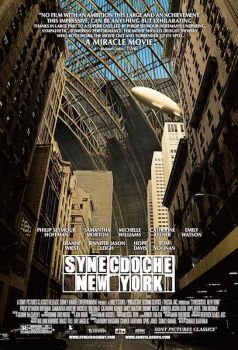
Synecdoche, New YorkDespite its unpronounceable title, Synecdoche, New York starts out like a relatively normal comedy/drama… but then weird touches begin to creep in. A house that’s on fire when a character buys it and continues to be on fire for the next several decades, for instance. No one in the film bats an eyelid. Then the really weird bit arrives; the bit you all probably know; what the film’s about (except, of course, not what it’s About), as Philip Seymour Hoffman’s theatre director begins to construct a life-size New York within a warehouse.

This film is written and, for the first time, directed by Charlie Kaufman. “Ah,” I hear you say, “that explains everything.”

And if it was anyone but Kaufman at the helm you’d say the film loses its way at the point Hoffman begins his impossible undertaking. And maybe it does anyway. It becomes a complex mishmash of reality and the play being staged; although you’re never in doubt about which is which (such a twist would be far too obvious), you are in doubt about why it’s all happening. The relatively congenial first hour (ish) is followable; the rest… bizarre, weird, inexplicable. I’m sure it all Means Something, but I can well imagine as many viewers getting thoroughly fed up as finding it revelatory. I don’t think one opinion would be inherently superior to the other.

At times it almost reclaims itself from this descent into impenetrability, almost edging toward finding a revelation that will explain what we’ve seen. And I’m sure there is an explanation of some kind. But, by the time it reached its end, I’m not sure I really cared any more; Fiction meets realityand I haven’t begun to care in the months since I watched it. It’s the kind of film where, as it gets on, you feel it’s a rich experience that you’ll have to ponder for a bit once it’s done, even if there’s something you quite fancy watching on the same channel immediately afterwards. But by the end it became the kind of film I was fed up with pondering, and I bloody well watched what was on the same channel immediately afterwards. Kaufman’s weirdness can wear you down to the point where characters who were interesting and ideas (both plausible and of Kaufman-logic) that had potential cease to be worth caring about; where you go from the point of “I’ll look up an explanation on the internet once it’s finished” to “…meh”.

That could be just me of course. Roger Ebert asserted it was the best film of the 2000s. Maybe you’ll agree. Maybe you’ll find it inspiring or life-affirming or goodness knows what else. Maybe you’ll be so bored you’ll give up even before the end. But, having made it to the end, I’m torn between not being sure what to think, thinking I should make the effort to understand it, and still just not caring.

Right at the end of that Ebert article, way past the bit on Synecdoche, he says this:

The set of a set

Almost the first day I started writing reviews, I found a sentence in a book by Robert Warshow that I pinned on the wall above my desk… it helps me stay grounded. It says:

A man goes to the movies. A critic must be honest enough to admit he is that man.

That doesn’t make one person right and another wrong. All it means is that you know how they really felt, not how they thought they should feel.

This quote isn’t inherently more relevant to this particular review than it is to any other particular review, but I feel the need to consider it and include it for your consideration also. That said, it is relevant in this respect: it’s already provoked more reflection on my part than Synecdoche did. I think I’ll discuss it further another time.

3 out of 5

Synecdoche, New York is on BBC Two tonight, Friday 17th April 2015, at 12:40am (so, technically Saturday 18th).

The Girl with the Dragon Tattoo (2009)

aka Män som hatar kvinnor

2011 #35
Niels Arden Oplev | 153 mins | Blu-ray | 18 / R

The Girl with the Dragon TattooFrom the same production company that brought us the popular Swedish Wallander series comes an adaptation of the other apparent cornerstone of modern Scandinavian crime, The Girl with the Dragon Tattoo, the first entry in Stieg Larsson’s best-selling Millennium Trilogy.

Investigative journalist Mikael Blomkvist is hired by the head of the sprawling, filthy rich Vanger family to look into the disappearance of his favourite niece from an isolated and, at the time, inaccessible island. A (possible) murder in an isolated country mansion full of rich suspects? So far so Christie… except this crime happened over 40 years ago. Almost ironically, it’s this last fact that helps make the tale ever so modern: Blomkvist uses the Internet to death, enlarging and animating old photos, researching family members and connected cases, and accidentally roping in hacker Lisbeth Salander, the titular girl.

Men Who Hate WomenThe original title translates as Men Who Hate Women, which is certainly very apt. The subject matter is grim and dark; horribly plausible, in fact. It’s unwaveringly depicted with some brutal, hard-to-watch scenes. They’re not exploitative though, as a lesser film merrily would be, and that makes them appropriate to the tale being told. Subplots about the two leads support the themes underpinning the main investigation — both about abuses of power, in different ways — justifying their apparent tangentiality, and consequently the film’s length.

I believe the title was changed by the US publisher, who felt such a name wouldn’t sell the book as a thriller to English-speaking readers. They were probably right, but it has an important side effect: it shifts the emphasis away from the story and its themes and onto Salander, arguably more so than is fair. I’m not entirely sure I see what all the fuss is about when it comes to Salander. She’s a good character and very well played by Noomi Rapace, who always looks so sweet and innocent in her normal persona, but I guess I’ve missed what makes the character so exceptional. Perhaps she’s just the victim of hype, too many other reviews telling me how incontrovertibly brilliant she is.

Lisbeth SalanderDespite the modern stylings, dark themes and attention-grabbing characters, much of the film unfolds as a procedural whodunnit like, for instance, the Wallanders, complete with piles of red herrings and last-minute twists. This is probably why the book has sold so well and the film has taken over $100 million worldwide: it tickles the same nerves as all those ever-popular TV police dramas. Indeed, this adaptation is rooted in a television miniseries (an extended version exists as two 90-minute TV episodes) but it doesn’t look like it: it’s quite beautifully shot; not showy or stylised, but there are some lovely shots of scenery in particular.

Naturally that popularity means an English-language version is on the way — “American version” is the standard designation, but despite Oscar-robbed American David Fincher directing and Oscar-winning American Steven Zaillian adapting, it’s being produced by BBC Films with an international cast: Brit Daniel Craig as Blomkvist, American Rooney Mara as an even more extreme-looking Salander, Canadian Christopher Plummer as the Vanger patriarch, and even a genuine Swede, Stellan Skarsgård, in a key role; not to mention the rest. I’ve long felt (though, it seems, forgot to mention it during my David Fincher Week) that Fincher’s films have thus far alternated between “good” and “great”, in that order, and that the merely “good” ones are (arguably) on a steady upward curve. With Dragon Tattoo featuring material that seems ideally suited to the director who gave us Se7en, Zodiac and The Social Network, his remake may prove to be the point where the “good” curve reaches the “great” line. Or he might balls it up — apparently they’re changing the ending, and unless they’ve come up with something very good that could be a bad misstep. Only time will tell.

For Dragon Tattoo’s legions of fans, this version will be tough to beat — though I’d wager if anyone can top it, Fincher can. For now, though, there’s this, a well-made dark thriller, which serves primarily as a mystery but also supplies themes and characters that may offer further contemplation.

4 out of 5

This time next week, The Girl Who Played With Fire. Hopefully.

The Girl with the Dragon Tattoo merited an honourable mention on my list of The Best Films I Saw For the First Time in 2011, which can be read in full here.

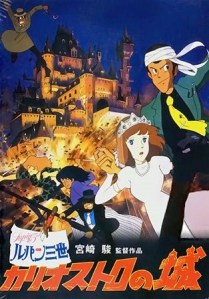
Lupin the Third: The Castle of Cagliostro (1979)

aka Rupan sansei: Kariosutoro no shiro

2011 #9
1979 | Hayao Miyazaki | 100 mins | TV | PG

The Castle of CagliostroThe Castle of Cagliostro, the second animated big-screen spin-off from manga-inspired anime TV series Lupin III, was the first film directed by Hayao Miyazaki, who even non-anime fans have heard of these days thanks to Spirited Away’s Oscar win (eight years ago now!) and Pixar’s recent championing of him.
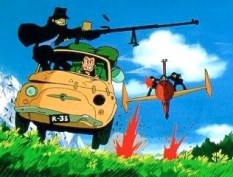
I’m ashamed to say I haven’t see a great deal of Miyazaki’s output, so I can’t comment on how much of an indicator (or otherwise) Cagliostro is of what was to come, but it’s a fine film in its own right — Steven Spielberg reportedly called it “one of the greatest adventure movies of all time”, and I’m inclined to agree.

For starters, the action sequences are brilliant — exciting, inventive and varied. I don’t know if Spielberg saw this before tackling any of the Indiana Joneses, but you can feel the tonal connection. There’s also a similar amount of humour. The animation itself is very good — there are prettier examples of the genre, but the locations especially are beautifully painted, and it’s aged very well for a ’70s-produced animation. The score is rather dated though.

Lupin in actionAs I mentioned, this is the second spin-off film from a TV series, and at times it does feel like it: characters turn up under the impression the audience already knows who they are and what their connection is to the others. It’s not a major problem — most are introduced well enough within the context of the film that it can still be easily followed — but it’s there.

Is this a good film to interest non-anime fans? Maybe. The plot and structure are familiar (in a good way) from the wider adventure genre, and some of anime’s regular stylistic flourishes aren’t as much in evidence as in some other works. The genial tone may make it too “Saturday morning cartoon” for some — and by “some” I tend to mean teenagers or the teenage-minded, who would be better suited to something like Akira because it’s all Dark and Serious and Grown-Up; the kind of person who would’ve chosen a PlayStation over a Nintendo console because it was black instead of white/coloured and therefore Adult and Not For Children; childish idiots who think they’re Mature, in short.

Lupin sceneryUm, where was I? Oh yes: Indiana Jones; Roger Moore-era James Bond — it’s that kind of tone, more or less, and if you enjoy that kind of film then I don’t see why you wouldn’t enjoy this. Unless you think cartoons are for kiddies only (in which case, see the long sentence at the end of the last paragraph).

The Castle of Cagliostro is a fun and exciting adventure, and convinced me enough that I bought the only other Lupin III title currently available on UK DVD (the film that precedes it, The Secret of Mamo). And when the director of Raiders of the Lost Ark and Jurassic Park says something is “one of the greatest adventure movies of all time”, one really ought to listen.

5 out of 5

The Castle of Cagliostro placed 4th on my list of The Ten Best Films I Saw For the First Time in 2011, which can be read in full here.

Bolt (2008)

2011 #11
Byron Howard & Chris Williams | 96 mins | Blu-ray | PG / PG

BoltBolt is the 48th film in Disney’s animated canon (whatever the official name for that is these days), from their CG-only era that filled most of the ’00s. It’s a period already remembered as When Disney Lost Its Way, after the second (or is it third? I forget) ‘golden era’ of the early ’90s; the time that produced flops like Treasure Planet, Home on the Range and Meet the Robinsons. Things are looking up — it’s been followed by The Princess and the Frog, where a return to 2D animation distinctly marked a more widespread change of direction, and the praised Tangled — but it may be Bolt that comes to be seen as the true turning point, because it’s actually rather good.
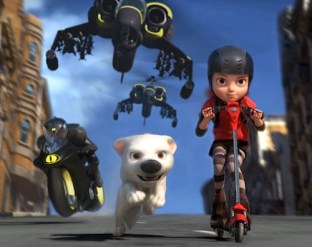
Let’s get the worst bit out of the way first: thankfully, Miley Cyrus’ part is quite small. She’s adequate, but one suspects she got roped in because a) Disney were already trying to find a way to continue making money out of her post-Hannah Montana, and b) she provided a surefire-selling song for the end credits. Chloë Moretz reportedly recorded all of Penny’s dialogue before Cyrus was brought in; one can’t help but feel that, age-wise (and probably acting-ability-wise too), she would’ve been a better fit for the character.

But it’s not about Penny, it’s about Bolt, and he is excellently realised. Bolt, if you don’t know, is a dog, and the animators have captured dogs’ behaviour perfectly. It’s not just the obvious things, as seen during the sequence where Mittens the cat trains him to be a ‘regular dog’, but all the little mannerisms throughout. The animals are anthropomorphised, of course, but they’re not just animal-shaped-humans; they’re what these animals would be like if they could talk. Crossed with humans, anyway.

Penny and Bolt in actionAlso noteworthy are the action sequences. Far from being perfunctory attempts at liveliness, these are properly exciting, making full use of 3D CGI to create exciting and dynamic sequences. I’m not just talking about the couple we get from the TV-series-within-the-film either, but also the ‘real world’ ones as Bolt, Mittens and Rhino jump onto trains, out of moving vans, escape from a pound, etc. Of course, the TV-series-within-the-film is completely implausible — like you could film a TV show with massive action sequences in such a way that you only ever do a single take, never mind achieve all those effects on a TV budget. But then this is a film where a talking dog, cat and hamster work together to travel from New York to Hollywood entirely of their own volition — I think it’s safe to say no one’s aiming for documentary levels of realism.
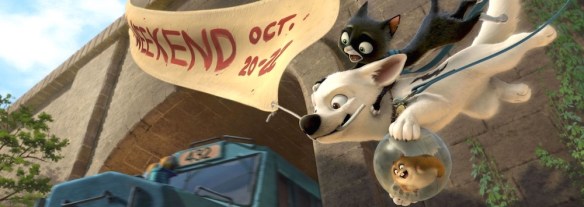
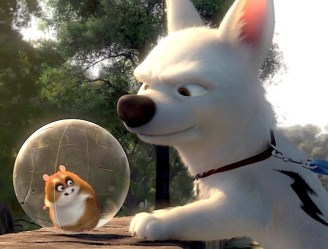
And it’s funny too, especially once Rhino the hamster turns up. It’s not the greatest comedy ever made (and the level of praise attributed to Rhino in some quarters may have taken it too far), but it’s genial enough and elicited a few decent laughs. It even had me getting a little emotional at the end, which isn’t something I ever expected to feel about a film starring Miley Cyrus and a dog made out of polygons.

Bolt swings into action

Despite being computer-generated and 3D, there are attempts to add a painterly look to the film — brushstrokes, pastel colours, that kind of thing. It works rather well when seen in isolation in backgrounds, some of the big wide shots, etc; but the obviously-CG main elements jar against it, the painterly style not extending to the characters or main environments fully enough for it to gel. Especially when the apparently-flat paint-styled backgrounds begin to move in three dimensions (for instance, as the camera pushes into scenery, so that trees/buildings move relative to road/field/hills/streets), it becomes a little weird. An interesting experiment, but not a wholly successful one I think. Something like Ratatouille’s attempt at softening CG animation’s usual hard crispness was more effective.

Bolt and RhinoIt would be easy to dismiss Bolt as part of Disney’s CG folly, especially as it stars Miley Cyrus and is immediately followed by their return to 2D animation, but I think that would be a mistake. It’s a fast-paced and fun adventure, with accurately-captured animals meaning it’s especially likely to appeal to dog lovers. Disney’s next golden era just might begin here.

4 out of 5

Some thoughts on star ratings

Last week’s run of films from 1953 got me thinking about a couple of things. Firstly, about coincidence — out of a pile of 20 unposted reviews, it happened to be those that were among the first few I had ready to post. But, more pertinently, it was the last two, and the scores I gave them — The Big Heatfour for The Big Heat, five for Roman Holiday — that gave me the most to mull over.

To put it simply, I wondered “why?” Why is The Big Heat only worthy of four stars and Roman Holiday worthy of five? They weren’t scored relative to each other — I watched them almost a month apart, and while I take forever to post my reviews I usually rate the films straight away — so this contrast hadn’t been thrown up before, and probably would never have been had I not happened to post them side by side.

The thing is, when considered against each other, The Big Heat is more my kind of film than Roman Holiday; if asked to pick a favourite, I’d probably choose the noir; I’d be more likely to buy it on DVD; I’d be more likely to watch it again. That’s nothing against Roman Holiday — it’s a great film — but, in direct comparison between just these two films, The Big Heat is more my kind of thing.

And yet, for all that, and having considered changing both scores, The Big Heat still has four stars and Roman Holiday still has five.

Putting The Big Heat up to five didn’t sit wholly easy, especially when I compared it to the scores I’ve given other noirs. This led me to wonder if I’m harsher on film noir because it’s a genre which, though I’m unquestionably still discovering it (most of those I’ve ever seen are reviewed here), Roman HolidayI have a good deal of affection for — and, therefore, expectation for its films. The same could be said of other favourite genres — action, thriller, etc.

Dropping Roman Holiday to four seemed wrong too, as if underrating it. This made me wonder if I was influenced by expectations — Roman Holiday is simply the kind of film one gives five stars too, thanks to Oscar wins and making a star of Audrey Hepburn and all that. I don’t think this is always an influence on me — I’m happy to give a respected film a slating if I disliked it, and vice versa — but when something sits borderline, I can be swayed by reputation.

Are star ratings just inherently rubbish? There’s a reason why reviewing publications from Sight & Sound to Doctor Who Magazine choose not to use them — and that’s in part because they invite instant, arguably invalid comparisons (such as the one I’m discussing). “Is W a whole star better than X?” “Are Y and Z actually worth the same score?” On many occasions the answer to such questions is “no”; that’s the inherent imprecision of having five possible scores and thousands of things that need scoring. By rating things with five stars the reviewer is placing them in broadly defined groups, and some will always be better than others within their group, and some will always be on the borderline — and some will get placed on the wrong side of it.

Many games magazines and websites using a percentage system (or they did in my day — several now seem to use an out-of-10 score… but merrily use decimal points, so it’s the same damn thing). I guess it’s an inbuilt cultural thing, because (other than an aggregate site like Rotten Tomatoes) Games reviews use percentagesI’ve never seen films reviewed with a percentage. Theoretically, this method allows for 100 different scores — much more precise. In practice, of course, the lower ones are rarely used and the tippity-top ones are seldom (if ever) reached. Partly this is because you find your ‘average’ review score sitting less at 50% and more at 70% or higher. I believe this is because (like almost any reviewed art form) the bulk of what one encounters has been polished enough to earn a higher score — the average quality of work is of above-average quality, if you will. It also makes the system more liable to awkward questions: give one thing 95% and another 96% and you provoke “is the second definitely superior” arguments you wouldn’t get if they both just had 5 out of 5. Arguments aren’t necessarily a bad thing, of course, but it does require one to be frighteningly precise when scoring.

I’m not convinced the answer is to ditch all forms of rating. Perhaps a skilled reviewer could always present a perfect balance between their pro and anti thoughts on a review subject, Full of starsbut I don’t think there are many of them about. Giving something a score stamps your opinion nice and clearly: there have been a good few reviews where I’ve mainly discussed the negative points of a film I’ve primarily liked, for whatever reason, and without the score at the end readers might get the wrong impression; I may even have penned a review or two where I’ve tried to draw out the positives from something I was giving a low score to. I’d wager this is true of most reviewers — it’s always possible for your text to be misinterpreted; for a reader to see a positive (or negative) bias, however balanced or actually-the-other you thought you were being.

That all said, a definitive summary sentence or paragraph would serve just as well — better, maybe — than a little line of stars. Hm.

I’m not going to ditch my star ratings, but this has caused me to have a good think about them. It’s clear the way I apply them is not always accurate (as if the fact I often include four-star films on my top tens while excluding numerous five-starers hadn’t made that clear), but — if only for my own satisfaction — I like the way they separate the bad from the good, the good from the great… however broadly.