2011 #75
Gabriele Salvatores | 89 mins | TV | R
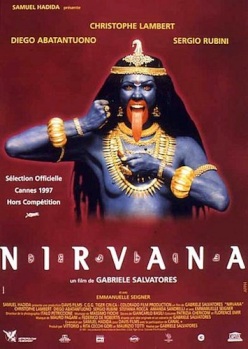 The Radio Times film section may be steadily going down the drain, but when anyone describes something as “one of the best science-fiction films ever made” it’s worth paying attention. “Yet few people outside Italy have seen it,” they add. Indeed, despite screening at Cannes (albeit out of competition), this Italian movie has never been classified by the BBFC, so I presume it’s never been released here (though this was its third showing on the BBC). It’s been released in America though… by Miramax. They did their usual foreign film job, chopping out 17 minutes, changing the music and adding an English dub. This is the version shown by the BBC (at the time of posting, also available on iPlayer) and reviewed here.
Most sci-fi we see is of the American variety — partly due to the fact most of any cinema and the vast majority of imported TV we get is from there, partly due to that being where the money is for special effects and what have you — and that tends to mean tonnes of CGI, a fast pace and action sequences up to the eyeballs. Nirvana is more stereotypically European, however: it’s clearly a Deep and Meaningful film, though unlike many examples of Thoughtful cinema it at least has a slightly thriller-ish plot and a hefty dose of cyberpunk styling for us plebs to pick up on.
Sometime in the future (I read 2005 in one review, but best to ignore that now), Christopher Lambert is a computer game designer working on a new title for Christmas. Somehow a virus invades his system, in the process making his lead character, Solo, fully sentient. Unable to escape the game, Solo wishes to be deleted, but Lambert can’t because the final software is owned by some giant corporation and will be released in just three days… so he has just three days to get into their computer system and delete the file, before Solo is condemned to never-ending life stuck in the game.
 The most obvious point of reference for Nirvana is Blade Runner, which I’d wager was a hefty inspiration. Writer/director Salvatores introduces themes of what it means to be human and a lead character one might like to decide isn’t after all, and sets it in a perma-night, dystopian, multi-cultural future. It doesn’t quite have Ridley Scott’s consistency of vision, though: while he just rendered an Asian-American future L.A., Salvatores takes globalisation to the max, running us through locations named after Marrakech and Bombay City, which may or may not be part of the same sprawling metropolis, and which all exhibit appropriately specific cultural stylings. These aren’t just pretty backgrounds, but in some ways reflect the film’s use of video games — in which you can, of course, constantly re-spawn your character — as a metaphor for reincarnation.
In aid of this, while Lambert is collecting the plot pieces needed to attack that corporation — at the same time as following a subplot about a missing girlfriend — we get to witness Solo’s experiences inside the game, frequently dying and re-living the same story with a group of characters who aren’t aware in the way he is. To be blunt, the in-game stuff is a bit odd. It doesn’t really go anywhere, and builds to a lacklustre climax — indeed, the word climax is a bit strong. But perhaps this is part of the point: as the only character in the game capable of independent thought, Solo is stuck in a loop of story and fellow characters who just re-enact what they were programmed to re-enact. Literally, he can’t go anywhere.
This part of the film calls to mind eXistenZ, David Cronenberg’s film about a virtual reality game that blurs the line between reality and the game. It’s rather a surface similarity though — Lambert barely spends any time in his game,  interacting with Solo merely though a series of screens on his journeys (and, one presumes, a series of microphones too). Cronenberg’s film was made a couple of years after this, so commending it for not doing the same thing would obviously be a bit rich. It is to be commended for not descending into a needlessly twist-strewn third act though, which I had thought was coming — there’s plenty of bits along the way that could be used to build a ‘surprise’ or two. There’s some ambiguity in the ending, but not too blatantly (unlike later versions of Blade Runner, for instance), and Emmanuelle Seigner’s ex-girlfriend character is never quite used in the way I expected.
For all its intellectualising, Nirvana can still be a fun film, and not just because Lambert’s accent is always set to provoke a giggle. That sounds horribly xenophobic written down, but it’s all Highlander’s fault: there’s no reason he shouldn’t sound European here (and he has dubbed himself), but the memory of that accent supposedly being Scottish does linger. (And, just so we’re clear, I love Highlander.) But no, there are proper dashes of humour, scattered here and there to provide some subtle texture. And there are action sequences too, and dated ’90s music (presumably thanks to Miramax), and even some boobies. To be honest, though, if you just want humour, action, dated music and boobies, there are dozens of films that will serve you better. At least they stop it becoming too dry, and give you a chance to let what’s going on sink in, helping prevent total confusion every time the film threatens to become incomprehensible (maybe it’s just me, but it took a little while to work out what Lambert was actually getting up to in the main plot).
I’d quite like to see the original version. Who knows what changes Miramax have wrought with their fiddling (that woman on the poster certainly isn’t in this version, at least),  and I imagine subtitles could be easier to follow than this dubbed version, in which everyone’s covered by either the original actors straining with English (based on the accents) or the typically bad voice actors employed for such dubs. The Italian DVD is reportedly English-friendly and very good quality, so perhaps I’ll get hold of that (expect another review if/when I do… well, eventually).
Apparently Nirvana “has achieved something of a cult status, especially in Europe”, and I think I can see why: there’s a few themes that might be worth a ponder, and enough splashes of style and action to keep one’s attention… most of the time. It might not be as stylistically delineated as either of the films it brought to mind, but then Blade Runner is perhaps the pinnacle of screen SF and eXistenZ… well, now I really want to see that again. I don’t know if this is “one of the best science-fiction films ever made” — especially not in this Americanised version — but it certainly has a few things going for it.
Nirvana is available to UK viewers on the BBC iPlayer until 3AM on Saturday 3rd September (i.e. Friday night).


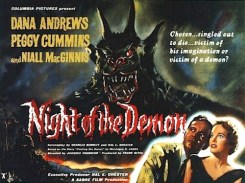 Adapted from an M.R. James story, Night of the Demon sees Dana Andrews as Dr. John Holden, a psychologist arriving in Britain to discredit satanic cult leader Julian Karswell. To cut to the chase, Holden begins to wonder if Karswell has placed a curse on him, and perhaps what he had set out to disprove isn’t such mumbo jumbo after all…
 Tourneur’s film is beloved by some, but I don’t think I quite got it myself. There are some great sequences, but I didn’t always find it hung together in between. Ironically, while many have criticised the actual appearance of the titular beast at the end, I think it works rather well — it’s surprisingly well realised, and you can take it as either a real manifestation or part of one character’s deranged imaginings. It’s an effective climax.
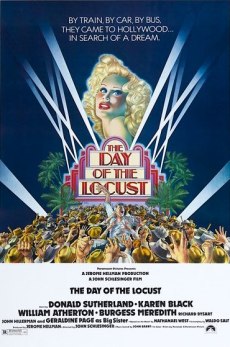 Adapted from the novel by Nathanael West, The Day of the Locust is a slightly scrappy film about the seedy underside of Hollywood’s golden age. The plot is neither here nor there in many respects — the film is about the grotesques who are attracted to Hollywood, and that being exactly what it feeds on. The bizarre, surreal ending definitely makes more sense if you’re already thinking about the film in this way.
 Also brilliantly staged is the collapse of a Waterloo battle set. Appropriate as it’s one of the novel’s most memorable moments.
 The Day of the Locust may be a mess, or it may be a flawed masterpiece. It may very well be both. For much of it’s running time it pootled along at 3 stars, pushing down toward 2 the more diluted it began to feel. But seeing the completion of Donald Sutherland’s performance in the final scenes, plus the way those scenes seem to draw together the whole film, revealing and fulfilling themes I hadn’t even noticed developing until that point, in a spectacular orgy of apocalyptic violence… well, the stars suddenly ratchet back up.
 A faded action movie star (Burt Reynolds) thinks he’s been signed up to play King Lear with the RSC… but when he arrives in England, he finds it’s just a small village amateur dramatics group. Hilarity, and the odd heart-warming message, ensue.
 Imelda Staunton and Derek Jacobi, all ceaselessly watchable, plus a supporting cast of faces you’ll likely recognise from British telly.
 Probably the best bit is the series of films Reynolds’ character is known for: Ultimate Finality 4 plays as a nice, subtly-used background gag.
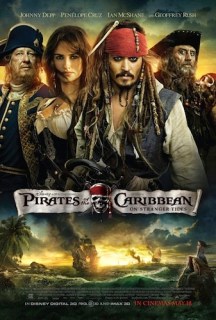 No one had high hopes for
  It still cost $250m, mind, and the fact that’s what’s considered a cutback arguably shows.
 The love story between a missionary and a mermaid barely factors. Word was this pair would be the series’ new Orlando Bloom and Keira Knightley, but whereas Elizabeth Swann and Will Turner were central to the plot of all the previous films (appearing before even Captain Jack in the first, if I recall), these two turn up late in the day and never have a chance to go anywhere. There’s also a surfeit of villains, meaning they either barely appear (the Spanish) or aren’t given close to enough screen time (Ian McShane’s Blackbeard). Every introduction is rushed, every subplot underdeveloped, every ending unsatisfactory. There’s too much, even for a movie that still runs over two hours.
 (much-heralded work like
  If The Locket is known for anything, it’s for a plot structure that places flashbacks within flashbacks within flashbacks. There’s always the potential for good fun in that kind of structure, though it’s usually the kind of thing that sounds more complicated than it is — the straightforward ‘concentric circle’ arrangement here makes them a doddle to follow; so straightforward, in fact, that it would be easy to miss how it was so structured.
 It might have been more interesting if the doctor had been making it all up; or if it had been left open ended, with Nancy set to ruin someone else’s life. That could well have worked, leaving the audience to come to its own conclusions, etc. Considering the film’s age, however, I’m sure there were demands we see this thief and murderess brought to justice.
 manipulative criminal it seemed all along, but instead a damaged individual doing these things involuntarily. This isn’t the wholly nonsensical part of the film — her apparently-accidental marriage to the son of the house she grew up in would be that bit — but I preferred it when she was just a villain. Psychologically it holds relevance, but at the same time she’s rather taken it to extremes. Or maybe I was just fed up by then.
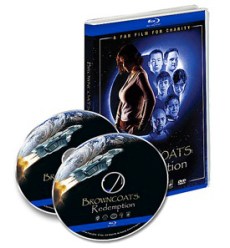 But only until September 1st, which (as the handy countdown on
  More importantly than all of that, and why I’m mentioning it despite my rating, is that all profits go to
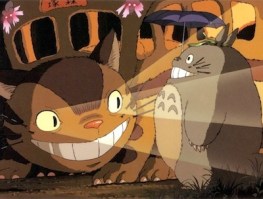
 Once, a few years ago, SFX published an anime special (it was their first, I think) with a rundown of the Best Ever Anime Films. You’d expect it to be topped by something regularly cited and, considering the source magazine, science-fiction/fantasy-y —
  It’s not scary in the slightest (well, maybe in the slightest, for some kids, but note the U and G ratings), but in terms of how it balances real-life dramas with the fantasy element. Only in both the real and fantasy worlds it’s a lot nicer, friendlier and cheerier than del Toro’s acclaimed fantasy-horror. To put it more succinctly, they share a similar structure and balance, but a completely different tone.
 The English-friendly version has advantages too: I love any subtitles which use semicolons. It’s not inundated with them, but there was at least one. Semicolons are so underused. I love a good semicolon.
 The second directorial outing from BAFTA-winning Brit Duncan Jones (after
  because Source Code is hardly groundbreaking. It’s certainly a solid, dual-pronged, science-fiction mystery — dual-pronged because not only is Stevens working to find the bomber, but also fighting amnesia to discover what the source code is and how he wound up there — but not an especially deep or complex work. There’s nothing wrong with something being little more than an exciting, engrossing thriller, it’s just not revelatory.
 The other side of the plot is not only where the heart is, but also where the real twists and mysteries lie — I guessed the bomber the first time I saw the character; even if you don’t, it ultimately matters little. Vital to the finale are the subplots like Stevens’ relationship with his father and his growing affection for the passenger his alter ego was travelling with — but who he can’t save, of course, because the source code isn’t time travel.
 Did he create a new parallel world every time he entered the source code, or only the last time? I’m not sure that’s relevant. This is, though: at the end, he seems to remain in Sean’s body. So if he’s in a parallel world, he’s just stolen another man’s life? And Stevens — at least, the Stevens of that reality — is still lying, mutilated, half dead, in some government research facility? Hardly a cheery resolution.
 Still, problems aside, Source Code remains an exciting, taut, puzzling sci-fi thriller. On a train — there’s a whole long line of movies and connections to be explored there. Many reviews have noted the Hitchcock connection and I’m sure that’s an interesting route to look down, so maybe there is a bit more to Source Code after all… but even if there isn’t, it’s a fun ride.
 100Films.co.uk