Unknown's avatar

About badblokebob

Aiming to watch at least 100 films in a year. Hence why I called my blog that. http://100films.co.uk

Harry Brown (2009)

2009 #13
Daniel Barber | 103 mins | Blu-ray | 18 / R

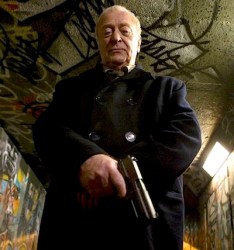
Harry BrownMichael Caine killing hoodies. How great does that sound? As a film premise, that’s awesome. If it doesn’t get you excited about seeing this movie, then what kind of film fan are you, eh?

A mentally mature one, probably. But hush, don’t spoil our fun — those of us who may occasionally hanker for a morally simple form of voyeuristic vigilante justice want to see Sir Michael shooting yobs who definitely Have It Coming. Harry Brown delivers this wonderfully.

Politically and morally, in a real-world sense, Harry’s actions are as questionable as those in any vigilante movie. And yet, for that, it’s hard to avoid the sense that he’s bloody well right. Even as someone against capital punishment, against unnecessarily arming the police, and so on, there’s still satisfaction in witnessing Harry carry out his revenge; justice. When police raids kick off a violent riot at the climax, there’s the thought that Harry was dealing with this more effectively; that cutting the yobs down in a swathe of machine-gun fire might be the best solution for the future of humanity. Michael Caine is Harry BrownWhich in some ways is quite a chilling way to feel. I’ll be buying the Daily Mail and watching Sky News next.
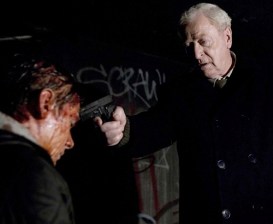
Barber’s film tries to dress itself up as plausible social drama, mind. Of course it’s more revenge fantasy wish-fulfilment, but perhaps the veneer of believability makes what happens even more satisfying. The bright side of that is the film manages to be a bit more than just a celebration of violence. It takes the moral question head on… sort of. “Where does it stop?” asks one character, once Harry’s dispatched with all but one of the main bastards who need dispatching. There’s a twist, which is neatly built up and I didn’t see coming so I won’t spoil, and it does make you briefly question, “where does it stop?” And that’s why vigilantism, or revenge in any way, is an ineffective solution in the real world. But this is a film and there comes a solution, so that’s OK. As with the rest, it is deserved, and it’s difficult not to think, “well, Harry was right, actually”.

Caine gives a stunning performance as the titular pensioner. The film bothers to invest you in the character: a man shattered by the death of his wife, the murder of his only friend, the past loss of a daughter, and buried experiences serving as a Marine in Northern Ireland. The evolution from quiet, downtrodden everyman to skilled vigilante is plausibly created — or, at least, plausibly enough. It’s to the credit of screenwriter Gary Young that he doesn’t dive to the vengeance action as soon as possible; to the credit of Barber that he’s not afraid to let the early scenes play out slowly, often with lots of silence, conveying the reality of the lonely pensioner. King of CoolWhatever you may think of the revenge thriller it turns into, I think it’s hard to deny these early scenes have a realism and power. It is, of course, to the credit of Caine that he performs all this flawlessly. Oh yes, he’s (to quote another review) “the king of cool” when blowing away the scum that surround him, but before that he’s an affecting old gent, abandoned by the world.

Comparisons with Death Wish should probably be made, because yes, they do have much in common. Harry Brown is more skilled, though: Caine out-acts Charles Bronson at every turn, and Barber clearly is a director of not inconsiderable talent, something Michael Winner patently is not. The structure is the same, really — motivation from a brutal attack on the closest person to our lead character; spurred by his general feeling of useless ineffectiveness in the face of the modern, violent world; a long, steady slide downhill before our hero turns to vigilantism; his struggle to pull off the attacks — he’s no superman, they don’t go perfectly. But Harry Brown feels superior. Perhaps because it’s more vital to our times — this is a situation occurring in our country right now, not a somewhat abstract rape and murder. Not that those aren’t foul crimes, but Harry Brown has more of a relevant social conscious. Killing criminalsThe counter to that would be that a murder spree may be viscerally satisfying but isn’t a real-world solution, so this is just as useless at relevancy as Death Wish.
One might also argue that Harry Brown loses Death Wish’s strongest aspect: Bronson never gets the men who attacked his family, only able to exact vengeance on criminals he happens across; Caine, on the other hand, gets to attack those responsible… and a couple of others who are peripherally connected and at least as deserving of his bullets. It’s more narratively satisfying to get revenge on the actual perpetrators, but not always as realistic. While that is a strength in Death Wish, it doesn’t make Harry Brown a lesser film for not following the same path. This is a different story, despite the similarities — it’s set in a more confined area, with more specific problems, and the murder is the catalyst for Caine’s character to take action against the people who are perpetrating all the crime, not just the particular one that galvanises him.

This is the kind of movie that can polarise an audience. For one thing there’s lurid and extreme language and violence, and lots of it — this well earns its 18 — but it is, largely, justified by the context. Beyond that, there are a lot of political and moral implications raised by the film’s realist tone. Harry Brown is Michael CaineSome will think it tackles these, others that it’s just a facile revenge movie; some will think it’s cool, others despicable; some will think it plausible, others anything but. Or maybe, rather like me, you’ll think it’s all of those things, however mutually exclusive they may seem.

Harry Brown is satisfying when you know it probably shouldn’t be, and because of that it’s also thought-provoking, and because of those things it’s five stars from me.

5 out of 5

Salt: Director’s Cut (2010)

including a comparison to the Theatrical and Extended versions.

2011 #53
Phillip Noyce | 104 mins | Blu-ray | 15 / PG-13

Salt Director's CutAngelina Jolie takes on a role originally earmarked for Tom Cruise in this Bourne-ish spy thriller from screenwriter Kurt Wimmer (Law Abiding Citizen, the Total Recall remake; writer/director of Equilibrium, Ultraviolet) and director Phillip Noyce (Patriot Games, Clear and Present Danger, The Saint, The Bone Collector).

I list all of those previous projects because it might give you some idea of the calibre involved here — i.e. solid, but perhaps not exceptional. That’s more or less what Salt represents. It offers a handful of moderately exciting action sequences — a multi-vehicle highway escape is the best — and a plot with an engaging mystery eked out through good twists and developments.

Said plot sees Jolie as Evelyn Salt, a US spy accused of being a Russian sleeper who will assassinate a high-profile Russian at a high-profile US funeral in a few days. (In truth, I forget who the Russian is and who the funeral is for. I think they’re the President and Vice-President, respectively. Really, such things are immaterial.) Naturally, she goes on the run… to prove her name, presumably, or is it because she is indeed out to complete said mission?

Salt improvisesThis is Salt’s mystery, and this is one of its strong points. The plot developments are well-paced throughout, developing and shifting our expectations rather than stretching it all for a glut of final act reveals. In this regard it goes places you might not expect from a mainstream Hollywood thriller. For starters, you expect the funeral-set assassination to eventually be the film’s climax, no doubt revealing our heroine isn’t a Russian spy as she unmasks the real killer. But that occurs at the halfway point, spinning the film off in new directions. To say more would spoil one of the film’s strongest elements: that, as I said, it has twists and follows storylines you wouldn’t expect in a Hollywood summer blockbuster.

But now I am going to digress into spoiler territory, because on Blu-ray Salt comes in a choice of three cuts. Excessive? Yes. One version is basically a glorified way of showcasing a deleted scene. But, actually, these are more interesting than most extended cuts — not merely slight extensions, there are genuine impactful changes to be found here. And that’s what I’m going to natter about now, complete with spoilers. Just so you know. (The final paragraph, incidentally, is spoiler-free.)

The good guys... or are theyThe three cuts, then, are: Theatrical (100 minutes — this was trimmed for the UK to make 12A, but is apparently uncut on disc); Director’s Cut (the one I viewed, this is 4 minutes 5 seconds longer); and an Extended Cut (1 minute 5 seconds longer than the Theatrical). The latter is based on the Director’s Cut and I’ll come to it in a minute. The differences between the Theatrical and Director’s cuts are numerous, but mainly amount to some extra character beats (including more flashbacks to Salt’s childhood) and violence — more blood; seeing people get hit rather than just seeing Salt firing; the President is killed rather than just knocked out; plus a very different death for Salt’s husband (again, more on this in a moment). Plus there’s a voiceover ending too, which in my opinion sets up the sequel even more than the Theatrical version does, with a blatant cliffhanger and suggested plot direction. My regular comparison site Movie-Censorship.com disagrees, but… they’re wrong. So there.

Who is Salt

As I mentioned above, the Extended Cut seems to have started with the Director’s Cut, then stripped out all references to the death of Orlov (Salt’s spymaster villain, killed around halfway through in both the Theatrical and Director’s versions) in order to include an alternate ending in which Salt travels to Russia to kill him. Additionally, the President doesn’t die in the Extended Cut, presumably to help provide a more conclusive ending — the Extended Cut is the only one that doesn’t suggest a sequel.

One of the key differences — tonally, at least — is the murder of Salt’s husband, which occurs in a very different way in the alternate cuts. In the theatrical version, she walks around a corner and he’s instantly shot. Salt's husbandShe has to control her emotions so as not to give herself away. In the other versions, however, she’s presented with him in a chamber and given a choice to save him — except trying to save him would give her away, so she’s forced to watch, blank-faced, as he slowly drowns. Salt sacrifices him for the greater good; he dies seeing her cold emotionless face. Ouch. By comparison, the theatrical cut’s blunt gunshot is much softer.

The extended version plays on this nicely with its alternate ending: Salt grieves for her husband during her post-climax interview with Chiwetel Ejiofor’s investigator, even though he reassures her she did it for the greater good (just in case you didn’t understand that when it happened). Then she escapes and toddles off to Russia to kill Orlov. Fundamentally I’m not a fan of this alternate ending — I like that she takes her revenge on the boat-load of people when she does — but it does have one fairly major plus point, I think: she kills Orlov by tying him to a stone and pushing him into the river; she watches him drown, just as he made her watch her husband drown — Noyce’s choice of camera angles emphasises this comparison — but whereas before tears formed, now she is genuinely stony faced. It’s a fitting form of revenge; more fitting, really, than just stabbing him with a broken bottle, as she does in the two other cuts. And this is the real advantage of the DVD era: Salt with a gunif the filmmakers considered another option, now we can see it, and in cases like this choose our preference. Though it seems clear, by its inclusion in both the theatrical and director’s cuts, that Noyce preferred the instant-revenge option.

In conclusion, Salt isn’t really the kind of film that massively deserves multiple versions — it’s a divertingly fun action-thriller, not much more, but for that I think it merits a watch by fans of the genre. Of all the versions my preference is for the Director’s Cut — it packs a better punch than the tamed-down Theatrical, and while it loses the nice revenge parallel of the Extended’s alternate ending, I think it’s overall the most coherent experience.

4 out of 5

Salt begins on Sky Movies Premiere tonight at 8pm, and continues daily until Thursday 7th July. I expect it’ll be the theatrical cut though.

If you’re interested in a full catalogue of differences between the versions, Movie-Censorship.com have three (unusually imperfect, sadly) comparisons to offer: between the Theatrical and Extended, Theatrical and Director’s Cut, and Extended and Director’s Cut.

Unthinkable (2010)

2011 #28
Gregor Jordan | 93 mins | TV (HD) | 18 / R

UnthinkableStar Wars’ Samuel L. Jackson, The Twilight Saga’s Michael Sheen and The Matrix’s Carrie-Anne Moss star in this low-key thriller from the director of Buffalo Soldiers, Ned Kelly and The Informers. Sheen plays an American Muslim who alleges he has planted bombs around the country; after he is captured, Moss’ FBI team are brought in to locate the bombs; Jackson is a black-ops interrogator brought in to get the truth out of Sheen — by any means necessary. Including — or, perhaps, especially — illegal ones.

I say it’s a “low-key thriller” because, though the stakes are high, the vast majority of the action takes place in a deserted high school commandeered as a temporary military base, where Moss’ team work out of re-appropriated classrooms and Jackson conducts his interrogation in a sort of one-way-glassed torture tank placed in the gym. So there’s no 24-style thrills as people rush around the city/country hunting out bombs — Unthinkable is wholly reliant on the script and performances to draw us into its story, and its debate.

The debate in question is torture, and whether it’s excusable, and under what circumstances, and how far it’s OK to go. Though it’s grafted on to a story, it’s pretty clear that screenwriters Oren Moverman and Peter Woodward are as much, if not more, concerned with the issues at play than with the story they’re telling; the story, rather, I said it's NOT like 24is a decently dramatic way of drawing out and considering these issues. In my opinion, it works; at least, works well enough.

For some reason, Rotten Tomatoes only cites two professional reviews for Unthinkable (don’t know why, I know there are more — one’s quoted on the US DVD cover for starters), but the chosen pullquotes seem to sum up the opposing reactions I’ve spotted elsewhere, and indeed the opposing reactions a film such as this is predisposed to provoke. On one hand, one might find it “an entertaining and thought-provoking drama,” as does David Nusair of Reel Film Reviews; on the other, one might consider it “a clumsy polemic that bounces between the boundaries of stage-play debate and torture porn spectacle as everyone argues over ethics,” as does Sean Axmaker of Seanax.com. I’m far more inclined to agree with the former, and now intend to take Mr Axmaker’s four contentions one at a time as a handy way of shaping some more of my thoughts.

a clumsy polemic

As I’ve already insinuated, Unthinkable isn’t particularly subtle in its foregrounding of the torture debate. The thing is, a polemic requires it to be an “attack on someone or something”, A form of debatewhich I don’t think Unthinkable is — I think it argues both for and against torture. Perhaps if the viewer is firmly entrenched in one viewpoint then the film will seem to support it to a polemical level; or perhaps they’d read it the other way, and see it as a polemic against their viewpoint. I don’t know which, though, because I don’t think it comes down hard on either side.

stage-play debate

I think such criticism also does it a disservice; or does the theatre disservice, because it seems implicit in this comment that something limited in the way a stageplay would be can only be simplistic and unworthy. Unthinkable takes place in a limited number of locations, true, but not so limited that it feels forced. Nor is it so flatly directed as to feel like a filmed play, nor are the performances theatrical in the negative sense.

torture porn spectacle

This is just rubbish. “Torture porn” has become an overused phrase; something readily grabbed to bash a film with. I’m not saying the sub-genre doesn’t exist, and I’m not saying it’s a good thing, This isn't what it looks likebut Unthinkable is not a torture porn film. Yes, it contains torture, and some of it is shown in some degree of detail, but it does not depict it as brutally as it could, and it does not revel in it. This isn’t torture for the audience’s enjoyment, this is torture as a point for debate — “is it allowable to do this to another human being to get results?”, etc. Which brings us to:

everyone argues over ethics

And? As I said, Unthinkable doesn’t try to hide that it’s a debate on torture, but nor does it use it in place of a plot. This isn’t an essay pretending to be a film.

There are, apparently, two cuts of Unthinkable. I watched it on Sky Movies and they showed the extended version, which is also the one on DVD/BD (or maybe they both are), which I can only imagine is the director’s preferred version. The only difference is an extended ending. Why a shorter one even exists is baffling, because that final shot is essential. There are films where an ambiguous ending fits — I’ll happily line up to argue in their favour should such a line be necessary (first example that randomly pops into my head: In Bruges) — but it wouldn’t work here, in my opinion, and so the final shot becomes a necessary tie-off. Looks painfulIt’s much more important than simply answering a lingering question — it unequivocally presents the ultimate outcome of the characters’ actions. Like the rest of the film, it doesn’t seek to tell you whether this is right or wrong, but shows you where such decisions lead. Moralising is left up to the viewer. (Apologies if this is vague, but I don’t want to spoil it.)

Unthinkable has been largely missed as a direct-to-DVD effort, despite its moderately high-profile cast and relevant themes. It’s an effective thriller based around a debate that is perhaps simplistic, but also thought-provoking. It’s easy to dismiss torture in the abstract, but there are endless “what if”s and “how far”s that can change things. But should they? And so on…

4 out of 5

Evangelion: 2.22 You Can (Not) Advance. (2009/2010)

aka Evangerion shin gekijôban: Ha / Evangelion New Theatrical Edition: Break

2011 #65
Hideaki Anno, Masayuki & Kazuya Tsurumaki | 112 mins | Blu-ray | 15

Evangelion 2.22 You Can (Not) AdvanceJust over a year since the preceding film made it to UK DVD and Blu-ray, and two years since this was theatrically released in Japan, the second part of creator Hideaki Anno’s Rebuild of Evangelion tetralogy reaches British DVD/BD today. Continuing to re-tell the story originally visualised in the exceptional, and exceptionally popular, TV series Neon Genesis Evangelion, You Can (Not) Advance throws in more changes to the original tale than its predecessor, including at least one significant new character.

This is very clearly a second part. It hits the ground running, with no thought for those not up to speed on the characters and events so far. Indeed, there’s perhaps little regard for those who may be familiar with it anyway: certain significant events rattle past, the storyline spewing mysteries via dialogue we barely understand, so dense is it with references and allusions. In some respects that’s realistic, of course — why would characters explain, for instance, the Vatican Treaty to each other when they all know about it — but it might leave the viewer struggling to keep up. It’s not all like that, but there’s plenty of it; and when there’s few answers forthcoming within the film itself, the mysterious references feel even more opaque.

Eva vs AngelFor my money, the first 40 minutes or so of the film are (by and large) the best bits. It opens with a barnstorming action sequence, a great scene for newbies and fans alike as we’re introduced to Eva pilot Mari, who didn’t appear in the TV series. That she then disappears for most of the film, only to make a thoroughly mysterious return later, is one of those explanation-lacking flaws. I’m sure it won’t look so bad once the next two films provide us with answers. Well, I hope not.

After that the film seems to trade one-for-one on character scenes and action sequences: ostensible lead character Shinji and his father have what amounts to a heart-to-heart, for them, in a vast cemetery; Eva pilot Asuka is introduced in another action sequence — different to her intro in the TV series, and I’d say not as memorable, though it’s still visually exciting. This is followed by some of the film’s best sequences: an “everyday morning in Tokyo III” montage is a beautifully realised piece of animation, depicting the commute to work/school under the backdrop of a megacity that can sink and rise as needed, moving into the school lives of our band of awkward misfit ‘heroes’. It’s not readily describable on the page, which is arguably the definition of properly filmic entertainment.

AsukaThen the gang take a trip to a scientific installation which is trying to preserve the oceans and their wildlife. It feels like animation shouldn’t be as effective for such a sequence as, say, the footage in a David Attenborough documentary, but nonetheless it feels extraordinary, in its own way. It also marks itself out with the interaction of the characters on a fun day out rather than their usual high-pressure monster-fighting world. And then it’s back to that world for another impressive three-on-one Angel attack.

I’m loath to say it’s after this that Evangelion 2.22 begins to slip off the rails, because flicking back through it after (the distinct advantage of watching something on DVD rather than in a cinema!) I struggled to find any point where I felt it lost its way or dragged with an interminable or pointless sequence. That said, this is where it begins to get more complicated. Much is made of the international situation, something I don’t recall from the TV series. It’s a neat addition — the world bickering over who has the Evas and how many — but it takes some following at times and the relevance isn’t always clear.

Rei vs AsukaBut it’s all building somewhere. For one, there’s another of the film’s best sequences — certainly, its most shocking, which readily earns the 15 certificate. I don’t want to spoil it for anyone yet to see the film, because it’s one of the plot points that differs from the TV series, but it involves the death of a main character in a brutal, deranged way. I say “death” — they pop up in the third film trailer that runs after the end credits, so there’s more to this yet…

Other than that, it sometimes feels like the story is meandering through thematic points that don’t engage as well as the character and action ones earlier in the film. Again, flicking back through, I couldn’t spot what I felt had slowed it, so maybe it functions better on a second viewing, knowing what ending it’s headed towards — at least one apparently minor subplot is, in its own way, vital to the climax, and the climax is certainly vital: unlike the first film’s ending, which was suitably climactic but clearly with story left to tell, this is a major turning point, a proper cliffhanger. Indeed, after a long stretch of confusion, it’s something of a gut-punch to reach such a dramatic point. I loved it, even if I felt I was missing some of the significance of the five minutes that led up to it.

Watching Third ImpactAnd then, after the end credits, there’s a brief scene that throws another spanner in the works! Double-cliffhanger-tastic… one might say…

Oh, and we get an explanation for why Shinji’s still using a tape player in the near-future (which, you may remember, was a (minor) complaint I had about the last film).

The second new Evangelion film isn’t as straight-up enjoyable as the first. It starts incredibly well, but then it feels like its getting too bogged down in the politics of a world that hasn’t been properly established for us and in the intricacies of some thematic considerations — the latter is especially worrying as it was this that made the ending of the TV series so unsatisfactory, which in turn led to a pair of movies that, frankly, didn’t do that much better. But the ending did cause me to rethink my position a little, and perhaps a second viewing would find the whole film a better structured and more understandable experience.

Tokyo III sunsetIn short, if you’ve always liked Evangelion then you won’t be waiting for me to tell you this is a must-see reimagining; if You Are (Not) Alone was your first experience and you enjoyed it, this is an essential continuation of the story — but be prepared that it’s not as simplistically entertaining. I didn’t enjoy it as much on this first viewing, but it may in retrospect pan out as the better of the two.

4 out of 5

Evangelion 2.22 is out on DVD and Blu-ray today.

The Thief (1952)

2011 #58
Russell Rouse | 87 mins | TV

The ThiefRay Milland stars as Dr. Allan Fields, a nuclear physicist working at the United States Atomic Energy Commission, who is photographing secret files and passing them to The Other Side, until something goes wrong and the authorities are on his tail. But that’s almost beside the point, because if The Thief is known for anything it’s for its dialogue — as the poster proclaims, “not a word is spoken…!”

At some points in cinema history that would go without saying, obviously, but this is 25 years after the first talkie, so it’s being Experimental. It’s not silent film styled either, unlike recent attempts to recreate that early era like La Antena or 2011 Cannes competitor (and Palm Dog winner*) The Artist. There’s a minimal use of text here too — certainly no intertitles, and only a couple of printed pages to help us follow the story. I’d argue most of those aren’t needed either. They all crop up fairly late on, by which point we’ve grown accustomed to interpreting what we’re seeing without the help of words, so it’s almost a shame Rouse resorts to them.

It’s credit to Rouse’s direction and performances, particularly by Ray Milland, that we can follow what we’re seeing without more text. That said, it is a fairly straightforward and archetypal story — while it demonstrates that you can tell a story without dialogue, it might leave one wondering about the possibilities for telling a wholly original or truly complex story that way. The Thief on the phoneObviously we can look back to the silent cinema for that kind of thing, but while that era could probably still teach many filmmakers something about visual storytelling, it’s hard to deny that the advent of synchronised sound adds a helluva lot to the ability of film — if it didn’t, it wouldn’t have taken over so fast and remained virtually 100% dominant for the last 80+ years.

But anyway. Milland conveys the necessary emotions through his face and actions alone. Rouse manipulates the plot to suit a little showcasing of his direction: mostly it’s a tale of espionage, meaning tense chase sequences that are often only underscored by music in regular films anyway, but the second half presents an aside in which an alluring Rita Gam — credited only as The Girl — seduces Miland as he hides out in a New York apartment. “Look,” Rouse seems to say, “we could do a romance too.”

It’s unusual that the hero is working for the other lot. Sure, there are plenty of murderers and assorted other crooks as heroes in film noir, but here we’re expected to identify with a Commie traitor? How very dare they! The Girl in The ThiefPerhaps this is why the villains are never explicitly named. But they’re definitely not American! Tsk tsk. More crucially, it’s a bit slow at times — it seems to take longer to explain things when stuck doing them through visuals alone. That said, it could probably have survived a speedier approach even doing what it does — perhaps, then, Rouse is playing for time: the film only runs 87 minutes in spite of its pace.

The Thief tells its story and relays the thoughts and feelings of its lead character effectively, even if that story is a bit simplistic and even if there are times when it’s clearly jumping through a hoop or two to make sure no dialogue is required. The lack of dialogue is certainly a gimmick, albeit one that — more often than not — works. It’s an interesting film, I’ll certainly give it that.

3 out of 5

* I didn’t know they had a Palm Dog award until this. That’s… well, I think that’s awesome; as the Americans like to say, your mileage may vary.

Sorry, Wrong Number (1948)

2011 #32
Anatole Litvak | 85 mins | TV

Sorry, Wrong NumberA film noir screenwritten by Lucille Fletcher, “based on her famous radio play” — I love how old movies have credits like that. It sounds like pure hyperbole, but in this case seems to be justified: the original play was broadcast in May 1943 but was so popular they chose to re-stage it with the same lead, Agnes Moorehead, a total of seven times up to 1960. Seven!

It’s easy to see how it would work on radio: the plot is primarily characters talking on the phone, though in this case there are flashbacks and visuals to flesh it out. And there are flashbacks within flashbacks too, just to keep us on our toes. Naturally it’s based around a series of mysteries related to our bed-ridden heroine, who overhears a threat on someone’s life and begins to wonder if it’s actually about her. So we wonder, what is her illness? Is it relevant? Is her paranoia a symptom? All are well played, mixed up with possible reasons and motives for her being murdered, which also shift around neatly.

Barbara Stanwyck portrays a not-very-sympathetic lead character, which makes the viewer question how we feel about her possibly being murdered. We should be against it, but she’s not nice, but she is ill, and her whole life’s falling apart down the phone… Please hang up and try againAs if keeping us guessing wasn’t enough, our feelings are shifting in this respect too. Arguably it unravels a little late on — when Evans is explaining his part to her, it’s getting a bit implausible — but it’s all redeemed by the finale.

The film concludes with a hair-raising final sequence. I reckon it must be among the most tense, scary and chilling sequences in all of cinema, certainly that I’ve seen. It’s not so much the performances, or the shadow on the wall, or the screeching music — though they all contribute — as the fear of the actual situation: your home, your personal, private, safe space, being invaded, and the first you know of it is an all-too-solid shadow on the wall, coming up the stairs to get you… It’s horridly brilliant.

Most of Sorry, Wrong Number is very good. If that wasn’t enough, the finale cements it as a memorable must-see.

4 out of 5

Funny Face (1957)

2011 #48
Stanley Donen | 99 mins | TV (HD) | U

Funny FaceLike Sabrina, Funny Face has Audrey Hepburn falling in love with someone old enough to be her dad. Fortunately, there’s enough other entertaining stuff going on to keep us distracted from that fact.

But let’s start with the negatives anyway. The plot, about a bookworm intellectual girl reluctantly being drawn into the world of high-fashion, falling in love with a photographer in the process, is as predictable as they come. It doesn’t matter, aside from the aforementioned fact that Fred Astaire is 30 years Hepburn’s senior and, though it’s obvious the characters are destined to get together, it doesn’t feel like the actors should. In fact, I’m not even really sure the characters belong together — of course they’re going to go that way, but the film doesn’t put a great deal of effort into making us believe it.

But the rest of the film does make up for that, with a surfeit of excellent humour, choreography, cinematography, light satire of both the fashion world and the intellectual world… Indeed, dishing out said satire in both directions means the film never comes across as either snobbish or anti-intellectual. It could well have dismissed the shallow world of fashion in favour of the depths of intellectual thought, Funny Danceor dismissed the dullness of philosophy for the glamour of couture, but it takes fair jibes at both equally — it’s not mean-spirited or cynical or dismissive, just… quite true.

All films look better in HD (when well done, naturally), but some seem to benefit more than others. Funny Face is one of those. It looks stunning — vibrant colours (especially in the opening Think Pink sequence), gorgeous location shots of Paris, the smokey confines of the intellectuals’ cafe… It’s a beautiful film. What it lacks in widely-remembered songs it makes up in the stunning visual sequences that accompany them. The opener may again be the standout, even though it features neither of the leads, but Hepburn’s barmy interpretative dance in the Paris cafe is also memorable, as is the three-way Bonjour, Paris!, or Astaire’s solo in the courtyard of Hepburn’s hotel, or their little darkroom number…

The cast are all great; specifically the three leads. Hepburn shows a perhaps-surprising affinity for dance (I wouldn’t say she’s known for it) and singing (she was dubbed in the later My Fair Lady); a rare film role for Kay Thompson as the fashion magazine editor, like Meryl Streep’s take but 50 years early (even the office looks familiar; which means they both look just like Anna Wintour’s — the more things change, etc); and Astaire is, naturally, brilliant.

Funny LeadsFunny Face seems to have plenty of critics — mainly on the notion that Hepburn could be said to have a funny face. Pretty shallow reason to dismiss a whole film, if you ask me. While there are couple of bits that don’t wash with my appreciation — the age gap; I could take or leave the two scenes at the church — there’s far more to love about the film.

4 out of 5

Sabrina (1954)

2011 #22
Billy Wilder | 109 mins | TV | U

SabrinaAudrey Hepburn’s next leading role after her star-making turn in Roman Holiday sees her playing a role that seems almost the opposite: going from European princess to servant girl for a rich American family. She’s still the romantic lead wanted by all the men, though.

My top note for Sabrina is “morally suspect”. Unfortunately I forget why exactly, but I seem to remember it was a variety of character traits and actions that left me supporting no character and disliking what a number of them got up to.

Take Hepburn, for instance. It’s hard to like Sabrina when she remains so stubbornly fixated on her uncaring childhood crush. You just want her to grow up, to see some sense. She goes off to Paris for two years and comes back still in love with him, but this time she manages to snag him. You keep hoping she’s returned wiser; that she’s actually playing with him in some kind of revenge… but no, she’s just finally realising her misplaced dream. A bit of complexity here would’ve been welcomed — it would’ve been more interesting; it would’ve been more likeable.

Then there’s Humphrey Bogart. He plays the brother of said childhood crush, who sets about luring Hepburn away from him. Hm. Hepburn is playing 22; he was 55. At least his character is playing her, pretending to fall for her in order to get her away from his wastrel brother. SabrinaBut it actually feels very mean-spirited — Sabrina is likeable enough that we dislike his machinations. Which means that, for me anyway, there’s no truly supportable lead character. And then at the end he genuinely falls for her, which I found an equally implausible development — as well as seeming totally out of character, it did nothing to redeem what had come before. And he’s old enough to be her dad.

Sabrina has its moments — it’s got a top class cast and director, after all — but I had plenty of problems with it that niggled.

3 out of 5

Breakfast at Tiffany’s (1961)

2011 #26
Blake Edwards | 110 mins | TV (HD) | PG

Breakfast at Tiffany'sBreakfast at Tiffany’s is a stonkingly famous film — it’s the one most of the famous images in the cult of Audrey Hepburn come from — this despite the fact that, as one IMDb review puts it, the plot makes it sound like “a gritty, vulgar film”.

It originates from a Truman Capote novel. That makes “gritty” and “vulgar” less startling adjectives. This was the early ’60s, though, so George Axelrod’s adaptation sanitises things for a mainstream US cinema audience. You can’t help but wonder if there’s a more faithful remake to be done, but how would that sit with those who idolise Hepburn’s take on Holly Golightly? Not well, I suspect. But faithfulness aside, in the hands of director Blake Edwards any grittiness disappears in a wave of pastel-coloured humour and frivolity.

And a happy ending. Not that the novel’s ending is unhappy per se, but this version is certainly more Hollywoodised. Some hate it, and I can see their point, but as the whole film has been appropriately smoothed in parts from the original, the modified finale doesn’t sit too badly. Casting Mickey Rooney as an OTT Japanese character really was a bad idea though. Another strike against the film could be that it originated the song Moon River, which I hate; Tiffany's kissbut it works here, especially when sung plainly by Hepburn.

Breakfast at Tiffany’s isn’t Capote’s novel, but it is fun, and it’s plain to see why men and women alike have fallen for Hepburn’s Golightly. A more sordid adaptation of the book might be interesting, but that doesn’t negate the unique qualities of the film.

5 out of 5

Breakfast at Tiffany’s is on Film4 tomorrow, Tuesday 28th October 2014, at 11am.

Audrey Hepburn, er, ‘Week’…

Audrey HepburnFollowing Valentine’s Day — yes, I’m talking about way back in February — Channel 4 attempted a week of Audrey Hepburn films. Except for some reason they didn’t schedule one for Monday. And then Friday’s, Breakfast at Tiffany’s, was replaced by delayed horse racing. And for my part, I forgot to record Thursday’s film, Funny Face.

So following Valentine’s Day, Channel 4 showed a pair of Audrey Hepburn films (that I saw). One of those I posted a while ago — it was Roman Holiday — but I’ve caught Funny Face since, and Breakfast at Tiffany’s on the racing-motivated repeat, so I’ve actually wound up with three Hepburn reviews to post. None are particularly long, so here they all are:

Then there’s Humphrey Bogart… At least his character is pretending to fall for [Hepburn] in order to get her away from his wastrel brother. But it actually feels very mean-spirited — Sabrina is likeable enough that we dislike his machinations. Which means that there’s no truly supportable lead character. Read more…


a surfeit of excellent humour, choreography, cinematography, light satire of both the fashion world and the intellectual world… Indeed, dishing out said satire in both directions means the film never comes across as either snobbish or anti-intellectual… it takes fair jibes at both equally. Read more…


this version is certainly more Hollywoodised. Some hate it, and I can see their point… but it is fun, and it’s plain to see why men and women alike have fallen for Hepburn’s Golightly. A more sordid adaptation of the book might be interesting, but that doesn’t negate the unique qualities of the film. Read more…


Pair this lot up with Roman Holiday and you can see plenty of connections, overlaps, similarities and juxtapositions between Hepburn’s roles… few of which I’ve drawn out in this set of reviews. Plenty of actors play the same character with tiny variations in multiple films; while Hepburn’s parts may not be poles apart (especially if you take Tiffany’s out of the equation), I’m sure the dedicated might find some interesting points to observe.