Tom McCarthy | 129 mins | streaming (HD) | 1.85:1 | USA & Canada / English | 15 / R

2016 Academy Awards
6 nominations — 2 wins
Nominated: Best Supporting Actor (Mark Ruffalo), Best Supporting Actress (Rachel McAdams), Best Director, Best Film Editing.
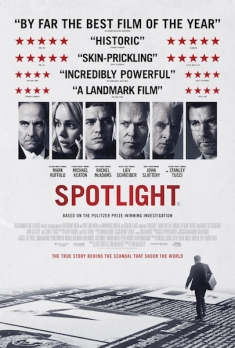 The most recent Best Picture Oscar winner tells of how the Boston Globe’s investigative journalism unit, the eponymous Spotlight team, exposed the widespread sexual abuse of children by the local Catholic Church — and, just as shockingly, the way the institution itself swept this under a rug for decades. As a film, this story is effectively a conspiracy thriller: a team of journalists expose a wide-reaching criminal cover-up within a respected and powerful institution. If it were fiction, you’d struggle to believe it, the scale of the conspiracy so vast that the very notion of it would be implausible. So it’s all the more astonishing — and horrifying — that it was real. And, as the closing title cards reveal, far larger than the Spotlight team realised even when they went to print.
There are many fascinating true stories that have produced merely adequate movies, so it’s something else again that transforms Spotlight into a Best Picture winner — albeit a somewhat controversial one, in that it came in a year when the top award went to one of three different films at the major awards (the others being The Revenant and The Big Short), rather than a consensus emerging as the various ceremonies all rewarded the same film (as usually happens, more or less); relatedly, it was the first Best Picture winner for over 60 years to only nab one other gong. More pertinently, doubts about the film’s deservingness stem from criticisms of its relatively plain directorial style, its focus on the plot rather than the characters within it, and its monomaniacal attention to the process of investigation rather than the thing being investigated.
In my opinion, the film’s storytelling would be better described as no-nonsense. It actually takes confidence to be this understated, I think. Tom McCarthy’s direction isn’t slickly shot and edited to make the story seem like a whizz-bang fast-paced thriller; nor is it affectedly artistic or indie, the kind of style this sort of low-to-mid-budget drama often resorts to nowadays. 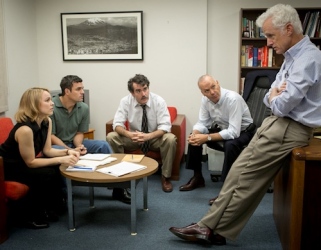 Instead, it lets the story and the events speak for themselves, with the screenplay being the real powerhouse here. On that scale the directing isn’t even in second place. That’d be the performances, as the actors carry the delivery of information while still feeling like human beings pursuing an investigation, rather than mere narrators of what they discovered. McCarthy’s work is therefore the kind of helmsmanship that wouldn’t attract awards attention, except maybe by association with the film’s overall acclaim (he did get nominations, but the cynical side of me doubts awards bodies genuinely appreciated the qualities of what they were watching). Nonetheless, awards are not the be-all-and-end-all, and the low-impact style was surely the right way to go. This is a tale bigger than auteurist showboating, and McCarthy handles it with appropriate respect.
I think the perceived lack of characterisation for the journalists is due to similar reasons — both that the film has different fish to fry, and also that it goes about such business with greater subtlety. Personally, I think you come away with a really good sense of who these men and women are as people; at the very least, how they are in their work environment, which at the end of the day is where we’re observing them. This is accumulated through how they behave in interviews and meetings, how they react to developments and revelations, how they do their jobs. It’s good writing and good acting, because there are no scenes devoted to merely “exploring character” or whatever. There are allusions to their private lives without making them full-blown subplots, and that’s a good thing — this tale doesn’t need embellishing with a shoehorned romance or a failing marriage. That said, 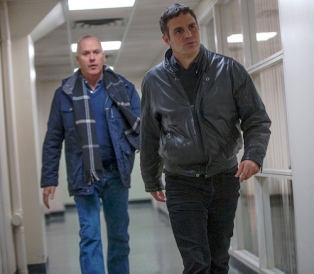 this is also perhaps where the film’s only egregious bum note comes in: Ruffalo’s shouty speech about how they need to go to press now, which was naturally used across all the trailers and clips. It feels like that is precisely what that speech was designed for — that it was written, directed, and acted with the “here’s our big dramatic trailer moment” in mind. It’s not entirely out of character in context, but it is a bit much.
One reason it feels out of place is that the film perhaps hasn’t quite whipped up our fury at the situation to the same level. That’s not to say it’s soft on it — there are horrifying tales and facts related — but while the film is about historic Catholic abuse, it’s really about journalism. Other critics of the movie accuse it of telling the abuse story in a way that could be better covered through a documentary or reading a Wikipedia article, but I think that misses what makes Spotlight really tick. It’s the process the journalists go through — how they uncover the story as much as what they uncover — that the film is demonstrating for us. Sure, you can read a Wikipedia article to find out what they unearthed, but without them unearthing it in the first place there’d be no Wikipedia article to read. That’s what the film is really about. These events happened 15 years ago; the truth they outed has been a massive story ever since — that’s not something that needs fresh exposure (other than it never hurting to remind people). But as the world moves away from proper journalism, into the realm of amateur bloggers rehashing press releases and ‘professional’ organisations running endless clickbait listicles because that’s where the advertising revenue is, it’s a timely reminder that it’s this kind of proper, old-fashioned journalism that can expose massive, important issues; issues that you might think the police or legal system should expose, but which they’re sometimes (maybe even often) complicit in.
 So was it the best film of last year? Perhaps that depends what you look for in movies. As much as I think the understatement fits, I also think it’s what stops it from being as cinematically exciting as, say, the visually-driven hyper-kinetic storytelling of Fury Road. But to focus too much on the deservingness or otherwise of awards is to miss the point. Much like it doesn’t need flashy camerawork or editing, or diversions into the characters’ private lives, so Spotlight doesn’t need awards to make you pay attention. It’s a story about the importance of independent investigation, told in a strong but no-frills fashion that befits the weight of the material.

Spotlight is available on Amazon Prime Video UK from today.
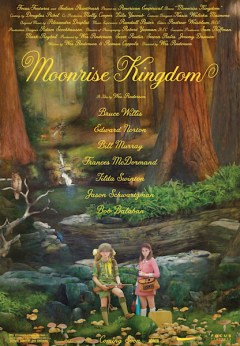 On the New England island of New Penzance in the summer of 1965, a troop of scouts at camp discover that unpopular member Sam Shakusky (Jared Gilman) has fled in the night. Meanwhile, on the other side of the island, troubled kid Suzy Bishop (Kara Hayward) runs away from home. Unbeknownst to Sam’s scoutmaster (Edward Norton) or Suzy’s parents (Bill Murray and Frances McDormand), the pair of unhappy 12-year-olds have secretly plotted to disappear together. As a violent storm threatens to hit the island, the scouts and police Captain Sharp (Bruce Willis) hunt for the runaways.
 If the film has a fault it’s in this part, where the entire cast engage in a runaround as the hurricane arrives and floods the island; but (to give it the benefit of the doubt) perhaps that plays more smoothly with familiarity. And I don’t know what it is that Anderson has against dogs (nor, it seems, does anyone else, bar

 Score:



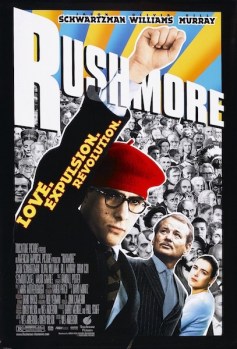 The breakthrough film of cult writer-director Wes Anderson, Rushmore is the story of high school student Max Fischer (Jason Schwartzman, making his debut, aged 18 but still looking like one of those twentysomethings-playing-highschoolers you so often see in US productions). He’s a prolific participator in extracurricular activities at the prestigious Rushmore Academy, but is put on notice for his failing academic standard. At the same time, he becomes infatuated with first grade teacher Miss Cross (Olivia Williams) and attempts to woo her by building an aquarium on school grounds. He enlists the support of local business magnate Herman Blume (Bill Murray), but soon Blume is falling for Miss Cross too, setting the men on a path of mutual enmity.
 Part of that is probably tied to Anderson’s own development. It’s not only his very personal touches that have flourished with further films, but I feel like his storytelling and depiction of character has become more sophisticated, too. That’s not to say Rushmore comes up short, but coming to it for the first time with that degree of hindsight, it feels very much like a formative work.
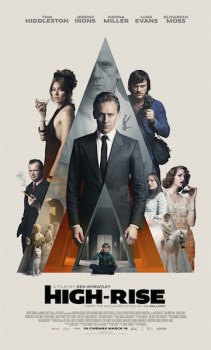 I was looking forward to this sci-fi-ish ’70s social satire, but, having let it percolate for a few months, I still have no real grasp of what it was about. I mean, it’s obviously about society, but what its point about society is… I have no idea.
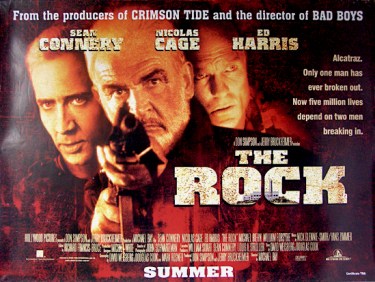
 Believing the mission lost, the military has launched its back-up plan: an airstrike that will destroy the poison gas but also kill everyone on the island. Naturally our heroes manage to complete their mission nonetheless, and as the jets streak across San Francisco Bay, Stanley attempts to signal abort with two green flares. In slow motion, of course.

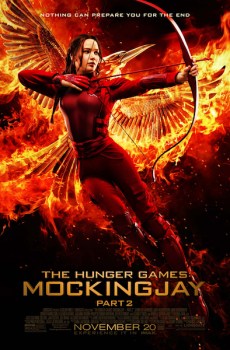 The artificially-extended Hunger Games trilogy-turned-tetralogy climaxes here. Presumably you’ve seen the first three and so know what you’re into by this point — either you’re invested or you’ve given up. Unless you want to know “does it end well?” before embarking on the whole thing, of course. While Mockingjay Part 2 is not the series’ finest instalment, it brings things to a decent head… eventually.
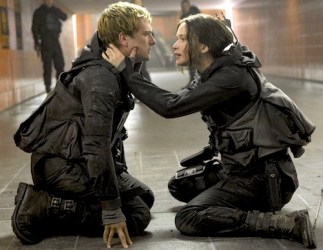 What follows isn’t perfect — in particular, the storyline could’ve done with tightening up — but it does have a lot going for it. There’s strong characterisation: Katniss is as confused, conflicted, and incapable of engaging with her emotions as ever, while Peeta’s PTSD is well-handled, with an effective device where he repeatedly makes a statement before asking, “real or not real?” There are other nicely developed thematic points too, like expanding further on the rebels not being perfect good guys (as initiated in Part 1), which plays a central role in the denouement. The action sequences are well staged and occasionally inventive, but best of all is that the climax doesn’t lean on being the biggest fight scene yet — it’s driven by the story, and the characters and their decisions, rather than being a ginormous shoot-out.
 Mockingjay Part 2 is not the best instalment of the Hunger Games, a series whose second half didn’t quite live up to the developed potential of the excellent
  The debut feature of Terrence “four films in 30 years” Malick comes with a tagline-cum-plot-description so good I’m just going to quote it wholesale:
 the leads start out from bleeds outwards into their time on the run, which Holly romanticises but feels constantly grotty. I suppose a film about killers shouldn’t be nice, but maybe this is why the time in the treehouse stood out for me — a little oasis of pleasantness; a break from the insalubriousness of the rest of the picture.
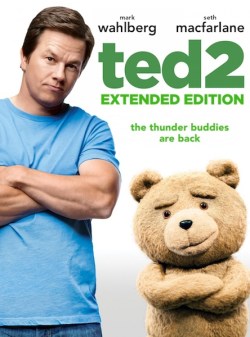 Comedy sequels often struggle, and writer-director-producer-star Seth MacFarlane’s