Quay Brothers + Christopher Nolan | 68 mins | Blu-ray | 2.35:1 + 1.85:1 + 1.33:1 | UK & USA / English | 12*
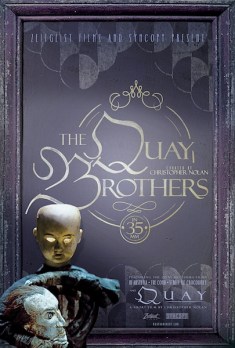 Christopher Nolan made a few headlines last year when his first post-Interstellar film was announced for near-immediate release. Not Dunkirk, of course, but an eight-minute short documentary, Quay, about British-based American-born identical-twin animators the Quay brothers. The short was screened theatrically as part of a programme of animated shorts directed by the brothers, curated by Nolan to accompany his documentary, all from 35mm prints — because it’s Nolan, so of course. One critic reckoned it “will always be one of [Nolan]’s most important contributions to cinema.”
Today, the BFI release a Blu-ray set of the Quay brothers’ short animations, containing 24 of their works plus special features, among which is Nolan’s short. As a complete neophyte to the Quays’ work, I thought the best way to begin approaching it might be via the selection Nolan programmed, which was at least partly minded as an introduction to the brothers’ oeuvre. (Now, obviously I’m not watching this on 35mm, nor in its intended form (i.e. in a cinema), and it’s technically a selection of short films, so can I really count it towards my list? We’ll leave that to my conscience.)
Though if it is a beginner’s course, it’s the kind that throws you in at the deep end. In Absentia (2000) was, remarkably, made for the BBC as part of a season about sound on film — you can’t imagine them commissioning anything like this today. Maybe for BBC Four. Maybe. It’s an inscrutable 20-minute nightmare of a film, with sci-fi landscapes, a demonic puppet, sentient pencil leads, and the graphite-stained fingers of too many hands. It’s clear from the outset that these are films more about mood, atmosphere, and feeling than they are strictly concerned with plot or character, and to an extent one needs to be open to just going along with it in the hope that meaning or significance reveals itself.
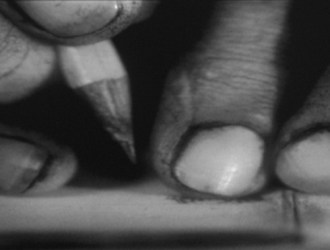 For all that In Absentia initially feels like flailing in deep water without armbands, accompanied with “what have I got myself into?!” thoughts, in retrospect I found it to be the most accessible of the three animations. It’s abstract and confusing for most of its running time, but by the end you can decipher some meaning; you can understand the relevance of the feelings it aims to generate — and if you haven’t got there yourself, or if you’re unsure, there’s a dedication to point you in the right direction. I didn’t get that with the next two; not so easily, anyway, which is why I say they’re less accessible rather than less good per se.
Nolan follows this opening salvo with his documentary, Quay. It provides a sliver of insight into the brothers’ methods and thought processes; the merest glimpse into how they do what they do, with little or no explanation for why or what it means. I suppose Nolan wasn’t aiming for enlightenment or explanation, but to instead acknowledge the craftsmanship of the animators. Rather than the kooky outré bohemians you might imagine from their bizarre films, the brothers seem quiet, calm, and, for want of a better word, ordinary. By placing his documentary here, Nolan gives you an idea of the people whose hands you’re in, before diving back inside their imagination…
The Comb (1990) professes to be adapted from something and has immediately obvious characters, both human and puppet. “Ah,” you may think, “a clearer narrative.” No chance! I came away with even less of an idea what this was about than I did In Absentia, and certainly no clue what a comb has to do with most of it — the exception being the bits where there is a comb, because then there is a comb there. In a piece on the film at BFI Screenonline,  Michael Brooke notes that it is “setting out to wrong-foot the viewer at every turn, and the result wilfully defies verbal analysis.” What can be easily discerned is that it’s about a dream, and it probably shouldn’t be a surprise that there’s some dream-logic involved. As to what else is to be gleaned, your guess is as good as mine.
Last up is the film that’s reckoned to be the Quays’ masterpiece, Street of Crocodiles (1986) — Terry Gilliam picked it as one of the ten best animated films ever, while critic Jonathan Romney has twice nominated it in Sight & Sound’s famous “greatest films of all time” poll. Once again, I was left initially floundering for significance. There’s some fascinating imagery, and the implication again that parts function though dream-logic, but as to an overall story or message… Reading various sources before writing this, a theme emerges: that to search a Quay Brothers film for direct meaning is futile; it’s more about somehow accessing the same otherworldly psychological and/or emotional space that’s peculiar to these filmmakers. Even when the Quays themselves describe what’s going on in Street of Crocodiles, you’ll notice there’s nary a nod to meaning — though even an outline of the plot as they conceived it is illuminating, unlocking something you sort of already knew, but providing a kind of clarity that felt absent before. A bit like that title card at the end of In Absentia, I suppose.
It’s true what they say: watching Quay Brothers shorts is like being given a glimpse into another world, connected to our own but also other to it — hiding in the cracks or around the corner, perhaps; or only in our dreams and nightmares; on the other side of the mirror, were we able to pass though it. Their work is our conduit to this otherness, which is 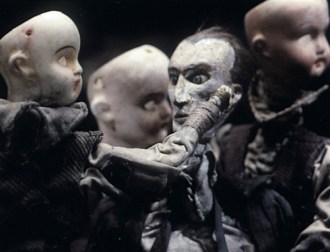 sometimes informative about the world the rest of us live in (In Absentia), sometimes a twisted analogy for it (Street of Crocodiles), and sometimes just fascinatingly unknowable (The Comb). All the films are teasingly oblique, and by all rights that should make them frustrating to the point of irritation, even abandonment… yet they’re kind of compelling nonetheless.
Oh, and do I need to throw in a “they’re not for everyone” at this point? I imagine that’s implicit.

The aforementioned Blu-ray collection, Inner Sanctums – Quay Brothers: The Collected Animation Films 1979-2013, is released by the BFI today. The genuine Quay Brothers in 35mm is screening at London’s Prince Charles Cinema in November.
- The Quay Brothers in 35mm official website, including a trailer, bios, and more.
- An hour of audio interviews with Nolan and the Quay Brothers, recorded at screenings at New York’s Film Forum, is available on Film Forum’s website or in their podcast on iTunes (episodes 27 and 28).
- As well as the piece on The Comb, Michael Brooke has also written about Street of Crocodiles and In Absentia.
* Although this particular presentation hasn’t been certified by the BBFC, a collection of Quays shorts featuring these is rated 12, and Nolan’s short is classified U. ^


 Score:



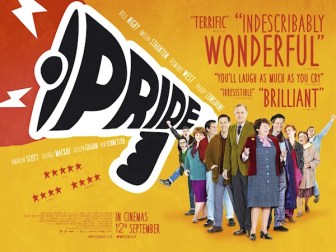 I don’t know if the true story behind Pride was big news back when it all actually happened in 1984, but I hadn’t heard of it until the film came along. For those who’ve still missed it, it’s about a group of gay activists deciding to form a group, LGSM, to support the striking Welsh miners — two groups who were poorly treated in one way or another by ’80s Britain.
 whose dancing display has to be seen to be believed. Bill Nighy and Paddy Considine are understated as quiet, hesitant characters who have inner steel, and Jessica Gunning makes a similar impact as a housewife who is completely emboldened by the activism.
 Adam Sandler, eh? He has his fans, though apparently not among people who can write because you rarely see a good word penned about him. The one exception is
 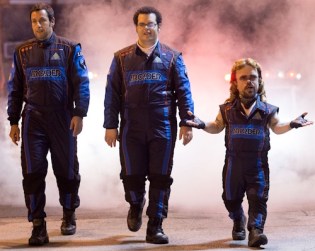 Pixels is the virtual definition of brain-off entertainment. The story has the plausibility of a kids’ daydream, the humour is frequently unimaginative, and the action sequences mostly coast on their basic concept rather than trying to elevate them. And Peter Dinklage is going to get a reputation for having terrible taste. I mean, I liked
 There are two stars in Mike Leigh’s biopic of famed British artist J.M.W. Turner: Timothy Spall, grunting his way through the title role with a deceptively layered realisation of an apparently simple but deeply complex man; and Dick Pope’s cinematography, which makes almost every frame look like a rich landscape painting, so that you feel you can almost see the brushstrokes.
 sometimes lack clear relevance (recognisable-off-the-telly actors turn up silently for what we’d call cameos if they were more famous). It creates a measured pace that is surely not to every taste, especially over the long running time, though personally I only found it sluggish towards the very end.



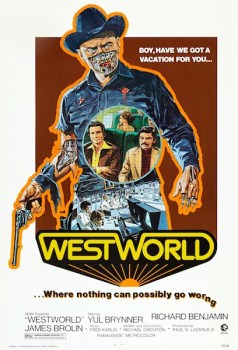 When writer-director Michael Crichton hit upon the notion of a theme park where the future-science star attractions broke free of their shackles and endangered the lives of the guests, it was so good it served him twice: he replaced the initial murderous AI-powered robot cowboys with rampaging genetically-engineered dinosaurs and sparked
 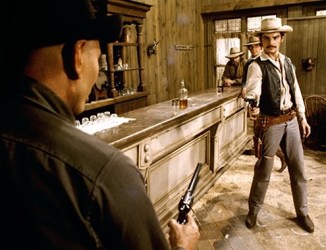 under $76,000, or about £58,200. The potential threat of the robots malfunctioning is built up gradually here and there, in asides from what our ostensible heroes are up to, and isn’t explained. There are nods to the fact the human staff don’t actually know how the robots work, but why should that be? Some of them were apparently designed by other robots, but how did the designing robots come about? Rather than explore any of its science fiction themes, the film just uses the basic idea to have the robots go on a killing spree right at the climax. This is something Crichton definitely turned around for
 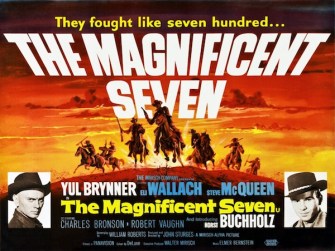 Described in the booklet accompanying the Ultimate Edition DVD release as “the last great American western before Sergio Leone reinvented the genre,” The Magnificent Seven doesn’t feel as dated as that might make it sound. Famously, it’s a remake of Akira Kurosawa’s
 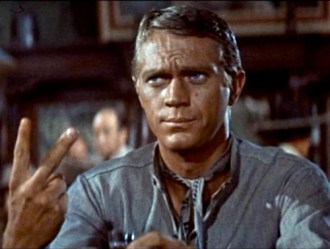 With even less screen time to go round than in Kurosawa’s original, the cast only get to provide thumbnail sketches of their characters. However, bearing that in mind, only Vaughn really feels shortchanged on time, while McQueen manages to steal every scene he’s in, even when he was supposed to just be in the background — much to Brynner’s annoyance. One reason this works is because the seven represent more or less the same things thematically, in some respects functioning as one hero character with seven parts. They are all unsettled drifters, good at killing but not at settling down; they have nothing to do but win and so be damned to go find another cause, or die trying. This is taken from Kurosawa’s film too, of course, but it fits just as well in its new setting, and the main scene where the seven discuss it is a definite highpoint of the movie.
 That’s not something that bothered me, but where I did find it suffering was in comparison to Kurosawa. While it has obviously been rejigged for its new setting, it’s not just borrowed the basic concept of seven violence-skilled loners defending a needy village, but rather retained all the bones of the samurai original. As with most remakes, it falters by not doing the same thing quite as well, for one reason or another. Still, if it is a faded copy then at least it’s of one of the greatest films ever made, which leaves it a mighty fine Western in its own right.




 Favourite Film of the Month