Knives Out (2019)

2020 #55
Rian Johnson | 130 mins | Blu-ray (UHD) | 1.85:1 | USA / English | 12 / PG-13

Knives Out

After creating the widely beloved and totally uncontroversial Star Wars instalment The Last Jedi, writer-director used his newfound filmmaking cachet to quickly launch a passion project that he’d been working on since after his debut feature, Brick: a whodunnit murder mystery in the Agatha Christie mould, a genre of which Johnson is a lifelong fan.

The story revolves around crime novelist Harlan Thrombey (Christopher Plummer) and his family of hangers-on, played by an all-star cast (including the likes of Jamie Lee Curtis, Michael Shannon, Chris Evans, Toni Collette, and Don Johnson). When Harlan dies, seemingly by suicide, freelance detective Benoit Blanc (Daniel Craig) has reason to suspect foul play, and teams up with Harlan’s nurse, Marta (Ana de Armas), to find out which of the family members dunnit.

Knives Out is clearly built like a Christie story, though perhaps with a touch more satire and humour. That’s not to say it’s an outright comedy (though I’ve tagged it as one, because it’s often amusing), but this is a heightened world we’re in; it’s the real world, but filtered through the lens of a genre. And rather than follow the familiar formula of a Poirot- or Marple-type case, the film is like one of Christie’s other novels; one of the ones where the broad shape is the same, but there’s some twist or variant in how it’s told. Here, it’s that the detective isn’t actually our POV character, and at times we know a lot more than him (or, at least, different stuff to him). That leads to some effective twists that I won’t spoil, but which certainly keep you thinking and on your toes. I made a prediction as to the true solution before the halfway mark, and it turned out to be wrong, so that was fun (I don’t mean to boast, but plenty of murder mysteries are thoroughly guessable).

The name's Blanc, Benoit Blanc

That said, I wasn’t a million miles off with my guess, but that also doesn’t matter. As I noted in my summation of the film for my 2020 top ten, it’s not so important who actually dunnit when it’s so much fun spending time with the outrageous suspects and Craig’s implausibly-accented detective. That means it achieves something many mystery-based films miss: it’s highly rewatchable, because knowing the outcome isn’t the be-all and end-all. And yet, to achieve that, it doesn’t sell out the mystery entirely — I say “it barely matters who dunnit”, but it’s still an engaging riddle on first viewing.

Knives Out was a notable success, eventually leading Netflix to pay a frankly ludicrous sum for two sequels. I’m glad there’ll be followups, because more mysteries in this vein promises more fun, but it’s a shame that what could’ve been a non-superhero non-action-based big-screen franchise has been nipped in the bud by the streamer. I expect that was literally their goal (and why they paid so very, very much money), but that’s a whole other debate.

5 out of 5

The UK network TV premiere of Knives Out is on Channel 4 tonight at 9pm. It placed 13th on my list of The Best Films I Saw in 2020.

Netflix’s currently-untitled sequel is due for release later this year.

Archive 5, Vol.5

I have a backlog of 427 unreviewed feature films from my 2018 to 2021 viewing. This is where I give those films their day, five at a time, selected by a random number generator.

Today, melancholic Frenchmen, screwball Americans, and royal Africans are followed by a superhero team-up and a lesson on the evils of social media.

This week’s Archive 5 are…

  • La Belle Époque (2019)
  • The Awful Truth (1937)
  • Coming to America (1988)
  • Scooby-Doo! & Batman: The Brave and the Bold (2018)
  • The Social Dilemma (2020)


    La Belle Époque

    (2019)

    Nicolas Bedos | 115 mins | cinema | 2.35:1 | France / French | 15 / R

    La Belle Époque

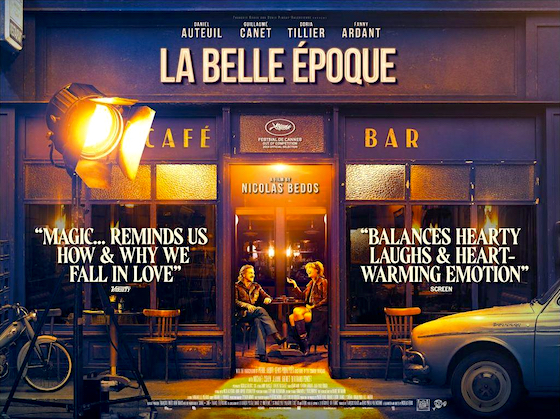
    Sixtysomething Victor (Daniel Auteuil) is officially a grumpy old man, and his marriage is on the rocks because of it. To cheer him up, his son buys him an experience with his friend’s company, who stage bespoke historical reenactments as a form of time travel. When Victor’s wife finally has enough and throws him out, he uses his experience to revisit 1974, when they first met and fell in love.

    To oversimplify things, it’s kind of like Groundhog Day by way of Charlie Kaufman: the immersive theatrical experience recalls Synechdoche, New York (in a superficial way, I guess), and Victor’s desire to live it over and over again is, well, obvious. Except he’s not stuck there, but choosing it. It’s a mix of nostalgia and melancholy, because, of course, he’s not actually reliving that day, however much he comes to believe in it.

    Advance reviews led me to believe La Belle Époque would be little more than a pleasant diversion, but there’s a lot more to it than that. It clearly has something to say as regards the power of nostalgia and the need to live in the present. But, deep thoughts aside, it’s also a charmingly romantic film — sharply witty, unexpectedly beautiful in places, and genuinely emotional by the end. It’s a shame that it seems to have had half-hearted distribution outside of France (perhaps the fault of it being acquired by Disney, I suspect with an English-language remake in mind, rather than a ‘proper’ distributor of foreign fare who would’ve shown it more love) because I think it deserves, and would reward, a wide audience.

    5 out of 5

    La Belle Époque was #140 in my 100 Films in a Year Challenge 2019. It placed 7th on my list of The 15 Best Films of 2019.


    The Awful Truth

    (1937)

    Leo McCarey | 91 mins | Blu-ray | 1.37:1 | USA / English | U

    The Awful Truth

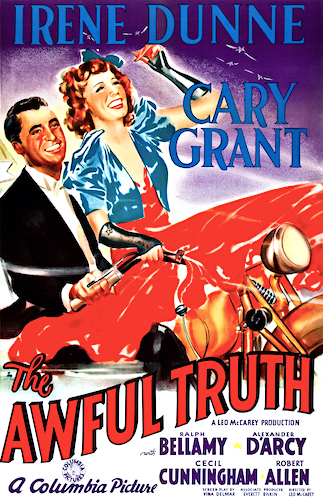
    When Leo McCarey received his Best Director Oscar for this film, he said that he got it for the wrong film — a clear reference to his fondness for Make Way for Tomorrow, which he made the same year. I’m not wholly sure I agree with him, although Tomorrow’s is clearly the ‘worthier’ picture — but that doesn’t always mean better.

    The Awful Truth was the first of three screen pairings of Irene Dunne and Cary Grant, and the film that refined the latter’s famous screen persona. Here, the duo play a married couple who begin to divorce, only to then interfere with each other’s further romances. When it’s on form, the film is up there with the best of its subgenre: a sparkling screwball comedy with glorious dialogue, a pair of splendid lead performances, and a magnificent dog. Unfortunately, it goes on a mite too long and begins to lose steam in the final act. While that might hold the film back from perfection (and so open the door to the idea that Make Way for Tomorrow is somehow superior), the magnificence of what comes before means it’s still a must-see for fans of this style of comedy.

    4 out of 5

    The Awful Truth was #95 in my 100 Films in a Year Challenge 2021.


    Coming to America

    (1988)

    John Landis | 117 mins | digital (HD) | 16:9 | USA / English | 15 / R

    Coming to America

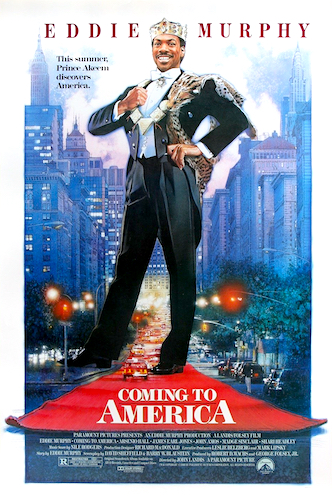
    Eddie Murphy plays a pampered but bored African prince, who dodges an arranged marriage to travel to America and find a bride. With that plot and the fact it was made a few decades ago, I was half expecting Coming to America to have aged badly. If nothing else, it seemed primed to base its humour around cringe-inducing culture-clash awkwardness — not necessarily an invalid kind of comedy, but not one I personally enjoy.

    As it turns out, it’s nothing of the sort. In fact, it’s actually rather sweet and kind-hearted, with just enough lewdness to give it a kick rather than make it eye-rollingly vulgar (I’m sure it would only take a couple of minor trims to get that 15/R rating down to a 12/PG-13). Some have criticised it for being too slow — including director John Landis, who asked Paramount if he could re-edit it for the Blu-ray release (they refused) — but I thought it was quite well paced. It doesn’t move at whipcrack speed, but it doesn’t need to. All in all, it holds up well enough that I can see why they decided to produce a belated sequel (which is still on my watchlist).

    4 out of 5

    Coming to America was #28 in my 100 Films in a Year Challenge 2021.


    Scooby-Doo! & Batman:
    The Brave and the Bold

    (2018)

    Jake Castorena | 75 mins | digital (HD) | 1.78:1 | USA / English | PG

    Scooby-Doo! & Batman: The Brave and the Bold

    There are an awful lot of Batman movies nowadays (58 and counting, according to my Letterboxd list), but I thought I was at least aware of them all. Turns out not, because I hadn’t even heard of this one until I happened to see someone log it on Letterboxd several years after its release. (It’s a direct-to-video production that they didn’t bother to release on Blu-ray, so that’ll be a big part of why it slipped under my radar.)

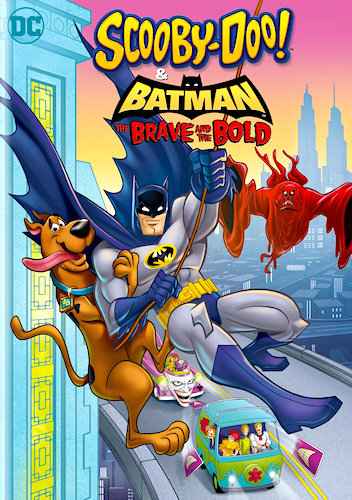
    A plot description is pretty unnecessary here: the title tells you all you need to know. The reason it’s a particularly unwieldy one is because Scooby-Doo and friends team-up with, specifically, the Batman from animated series Batman: The Brave and the Bold. I watched a selection of episodes from that show a few years ago and, frankly, didn’t enjoy most of them (although a couple are excellent: Mayhem of the Music Meister is so good I watched it twice in as many days, which regular readers will know is very unlike me), so I didn’t have high hopes for this movie either.

    At least it’s an appropriate iteration of Batman to crossover with Scooby-Doo, because (a) the whole point of the show was team-ups, with every episode seeing Batman join forces with a different DC hero (the subtitle is derived from a classic DC team-up comic), and (b) the overall tone of the show was camp and comical, which chimes well with Scooby-Doo. In fact, despite Scooby-Doo getting top billing, the film is really a feature-length episode of Batman: The Brave and the Bold guest starring Mystery Inc, rather than the other way round. I mean, it’s set in Gotham City, stuffed with appearances and cameos by other DC characters, and (most of all) it uses The Brave and the Bold’s animation style, even featuring a version of the series’ title sequence and theme music — with a Scooby makeover, of course. Nonetheless, it also adopts plenty of the tropes of a Scooby-Doo story, like the unmasking at the end.

    Thanks to all that, it’s everything you’d expect from “Scooby-Doo meets Batman” — they leave nothing on the table, right down to having Scooby actually say, “Holy Scooby-Dooby-Doo, Batman!” And would you have it any other way? It’s a daft concept, mashing these two cheesy franchises together — there’s no point trying to be above it. By embracing what it is, it delivers what you’d expect as well as could be imagined. For that, I quite enjoyed it on the whole. And so I would say that, if the basic idea of it doesn’t interest you, give it a miss; but if you think it sounds potentially appealing, you should definitely watch it.

    3 out of 5

    Scooby-Doo! & Batman: The Brave and the Bold was #105 in my 100 Films in a Year Challenge 2020.


    The Social Dilemma

    (2020)

    Jeff Orlowski | 94 mins | digital (UHD) | 16:9 | USA / English | 12 / PG-13

    The Social Dilemma

    One of those Netflix documentaries that everyone seems to be talking about for a while but then forgets just as quickly, The Social Dilemma is essentially about how dangerous social media is, as told to us by the people who created it. Not the Mark Zuckerberg of the world, obviously — they’re still raking in far too much cash to want to dissuade us from using their products — but various other developers and whatnot who’ve been involved over the years.

    Naturally, the main reaction to all this information is: “OMG, I totally need to change all my social media habits!” And do people? Not as far as I’ve seen. As one contributor in the doc comments, “knowing what was going on behind the curtain, I still wasn’t able to control my usage. So that’s a little scary.” Eesh. We’re doomed.

    4 out of 5

    The Social Dilemma was #20 in my 100 Films in a Year Challenge 2021.


  • 2022 | Weeks 4–6

    It’s been a busy start to the year… at my day job, which has had the knock-on effect of lower film viewing than has been the case in recent years. (I say that, but as February passes its midpoint, I’ve actually watched slightly more films than I had at the same point in 2020; but the last time I was lower than that was right back in 2014, so…)

    As well as work, there’s the psychology of my new reviewing practices. These regular up-to-date roundups have taken me right back to the days when I used to review everything in order, and how not being caught-up on my reviews made me not want to watch anything more. I’m getting those same kinds of twinges now. I need to try to use them to my advantage — take the time to read more books or something.

    Anyway, enough about me — let’s have some film reviews…

  • Voyage of Time: An IMAX Documentary (2016)
  • L’avventura (1960)
  • She’s Gotta Have It (1986)
  • Don’t Look Up (2021)
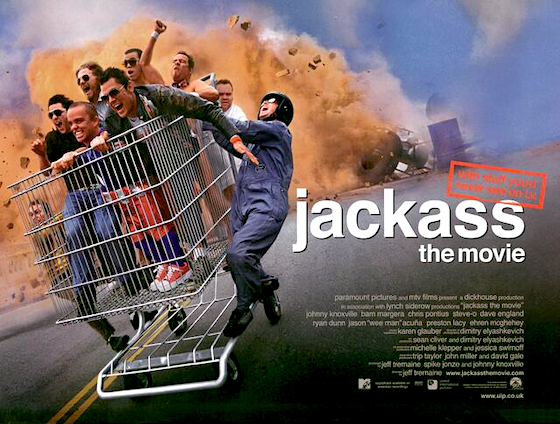
  • Jackass: The Movie (2002)
  • Jackass Number Two (2006)


    Voyage of Time

    (2016)

    aka Voyage of Time: An IMAX Documentary / Voyage of Time: The IMAX Experience

    Terrence Malick | 46 mins | digital (UHD) | 1.90:1 | USA / English | NR / G

    Voyage of Time: An IMAX Documentary

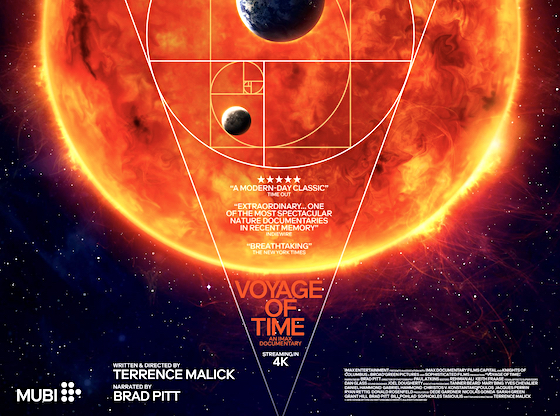
    Calling a film “a visual poem” sounds either clichéd or pretentious, or both, but how else to accurately describe this work by Terrence Malick? It’s labelled “a documentary”, because only because it’s not strictly fiction — if you come looking for the kind of education you’d get from something narrated by David Attenborough or Brian Cox, say, then I think you’d leave disappointed.

    No, film-as-poetry is the most appropriate way to attempt to engage with Voyage of Time; and, as with so much written poetry, your personal tolerance for and interest in it will vary. That’s how I found it, anyway: like most poetry, I felt I should appreciate it, but really was glad it was quite short. (The non-IMAX version of the film, subtitled Life’s Journey, runs about twice as long.) There’s some stunning photography, of everything from the birth of the universe to prehistoric vistas (presumably shot in remote modern-day locales rather than computer-generated), and Brad Pitt occasionally whispers some abstrusely meaningful ponderings over the top. As much as the pretty pictures are a draw, you can also find gorgeous nature photography in a BBC Attenborough documentary, and you’ll learn something at the same time.

    The IMAX version of the film has been streaming on MUBI since the end of last year, and they definitely sold it on the visual experience, boasting about offering it in 4K. I found the quality to be variable, with the stream unable to keep its end up for the whole running time, sometimes sinking to sub-1080p levels, becoming blocky and compressed. This is why physical media remains the best, when possible.

    3 out of 5

    Voyage of Time: An IMAX Documentary is the 11th film in my 100 Films in a Year Challenge 2022.


    L’avventura

    (1960)

    aka The Adventure

    Michelangelo Antonioni | 143 mins | digital (HD) | 1.85:1 | Italy & France / Italian, English & Greek | PG

    L'avventura

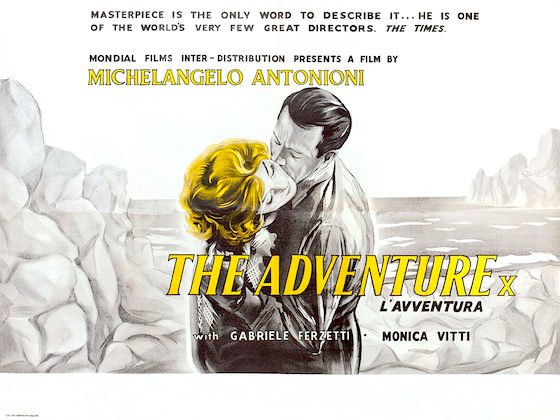
    I don’t have a great track record for enjoying acclaimed classic Italian cinema (neither Bicycle Thieves nor were to my taste, for example), so I’ve put off watching L’avventura for years, expecting I wouldn’t get on with it. But, inevitably, I had to face it someday… and, as it turned out, I really liked it… for a while…

    The film begins with Claudia (Monica Vitti) and her wealthy friend Anna (Lea Massari) meeting up with the latter’s wealthy boyfriend, Sandro (Gabriele Ferzetti), to go for a cruise on the yacht of some other wealthy friends. When they dock on a small island, Anna goes missing. The party scour the island, but there’s no sign of her. Police and divers arrive, but no luck. Reports suggest maybe she boarded another boat; possibly she was kidnapped. The wealthy friends quickly drift back to their lives, but Claudia and Sandro keep searching, following scant clues. Soon they too begin to get distracted — by each other.

    I don’t think it’s a spoiler to say that L’avventura starts out looking like a missing-person mystery only to get sidetracked into being a kind of romantic drama. I certainly knew that going in; and it’s probably beneficial to know it, spoiler or not, so as to manage your expectations of the film appropriately. Anyone expecting a Christie-style hunt through clues and suspects until the truth is unearthed will come away severely disappointed. No, this is the Mystery genre reimagined through an arthouse lens: it’s inconclusive, more interested in the characters than the hunt they’re on, and notoriously slow paced.

    With that in mind, I was surprised by how effective I found the mystery part of the movie. It’s not a whistle-stop action-adventure, but it’s not significantly slower than your average murder mystery, and accusations of it being uneventful seem misplaced — if I were expecting it to unfold like a regular mystery, there’d be plenty of places to look out for clues. It’s as the film shifts more towards Claudia and Sandro’s burgeoning romance that it begins to drag. The pair start just hanging around places as tourists, at which it does begin to seem like nothing’s happening and so what’s the point? The conceit of them falling for each other when they’re meant to be searching for someone they mutually care about is a good storyline, but I wasn’t convinced by how it played out. There doesn’t seem to be any time when they’re actually falling in love, they just suddenly are. Maybe I’m missing some point there. Or maybe it’s beside the point. Until I can work that one out, I’m going to have to chalk this up as half great, half A Shame.

    4 out of 5

    L’avventura is the 12th film in my 100 Films in a Year Challenge 2022. It was viewed as part of Blindspot 2022.


    She’s Gotta Have It

    (1986)

    Spike Lee | 84 mins | digital (UHD) | 1.66:1 | USA / English | 18 / R

    She's Gotta Have It

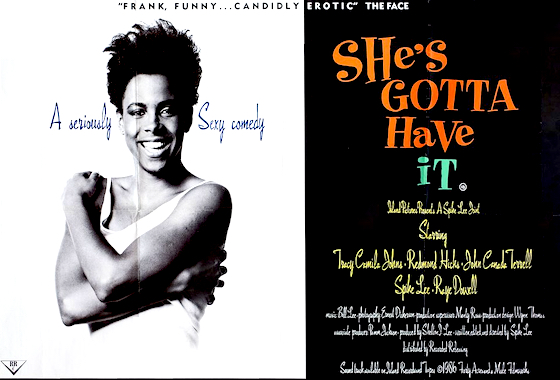
    Spike Lee’s post-student debut concerns twentysomething Brooklynite Nora Darling (Tracy Camilla Johns), who’s openly dating three men: upright ‘nice guy’ Jamie (Tommy Redmond Hicks), preening model Greer (John Canada Terrell), and streetwise Mars (Lee himself). And let’s not be coy (because the film certainly isn’t): she’s not just dating them, she’s sleeping with them all. The story of this love ‘square’ is partially narrated to camera by its four participants, as well as some of Nora’s other friends and acquaintances.

    It’s kinda crazy to think that the American indies were making sexually frank films like this and sex, lies and videotape in the late ’80s (a precursor, no doubt, to the wave of ‘real sex’ movies in the early ’00s), while nowadays we regularly get young people on Twitter arguing that no movie ever needs to have a sex scene, ever. So while I’m tempted to describe the film’s views on promiscuity as “then-modern”, perhaps just “modern” will still suffice — it’s certainly taken most (arguably all) of the intervening decades to get rid of the double standard for men and women as regards having multiple partners. That said, what has perhaps changed is our idea of what counts as “sexually explicit”. The film was obviously quite shocking back in its day, with the MPAA insisting on cuts before they’d give it an R (the unrated “director’s cut” had a Criterion LaserDisc release, but hasn’t surfaced anywhere else since), but you’ll see more nudity, more thrusting and moaning, on certain TV shows nowadays.

    Sexual stereotypes are not the only ones Lee sought to subvert here, as he also attempts to combat stereotypical depictions of African-Americans on screen — note the prominent message in the end credits that “this film contains are no jerri curls!!! and no drugs!!!” (punctuation as seen on screen). It extends beyond those basic signifiers; for example, how Nora’s three lovers are such different personalities. Partly that makes sense for the plot — that different sides of Nora’s personality like different types of guy — but also it shows different ideas of male Blackness; that The Black Guy is not just one thing. The jazzy score is another definite contrast to what you’d expect from a Hip Young Black Movie in the ’80s. Maybe that’s just Lee’s personal preference, but maybe it’s another conscious subversion of expectations.

    Lee’s politics are clear and forthright, but his filmmaking still needed some work. A lot of the film looks great, mostly shot in high-contrast black-and-white (plus one striking, ultra-saturated colour sequence), but some of the editing and performances could use refinement. Rough round the edges though it may be, She’s Gotta Have It is so clearly the calling card of a talented and individual voice with something brand-new to say that those rough edges are almost more of a feature than a bug.

    4 out of 5

    She’s Gotta Have It is the 13th film in my 100 Films in a Year Challenge 2022. It was viewed as part of “What Do You Mean You Haven’t Seen…?” 2022.


    Don’t Look Up

    (2021)

    Adam McKay | 138 mins | digital (UHD) | 2.39:1 | USA / English | 15 / R

    Don't Look Up

    Oscar statue2022 Academy Awards
    4 nominations

    Nominated: Best Picture, Best Original Screenplay, Best Editing, Best Original Score.

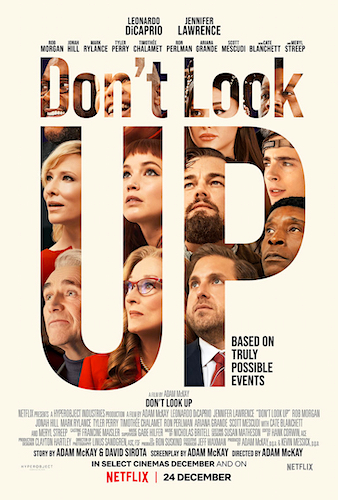
    Having targeted those responsible for the 2008 financial crash in The Big Short, and Dick Cheney and his responsibility for everything bad that’s happened in the last few decades in Vice, writer-director Adam McKay now turns his satirical attention to a fictional scenario, basically so he can have a go at anyone and everyone he feels like. The plot concerns a giant asteroid headed for Earth; an extinction-level event just 6½ months away. But, despite a handful of scientists trying to warn everyone, nobody seems in a great rush to do anything about it. It’s all an allegory for America’s carefree attitude to climate change, see.

    Really, this is a film I should be fully onboard with. It’s setting its sights on vacuous mainstream culture and Trumpian politics, after all. The problem is, these targets are low-hanging fruit, and — somewhat ironically, given its title — Don’t Look Up is satisfied with only plucking those lowest branches. Repeatedly. Unhurriedly. When they said the comet was 6½ months away, I didn’t expect the rest of the film to feel like it was covering that in real-time. It needed a better editor, or perhaps a studio who exerted a bit more quality control than Netflix’s famed “do what you want, we’ll just release it” approach. There are funny moments, certainly, but they’re literally few and far between when the pace is languid and the satire so broad, simplistic, and repetitious. Indeed, the most laugh-inducing stuff has nothing to do with the satire at all, just funny bits of business along the way (the best is a running gag about a general and snacks, which keeps cropping up unexpectedly).

    And for a film that’s entire thesis is being critical of American attitudes, it’s (again) ironic that it depicts this global crisis as so America-centric. Sure, there are cutaways to people watching events in other parts of the world, and a couple of belated nods to the idea that other countries might have their own thoughts on this impending disaster, but that’s all they are — sops and nods. “If America’s not going to fix this, no one can,” says the film. Ah, fuck off.

    2 out of 5


    Jackass: The Movie

    (2002)

    Jeff Tremaine | 85 mins | digital (SD) | 16:9 | USA / English | 18 / R

    Jackass: The Movie

    Jackass never appealed to me. I was a 14-year-old boy when it started, surely the franchise’s target audience; but I was an intelligent 14-year-old boy, so I was above it. Sorry, not sorry. But with everyone going on about the new movie, and reevaluating the whole franchise as some kind of essential classic of Cinema, I thought it was finally time to see for myself.

    For those not au fait with the series, it’s about a bunch of men who clearly aren’t old enough to know better performing stunts and pranks that no one in their right mind should ever want to do anyway. They’re frequently designed to induce pain. They’re often trying to be as crude or gross as possible. Some may make you feel ill just by watching them. And yet others are almost on the level of wholesome fun… albeit “wholesome fun” where you know participants will come away with bruises, at the very least.

    Almost everything the guys get up to is “dumb” — that’s kinda the point — and yet… It borders on “educational” when, for example, lead troublemaker Johnny Knoxville submits to being shot by “less lethal” riot control ammunition. The plan was for him to be shot in the chest, but the guys who make the stuff say if it hits his heart it could kill him, so they revise it to him being shot in the abdomen. Whereas most of the other stunts are followed by cutaways to the rest of the crew in hysterics, here the shocked silence of their reaction is telling. Or how about the kinda-feminism of a segment called “Ass Kicked by a Girl”, in which one of the gang enters the ring against a world champion female kickboxer. There’s no “haha, I can take her easily ’cause she’s a girl” posturing: the guy knows he’s about to get his ass handed to him. There’s some kind of respect for women in that, anyway, which you might not expect given the rest of the laddish antics.

    Taken as ‘a movie’, it’s rather formless — I suspect the TV show was exactly the same, just shorter — but the rapid-fire, standalone-stunt style does mean that no sketch hangs around too long. Some are literally seconds. But there’s not even a sense of escalation, say — it’s not like they save the largest or most outlandish stunt for the end (although there’s a post-credit scene that seems like it was probably the film’s most expensive single sequence). In some respects it doesn’t matter (who cares about the structure of a Jackass movie?), but in others, it’s what keeps it at the level of “feature-length special” rather than true Movie.

    But, ultimately, the important thing is this: some of it is funny. Reader, I laughed.

    3 out of 5


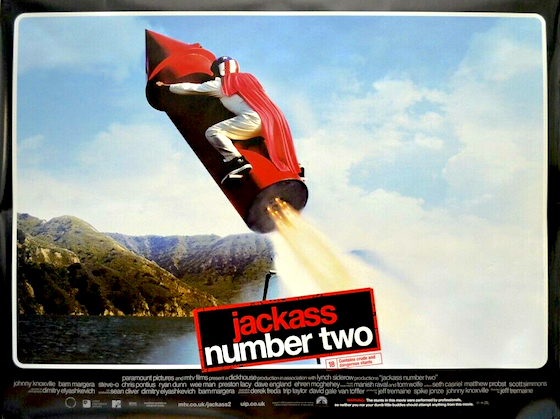
    Jackass Number Two

    (2006)

    Jeff Tremaine | 88 mins | digital (HD) | 16:9 | USA / English | 18 / R

    Jackass Number Two

    Even Jackass isn’t immune from the law of diminishing returns: after three seasons on TV plus a movie, this second big-screen outing feels kinda uninspired, like they’ve used up all their truly great ideas and are mostly running on fumes. That said, there are some good sequences — a variety of rodeo-based stunts with real live bulls are among the highlights — but other pranks feel reheated, or are just underwhelming; things you suspect would have been rejected in favour of better material before.

    In that sense it almost feels like it was rushed out to capitalise on success, but there’s a gap of four years, the TV show had ended, and they hadn’t necessarily intended to do any more — surely the only reason to return, then, was fresh ideas? Or, perhaps, being given the budget to do things they couldn’t before. That might be the case, because some of the material does feel like it’s got too much money and/or time behind it. I say “too much” because I think Jackass works best when it has a rough, cheap, “made at home” vibe. The finale here — a big “old Hollywood”-style musical number, with stunts mixed in — feels particularly out of place. Obviously it’s all a big joke, but the glossy, clearly-expensive visuals don’t feel of the right style.

    Plus, at various points you can feel some of the cast are getting genuinely fed up with this shit. Maybe they’d been doing it for too long by this point (I say there was a years-long gap, but some had been involved in spinoff projects). Whatever the reason, it serves to undermine the fun somewhat. One of the reasons you can enjoy these fools doing life-threatening stunts is because they’re volunteering for it and they seem to be having fun, however much they’re getting hurt or disgusted. But if they’re not enjoying it, aren’t we just watching people be tortured for our entertainment? It almost tips it from being stupid-but-funny into exploitative bullying. And we shouldn’t be having to think about anything that deep during a Jackass movie.

    As I’ve given both films 3 stars, let’s be clear: I’d definitely rate the sequel lower than the first movie, just not a whole star lower — it doesn’t merit being pulled down to a 2, while the first doesn’t merit a retrospective bump up to 4. If this kind of tomfoolery tickles you, there’s still plenty of entertainment to be had in Number Two, it’s just (mostly) not their finest output — which I guess is kinda apt, given the title.

    3 out of 5

    Jackass Number Two is the 15th film in my 100 Films in a Year Challenge 2022.


  • Archive 5, Vol.4

    I have a backlog of 432 unreviewed feature films from my 2018 to 2021 viewing. This is where I give those films their day, five at a time, selected by a random number generator.

    Today: singing vicars, grumpy gamers, very nice Kazakhs, and deleted actors.

    This week’s Archive 5 are…

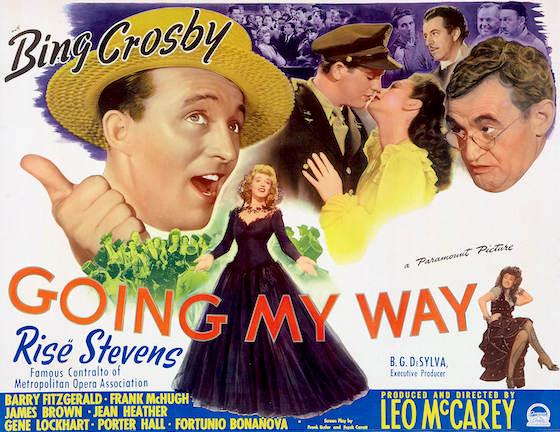
  • Going My Way (1944)
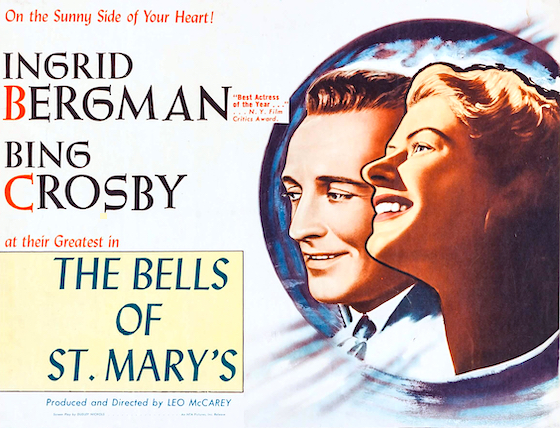
  • The Bells of St. Mary’s (1945)
  • Zero Charisma (2013)
  • Borat (2006)
  • The Thin Red Line (1998)


    Going My Way

    (1944)

    Leo McCarey | 126 mins | digital (HD) | 1.33:1 | USA / English | U

    Going My Way

    The Oscars, eh? Every year film fans pay them a load of attention, and every year we seem to be disappointed with the outcome. But this isn’t some new phenomenon: Going My Way hails from the 1940s, but is perhaps the definitive example of a film that managed to sweep the Oscars (it won seven awards from ten nominations) against a bunch of films that have endured to much greater acclaim (films it competed against included Double Indemnity, Laura, Lifeboat, Gaslight, and Meet Me in St. Louis. I think we can agree those are all better-remembered on the whole).

    None of which is to say it’s a bad film. It’s a gently-paced series of vignettes, almost like a collection of short stories, springing from young priest Father O’Malley (Bing Crosby) arriving to take charge of a struggling New York City parish. His modern ways clash with the old-fashioned values of the incumbent Father Fitzgibbon (Barry Fitzgerald), but his worldly knowledge allows him to connect with some of the parish’s disaffected inhabitants. Despite the religious setting, it doesn’t lean too heavily on the wonders of Christianity (you know I’d be the first to rip into it if it did). Overall, it’s perfectly pleasant; an easy afternoon’s viewing.

    Incidentally (and here’s a good bit of trivia that might come in handy for a quiz someday), it was the first Oscar Best Picture winner to have a sequel: The Bells of St. Mary’s, released the very next year… and also the very next review in this roundup…

    3 out of 5

    Going My Way was #93 in my 100 Films in a Year Challenge 2021.


    The Bells of St. Mary’s

    (1945)

    Leo McCary | 126 mins | TV (SD) | 4:3 | USA / English | U

    The Bells of St. Mary's

    This followup to Going My Way was not only the first sequel to an Oscar Best Picture winner, but was also the first sequel to be nominated for the Best Picture Oscar.

    Bing Crosby returns as Father O’Malley, sent to a new locale, ready to solve another series of subplots at a struggling religious institution, this time butting heads (sort of — it’s never as dramatic as that makes it sound) with Ingrid Bergman’s head nun. Like the first one, it’s really a bundle of subplots for Bing to ‘solve’. The low-stakes problems and amiable tone between the two leads, even when they’re disagreeing, makes for a gentle and relaxing kind of film. I’d give it the edge over its Oscar-winning predecessor, thanks primarily to Bergman’s performance, but neither film is likely to set anyone’s world alight.

    As well as their Oscar success, the films were the highest grossing at the US box office for 1945 and ’46, respectively, another first for a film ‘series’. And yet, with six decades distance, they’re little more than also-rans; nicely obscure trivia answers to “films that won/were nominated for Best Picture”. Maybe there’s a lesson in that for anyone obsessed with the current cultural zeitgeist.

    3 out of 5

    The Bells of St. Mary’s was #187 in my 100 Films in a Year Challenge 2021.


    Zero Charisma

    (2013)

    Katie Graham & Andrew Matthews | 88 mins | digital (HD) | 16:9 | USA / English

    Zero Charisma

    I’d nickname this Portrait of a Manbaby on Fire. The manbaby in question is Scott (Sam Eidson), a stereotypical alpha-nerd: he has a neckbeard; he wears black T-shirts that feature elaborate depictions of grim reapers and the like; he lives with his grandma; he paints miniature fantasy figurines; he’s the Game Master of a role-playing group, which he rules with an iron fist. But when into-geeky-stuff hipster Miles (Garrett Graham) joins the group and everyone really likes him, Scott finds his position threatened, and he’s not happy about it.

    As much as geek/nerd culture has transitioned into the mainstream over the past couple of decades, there’s still stuff that remains the preserve of the hardcore; the truly nerdy. That culture clash is part of what Zero Charisma is about, of course, with Scott’s true old-fashioned kind of nerdishness clashing with Miles’s new-school cool. But it’s also a character study of the former. Scott may seem a stereotype — like The Simpsons’ Comic Book Guy rendered in live-action — but I’d wager anyone who’s moved in nerdish circles has known someone at least a bit like him. Stereotypes are stereotypes for a reason. The film exposes and examines those to often amusing effect. Some have said it exaggerates these things, but I don’t think it’s particularly guilty of that. Maybe it generalises them, and lumps all the worst characteristics of the extremely nerdy together into one character, but that doesn’t make it inaccurate, just broad.

    My only real problem was the ending. There’s a scene where everything comes to a head — a climax, if you will — but, in the wake of that, I felt it lacked adequate resolution. Has Scott learnt anything from this experience? Is he a changed man? Maybe a little, but not completely. To be fair, that’s a realistic character arc, because whose personality changes overnight after a single revelation? And yet it also doesn’t feel like the filmmakers quite know how they want to leave things. If they’d been going for a “change takes time and is incremental, but Scott’s started on that road” kinda message, I would have approved. Instead, the film tries to have its cake and eat it by showing Scott as better on the surface, but then secretly GMing a game where he still behaves like an asshole. Maybe it’s trying to say we can never truly change, however much our flaws are highlighted to us, which would be a pretty glum way to end an otherwise likeable comedy.

    3 out of 5

    Zero Charisma was #109 in my 100 Films in a Year Challenge 2020.


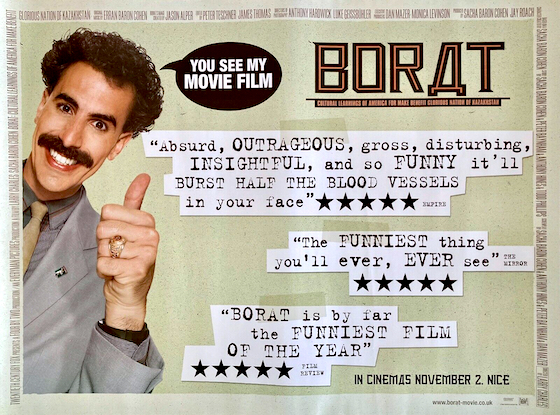
    Borat

    (2006)

    aka Borat: Cultural Learnings of America for Make Benefit Glorious Nation of Kazakhstan

    Larry Charles | 84 mins | digital (HD) | 16:9 | USA & UK / English | 15 / R

    Borat

    Ali G’s Sacha Baron Cohen adopts the persona of a Kazakh journalist to ostensibly interview Americans about their culture, but, unbeknownst to them, he’s of course really looking to expose their ludicrous views (you just know that, ten years later, a lot of these people voted for Trump) and take the piss out of them for our entertainment.

    As with most sketch-based comedy, the end result is a mixed bag. Sometimes it’s very funny; other times, it’s just being gross for the sake of it, like in a naked fight between Borat and his portly producer. A few bits don’t quite land — sometimes you can feel Baron Cohen’s not getting the response he wanted out of his target — and, even though he’s taking the piss out of people who deserve it, it sometimes gets a bit uncomfortable (though that might just be my English reserve/politeness kicking in and making me cringe). Most of the sketches are quite short, which is nice — they generally don’t outstay their welcome, and, if one isn’t working, you can be assured another will be along shortly.

    3 out of 5

    Borat was #220 in my 100 Films in a Year Challenge 2020.


    The Thin Red Line

    (1998)

    Terrence Malick | 171 mins | Blu-ray | 2.35:1 | USA / English | 15 / R

    The Thin Red Line

    An extensive cast of famous actors and recognisable faces star as a battalion of soldiers who spend 2 hours and 51 minutes taking one (1) hill in Terrence Malick’s very Terrence-Malick-y World War 2 movie. I mean, this is a movie about a battle in which the first shots aren’t fired until past the 45 minute mark, but there are plenty of shots showing the minutiae of nature. And there’s a lot of discussion about how there isn’t enough water.

    None of which is necessarily a problem — indeed, there are plenty of people who think this is a great movie, and I’m glad for them. But for everyone who loves it, there’s someone who’d call it “pretentious and self-indulgent, despite gun battles and lush cinematography.” I find myself somewhat stuck in the middle. I mean, if you were expecting a normal combat movie from Terrence Malick, more fool you. And it’s unquestionably beautifully shot — so many gorgeous visuals, but also effective camerawork and editing to convey, say, the chaos of battle. But I also found it to be bitty and episodic. Well, calling them “episodes” might be kind — they’re scenes; sometimes less than scenes; just moments, or even shots. It’s like a really long deleted scenes package pretending to be a movie.

    Of course, the behind-the-scenes stories sort of support that reading. The first cut clocked in at five hours. It took two editors and thirteen months of post-production to get it to a manageable size. Hans Zimmer composed over four hours of music, but only for a few bits of his work made it into the final cut. Billy Bob Thornton recorded narration for the entire film; the released cut has eight different narrators, but none of Thornton’s work is in there. Many actors thought they had significant roles, but found their performances reduced to little more than cameos. Most famously, Adrien Brody thought he was playing the lead role, only to discover at the premiere that he’s in just a couple of shots, and doesn’t even speak until over halfway through (and then it’s just a brief voiceover). And then there are the actors whose work was left on the cutting room floor: Bill Pullman, Gary Oldman, Lukas Haas, Viggo Mortensen, Martin Sheen, Jason Patric, Mickey Rourke… This movie has more great actors whose performances were deleted entirely than most movies have in their entire cast!

    All of which suggests a movie that should be universally recognised as a disaster. That it isn’t — quite the opposite — is testament to something. Maybe someday I’ll rewatch it and find out what.

    3 out of 5

    The Thin Red Line was #77 in my 100 Films in a Year Challenge 2020. It was viewed as an additional film for Blindspot 2020 after I failed to watch it for WDYMYHS 2019.


  • Ghostbusters: Afterlife (2021)

    Jason Reitman | 124 mins | Blu-ray (UHD) | 2.40:1 | USA & Canada / English | 12 / PG-13

    Ghostbusters: Afterlife

    Among the many, many discussions provoked by the last Ghostbusters movie was the notion of the 1984 original as “a comedy”. In short, people who consider themselves Very Clever were keen to point out that the ’84 film is, in fact, “a comedy”, and not whatever they thought some of its fans thought it was — a serious fantasy-horror film, I guess. But, as I see it, it’s the people insisting the original is “a comedy” who are actually the ones missing the point. It may star a bunch of SNL alumni, and it’s got a few gags, and if definitely doesn’t take itself seriously, but it’s not just a comedy — it’s a fantasy-adventure-horror-comedy. Those other three genres are just as important to the film’s style and tone — and to people’s love for the film — as the funny bits.

    I bring all this up because I think it has coloured reactions to Afterlife, a film which isn’t just the franchise’s fourth movie, but is very much a direct sequel to its first. Said reaction has been mixed, with some criticising it as a soulless exercise in nostalgia; a reaction and over-correction to the outright-comedy of the 2016 reboot, which was unpopular in some corners for daring to star women. That’s a dumbass criticism which, in the eyes of some, tars anyone who dislikes that movie — which is unfortunate, because a lot of perfectly rational people didn’t like it simply because it wasn’t very good (personally, I thought it was middling). On the flip side, a lot of people have found Afterlife very enjoyable — and I’m one of them. One of the reasons I’ve laid out that opening argument is because I don’t think Afterlife has been created as a reaction against the 2016 film — it’s tone hasn’t been set in opposition to the previous film, but rather is taking its cue from the 1984 original. In other words: it’s not just a comedy, it’s a fantasy-adventure-horror-comedy.

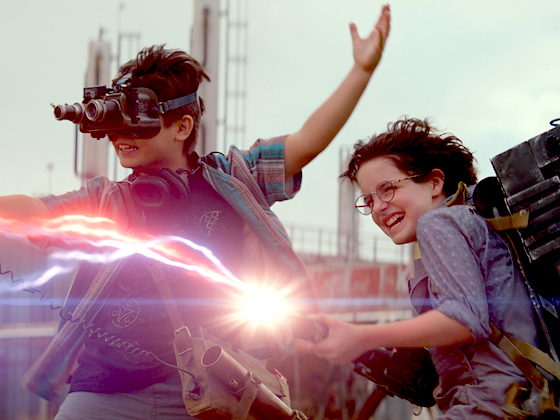
    Bustin' makes me feel good

    Set in the present day, it sees a family — mother Callie (Carrie Coon), son Trevor (Finn Wolfhard), and daughter Phoebe (Mckenna Grace) — inherit the remote farmhouse of the kids’ grandfather; the father their mother never even met. Turns out he was a Ghostbuster back in the day, and — surprise surprise — he ended up living in a back-of-beyond small town for a reason. With Callie uninterested in the father who was never interested in her, and Trevor off falling for a local waitress (Celeste O’Connor), it falls to curious Phoebe to investigate her grandfather’s life and, along with her new friend Podcast (Logan Kim) and summer science teacher Gary (Paul Rudd), discover what ghostly secret he was keeping.

    Really, Afterlife is a tribute to the original Ghostbusters. It’s full of nods and Easter eggs — some obvious; some subtle; some witty — and so will undoubtedly play best for a viewer who loves the original as much as the filmmakers seem to. That’s me, so I’m pretty much okay with the balance the film strikes. In other words, there’s enough new stuff to hang the old stuff on that I was able to just enjoy it. It would seem the film doesn’t play as well to viewers without that connection to the original, although I really think it depends how critical you’re being. This is a fun film — there are plenty of gags, plus a couple of suitably exciting action sequences — that I think anyone with reasonable expectations should still find it entertaining. As Phoebe, Mckenna Grace is particularly great — a really likeable lead to centre the narrative around.

    I’ve avoided stating which of the original Ghostbusters the new characters are related to because the film does the same, but — skip this paragraph and the next if you really want to avoid spoilers! — I don’t think it’s a particular secret, really. I mean, Phoebe’s been given a look that’s clearly reminiscent of her grandfather; and with the whole “he’s dead” plot point, well, that best applies to one of the actors, doesn’t it? So here’s another thing: Afterlife isn’t just a tribute to Ghostbusters ’84, but also to its co-writer and co-star, Harold Ramis. The characterisation of Callie and Phoebe was inspired by the autobiography of Ramis’s real-life daughter, Violet Ramis-Stiel, to the extent the actors were asked to read it as part of their preparation. Ramis-Stiel also signed off on her dad’s posthumous appearance in the film.

    Ghost in the machine

    Yes, thanks to CGI, the dead walk. This has been a controversial thing recently, mainly thanks to how the Star Wars films and TV series used it. Just last week there was a particularly big hoo-hah about Luke Skywalker being revived in The Book of Boba Fett. Generally, I agree that it’s distasteful. Using computers to ‘resurrect’ dead actors just so their pop-culture-favourite characters can live on? It’s kind of ghoulish. But I think the situation with Afterlife is a little different. Rather than a mega-corporation wanting to keep their space opera franchise stuck in the fan-pleasing past, this has been made by the actor’s friends and family as a tribute to him. If you bear that in mind, coupled with how exactly he’s used in the film, I actually think it’s rather sweet, and liable to bring a tear to the eye (though not to mine, because I am still a hard-hearted cynic in my core).

    I don’t know if Afterlife’s detractors will come round to it with time. Frankly, I don’t really care — if they didn’t enjoy it, that’s their business. At worst, it’s their loss, because this is an appropriately fun and affectionate addition to the franchise.

    4 out of 5

    Mass (2021)

    Fran Kranz | 107 mins | digital (HD) | 2.00:1 + 2.66:1 | USA / English | 12 / PG-13

    Mass

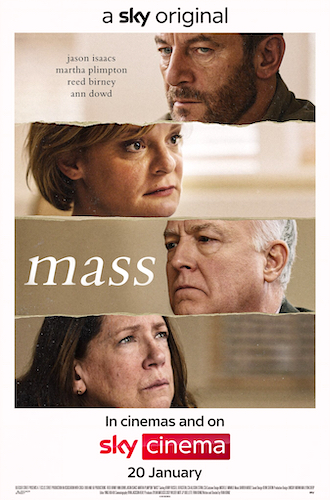
    The fact Mass been relegated to the status of a “Sky Original” in the UK might mislead you (not all their “original” acquisitions are bad, but the first few were dregs that distributors clearly didn’t want to send to cinemas and neither Netflix nor Amazon had any interest in, and they’ve not done much to turn that reputation around). This, however, is a blisteringly emotional gut-punch that definitely merits your time.

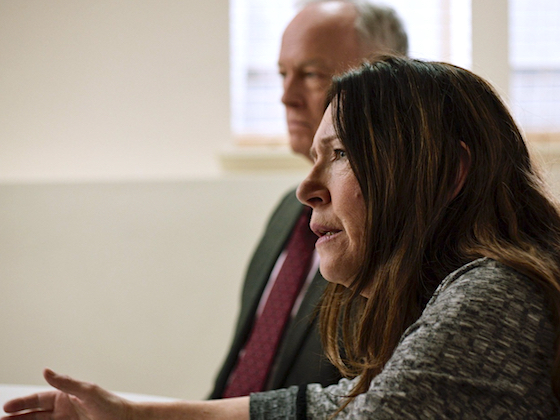
    The more one says of the plot, the more it spoils the film’s revelations — it’s a compelling watch however much you know, but the less the better, to allow some of the shocking moments to land at their most impactful. Suffice to say, it’s about two couples (Jason Isaacs and Martha Plimpton on one side, Ann Dowd and Reed Birney on the other) sitting down to talk. Yes, it’s mostly a four-hander, taking place in one room in real time, in which people talk to one another. That setup has led to accusations of staginess, because some people think that “a few characters sat in one room talking” automatically equals “like a play”. It’s more complicated than that, and Mass is a good example as to why. On screen, we have access to greater intimacy and subtly — the cast don’t need to project so the back row of the gods can hear; there are closeups to really see what the characters are feeling when they’re not speaking; and so on. In a literal sense, you could stage this script, but it wouldn’t have the same effect.

    Powerful performances

    It’s written and directed by actor Fran Kranz in his directorial debut, and it’s a real achievement. For a film that is literally about sitting down and expressing emotions, it’s remarkably subtle, especially coming from a first-timer. He also doesn’t seek to explain every little detail. So much of what has gone on prior to this meeting is only hinted at, which is partly realistic (no character explains things they all know just for our sake), but it also keeps the film focused on the true human emotions. And in that respect, it would’ve been so easy to give in to histrionics, especially when the subject matter is so explosive, but Kranz and his cast keep it reined in. All four of the leads are phenomenal, each in different ways, and it’s a shame that the film didn’t have the support of a bigger, savvier distributor to give it an awards season push — they should all four be in the conversation for every gong going, but there’s not an Oscar nomination between them, and only Dowd was recognised by BAFTA. A pity.

    Kranz’s one real flourish is a pronounced change in aspect ratio about halfway through. It comes at a key moment in the narrative, so clearly it’s meant to be significant, but I can’t quite work out how. Regular readers will know I normally love a film that plays with aspect ratios, but here it just seems like a distraction. It’s a minor misstep in a film full of bold moves that pay off. For example, it’s brave to risk undercutting the drama with the almost-comedic ordinariness of bookend scenes in which, at the start, the meeting room is prepared and, at the end, everyone leaves. It would’ve been easy to fade to black after the last big emotional moment in the room, but the return to everyday mundanity is, I think, part of the point.

    BAFTA nominee Ann Dowd

    Mass has flown under the radar somewhat, especially without the bonus of a clear presence in awards season. That’s a shame, because it’s a fine work that merits exposure. It’s not an easy watch — it’s liable to wring out your emotions — but, with that, it’s ultimately cathartic. A potent experience.

    5 out of 5

    Mass is the 9th film in my 100 Films in a Year Challenge 2022. It placed 5th on my list of The Best Films I Saw in 2022.
    Meat Loaf: In Search of Paradise (2007)

    Bruce David Klein | 88 mins | DVD | 16:9 | USA / English

    Meat Loaf: In Search of Paradise

    The singer Meat Loaf was very protective of his creative process, and apparently this documentary was the first time he’d allowed cameras behind the scenes to document it. Certainly, he’s frequently uncomfortable with or begrudging of their presence, although he seems to get used to them over time, allowing us some rare insights.

    The film follows Meat and his band as they prepare for and commence a mammoth 18-month world tour following the release of Bat Out of Hell III. Despite the lengthy schedule, a DVD recording of the concert is scheduled for just a few gigs in. It’s never mentioned who was responsible for booking that, but it clearly causes added stress for everyone: rather than allowing the show to become refined and polished over a long series of gigs, it’s got to be good enough to be documented almost as soon as it starts. No one here is ever pretentious enough to refer to the recording as an “historical record”, but that’s what it will be. This is the first tour in which Meat will perform songs from the entire Bat Out of Hell trilogy, and the gig that’s recorded for DVD is the one that will endure as the record of this tour. It’s got to be right.

    Perhaps the biggest obstacle is the fact that Meat Loaf is never satisfied. At one point, Meat’s mate Dennis Quaid is in town and pops by to watch that evening’s gig. Afterwards, he describes it as “an incredible show”. “It wasn’t one of my favourites, but thank you,” replies Meat. So Dennis asks, “how many times are they your favourite?” “Never,” Meat answers, “I hate ’em all… I’m waiting for the perfect show.” Of course, the perfect show never comes, and so Meat never feels it’s gone as well as it could have; he’s always apologising to fans that it won’t live up to expectations. But it’s not that the tour is genuinely coming up short — the band are happy; the crowds are certainly entertained — it’s just something in Meat Loaf’s character. He pushes himself so hard — too hard, given how exhausted it makes him, to the point he physically collapses after most shows. Whether you like his music or not, this film leaves you in no doubt about his dedication to his craft; to trying to give his fans exactly what they want.

    Looks like paradise to me

    That desire comes to a particular head in one of the film’s major subplots: the show is generally well reviewed in the press, but every critic takes issue with the staging of Paradise by the Dashboard Light, a number about teenage sex in which 59-year-old Meat duets with 28-year-old Aspen Miller — who looks a lot younger, especially in her skimpy cheerleader outfit. Frankly, I reckon the critics were at least partly jealous that Aspen Miller wasn’t writhing all over them, but maybe that’s just giving away something about me… Anyway, the number should be one of the highlights (as guitarist Kasim Sulton says, he’s been touring with Meat for decades and they’ve never done a show without it), but the criticisms are a cause of irritation backstage. Importantly, Miller doesn’t share the critics’ concerns; indeed, she seems to find it frustrating that they’re dismissive of her part in the performance, writing her off as a victim of it, when she’s an adult involved in the planning of what is a fully-choreographed routine. But the criticisms get to Meat even more — it’s not meant to be a song about a handsy old man attempting to assault a young girl, after all — and so various fixes are attempted to improve the song’s reception. It’s like a case study in revising a work while it’s already in performance, and shows that these tours don’t go out on the road locked and unchangeable — or, at least, they don’t when Meat Loaf is involved.

    The film’s final line is given to Meat Loaf himself. As he walks away after that all-important gig filmed for the DVD, he repeats several times: “I tried.” That’s his attitude in summation: he never thought it was good enough, but he always gave it his all.

    4 out of 5

    Meat Loaf: In Search of Paradise is the 10th film in my 100 Films in a Year Challenge 2022.

    Archive 5, Vol.3

    I have a backlog of 437 unreviewed feature films from my 2018 to 2021 viewing. This is where I give those films their day, five at a time, selected by a random number generator.

    Today, everything from silent comedies to afterlife comedies to toy-licence-based adventure comedies (a burgeoning genre we’re sure to see more of in years to come). Plus a revisionist Arthurian legend for good measure.

    This week’s Archive 5 are…

  • Guinevere (1994)
  • The Kid (1921/1972)
  • Defending Your Life (1991)
  • The LEGO Movie 2: The Second Part (2019)
  • Sherlock Jr. (1924)


    Guinevere

    (1994)

    Jud Taylor | 91 mins | digital (SD) | 4:3 | USA & Lithuania / English

    Guinevere

    This Lifetime TV movie is like an American Renaissance faire cosplay version of Arthurian legend. Its attempt at a feminist take on the famed stories is interesting, but deserves better writing, filmmaking, and accents.

    Most of Guinevere’s flaws come from its low-rent made-for-US-TV-in-the-’90s roots (the mediocre direction; the tacky music score), but that’s also its biggest asset, because when and for whom it was made means it was shot on film, which gives it a certain gloss (even when downgraded to SD) that taped or digital productions simply lack.

    Story-wise, the love triangle stuff from legend is there, but given a YA spin — it’s practically Arthurian Twilight. Are you Team Arthur or Team Jacob? The feminist bent is not subtle either, which, given changes in attitudes over the past few decades, makes you wonder if it’s ripe for a re-adaptation (it’s based on a trilogy of novels with magnificently florid titles like Child of the Northern Spring and Queen of the Summer Stars).

    You see, despite everything, I didn’t hate it. Maybe I should — it’s not good, by any means — but I liked what it was trying to do, even while it didn’t do it well (at all). It’s a concept someone should definitely take another run at.

    2 out of 5

    Guinevere was #209 in my 100 Films in a Year Challenge 2020.


    The Kid

    (1921/1972)

    Charlie Chaplin | 50 mins | DVD | 4:3 | USA / silent | U

    The Kid

    Charlie Chaplin’s first feature-length work as star and director sees his Tramp character caring for an abandoned child (Jackie Coogan). I say “feature length”, but when you combine a re-edit Chaplin performed in 1972 with PAL speedup, it runs just 50 minutes. I’ve gotta say, I appreciated that. I’ve felt some of Chaplin’s other films have gone on a bit, whereas this didn’t outstay its welcome. That said, I did feel the Dreamland sequence near the end was filler. That aside, it’s quite a nice film. Coogan is particularly effective — he has just the right look for the role, and was obviously very good at imitation and/or taking direction.

    Regarding the length, the original 1921 release was 68 minutes, but for a 1972 reissue Chaplin cut some footage, appears to have sped up the frame rate of the rest, and added a score and some sound effects too. It’s only this cut that gets released on disc nowadays (often with the excised footage included as deleted scenes). The original cut clearly still exists, and yet everyone just seems to overlook it — it’s only if you bother to read up on the film that you discover what most people are watching and reviewing as “a 1921 film” is actually a 50-years-later director’s cut. Imagine if we all just ignored, say, Blade Runner’s original version and just treated The Final Cut as— oh, wait. Never mind.

    4 out of 5

    The Kid was #60 in my 100 Films in a Year Challenge 2020.


    Defending Your Life

    (1991)

    Albert Brooks | 111 mins | Blu-ray | 1.85:1 | USA / English | PG / PG

    Defending Your Life

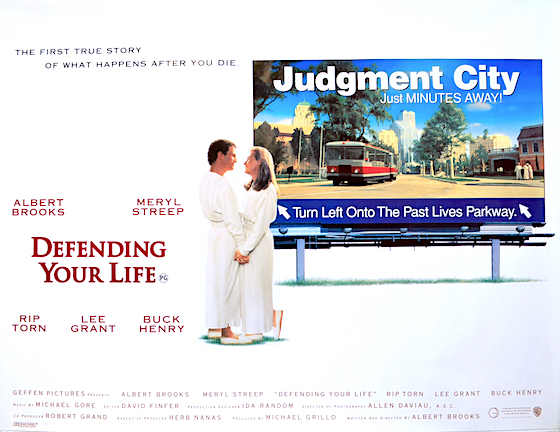
    Writer-director Albert Brooks stars as a loner advertising exec who dies and finds himself in a bureaucratic afterlife where he has to prove that he overcame his fears. While he awaits his trial, he finally meets the love of his (after)life, Julia (Meryl Streep).

    For a film that’s literally about life and death, Defending Your Life is rather gentle. Like, it’s rarely laugh-out-loud funny, but it’s often slightly amusing. And it’s unhurried, too: its 111 minutes aren’t tedious by any means, but it doesn’t rush anywhere. A fun side effect of this is how casual its world-building is. This is a very specific vision of the afterlife, an entire world with its own rules, and while that’s all explained, it’s not laid out in minute detail like a how-to guide. I feel like this is something movies used to happily do but has been eroded by the need for everything to be over-explained and -analysed.

    I liked Defending Your Life a good deal (I’ve picked up a couple more of Brooks’s films on Blu-ray off the back of it), and part of that is certainly its laidback style. Nonetheless, perhaps if it were snappier — quicker witted and paced — it might be a better-remembered film, comparable to something roughly contemporaneous like Groundhog Day.

    4 out of 5

    Defending Your Life was #113 in my 100 Films in a Year Challenge 2021.


    The LEGO Movie 2:
    The Second Part

    (2019)

    Mike Mitchell | 107 mins | Blu-ray (3D) | 2.40:1 | USA, Denmark, Norway & Australia / English | U / PG

    The LEGO Movie 2

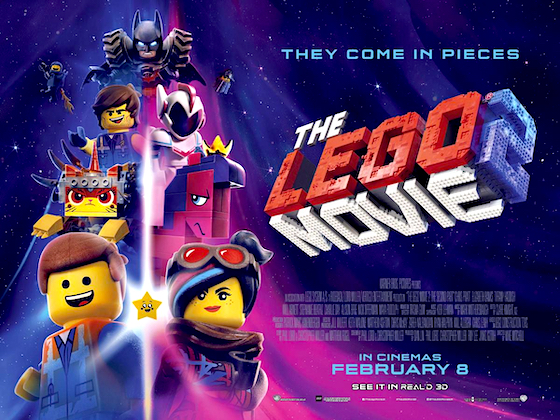
    After the surprise success of The LEGO Movie, naturally a sequel had to follow. Unfortunately, it’s altogether less surprising, because it’s that old fashioned sequel thing: a less-good do-over of the first movie.

    The Second Part feels less focused than its predecessor. It still has a positive message (about not needing to grow up, and about playing together, or something), but it takes a while to get to it, rather than baking it into the entire experience. Maybe that’s intellectualising things a bit — this is a family-friendly adventure-comedy starring toys, after all. But still, the overall journey doesn’t feel as exciting or fun. There are fun little bits on the way, but, moment to moment, it lacks the spark of the first one.

    For a specific example, take the breakout hit of the first film, the irritating song Everything Is Awesome. That angle has been doubled down on, with multiple attempts at emulating the “irritating but kinda loveable” song formula; but while these numbers are annoying while they last, they don’t have the irrepressible catchiness of the first film’s signature achievement — a mixed blessing, to be sure (at least they won’t be stuck in your head afterwards). The end credits are accompanied by a song that jokes about the credits being the best part… but, in this case, the credits kinda are the best part.

    3 out of 5

    The LEGO Movie 2: The Second Part was #33 in my 100 Films in a Year Challenge 2020.


    Sherlock Jr.

    (1924)

    Buster Keaton | 45 mins | Blu-ray | 1.33:1 | USA / silent | U

    Sherlock Jr

    Apparently there are ever-raging arguments within the silent film fan community about who was the best comedian of the era. Charlie Chaplin’s got the most widespread recognition, but Buster Keaton and Harold Lloyd have their advocates, of course, and I guess there are probably people shouting in favour of smaller names too. I didn’t think I’d ever pick a ‘side’ in these debates — I’m certainly not about to go seeking them out and wading in — and, fundamentally, I do hold with the notion that the greats are all great and so why not appreciate them all? — but, from what I’ve seen thus far, I’m finding Keaton’s work more consistently enjoyable than Chaplin’s. Sherlock Jr. is my favourite of his that I’ve seen so far.

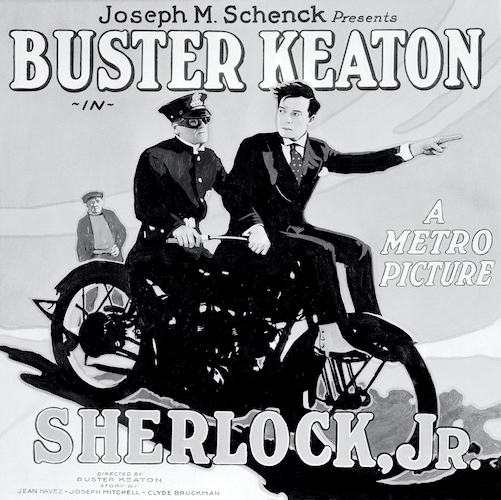
    Keaton plays a film projectionist who’s studying to be a detective on the side. When he’s framed for the theft of a watch, his apparent guilt doesn’t give him much chance to put his skills to the test. But when he falls asleep during a movie, he steps inside it and becomes the world’s greatest detective. And when I say “steps inside”, I mean it in the most literal sense possible: the projectionist walks through the screen and into the movie, and is suddenly subject to its whims — for example, he’s confounded whenever it cuts to a new location. The sequence is both thoroughly entertaining and technically faultless — and I say that viewing it nearly 100 years after it was made, after all the advances in technique and effects we’ve had in that time. Reportedly, the film’s cameraman, Byron Houck, went as far as using surveying equipment to ensure the camera was positioned correctly so the transitions were seamless. The effort paid off.

    The same is true in several other incredible sequences, like a billiards game filled with trick shots, which Keaton rehearsed for four months with a pool expert and then took five days to film. Or a motorbike chase with more I-can’t-believe-he-just-did-that death-defying stunts than one of Tom Cruise’s impossible missions. The technical skill is faultless and, even if you’re not wowed by how they pulled it off, the sequences are immensely entertaining in their own right. Maybe it’s just personal taste, but this is why I have a preference for Keaton: his skits are more ingenious, better paced, and backed up with impressive stunt work. When you mix those daredevil antics with genuine movie magic, as he does here, you get a majestic, unforgettable farce.

    5 out of 5

    Sherlock Jr. was #102 in my 100 Films in a Year Challenge 2019. It was viewed as part of What Do You Mean You Haven’t Seen…? 2019. It placed 3rd on my list of The Best Films I Saw in 2019.


  • January’s Failures

    Oo-ooh, wouldja look at this? After three years as just part of my monthly review, Failures has gone and got its own dedicated post! Well, it was getting ridiculously long to be just a part of something else. There’s just so much stuff to see every month, and so much of it I don’t see…

    We begin, as ever, with the big screen, where there’s something of a sense of things being back to normal, at least in terms of what’s being released. I think the closest to what could conceivably be called a blockbuster this month was the new Scream, while the rest of the UK release schedule was filled with belated bows for things like Licorice Pizza, Belfast, and Nightmare Alley. Let’s be honest, they’re not things that would tempt me out to the cinema in the best of days (I’ll wait for an at-home option), never mind in Covid times.

    I’m not alone in such thoughts, of course, and so the streamers continue to trot stuff out to capture our fleeting interest, though there weren’t any particularly big guns this month, unless I missed something. I think Netflix’s biggest offering was Robert Harris adaptation Munich: The Edge of War, as well as a UK debut for Chloë Grace Moretz sci-fi Mother/Android. Moretz used to be on track to be a genuine movie star, but nowadays I feel like I only see her turn up in direct-to-streaming stuff no one seems to know is coming — like, out of nowhere, there’ll be a new film starring her on Netflix or Amazon now and then. I don’t know if that’s a deliberate career choice or a case of reduced options…

    Meanwhile, over at Prime Video, there was George Clooney’s latest directorial effort, The Tender Bar, starring Ben Affleck, and acquired fourquel Hotel Transylvania: Transformania. I watched the first of those last year and thought it was moderately likeable, so maybe I’ll get to the fourth one day. There’s also Copshop, which I think they’re billing as a Premiere rather than an Original, or something? I can’t remember, and I can’t be bothered to load it up right now just to check. I guess it’s the difference between “stuff we own and will always be here” and “stuff we’ve bought exclusive rights to for a bit”. Sky’s ‘originals’ always feel like they’re in a similar limbo. This month those included Save the Cinema, which looks like a pleasant ‘little Britain’ kind of film, and Naked Singularity, which is apparently a heist movie starring John Boyega, Olivia Cooke, Bill Skarsgard. Again, having heard no one mention it doesn’t exactly suggest it’s worth one’s time.

    As usual with Sky, more interesting were their other premieres — the likes of Pig, A Quiet Place Part II, The Paper Tigers, and No Sudden Move. That last one’s actually been on there since October, but somehow I’d missed that it was a new Steven Soderbergh film. I need to catch up on his stuff. They also had Nobody, which I’ve seen and really should’ve reviewed, and Supernova, which I bought on disc and really should’ve seen and reviewed. Over on Prime, there was Demonic — which catches my attention purely because it’s the latest from Neill Blomkamp, a director who’s star has faded to the point where this got very little attention during its cinema window — and, eh, a bunch of older stuff. If I listed everything I deemed worthy of bunging on my watchlist, we’d be here forever.

    Netflix’s catalogue offerings all felt like hand-me-downs: The Gentlemen, after it was on Prime for yonks last year; and Dolittle, after it had been on iPlayer all over Christmas. Talking of iPlayer, they offered The Souvenir (which used to be on MUBI) and Mary Queen of Scots (which used to be on, er, Netflix). But, hey, at least you expect a free TV-schedule-derived streamer to be a relatively-late-to-the-game kinda place for these things. Still, iPlayer does a decent job nowadays, what with also offering the likes of The Sisters Brothers, sci-fi Little Joe, Lady Macbeth, and Personal Shopper. Plus, you’re more likely to find older classics there than pretty much anywhere else, which this month included In the Heat of the Night and a bunch of war films. You can find some similarly interesting stuff on Channel 4’s catchup — the main thing I want to try to catch from last month is Topsy-Turvy, which hasn’t been on UK TV for a ridiculously long time. It’s quite long though, and C4 does force adverts on you, so I can see myself failing at that again in February.

    I’m still subscribed to MUBI, though considering they add a film a day and this month I’ve only long-listed three to mention, and the only one I’m going to bother to mention is Céline Sciamma’s debut, Water Lilies, I do wonder if I should be. (There’s a bunch of stuff on there I keep meaning to catch up on, though.) As for Disney+, they seem to mainly be focusing on series right now, but did offer Marvel’s Eternals weeks before its disc release. Seems to be the way things are going.

    And talking of discs releases, yeah, I still bought dozens of the things. No such thing as a post-Christmas slump for me. Brand-spanking-new releases included the 4K discs of Edgar Wright’s Last Night in Soho and Ridley Scott’s The Last Duellast month I mooted that I should watch the latter on Disney+ before committing to buying it. Obviously, that didn’t happen. Hope I like it! Of course, most of my purchases are blind-buys anyway — I did exactly the same with Donnie Yen action-thriller Raging Fire. Exactly the same, because it was also a Zavvi-exclusive Steelbook that’s the UK’s only 4K release. Other new releases included more Asian action in Eureka’s double-bill of Warriors Two and The Prodigal Son; the mystery of a missing hammer in a nudist camp in Patrick; and importing the 4K of Blood for Dracula, aka Andy Warhol’s Dracula, to go with last month’s import of the 4K of Flesh for Frankenstein, aka Andy Warhol’s Frankenstein.

    You’d think January sales might account for much disc purchasing this month, but not really. I nabbed Blade in 4K when it was randomly cheap on Amazon the other week; and I think silent drama Piccadilly was slightly reduced when I picked it up — but that’s about it. Although I did get the limited edition of anime In This Corner of the World for a steal. Places like HMV are still selling it for £20, but there’s a guy on eBay who has it for a fiver. Seemed worth a punt, and it paid off. Otherwise, there were a couple of things that came out late last year and I didn’t get for Christmas (the BFI’s release of the original Invasion of the Body Snatchers, and StudioCanal’s 4K disc of Tinker Tailor Soldier Spy), and a semi-random US order. I almost order in ‘bulk’ from the US these days, to average out the cost of shipping. There’s always stuff I want to pad out an order, anyhow. This one was provoked by a Criterion sale (from which I only got High Sierra and Hitchcock’s The Lodger in the end), plus the new release of Gambit (the Michael Caine / Shirley MacLaine one) and some more new releases that are still in the post. I used it as a chance to also get Kiss Me Kate (in 3D) and Vincent Price I Am Legend adaptation The Last Man on Earth.

    Finally, I also bought the animated Transformers movie — fully known as The Transformers: The Movie, of course — on 4K. But does that really count as a failure when I consciously bought it to watch “sometime this year” as part of WDYMYHS? Something to mull over ’til next month…

    The All-New Monthly Review of January 2022

    I’ve already lied to you, dear reader. I say that because much of this monthly review is going to seem familiar — “All-New” it is not. “Partially new”, that would be the truth: there are new graphics, and a revised focus in some sections, both to fit in with the blog’s new identity.

    Despite that, I’ve stuck with the “all-new” moniker to reflect The All-New 100 Films in a Year Challenge, my progress with which is now the primary focus of these monthly updates… although you can still find links to all my reviews; and the Arbies survive, now in their 80th month, still drawing from everything I watched.

    Well, we’ll see how it goes. On which note, on it goes…


    This month’s viewing towards my yearly challenge

    #1 Carry On Spying (1964) — Decades #1
    #2 Gosford Park (2001) — Rewatches #1
    #3 Penny Serenade (1941) — Decades #2
    #4 The Navigator (1924) — Decades #3
    #5 Flight of the Navigator (1986) — WDYMYHS #1
    #6 In the Line of Fire (1993) — Decades #4
    #7 Barbie as The Princess and the Pauper (2004) — Decades #5
    #8 Free Guy (2021) — Decades #6
    #9 Mass (2021) — New Films #1
    #10 Meat Loaf: In Search of Paradise (2007) — DVDs #1
    #11 Voyage of Time: An IMAX Documentary (2016) — Decades #7
    #12 L’avventura (1960) — Blindspot #1


    • I watched 11 feature films I’d never seen before in January.
    • All of them counted towards my 100 Films in a Year Challenge, along with one rewatch.
    • As you may or may have inferred from that, this means I effectively have two counts running now: my 100 Films Challenge, and how many new films I’ve seen. The former may be the official thing going on nowadays, but a decade-and-a-half habit is hard to break, so on my ‘new film’ count goes. As I said up top, it’s the Challenge that’s the focus of these posts now, but I’ll still be including titbits about my overall new film viewing. And come the end of the year, it’s the overall new viewing that will continue to fuel things like my Top 10 and the statistics post.
    • So, to the Challenge. As the year gets underway, most — in fact, everything — I watch counts. I don’t expect that to be the case as we go forward.
    • For example: I’m not surprised to see the Decades category filling up fastest, because it’s so easy to complete. Slots are filled by any film that (a) isn’t better off counted towards another category, and (b) isn’t from a decade already ticked off — and, as the year begins, none are ticked off (obv). With 7 out of 12, Decades is already 58% complete. As for the remainder, the 1910s might require a special effort (I don’t watch many films that old without explicitly setting out to), but I imagine the others will take care of themselves in short order.
    • Just in case it needs stating for anyone: yes, Mass is “a 2021 movie” thanks to its festival screenings (the US and Canadian releases were also last year), but it didn’t come out in the UK until 20th January, which makes it a 2022 (i.e. new) movie for me.
    • This month’s Blindspot film was L’avventura, which I’ve been putting off including on the list (or watching in any other way) for years. I haven’t particularly enjoyed other classics of mid-20th-century Italian cinema, like Bicycle Thieves or , so I feared this would be the same. And that’s part of the motivation for watching it first: ripping off the plaster. Well, it was a somewhat pleasant surprise. More when I review it soon.
    • This month’s WDYMYHS film was Flight of the Navigator, which I watched on Prime Video. The danger of putting titles from streamers on a “movies I must watch this year” list is that at some point, possibly without warning, they could disappear from that streamer. But that also makes them an easy choice for where to start. This year there are only two across all 24 films from Blindspot and WDYMYHS, and they’re both on the latter list — I imagine the other will be next month’s pick.
    • I didn’t watch anything from last month’s “failures”. And as for this month’s failures: I’ve finally decided to spin the feature off into its own post. Look for that in the next day or two.


    The 80th Monthly Arbitrary Awards

    Favourite Film of the Month

    Although my viewing numbers this month were more than solid (getting to 100 films in a year at a steady pace — something the new challenge is partially intended to enforce — requires an average of 8.3 films a month), the level of quality was more middling. One film did stand out, though: Mass, a chamber piece that puts you through the emotional wringer, powered by a quartet of awards-worthy performances.

    Least Favourite Film of the Month

    Conversely, the month’s middling quality means it’s also hard to pick a worst film. By a nose, I’m going to say Voyage of Time, because I didn’t get as much out of it as I might’ve hoped. Plus, MUBI’s pathetic attempt at streaming in 4K (a feature they’d specifically pushed in the film’s advertising) got on my wick.

    Best Navigator of the Month
    The navigator in The Navigator is actually the name of the boat; and even if it weren’t, Buster Keaton is pretty poor at navigating it. The navigator in Flight of the Navigator is the kid who bonds with the spaceship, and while he’s ostensibly in charge, I think the spacecraft actually does most of the work. But in Barbie as The Princess and the Pauper, Barbie manages to ride into the forest and go straight to the exact hidden cabin where her doppelgänger is being held captive. Impressive navigation, Barbie.

    Biggest Mystery of the Month
    Whodunnit in Gosford Park? What happened to Anna in L’avventura? How did David lose eight years in Flight of the Navigator? Can they catch the assassin in In the Line of Fire? What are the villains up to in Carry On Spying? Can Meat Loaf put on a gig that makes him happy in In Search of Paradise? No, the biggest mystery of the month is: what the feck is Brad Pitt on about in the Voyage of Time narration?!

    The Audience Award for Most-Viewed New Post of the Month
    No break-out successes this month — the victor is down in 30th place overall, behind a slew of archive TV columns — but it was a close-run thing nonetheless, with two posts tied for second place, just two hits behind the winner. Said winner was, somewhat appropriately, The Best of 2021. And now it’s the best of (January) 2022, too. Hurrah.


    Every review posted this month, including new titles and the Archive 5


    It’s 100 Films’ 15th birthday (just two months after launching! Is this what being a time traveller feels like?)

    I had been thinking I’d mark the occasion with a revised version of 100 Favourites, as that’s five years old, but those things take literally years to put together (well, the first one did), and while I had been considering it for years, it’s been overtaken by the relaunch. Maybe in 2023.

    Other than that, erm, things continue much the same…