Eddie the Eagle (2016)

2017 #116
Dexter Fletcher | 106 mins | streaming (HD) | 2.35:1 | UK, Germany & USA / English, German & Norwegian | PG / PG-13

Eddie the Eagle

The unlikely hero of the 1988 Winter Olympics — ski jumper Eddie “the Eagle” Edwards — gets the Cool Runnings treatment in this comedy-drama. I make the Cool Runnings connection because, firstly, they’re both about unlikely competitors in the Winter Olympics (from the same year, in fact — what was in the water in ’88?!); and, secondly, because in their transition to the big screen they were both heavily fictionalised.

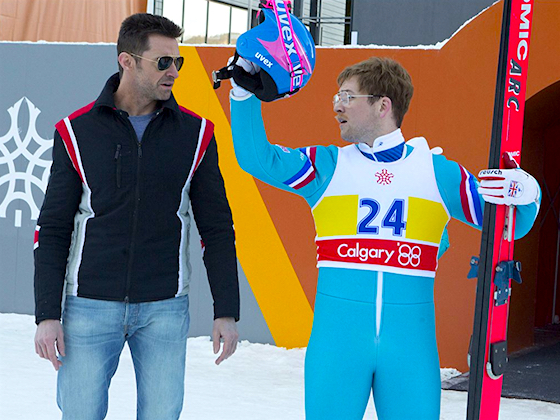
The story, at least as it goes in the film, sees young Eddie (played as an adult by Kingsman’s Taron Egerton) keen to participate in any Olympic sport, eventually settling on ski jumping because no Brit has participated in it for six decades. Disavowed by the British officials, he heads off to Germany to train himself. Trials and tribulations ensue that are by turns hilarious and heartwarming, but which eventually see him qualify for the 1988 Olympics — that’s not a spoiler, it’s why he’s famous!

Helping Eddie along his way is Bronson Peary (Hugh Jackman), a washed-up former US ski jumper who begrudgingly becomes Eddie’s coach, transforming the Brit from a no-hoper to someone who’s… not entirely bad. This is probably the film’s biggest whopper, because Peary didn’t even exist. It’s kind of brazen to make your co-lead and major subplot 100% fictional in a ‘true story’ film, isn’t it?
The Eagle has landed

But, hey, this isn’t a documentary — it’s a feel-good underdog story, about having a can-do attitude and dedication to your dreams in the face of adversity. It’s also about how it’s not the winning but the taking part that counts, in a very literal sense. That probably makes the film sound more twee than it is, but it’s not a grittily realistic take either — it’s a colourful, light, entertainment-minded film. It’s a good pick for Egerton too, getting to stretch different performance muscles than in Kingsman as our naïvely optimistic hero. Jackman makes for an easygoing co-star, getting to mix his Wolverine loner gruffness with a dash of his chat-show charm.

Eddie the Eagle is a thoroughly charming little film. Even if its tone and overall narrative may be familiar, it navigates them with a light touch and consistent good humour that — much like the eponymous Olympian — wins you over, even if it’s in spite of yourself.

4 out of 5

The 2018 Winter Olympics officially commence tomorrow, though some events have already started — including, appropriately enough, ski jumping.
The Cloverfield Paradox (2018)

2018 #18
Julius Onah | 102 mins | streaming (HD) | 2.39:1 | USA / English & Chinese

The Cloverfield Paradox

“Logic doesn’t apply to any of this.”

So says Tam, played by Zhang Ziyi, about halfway through this third movie in the Cloverfield sort-of-series. She’s talking about the crazy circumstances they’ve found themselves mixed up in, but she may as well be talking about the movie itself.

Set in the near future, the energy crisis has reached a point where it threatens the continued existence of mankind as we know it. Our last hope is an experimental particle accelerator that could provide all the energy we need, but it’s so potentially dangerous that it’s being tested in space. After almost two years of failed attempts the accelerator finally works… until it fails spectacularly, crippling the station. When the systems come back online, the crew realise they’ve lost something: the Earth. And that’s just the start of the crazy shit that’s gonna go down.

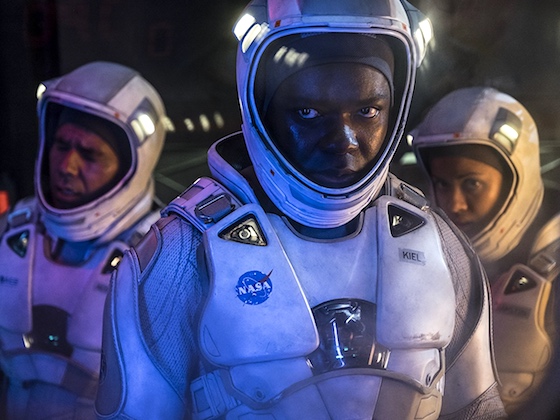
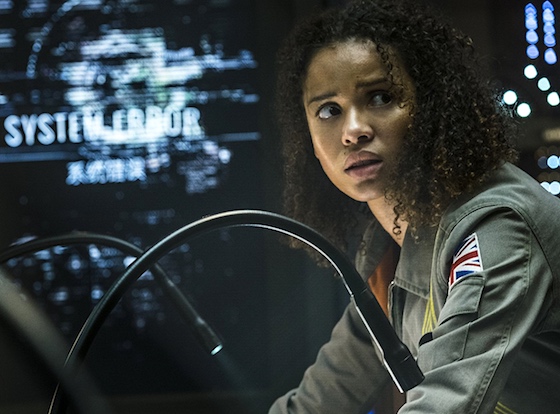
One worried astronaut

The Cloverfield Paradox started life as a spec script titled God Particle, which was at some point Cloverfieldised by J.J. Abrams’ production company, Bad Robot. The writer who originated the project, Oren Uziel, has said that “sometimes [sci-fi] movies tend to be more concerned with whatever the obstacle is, and I’m more concerned with the characters’ relationships to each other and that obstacle I guess. So to me, when you say it’s a contained astronaut movie, I’m just curious what those astronauts are going through and what they’re experiencing and what the character story is, and what specifically the threat is is often less of a concern to me.” Oh boy, is that apparent in the finished film. Whatever else Abrams & co changed to make this a Cloverfield film (and I’ll get to that later), I guess it’s Uziel’s original work that’s responsible for the half-arsed, inconsistent, and poorly-explained threats that the astronauts must face. No spoilers, but the explanation for what’s going on (which is so obvious that I don’t think even the film itself tried to play it as a twist in the end) doesn’t even vaguely begin to explain some of the random shit that happens. Uziel just throws sci-fi or horror ideas at the screen one after the other, with no care for if it hangs together consistently. Consequently, it doesn’t.

Unfortunately, his alleged interest in character hasn’t resulted in anything worthwhile either. At best they’re broadly defined archetypes — the Funny One; the Noble Captain; the One With A Tragedy In Her Past That We’ll Eventually Learn And It Will Affect Her Decisions; etc. At worst they’re utterly blank, with little or no time devoted to establishing or developing them. There’s a strong cast of good actors — people like Gugu Mbatha-Raw (who gets the best of a poor lot), David Oyelowo, Daniel Brühl, Elizabeth Debicki, Chris O’Dowd (who at least gets to be funny) — but they’re left to battle bravely against the mediocrity, and often terrible dialogue that comes with it, as they attempt to instil any kind of personality into their roles. They’re fighting a losing battle.

Two worried astronauts

Suffering most of all is Roger Davies as Michael, who’s the star of his own subplot back on Earth. Davies is probably aware this is his big break (his previous roles are mainly in things like Sky’s football soap Dream Team and Channel 5’s attempt at a soap, Family Affairs), but he’s lumbered with some of the clunkiest material of all. He struggles gamely to make Michael seem like a plausible human being while delivering first-draft-level dialogue, but I don’t think even Daniel Day-Lewis could make this material work. An item of trivia on IMDb (source uncited, as usual) claims that all the Michael stuff was added later (in reshoots, I presume) to strengthen the film’s Cloverfield connection. It feels like that too: his stuff is completely divorced from the main thrust of the story aboard the space station, and it looks like it’s been achieved on as few sets with as few additional characters as possible.

Indeed, almost everything that’s explicitly Cloverfield-y smacks of reshoots. There’s a newscast about the eponymous “Cloverfield Paradox” that’s all inserts, i.e. it’s on a screen with none of the main cast also in shot. The main characters do refer to the paradox later on, but I’m pretty sure they only ever called it “the paradox”. (Also, side note, I’m not sure anyone involved in the making of this film knows what a paradox actually is.) The space station is actually called “Cloverfield”, but that’s mainly (only?) seen on CG exterior shots and green-screened monitors. Perhaps I’m forgetting something — perhaps there was a Cloverfield reference or two in the main body of the movie — but the vast majority of them could just have been shoved in during post-production. And if they weren’t, they feel like they were.

Three worried astronauts

I enjoyed the original Cloverfield and I liked the idea of them creating a franchise that was Twilight Zone-esque — movies connected by theme and style rather than plot. It seemed like a good way of getting original sci-fi movies made at a time when Hollywood only wants franchises. But we’re two sequels in now, and they were both marred by the Cloverfield elements forced upon them. And whereas 10 Cloverfield Lane was a very good movie before its tacked-on finale, The Cloverfield Paradox is pretty terrible throughout. We’re on a downward curve.

What was once set to be the expensive big-screen older brother to Black Mirror is now cast in its shadow: they’re both debuting on Netflix, but while Charlie Brooker’s TV series benefits from months of enormous anticipation and glowing reviews, Cloverfield was dumped just a couple of hours after its first trailer premiered, presumably in the hope you’d watch it before the reviews rolled in. When you combine that with the fact it was meant to be a theatrical release but Paramount ended up flogging it to Netflix as one of their “originals”, you have to think that even the studios knew it was a dud.

2 out of 5

The Cloverfield Paradox featured on my list of The Five Worst Films I Saw For the First Time in 2018.

Blade Runner 2049 3D (2017)

Rewatchathon 2018 #5
Denis Villeneuve | 163 mins | Blu-ray | 2.40:1 | USA, UK, Hungary & Canada / English, Finnish, Japanese, Hungarian, Russian, Somali & Spanish | 15 / R

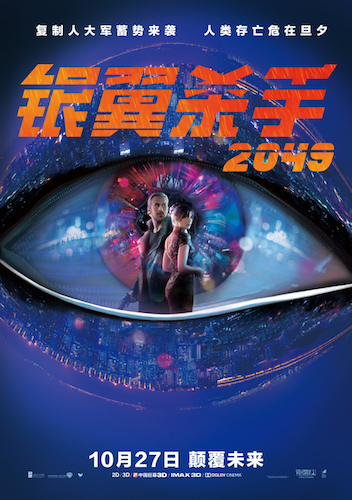
Blade Runner 2049

With its home media release comes my second viewing of Blade Runner 2049 (my review from the first is here); and, I must confess, it kinda makes me wish I’d gone back to see it on the big screen again…

First things first, though, what the title of this post promises: the 3D. Blade Runner 2049 was shot in 2D, but that’s commonplace for 3D releases nowadays — post-conversion has reached the point where its quality and, I presume, cost effectiveness means that it’s seen as the preferable option by studios (who’d’ve predicted that in the format’s early days? Some people still blame the bad post-conversion jobs on films like Clash of the Titans for damaging 3D’s prospects as a popular format). In the case of this film, however, I presume it was an artistic decision as much as a practical one: cinematographer Roger Deakins is, I believe, no fan of 3D. Indeed, he’s publicly expressed that his preferred version of Blade Runner 2049 is the 2D one — and the regular 2D version at that, not the one specially formatted for IMAX. Nonetheless, he also personally supervised the film’s conversion to 3D. I guess that’s some kind of dedication.

Distance

It shouldn’t be a huge surprise, then, that this is not a film designed to show off in 3D — but that’s not to say it’s bad. Rather, what it most often offers is a subtle, believable delineation of space. Confined rooms and the distance between objects within them all feels very real, very plausible. In some respects that just ties into the film’s overall style: it’s a beautifully shot movie, no doubt (give Deakins the bloody Oscar!), but only occasionally does it do that in a heightened way. Think of the scenes in K’s apartment, for instance, or his boss’ office, or several other locations along those lines. They look very naturalistic, which is surely part of the point.

Now, there are other times when the added emphasis of depth highlights things — Wallace’s little drone whatsits make their presence more known, for example; how see-through Joi is at times becomes more apparent (the fact the background is ‘peeking through’ her is understandably clearer when you’re able to sense how far away that background is). At other times, wide-open scenery stretches far into the distance. One of the most visually standout locations was the old furnace that K’s memories lead him to — the size of the space, plus all the levels of pipes and gantries, makes for a lot of depth markers.

Another was the office / seclusion chamber of the memory-maker — another large space, albeit empty this time, but I thought its isolating size felt clearer in 3D. That’s the kind of thing that can make quantifying the effect of 3D hard, especially for laypeople: sometimes it’s creating an effect that you don’t immediately notice (because it’s not poking you in the face or whatever), but if you directly compared it to a 2D version you’d see what it’s adding. I’m not going to argue Blade Runner 2049 is a demonstration piece for that particular quality, but one wonders how often it’s a factor.

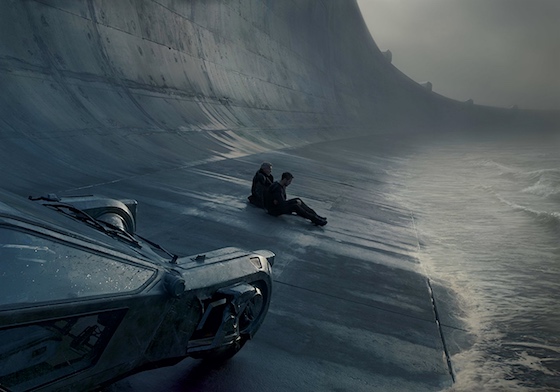
K's journey

Setting the 3D aside, this was (as I said at the start) the second time I’d watched the film, and I found it to be almost a weird experience. Blade Runner 2049 is not a film that’s just about the answers to its own mysteries; but, nonetheless, knowing those answers, and knowing where the story was going and how long it was going to take to get there, made the second viewing a very different experience to the first. For one thing, it doesn’t feel like such a long film at all — it’s in no hurry, but the pace is measured, everything happens for a reason, unfurls with the space it needs. (I’d still be fascinated to see the reported four-hour cut though, or at least the deleted scenes from it.) Knowing the answers also refocuses your attention. K’s often-silent reactions to what he uncovers are a big part of the film, and that feels different when you know how things will pan out versus when you’re discovering them alongside him.

Finally, swinging back round to the purely visual again, watching this particular movie at home came as a reminder of why the big screen can still matter. Deakins’ magnificent photography still looks incredible, of course, but those horizon-stretched vistas, or the tall city streets with their looming holographic advertisements, don’t have quite the same impact when they’re not being shown at more-or-less life size. I bet the IMAX version was a wonder…

5 out of 5

Blade Runner 2049 is released on DVD, Blu-ray, limited edition Blu-ray, 3D Blu-ray, limited edition 3D Blu-ray Steelbook, 4K Ultra HD Blu-ray, HMV-exclusive 3D & 4K Ultra HD Blu-ray Steelbook, and 4K Ultra HD Blu-ray gift set (not to mention being available from all good digital retailers) in the UK today.

Comedy Review Roundup

In today’s roundup:

  • This is the End (2013)
  • The Heat (2013)
  • In the Loop (2009)


    This is the End
    (2013)

    2017 #109
    Evan Goldberg & Seth Rogen | 105 mins | TV | 16:9 | USA / English | 15 / R

    This is the End

    Seth Rogen, James Franco, Jonah Hill, Jay Baruchel, Craig Robinson, and Danny McBride star as Seth Rogen, James Franco, Jonah Hill, Jay Baruchel, Craig Robinson, and Danny McBride (respectively) in a movie about the apocalypse written and directed by Seth Rogen and Evan Goldberg.

    And it’s pretty much exactly what you’d expect a movie about the apocalypse starring Seth Rogen, James Franco, Jonah Hill, Jay Baruchel, Craig Robinson, and Danny McBride, and written and directed by Seth Rogen and Evan Goldberg, would be like — for good or ill. Personally, I laughed and enjoyed myself more than I expected to, even if it is resolutely silly and frequently crude just for the sake of it.

    4 out of 5

    The Heat
    (2013)

    2017 #144
    Paul Feig | 112 mins | TV | 2.35:1 | USA / English | 15 / R

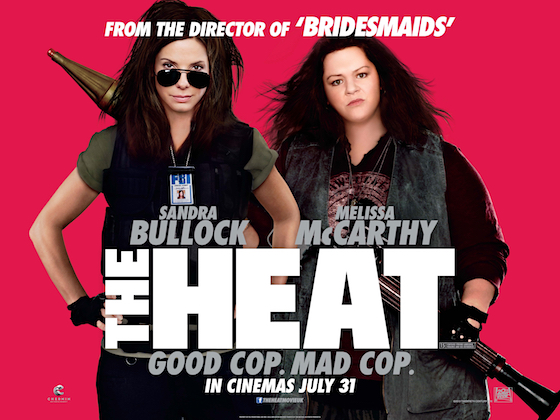
    The Heat

    Having been surprisingly entertained by Bridesmaids, Spy, and the new Ghostbusters, I thought I might as well tick off the last film-directed-by-Paul-Feig-since-anyone-noticed-he-made-films (he also helmed a couple of movies in the ’00s that no one mentions).

    It’s a female-led (obviously) version of the familiar buddy movie template, starring Melissa McCarthy (obviously) as an uncouth cop who must team up with a strait-laced FBI agent (Sandra Bullock) to bring down a drug lord.

    As I suspected, it’s the least likeable of those four Feig/McCarthy collaborations, although it manages to tick along at a level of passable amusement with occasional outbursts of good lines or routines. I wouldn’t recommend it to anyone who hadn’t first seen and enjoyed at least a couple of their other movies, but there are worse ways to spend a couple of hours.

    3 out of 5

    In the Loop
    (2009)

    2017 #147
    Armando Iannucci | 102 mins | streaming (HD) | 1.85:1 | UK / English | 15

    In the Loop

    Acclaimed political sitcom The Thick of It steps onto the global stage in this comedy, which sets its satirical sights on UK-US relations and the countries’ intervention in the Middle East.

    Despite the change in format and (intended) screen size, In the Loop manages to be as hilarious as the show it’s spun off from — not always a given when TV successes make the leap to the big screen. In part that’s the advantage of a 237-page script and 4½-hour first cut being honed to little more than an hour-and-a-half, but it’s also thanks to the skilled cast. The star of the show is, as ever, Peter Capaldi as sweary spin doctor Malcolm Tucker. Most of the rest of the UK cast carry over from The Thick of It (albeit in new roles) so are well versed in writer-director Armando Iannucci’s style of satire, but proving equally up to the task are a compliment of US additions headlined by James Gandolfini.

    It’s not perfect — there were a couple of subplots I could’ve done without (I’m not a big fan of Steve Coogan so wouldn’t’ve missed his near-extraneous storyline) — but they’re minor inconveniences among the barrage of hilarity.

    5 out of 5

  • King Arthur: Legend of the Sword (2017)

    2018 #15
    Guy Ritchie | 126 mins | download (HD+3D) | 2.35:1 | USA / English | 12 / PG-13

    King Arthur: Legend of the Sword

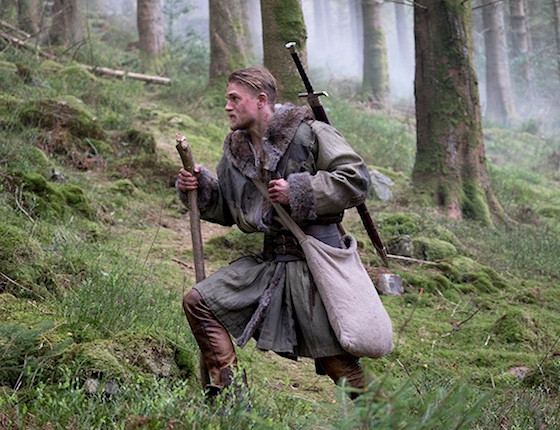
    After years of making fundamentally similar movies, director Guy Ritchie found renewed success reinventing Sherlock Holmes for Warner Bros. I presume that’s directly responsible for the studio tapping him to kickstart this long-gestating project: a series of films inspired by the legends of King Arthur. Unfortunately for them, plans for a six-film series were scuppered when this initial entry went down like a lead balloon with critics and consequently was a box office flop. Nonetheless, some people who I think are worth listening to reckoned it was actually pretty good. Turns out… eh…

    Set in a vaguely-defined historical Britain (the capital is called Londinium, but the king resides at Camelot, which is… somewhere else…?), Legend of the Sword begins with King Uther (Eric Bana) being deposed by his scheming brother Vortigern (Jude Law), with only his young son Arthur escaping. Arthur grows up in a brothel and on the streets, going from a weedy kid to… some kind of, like, gang boss type figure, I guess? Basically, we’re in familiar Guy Ritchie territory: lads up to criminal hijinks with a London accent, only now in medieval costumes. Anyway, long story short, Excalibur — the eponymous sword — reveals itself stuck in a stone, every young man is forced to try to pull it out, which obviously Arthur succeeds at, marking him out for death by Vortigern but also as the true king to those who remain loyal to Uther, who now have a Robin Hood-esque underground army — and so they begin a Robin Hood-esque campaign against Vortigern. Seriously, it wouldn’t take too many tweaks to make this as passable a Robin Hood film as it is a King Arthur one.

    King Arthur and his merry men

    So, to no one’s great surprise, if you’re looking for a broadly faithful adaptation of Arthurian legend then you’re out of luck here. There are obviously famous bits of the legend thrown in — the aforementioned Excalibur and its stone; the Lady of the Lake pops up too; and… um… other than that it’s pretty much just people’s names, really. I don’t know how much critics were hoping to see a more recognisably Arthurian tale, but I have to wonder if this massive deviance from the well-known stories of the eponymous hero is at least partly responsible for the film’s poor reception.

    Part of why I wonder this is that, if you approach Legend of the Sword less as a King Arthur film and more as a Guy Ritchie-flavoured fantasy movie, there are bits of it I think are really, really good. Some of it’s great, even, like an efficient and exciting montage that shows Arthur growing from child to adult. Or any other time there’s a montage, really — that’s the best one, but others are equally as effective. Second best, for instance, is one where Arthur has to go on a quest in some alternate dark dimension or something, battling giant bats and other such nasties. That’d be the whole of act two in other films, or at least a significant action sequence, but its basic content is all so rote — so Ritchie instead burns through it in a montage, which feels like a nod and a wink to the audience: “you know how this goes”. Editor James Herbert certainly gives his skills a workout making these sequences fast, clear, and cinematically thrilling.

    He's gonna need a montage

    Of course, if you really dislike Ritchie’s trademark style then him slapping it on the fantasy genre isn’t necessarily going to enrapture you. Reportedly the project was pitched to the studio and cast as “Lord of the Rings meets Snatch” and they’ve pretty much delivered on that promise, transposing Ritchie’s modern London laddish schtick onto medieval Londinium plebs. Personally, although I’ve somewhat tired of his recognisable approach in a contemporary setting, the temporal disjunct was a fresh enough variation for me, breathing new life into both Ritchie’s MO and fantasy tropes.

    Unfortunately, for all the verve of his own style that Ritchie injects, there are also bits that typify CGI-blockbuster blandness — the final fight is a nothingy blur. The speedy, montage-driven style also allows for only so much character development. What time there is gets focused on Arthur and Vortigern, which I suppose is appropriate enough, with a large supporting cast fighting over the scraps. It seems obvious to me that a mysterious female character known only as “The Mage” was meant to be revealed as Guinevere (a conceit broadly nicked from the Jerry Bruckheimer King Arthur, I think), and indeed that was apparently nixed in post-production. I guess they thought they could bump it to one of the five sequels… which now aren’t happening.

    Come and 'ave a go if you think yer 'ard enough

    My final three-star rating is maybe a bit harsh, but then maybe I’ve been too generous with my fours lately (or always). If Legend of the Sword had been able to carry through on the impetus of its best bits then it may even have been looking at a full five stars, they’re that good, but it doesn’t come together as a whole. It’s not the failure mass opinion painted it as, but it’s not quite a success either — it’s an interesting “good try”.

    3 out of 5

    King Arthur: Legend of the Sword is available on Sky Cinema from today.

    Say Hello to My Little Monthly Update for January 2018

    Let’s start the new year with a bang…

    Say hello to my little friend


    #1 Bright (2017)
    #2 The Narrow Margin (1952)
    #3 My Life as a Courgette (2016), aka Ma vie de Courgette
    #4 The 400 Blows (1959), aka Les Quatre Cents Coups
    #5 The Purge (2013)
    #6 The Treasure of the Sierra Madre (1948)
    #7 The Love Punch (2013)
    #8 The Pirates! In an Adventure with Scientists! (2012)
    #9 The Man from Earth: Holocene (2017)
    #10 La La Land (2016)
    #11 Zatoichi on the Road (1963), aka Zatôichi kenka-tabi
    #12 The Boss Baby 3D (2017)
    #13 Godzilla: Planet of the Monsters (2017), aka Gojira: Kaijū Wakusei
    #14 Scarface (1983)
    #15 King Arthur: Legend of the Sword 3D (2017)
    La La Land

    Scarface

    .


    • 15 new films this month gets 2018 off to a strong start. It’s equal to the 2017 average of 14.5, which bodes well for another good year.
    • It’s ahead of the January average (previously 11.2, now 11.5), though ranks joint third of all Januarys: it’s the same tally as last year, only slightly behind 2015’s 16, but 2016 retains the all-time best January with 20.
    • The Boss Baby was the first film I watched from 2017’s 50 Unseen. Did not expect that!
    • This month’s Blindspot film: on the rare occasion I watch a film from the nouvelle vague I always expect to find it irritating and pretentious, but there are some I’ve liked — Breathless, for example. Now joining that list is another of the movement’s best-known texts, François Truffaut’s The 400 Blows.
    • This month’s WDYMYHS film: Al Pacino stars in Brian De Palma’s ’80s epic about a Cuban immigrant who’s a whizz at designing winter neckwear, ScarfAce.


    The 32nd Monthly Arbitrary Awards

    Favourite Film of the Month

    There were quite a few films I really liked this month (by the time the reviews are in, four will receive full marks), but when I sat down to consider this award there was a clear victor for me. I can’t quite believe it’s taken me this long to get round to it (I first noticed it when it was getting raves at festival screenings in the latter half of 2016), and I’m not sure which stage of backlash we’re on at this point (so I don’t know if I’m currently ‘meant’ to like it or not), but I loved La La Land.

    Least Favourite Film of the Month

    There was nothing I’d consider an outright stinker this month (yes, I enjoyed The Boss Baby and King Arthur), so it falls to what I consider the most disappointing, basically. I’m afraid that has to be The Man from Earth: Holocene. After spending so long waiting for it (I supported the Kickstarter campaign back in 2014), the end result didn’t live up to the original. Perhaps it never could have, but here we are.

    Worst Title Translation from French of the Month
    The French title of François Truffaut’s debut film, Les Quatre Cents Coups, does indeed literally translate into English as The 400 Blows, but that’s not really what it means. It’s a (slight) abbreviation of a French idiom, faire les quatre cents coups, which has a meaning equivalent to “to raise hell”. So in English, The 400 Blows sounds like a pretty meaningless title once you’ve seen the film; something like Raising Hell, on the other hand…

    Worst Title Translation from Japanese of the Month
    The fifth film in Japan’s long-running samurai series is called Zatôichi kenka-tabi in its original language, which translates as Zatoichi’s Fighting Journey. Suggests some action, doesn’t it? Instead, in English it’s known as Zatoichi on the Road, which is both less exciting and also thoroughly generic — it could be the title of pretty much any Zatoichi movie. (Not that Fighting Journey is that much more specific, to be honest.)

    The Audience Award for Most-Viewed New Post of the Month
    A clear victor this month (it had five times as many hits as the post in second place), and for the first time in a quarter of a year it’s actually a film review too: The Man from Earth: Holocene.


    I didn’t bother to furnish my Rewatchathon with an introductory post this year because the concept remains fundamentally the same as 2017 (that intro is here). However, because reaching 52 felt like a bit of a scramble towards the end, I’ve lowered my sights ever so slightly to 50. It’s a rounder number anyhow.

    First off the block, then…

    #1 Dunkirk (2017)
    #2 Die Hard (1988)
    #3 The Man from Earth (2007)
    #4 Die Hard 2 (1990)

    That’s a bang-on-target start — a lot better than last year, when I only rewatched one film in January.

    Believe it or not, Die Hard and Die Hard 2 are the only Die Hard movies I’ve ever seen. I’ve been meaning to get to Die Hard with a Vengeance for absolutely ages, but for a while have also been wanting to rewatch the first two first. Well, that’s done now, so hopefully #3 will follow soon. And then #4 and #5? Perhaps. I mean, I watched Die Hard 2 for the first time in 2008 and I’m only now watching With a Vengeance, so maybe I won’t see the fifth one until 2038…


    The MCU is back, in black.