The Past Month on TV #24

After my busy summer of TV, this month has been very quiet. Isn’t it meant to be the other way round?

The Great British Bake Off  Series 8 Episodes 1-3
The Great British Bake Off 2017After its move to Channel 4, which was as controversial as it was high-profile, I wasn’t sure if I was going to continue bothering with GBBO. What would it be without Mel and Sue’s effortless chemistry and terrible puns, or Mary Berry’s kind twinkle? But cake always wins, and after a few weeks I caved and am now gradually catching up (I mean, too much cake in one go is bad for you, right?) Unsurprisingly, it’s still fundamentally the same show. Sandi Toksvig and Noel Fielding seemed like random picks for the new hosts, but they have the right mix of daftness, quick wit, and empathy to fill Mel and Sue’s shoes, and function surprisingly well as a double act too. New judge Prue Leith is no Mary Berry, but she can do the job. The judging’s hardly the most important bit anyway, is it? That’s the bakes, and they’re as incredible as ever. It’s funny that something that was a tough technical challenge back in series two or three is now just an unmentioned part of something much grander and more complicated. GBBO may have been slightly tarnished by the whole kerfuffle of changing networks and losing popular presenters, but the revised show has turned out to be less a soggy bottom and more a batch of ten almost-but-not-quite-identical sweet treats.

The Great British Bake Off: An Extra Slice  Series 4 Episodes 1-3
An Extra Slice 2017One thing that’s actually been improved by the Bake Off franchise’s move to C4 is this companion show. It always felt a bit cramped before, squeezed into a half-hour when it wanted to be longer, and not allowed to really cut loose with its content because, although it was on the more irreverent BBC Two, it was still on The BBC. In its new home, it’s only been extended by about seven or eight minutes (presumably a result of C4’s commitment not to cut the series’ running time — the old 30 minutes of material plus ads wouldn’t quite fill a 45-minute slot) but that seems to have made the world of difference, allowing it room to breathe and throw in a few more gags. It’s got distinctly cheekier too, which befits host Jo Brand and the kind of guests they have on (mostly comedians). And somehow it never stops being funny how people at home have messed up baking.

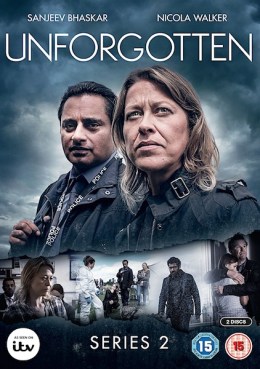
Unforgotten  Series 2
Unforgotten series 2I get the impression ITV’s cold-case thriller was a bit of a surprise success when the first series aired, because it felt like a finite unit that wasn’t expecting a continuation. Despite not having the grand old acting talent that perhaps made the first run a draw, the second series’ storyline is every bit its equal, a compelling mystery about how a successful entrepreneur came to be murdered and stuffed in a suitcase 26 years ago. The tone of the show takes its lead from its stars, the ever-excellent Nicola Walker and Sanjeev Bhaskar, playing a pair of coppers who are calm, understated and methodical when doing their job, but with deep wells of emotion and empathy for the people that job touches. Much of the series ticks along in this way — a good drama, but without many histrionics to wow you — until the finale, when the truth comes out in a devastating episode with heartfelt writing and incredible performances across the board, culminating in a striking final act. Unforgotten is far from the flashiest cop show on TV, but that doesn’t mean it can’t pack a punch.

Also watched…

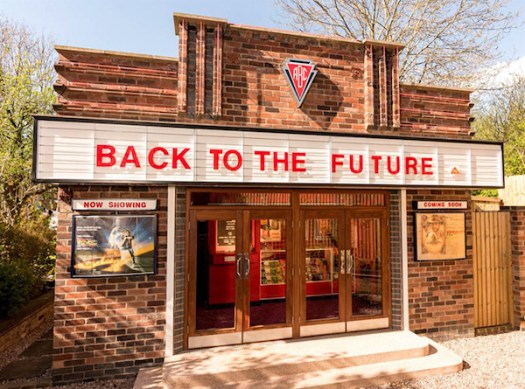
Where we're going, we don't need sheds...

Where we’re going, we don’t need sheds…

  • Amazing Spaces: Shed of the Year Series 4 Episodes 1-2 — Not normally my kind of thing, but episode one featured a cinema ‘shed’ and it was amazing. I’m not sure I’ve ever been so jealous in my life. You might think it’s just the façade pictured above, but oh no! You can have a look at a whole gallery of photos here and weep that you don’t have one in your back garden. Then, episode two had an impressive home-made TARDIS, as well as a little hedgehog rescue. I love hedgehogs. Someone should do a Pixar-esque animated movie starring hedgehogs.
  • The Musketeers Series 3 Episodes 5-6 — This final series seemed to attract a lot of criticism when it aired, but I think it contains as much good ol’ swashbuckling fun as ever.
  • Tim Vine Travels in Time — Exceptionally silly comedy pilot. What else would you expect from Tim Vine? It was pretty divisive on Twitter (too silly for some, it seems), but I enjoyed it. Hopefully they’ll do a series.

    Things to Catch Up On
    Star Trek: DiscoveryThis month, I have mostly been missing the return of Star Trek to TV, in the form of Discovery. It’s “a Netflix original series” everywhere outside the US and Canada, so I imagine I’ll catch up during one of my irregular Netflix subscriptions (after the whole first season is available to binge, of course). Also missed: Rellik, the new thriller with a Memento-esque structure from the writers of The Missing and One of Us, and the second series of Doctor Foster. I’m saving up both for a consecutive-day binge once they’re done.

    Next month… if rumours about a surprise mid-October release date are to be believed, I’ll probably review Netflix’s sixth Marvel show, The Punisher. If those rumours are rubbish, who knows?

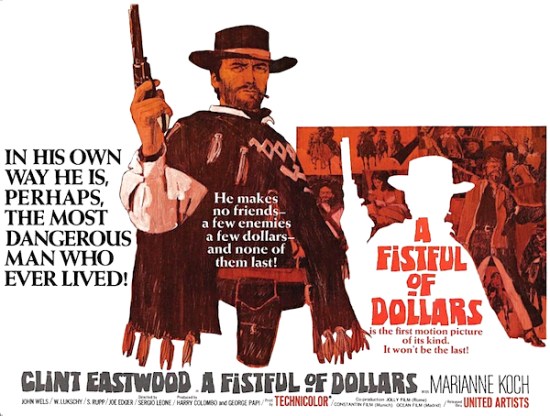
  • A Fistful of Dollars (1964)

    The 100 Films Guide to…

    In his own way he is, perhaps, the most dangerous man who ever lived!

    Original Title: Per un pugno di dollari

    Country: Italy, Spain & West Germany
    Language: English and/or Italian
    Runtime: 100 minutes
    BBFC: X (cut, 1967) | AA (1981) | 15 (1986)
    MPAA: M (1967) | R (1993)

    Original Release: 12th September 1964 (Italy)
    UK Release: 11th June 1967
    Budget: $200,000

    Stars
    Clint Eastwood (High Plains Drifter, Gran Torino)
    Marianne Koch (The Devil’s General, Spotlight on a Murderer)
    Gian Maria Volontè (For a Few Dollars More, Le Cercle Rouge)
    Wolfgang Lukschy (Dead Eyes of London, The Longest Day)
    José Calvo (Viridiana, Day of Anger)

    Director
    Sergio Leone (The Colossus of Rhodes, The Good, the Bad and the Ugly)

    Screenwriters
    Víctor Andrés Catena (Kill Django… Kill First, Panic)
    Jaime Comas (Nest of Spies, Cabo Blanco)
    Sergio Leone (The Last Days of Pompeii, Once Upon a Time in the West)

    Dialogue by
    Mark Lowell (High School Hellcats, His and Hers)

    Story by
    Adriano Bolzoni (Requiescant, Your Vice is a Locked Room and Only I Have the Key)
    Víctor Andrés Catena (Sandokan the Great, Cabo Blanco)
    Sergio Leone (Duel of the Titans, Once Upon a Time in America)

    Based on
    Yojimbo, a Japanese samurai film written by Akira Kurosawa & Ryûzô Kikushima and directed by Kurosawa. (Not officially, but the makers of Yojimbo sued and it was settled out of court — presumably because it’s really, really obviously a remake of Yojimbo.)

    The Story
    The Mexican border town of San Miguel is ruled over by two rival gangs. When a gunslinging stranger arrives, he attempts to play the two gangs off against each other to his benefit.

    Our Hero
    The Man With No Name, aka Joe, seems to just be a drifter, who rocks up in San Miguel and sees an opportunity to make some money by doing what he does best: killing people.

    Our Villains
    Neither of the two gangs — the Baxters and the Rojos — are squeaky clean, but the Rojos are definitely the nastier lot. Led by three brothers, the cleverest and most vicious of them is Ramón, who’ll stop at nothing to punish Joe after he threatens their empire.

    Best Supporting Character
    The innkeeper Silvanito, who warns Joe away when he first arrives, but becomes his friend and almost sidekick later on.

    Memorable Quote
    “When a man with .45 meets a man with a rifle, you said, the man with a pistol’s a dead man. Let’s see if that’s true.” — Joe

    Memorable Scene
    As Joe heads off to confront three of Baxter’s men who shot at him earlier, he passes the coffin maker — and tells him to get three coffins ready. Coming face to face with four of Baxter’s goons, Joe asks them to apologise to his mule. They, naturally, refuse… so he shoots them all dead. As he walks back past the coffin maker, he casually apologises: “My mistake — four coffins.”

    Memorable Music
    Ennio Morricone’s score is as much a defining element of this movie as the visuals or the cast. His later theme for The Good, the Bad and the Ugly may be his best-known work, but there’s a cracking main title theme here too.

    Letting the Side Down
    It’s just a fact of this kind of production from this era, but the English dubbing is really quite terrible. Well, the acting’s not all that bad, as it goes, but the lip sync is not very synced.

    Making of
    When it premiered on US TV in 1977, the network found the film’s content morally objectionable: the hero kills loads of people, apparently only for money, and receives no punishment. While that might sound perfectly attuned to US morals today, they had different ideals back then. So they ordered a prologue be shot, showing Eastwood’s character receiving a commission from the government to go sort out the town of San Miguel by any means necessary — thus morally justifying all his later killing, apparently. The short sequence was directed by Monte Hellman (Two-Lane Blacktop) and starred Harry Dean Stanton (RIP).

    Next time…
    The loosely connected Dollars (aka Man With No Name) Trilogy continued with For a Few Dollars More (which was part of my 100 Favourites last year) and concluded with The Good, the Bad and the Ugly (which someday will get the “What Do You Mean You Didn’t Like” treatment).

    Verdict

    The Dollars trilogy were among the first Westerns I saw, and I’ve been meaning to revisit them for many years. I was finally spurred on to start by watching Yojimbo for the first time. Watching that and this back to back, you can’t miss how similar they are — no wonder they settled the legal case, they wouldn’t’ve had a leg to stand on. Yojimbo is the classier handling of the material, giving the whole scenario a weightiness that has gone astray here. Fistful has its own charms, of course, as director Sergio Leone merrily reinvents the Western genre before our eyes — out go the simple white hat / black hat moral codes, in comes baser motivations (greed, lust) and quick sharpshooting. What it lacks in classiness or weight, it makes up with coolness and style.

    Kingsman: The Golden Circle (2017)

    2017 #125
    Matthew Vaughn | 141 mins | cinema | 2.39:1 | UK & USA / English | 15 / R

    Kingsman: The Golden Circle

    Critics, eh? There’s a lot you could say about them, both individually and en masse, but right now I’m concerned with the fact they’ve given Kingsman: The Golden Circle a Rotten Tomatoes score of just 50%.* More than that, many have gone further: I’ve read one-star reviews from several major outlets. Audiences disagree. On IMDb it’s got a very respectable 7.4 (just a few points down from the much better-received Wonder Woman, for comparison) and it topped the box office this past weekend, beating the latest LEGO movie in the US and almost doubling the first film’s opening weekend in the UK. Well, I’m definitely an audience member rather than a critic. In fact, I’m still weighing up the possibility that The Golden Circle might be even better than its predecessor.

    I’ll return to both the critics and the two films’ relative merits later. For now, the obligatory plot summary: a year on from the events of the first movie, Eggsy (Taron Egerton) is a fully-fledged Kingsman agent and is dating Swedish princess Tilde (Hanna Alström). An encounter with former wannabe-Kingsman Charlie (Edward Holcroft) sets Eggsy on the trail of Poppy (Julianne Moore), a drugs kingpin with a ’50s Americana fetish and a plan for global domination. Eggsy and tech whizz Merlin (Mark Strong) travel to the US of A to team up with their sister organisation, Statesman, in a bid to stop Poppy’s nefarious scheme.

    Magic us out of this one, Merlin

    That’s the coy version of things — more coy than the trailers, certainly, which brazenly gave away major developments and revelations. (You’ll note my summary’s shortage of big-name stars, for example, who have been plastered all over the advertising.) Director Matthew Vaughn even asked the studio not to reveal one thing in the marketing — namely, that Colin Firth was back — but they went ahead and did it anyway. I know they had a movie to sell, but I’m not convinced they needed to ignore him on that. Actually, that connects to my first complaint about how critics have treated the film: those one-star major reviewers seemed to hate the film so much that they were happy to spoil bits left, right, and centre. No such disregard for the audience here (though there will be minor spoilers, if you’ve not seen it yet). Nonetheless, if you were one of those people who seemed to find the first film’s anal sex joke to be the most heinously offensive sin committed by cinema since The Birth of a Nation, maybe read a couple of those reviews for a benchmark if you’re undecided about seeing this sequel — it may also offend your delicate sensibilities for reasons I can only vaguely comprehend.

    To me, The Golden Circle represents a commitment to being purely entertaining. It’s consistently funny and at times laugh-out-loud hilarious. The action sequences are crazily hyperkinetic to the nth degree. It mixes in all the classic spy movie shenanigans, like far-fetched plots and cool gadgets and exotic locales; but it also works to subvert, expose, or develop some of those things. Beyond that, however, it has surprisingly good character work for what could’ve been a mindless comedy shoot-em-up. I mean, Merlin’s arc… well, i said no spoilers. But the film also makes time to be concerned about Eggsy’s relationship and how his work might affect it. It’s almost a good subversion of the gentlemen-spy sleep-around stereotype, though the Glastonbury sequence rushes through that rather than meaningfully deconstructing it (more about that already-infamous scene later).

    The Lepidopterist

    Then there’s Harry’s return — not just a pleasant surprise, but an emotional minefield for our other heroes, who were still coming to terms with his demise. Now, some critics reckon that Harry’s revival lowers the stakes for the rest of the movie. Well, only if you choose to disregard the details of his return. OK, yes, there’s now a safety net in some scenarios; but a gel that slows the effect of a headshot isn’t much use if, say, you get blown to pieces. Also, the idea that Harry was “very much dead” is actually an assumption that’s not wholly supported by the first film. I mean, obviously it was implied that Harry is very much dead — that was the point at the time — but watch it again: you don’t actually see much detail of what happens, other than that Valentine shoots him somewhere in the head and he collapses to the ground. The scene ends almost immediately. Vaughn and co use this to their advantage, having the Statesman turn up with seconds of the shot being fired. Yeah, it’s still implausible, but then I don’t think people’s heads explode in choreographed light shows either, and that was a big part of The Secret Service.

    Comparisons to that previous movie abound in other reviews, I guess because it went down well while this one, which is ostensibly more of the same, hasn’t. Also, to be fair, because the film itself is constantly making such references too. Consequently, some critics are focused on the idea that what The Golden Circle lacks is the freshness of the original. Well, personally, I enjoyed the first one more when I re-watched it a couple of days ago than when I first saw it back in 2015, so the “I’ve not seen that before” factor is not its defining quality for me. Nonetheless, this is the kind of sequel that’s somewhat derivative of its own predecessor, with many riffs on stuff you’ll remember from before. The most regularly repurposed is the famous church fight, though I’d argue that it’s taken the style of that sequence and then applied it to several more in this film, rather than merely producing an outright copy of what came before — something I would (and did) accuse, say, X-Men: Apocalypse’s Quicksilver sequence of doing (even though it tried to find fresh angles on the same basic concept).

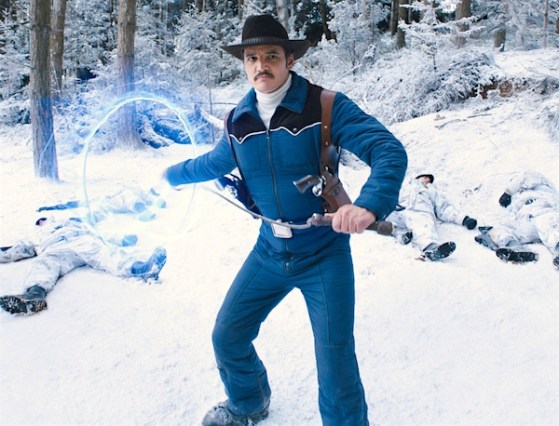
    Skipping rope in the snow

    One particular way that half the action sequences feel like they’re deliberately riffing off / ripping off that church fight is that they’re set to pop songs, and often unexpected ones. It may be repeating a trick, but this use of music is consistently entertaining — I mean, hasn’t Saturday Night’s Alright for Fighting always wanted a fight set to it? And the country-fied cover of Word Up for the finale is bang on. That’s not to mention the score by Henry Jackman and Matthew Margeson. I always liked the main theme from the first film, which is carried over here, along with effective action cues (for those times it goes without a pop song) and a neat integration of melodies from John Denver’s Take Me Home, Country Roads. That song is used to very particular effect at one point, and, listening to the soundtrack while writing this review, the bit of Mark Strong singing it that’s included did actually leave me with a little something in my eye — again, not what you expect from a film like Kingsman. Though I must clarify, that is due to the memory of the film, not the quality of Mr Strong’s singing, which is certainly… Scottish-accented. Something I didn’t notice particularly when watching the movie (and why would you on a first viewing?) is that those melodies are there right at the start, played on bagpipes and segueing into the opening theme. Cheeky foreshadowing beggars.

    While there may be some dimension of merit to some of the criticisms I’ve referenced so far, others merit mention only to be ridiculed. I mean, one critic slagged off the fact that most (but not all) of Poppy’s scenes take place in one location, which must be the most ludicrous factor contributing to a film getting one star that I’ve ever read. Relatedly, that the big-name new cast members are given less focus than the returning characters seems to be a recurring sticking point. Well, what do you expect? In fact, what do you want? It’s like thinking the solution to Quantum of Solace’s woes was to spend less time with James Bond and more with Agent Fields. Plus, surely the fact that some prominently-billed new names turn out to be glorified cameos is more to do with the marketing overhyping them — as you do when you’ve got genuine movie stars in your movie — than the film itself fundamentally underserving them. Sure, I’d like more of Channing Tatum’s character too, but hey-ho; and it’s not like his limited screen time isn’t put to memorable effect, several times over. The same can be said for Julianne Moore and, arguably best of all, Elton John. They may reuse the same Elton gag a couple of times too often, but on the whole he has a surprisingly effective part to play. On the other hand, after “more Halle Berry” was something that eventually undermined the X-Men films, I’m fine with her role being kept to a minimum. Still, for everyone who wished for more of Tatum and co, there are already rumours of an extended cut coming to DVD and/or Blu-ray. Oh, but those critics moaned about it already being too long. There’s no pleasing some people…

    More Tatum, less Berry

    There is perhaps a case to be made that the film has bitten off more plot than it can comfortably chew. I’ve already said that some sequences feel a little too hasty, and there might be one big set piece too many — I assumed the film was about to head into its final act, before remembering we hadn’t had all the snowbound set pieces from the trailers yet. Personally, I didn’t mind this additional length — at no point did the film bore me. I’ll be more than happy if that extended cut does materialise. Perhaps the paciness despite the length is what led many critics to call it out for having too complex a plot, an accusation I find somewhat implausible. I can only assume they weren’t expecting to think at all and so almost literally turned their brains off, because this isn’t some intricate thriller, it’s a big action spy movie that moves pretty linearly from plot point to plot point. That’s not a criticism, just an observation.

    And if you want to go the other way and overthink the film, some people do get very het up about what the political messages and affiliations of these two movies may or may not be. Now, I’m not going to argue they don’t have a political dimension — that would be a patently ludicrous position to take, given how much they both allude to real-world issues like climate change and the drug trade — but, allowing for that, I don’t think the films care what their political allegiance is. That’s how some people can manage to read a movie in which the working-class hero blows up the world’s conspiring elites in order to stop the common folk from massacring each other as nothing but a right-wing fantasy, and how other people can manage to read a movie in which an unaccountable intelligence organisation gentrifies a lower-class kid to make him worth something, before blowing up an environmentalist and President Obama, as proletariat wish-fulfilment. Both of those describe The Secret Service, but there are elements in the sequel that have the same effect — this time, it’s your stance towards the war on drugs and how we deal with addicts that is being prodded.

    View to a kill

    All of that said, the more I’ve thought about the film afterwards (as you do, especially if you’re going to, say, write a review for a blog or something), the more some issues do begin to become apparent. While I don’t inherently object to the Glastonbury sequence (I’d wager it in part exists as another way for Vaughn to thumb his nose at critics of certain parts of the first movie, and he got ’em too), I do think there were cleverer ways to handle it. Vaughn has said that sequence is meant to be about having to do something you don’t want to do for the sake of your job, but that doesn’t wholly explain the teenage smuttiness of how it plays out. I mean, wouldn’t it be funnier if Eggsy felt he had to stick to his principles and find a way to clumsily shove his finger up Clara’s nose? Then phone Tilde back: “It’s okay babe, I only put it up her nose.” “You did what?!”

    So yeah, it’s not a perfect movie. But, at least while it was on, I was having way too much fun to care. If you’re the kind of person who found something (or lots of things) about the first movie offensive to your moral fibre, chances are slim that you’ll like this sequel. Conversely, if you’re the kind of person who misses ’90s lads-mag culture, you’ll bloody love it, mate. For those of us somewhere on the (very broad) spectrum between those two points, other reviews make it clear that it’s not to everyone’s taste, but it was very much to mine. The niggles I’ve mentioned have led me to give it a lower score than the first film, but I reserve the right to change my mind as soon as I get a chance to rewatch it — I can envision myself ultimately revisiting The Golden Circle more regularly than The Secret Service.

    4 out of 5

    Kingsman: The Golden Circle is in cinemas most places now, and in the other places soon.

    It placed 15th on my list of The 17 Best Films I Saw For the First Time in 2017, which can be read in full here.

    * At time of writing. It was 49% on Saturday and 51% on Sunday, so it might be different again by the time you read this. ^

    The Accountant (2016)

    2017 #73
    Gavin O’Connor | 128 mins | download (HD) | 2.40:1 | USA / English | 15 / R

    The Accountant

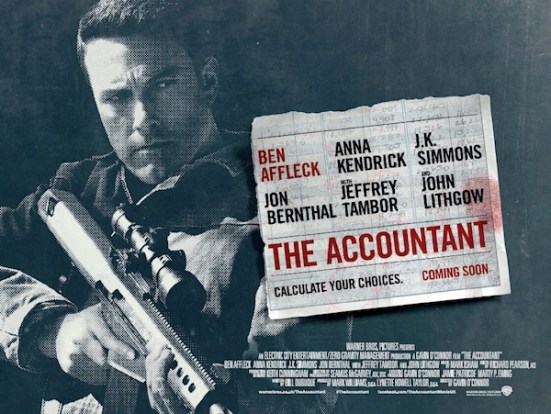
    In this action-thriller from the director of the overrated Warrior, Ben Affleck stars as Chris Wolff, an autistic accountant who excels at auditing complex financial records. No, wait! I did say action-thriller, because Chris’ clients are mostly criminal organisations, and he uses the martial arts training his father instilled as a child to double up as a hitman. See, it’s exciting really.

    When Chris is called to audit a robotics company (run by John Lithgow) who have found irregularities in their books (why this criminal accountant is called to work for a legit company I can’t remember, but I’m sure it was explained in the film), he unexpectedly bonds with Dana (Anna Kendrick), the company accountant who spotted the problem. After his audit unearths evidence of embezzlement, both Chris and Dana find themselves the target of bad people (led by Jon Bernthal) who want to keep the company’s secrets. Meanwhile, a couple of FBI agents (J.K. Simmons and Cynthia Addai-Robinson) are on the trail of the mysterious criminal known primarily as “the Accountant”…

    Maths!

    The Accountant has lots of moving bits and pieces — I’ve not even alluded to all of them in that summary — but to call it a complicated film would be either too generous or a disservice, depending on your point of view. There’s a clarity to it all that keeps it easy to follow but suitably engaging, even as it plays out multiple storylines in a couple of time periods (there are flashbacks aplenty to Chris’ childhood training). And if you’re thinking, “finally a film that makes accounting exciting!”, I’m sorry to disappoint you but Chris’ maths skills are really just a MacGuffin to get the ball rolling. What it does deliver is a decent thriller plot, with a couple of twists to keep things lively. It’s also a pretty satisfying narrative — I’m not sure there’s ever been another movie that so thoroughly tied up everything into nice neat little bows. I suppose that’s at least kind of appropriate given the hero’s condition.

    The action element is mainly reserved for the second half, when Chris has to deal with the people out to get him. This isn’t one for adrenaline junkies — it’s not a nonstop fight-fest like, say, a Bourne movie — but there’s a suitably violent climax nonetheless.

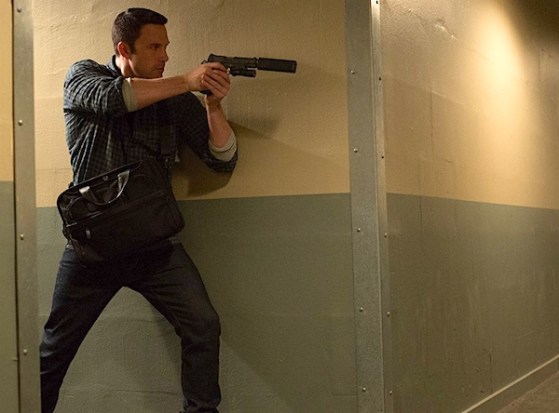
    Shooting!

    In some respects The Accountant shouldn’t be a good movie. It treats autism as a superpower, which is both inaccurate and turning into a cliché; but it doesn’t do it so egregiously that it feels entirely tacky. The whole side story with the FBI also feels kind of clunky, though at least eventually goes somewhere — whether that somewhere is relevant and clever, or pointless and daft for the sake of a twist, is up to your own judgement. Same goes for the other major final-act reveal.

    Yet, for all that, it’s kind of fun. Not in the obvious jokey way that, say, Guardians of the Galaxy is fun, but in the way that it provides decent characters, decent thrills, decent action, and a thorough set of conclusions that put pins in everything, including things you didn’t even think needed tying up. There may be points in the middle when you come close to rolling your eyes and almost wanting to give up on it, but by the end it’s all pretty satisfying.

    4 out of 5

    The Accountant is available on Sky Cinema from today.

    Muppet Review Roundup

    In today’s round-up:

  • The Muppet Movie (1979)
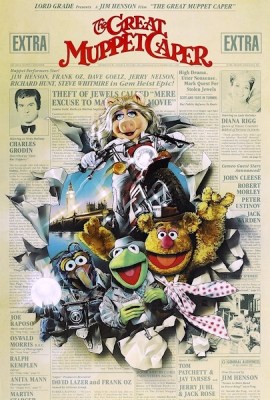
  • The Great Muppet Caper (1981)


    The Muppet Movie
    (1979)

    2017 #77
    James Frawley | 91 mins | TV | 1.85:1 | UK & USA / English | U / G

    The Muppet Movie

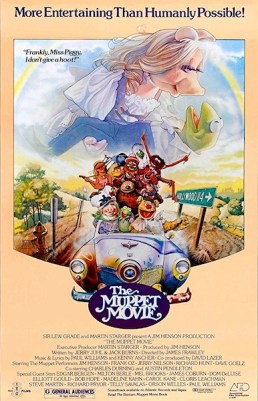
    “The Muppets Begin” in their big-screen debut, which sees Kermit going on a road trip where he encounters most of the key Muppets one by one, while being chased by a businessman who wants Kermie to be the poster-frog for his frog legs restaurant.

    It feels like a succinct distillation of the Muppet style, driven by gentle surrealism, meta humour, musical numbers, and a ton of cameos. How well the latter have aged in four decades is debatable — I knew a fair few (James Coburn, Telly Savalas, Elliott Gould, Bob Hope, Richard Pryor, Steve Martin, Mel Brooks, Orson Welles), but, looking at the list on Wikipedia, there were plenty I didn’t get. Time has also added humour where none was intended: Gonzo’s comment that he wants to go to India to become a movie star isn’t actually a Bollywood reference — Jim Henson picked the least likely place Gonzo could become a movie star, unaware they produce twice as many movies as Hollywood. Oops. On the other hand, I don’t know if the subplot where Gonzo seems to fancy chickens was ever just wacky, but today it feels weird and kind of disturbing.

    Aside from the recognisability of the cameos, the Muppet style has aged pretty well — some things that were once outré just become part of the culture as time wears on, but much of the Muppets’ material is still entertainingly irreverent today.

    4 out of 5

    The Great Muppet Caper
    (1981)

    2017 #87
    Jim Henson | 94 mins | TV | 1.85:1 | UK & USA / English | U / G

    The Great Muppet Caper

    The second big-screen outing for the Muppets casts Kermit, Fozzie Bear and Gonzo as reporters who travel to England to investigate a jewel theft. Of course, this being a Muppet movie, the plot is less important than the crazy comical antics.

    To that end there are some good songs and sequences: the opening number about it being a movie, the Happiness Hotel song, a couple of dance routines centred around Miss Piggy — one of those underwater! There are plenty of good individual lines as well, particularly when it breaks the fourth wall, which is often. Favourites include the commentary on the opening credits, noting an exposition dump, a gag about brief cameos, and a variety of neat running gags, in particular one about Kermit and Fozzie being indistinguishable identical twins.

    Other sequences are sadly less effective: the one in the park (even if the use of bikes is quite impressive); or, most disappointing of all, an extended skit with John Cleese. It also comes up short on the cameo front. There are a couple, but they don’t feel as frequent or all as well-known as in the first film. Maybe it shouldn’t matter, but it’s part of the Muppets’ schtick, so that aspect is left feeling rather anaemic by comparison to some of their other movies.

    Overall, The Great Muppet Caper is a solid, largely entertaining Muppet outing if you like these characters and their style of humour, but otherwise nothing exceptional.

    3 out of 5

  • The Mid-Month Update for the Middle of September 2017

    Hello, dear reader! How are you? Well, I hope. Me? Can’t complain.

    That said, you may have noticed it’s been a tad quiet here of late. (Or maybe you haven’t. That’s OK, I don’t blame you.) There’s no grand or exciting reason for that, I’m afraid — September’s just turned out to be a busier-than-average month ’round these parts, leaving precious little spare time for blogging.

    Indeed, the fact it’s the middle of the month (a couple of days past, in fact) has snuck up on me somewhat. Thanks to that, September is trending behind average: with only four new films watched so far, could this be the first month in over three years to not reach the ten-film threshold? (Gasp!)

    Anyway, things are hopefully calming down now, so regular reviewing should resume shortly…

    The Is It Future or Is It Past Week on TV #23

    What the fuck just happened?

    Twin Peaks  Season 3 Episodes 17-18

    Well.

    Twin Peaks: The ReturnThe entirety of The Return has been a very divisive piece of television. For all the praise it’s received from certain critics and cinephiles, there are other viewers and reviewers who think it’s a case of Emperor’s New Clothes. The finale — which looks likely to also be the finale to the entire Twin Peaks universe, unless something changes — is all of that in a microcosm, with some hailing it as a perfect capstone on a masterpiece, while others berate it for being inconclusive and overly ambiguous rather than a true ending.
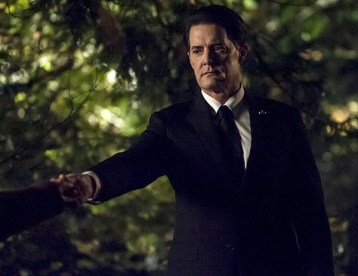
    In my view, anyone who expected co-writer/director David Lynch to resolve and explain everything in a clear and concise manner was on a hiding to nothing. Even with the normalising influence of co-writer Mark Frost, it’s been clear throughout the season that this is more of an 18-hour David Lynch film than another season of Twin Peaks as we knew it. That said, I confess I’d hoped for more wrap-up than we got. I never expected every aspect of the series’ complex mythology to be explained — both Lynch and Frost revel in the idea that a bit of mystery is more interesting than a thorough explanation — but what we did get looks an awful lot like a cliffhanger. It’s perfectly possible to finish a story without explaining all of its mysteries, but this feels like a story unfinished.

    But let’s not let the closing moments overshadow everything. There was a lot to like in the double-bill finale — and I say “double-bill” rather than “two-part” because Part 17 and Part 18 felt distinctly different from one another. Some have called Part 17 the true ending of The Return and Part 18 the start of something else. If there was another season (or a movie, or whatever) coming, I’d agree with that explanation; but there isn’t, so we have to view it all as part of the one thing.

    Coop de grâcePart 17 saw most of the series’ central characters converge on the Twin Peaks Sheriff Station for a showdown with, first, the evil Mr. C, and then BOB, now in the form of a floating ball with a face. In most shows none of this would make a blind bit of sense, but in Twin Peaks it’s what amounts to clarity. Indeed, I’ve even seen some people criticise it for being too pat and obvious. Everyone’s entitled to their opinion, right? But anyone who wanted a full-blown reunion between their favourite characters was in for disappointment, because almost as soon as Agent Cooper was back among both his Twin Peaks and FBI friends, he was off again — transported into the past, into the events of Fire Walk with Me, to try to save Laura Palmer. It was an effective use of old footage and new matching bits, and it suggested we may be in for some kind of conclusive end to the main storyline, especially when there were further modified flashbacks to the pilot.

    But then there was a cliffhanger and Part 18… well, Part 18 had very different ideas. Even this late in the day — the last 5.5% of the season — Lynch was merrily introducing new mysteries, paying no heed to the dozens already unanswered. At the very beginning of the season, the Giant, aka the Fireman, had told Cooper, “Remember 430, Richard and Linda, two birds with one stone”. Now, we seemed to be finding out what that meant, as Cooper and Diane drove 430 miles to… something… after which they stopped at a motel, slept together, and Cooper woke up to find a note for him but addressed to Richard from Linda. O…kay…

    Coop de grâceAs the episode went on, most of it seemingly filled with people driving together in silence, it became increasingly clear that we weren’t going to find out many of the things we’d been wondering about (first among them for many fans: what was going on with Audrey?), nor did it look likely we’d be getting a nice button on the main plot line of the show. That turned out to be the case, with a mysterious final scene that, as I said earlier, felt more like a cliffhanger than an ending. That happened in season two as well, of course, but back then it wasn’t intended to be the final end — this is. You can see why some fans would be angered by that. Conversely, others revel in the open-ended-ness. Horses for courses, I guess.

    Personally, I don’t know that I’d call this belated third season of Twin Peaks an unqualified success. It was certainly an experience, a journey I’m glad to have gone on, and one I expect I’ll undertake again someday — indeed, I feel more like watching it again soonish than I did season two, which I also watched for the first time this year. That said, in part that’s because season three moved at such a unique pace, and ends with so many apparently unanswered questions, that it feels more like it requires a second viewing to make sense of it; to understand it as one singular 18-hour work. And while that remains true, it still didn’t fulfil everything that I hoped it would.

    I’ve already spent several hours reading articles trying to make sense of it all. I expect, in the years to come, I’ll be reading more. I guess whether it is a masterpiece or it is the Emperor’s New Season, that shows its power as a work of art.

    You've been Lynched

    Next month… after a busy summer, I intend to put this TV column back in its place: monthly.

    Musical Review Roundup

    My blog is alive with the sound of music, courtesy of…

  • Sing Street (2016)
  • Jersey Boys (2014)
  • Sing (2016)
  • Into the Woods (2014)


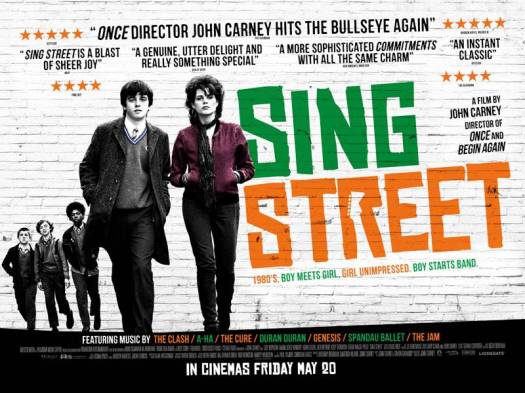
    Sing Street
    (2016)

    2017 #13
    John Carney | 106 mins | streaming (HD) | 2.35:1 | Ireland, UK & USA / English | 12 / PG-13

    Sing Street

    A struggling busker — sorry, a failing record exec — no, sorry, a misfit teenage boy… sets out to impress a beautiful fellow busker — sorry, a promising singer-songwriter — no, sorry, a cool girl… by helping her record a record — sorry, by coercing her to record a record — no, sorry, by persuading her to star in the music video for the record he’s recorded. Except he hasn’t actually recorded that record yet. In fact, he doesn’t even have a band.

    Yes, the writer-director of Once and Begin Again has, in some respects, made the same film again. Yet somehow the formula keeps working. Here there’s extra charm by it being school kids dealing with first love and finding their place in the world. It’s something we all go through, so there’s a universality and nostalgia to it that perhaps isn’t present in the story of twenty/thirty-somethings who are still floundering around (especially Begin Again, which made them cool twenty/thirty-somethings living in cool New York).

    It’s fuelled by endearing performances, particularly from young leads Ferdia Walsh-Peelo and Lucy Boynton, and a soundtrack of era-aping toe-tappers — in an alternate (better) universe, The Riddle of the Model and Drive It Like You Stole It competed for the Best Original Song Oscar, and one of them won it too. And those are just the highlights — the rest of the soundtrack is fab as well. I imagine if you were a music-loving teenager in the ’80s, this movie is your childhood fantasy.

    5 out of 5

    Sing Street placed 7th on my list of The 17 Best Films I Saw For the First Time in 2017, which can be read in full here.

    Jersey Boys
    (2014)

    2017 #97
    Clint Eastwood | 134 mins | streaming (HD) | 2.35:1 | USA / English | 15 / R

    Jersey Boys

    A musical biopic about Frankie Valli and the Four Seasons doesn’t seem like a very Clint Eastwood film at first glance, but when it turns out to be kind of Goodfellas but with the music industry, it becomes at least a little more understandable.

    Based on the hit Broadway musical, it retains a staginess of structure — the four band members take turns narrating the story by speaking to camera — while also opening out the settings so it feels less “jukebox musical” and more “biopic with songs”. It takes some liberties with the chronology of events for dramatic effect, but that’s the movies for you.

    The shape of the story feels familiar and it feels leisurely in the time it takes to tell it, but the songs are good and most of it is perfectly likeable. It’s by no means a bad movie, just not one that’s likely to alight any passion.

    3 out of 5

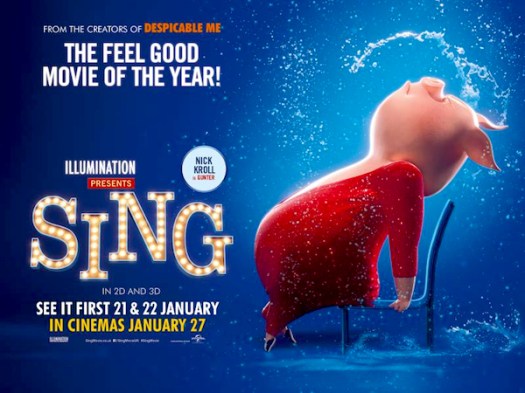
    Sing
    (2016)

    2017 #107
    Garth Jennings | 108 mins | download (HD+3D) | 1.85:1 | USA / English | U / PG

    Sing

    The seventh feature from Illumination (aka the Minions people) comes across like a cut-price Zootopia: in a world where animals live side-by-side in cities like humans, a struggling theatre owner launches an X Factor-esque singing competition to revive his fortunes. Naturally there’s a motley cast of participants, all with celebrity voices, and hijinks ensue.

    Apparently the film features 65 pop songs, the rights to which cost 15% of the budget — if true, that’s over $11 million just in music rights. The big musical numbers (all covers, obviously) are fine, with the best bit ironically being the new Stevie Wonder song on the end credits, which is accompanied by Busby Berkeley-ing squid. Elsewhere, there are some moments of inventiveness, but it doesn’t feel as fully realised as Zootropolis. Perhaps that’s part and parcel of Illumination’s ethos: to make films that translate internationally, presumably by being quite homogeneous. And to make them cheaply (their budgets are typically half of a Pixar movie), which has its own pros and cons.

    Anyway, the end result is fine. Much like Jersey Boys, Sing is perfectly watchable without ever transcending into anything exceptional.

    3 out of 5

    Into the Woods
    (2014)

    2017 #118
    Rob Marshall | 125 mins | streaming (HD) | 2.39:1 | USA, UK & Canada / English | PG / PG

    Into the Woods

    Fairytales are combined and rejigged in Stephen Sondheim’s Broadway musical, here brought to the screen by the director of Chicago. The original is a work that definitely has its fans, but doesn’t seem to have crossed over in the way of, say, Phantom of the Opera or Les Mis — I confess, I’m not sure I’d even heard of it before the film was announced.

    The film adaptation readily suggests why that might be. For one, it’s light on hummable tunes. It’s almost sung through, with only a few bits seeming to stand out as discrete songs in their own right. For example, it takes the opening number a full 15 minutes to reach its culmination, having been diverted into a few asides. Said song culminates with most of the main characters going into the woods while singing about how they’re going into the woods, and yet the film doesn’t put its title card there. The placement of a title card is a dying art, I tell you.

    Performances are a mixed bag. Everyone can sing, at least (by no means guaranteed in a modern Hollywood musical adaptation), and the likes of Emily Blunt, James Corden, and Anna Kendrick are largely engaging, but then you’ve got Little Red Riding Hood and her incredibly irritating accent. Fortunately, she gets eaten. Unfortunately, she gets rescued. On the bright side there’s Chris Pine, his performance well judged to send up the romantic hero role. You may remember Meryl Streep got a few supporting actress nominations for this, which is ludicrous. It’s not that she’s bad, but she’s in no way of deserving of an Oscar.

    There are witty and clever bits, both of story and music, but in between these flashes it feels kind of nothingy. It’s also overlong — the plot wraps up at the halfway point, with the second half (presumably what comes after an interval on stage) feeling like a weak sequel to the decent first half. All in all, another one for the “fine, but could do better” pile.

    3 out of 5

  • 21 (2008)

    2017 #114
    Robert Luketic | 123 mins | streaming (HD) | 2.35:1 | USA / English | 12 / PG-13

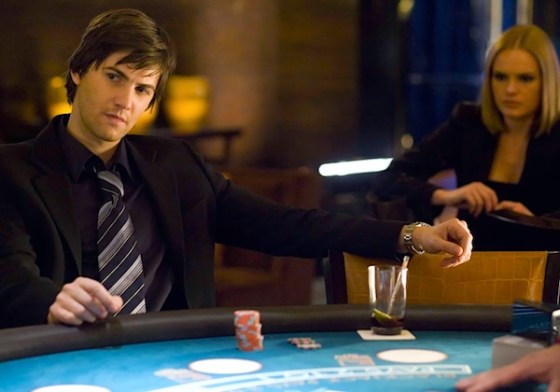
    21

    21 is based on a true story. Actually, it’s based on a book that’s based on a true story. Bringing Down the House by Ben Mezrich was a non-fiction bestseller, telling the fun and exciting story of the MIT blackjack team, a bunch of college kids who learnt card counting and took Vegas for millions of dollars. It was such a popular book that all the attention made people look into it, and it turned out it was heavily fictionalised — Mezrich not only exaggerated events, he flat out invented whole chunks of the story. (At the same time, he also left out some good stuff.) In turn, the book has itself been heavily melodramatised for this movie adaptation. What we’re left with is probably about as close to the truth as Game of Thrones is a fair depiction of the Wars of the Roses: some of it happened, but not to those people, not in that way, not at that time, and certainly not all of it.

    As a film, it’s been mashed broadly into the heist movie template. Setting aside the veracity and treating it purely as an entertainment, this has pros and cons. Whenever it’s whizzing around in Vegas it’s kinda fun, with flashy camerawork and a slick feel for the excitement of being a successful high-roller. But when it puts that aside to get stuck into the characters’ thinly-drawn personal lives, it gets kinda dull. Part of the point of the book is how boring normal life began to seem to the team when compared to their Vegas lifestyle, but 21 tacks on more interpersonal subplots that just become finger-drumming.

    Counting cards

    Trying to make the chosen genre function isn’t helped by the fact that there’s no complicated heist here. The blackjack team are doing the same thing over and over — that’s basically how their system works as a moneymaker — and once the system’s been explained and we see it in action, the film only has a few ways to jazz that up. Between that and those subplots, at over two hours 21 is much longer than it needs to be, but doesn’t focus that time in the right areas: at least one major character undergoes a huge personality change across a single montage.

    21’s got enough pizzazz to make it enjoyable purely as a lightweight movie experience, but you do have to wonder: would the incredible real story, by dint of being true and not movieised to fit a genre template, actually have been more interesting?

    3 out of 5

    The Deathly Monthly Update for August 2017

    It’s been a quiet summer here at 100 Films


    #108 Shin Godzilla (2016), aka Shin Gojira
    #109 This is the End (2013)
    #110 Death Note (2006), aka Desu Nôto
    #111 Nashville (1975)
    #112 Death Note: The Last Name (2006), aka Desu Nôto: the Last name
    #113 The Girl on the Train (2016)
    #114 21 (2008)
    #115 Death Note (2017)
    #116 Eddie the Eagle (2016)
    #117 Anvil: The Story of Anvil (2008)
    #118 Into the Woods (2014)
    Shin Godzilla

    Eddie the Eagle

    .


    • With 11 new films, August has the lowest total for any month of 2017 to date.
    • It’s below the August average (previously 11.78, now 11.7), the rolling average of the last 12 months (previously 14.6, now 14.25), and the 2017 average (previously 15.3, now 14.75).
    • With such low numbers, other stats can rack up quickly: over a quarter of films were from Japan, another over-a-quarter were Death Note movies, and just under a fifth starred Emily Blunt.
    • This month’s Blindspot film: the film that established Robert Altman’s trademark ensemble style, Nashville.
    • No WDYMYHS film this month. There are only 10 of them, so two months were always going to go without. August is the first of those.


    The 27th Monthly Arbitrary Awards

    Favourite Film of the Month
    It was kind of an unremarkable month quality-wise as well as numbers-wise this August — plenty of films I liked, some I even liked quite a bit, but few that I loved. The exception would be Shin Godzilla, which seems to have a mixed response generally but I was this close to giving five stars.

    Least Favourite Film of the Month

    To repeat myself: it was kind of an unremarkable month, which also means there was nothing remarkably bad. That said, Netflix’s remake of Death Note was a disappointment. I don’t care about its relocation to America, I don’t even care that it wasn’t especially faithful to the original characters, I just care that it wasn’t very good in its own right.

    Biggest Dick of the Month
    Satan may rock up with a giant schlong in This is the End, but he’s got stiff competition (er, as it were) from James Franco, especially as James Franco is playing James Franco. But they’re both beaten by Light Yagami, who as well as being a cocky little shit (spoilers!) murders his completely innocent and perfectly sweet girlfriend just to prove he’s not a murderous psychopath. What a dick.

    Least-True True Story of the Month
    Eddie the Eagle may’ve invented a character out of thin air to be its hero’s coach, thereby completely changing the story of how he trained to compete in the Olympics — or “the whole story of the film” — but it’s got nothing on 21. The Vegas heist drama makes massive changes to the non-fiction book it’s based on that include simplifying the card counting system (the central point of the film), setting it in the present day (when surveillance technology would prevent them doing what they do), changing the characters’ ethnicities (whitewashing!), and, er, inventing half of the events that happen to them. Compound that with the fact the “non-fiction” book it’s based on is itself half made-up and you’ve got a film that’s roughly as historically accurate as Game of Thrones.

    The Audience Award for Most-Viewed New Post of the Month
    For the third time this year, this film blog’s most-read new post was about TV: The Past Month on TV #21, which covered Top of the Lake: China Girl, Game of Thrones episodes 2-5, Twin Peaks episodes 11-14, Line of Duty series 3, Peaky Blinders series 2, and more. (The highest film review was in (a fairly distant) second, and was something some people would argue is also a TV review: Netflix’s Death Note.)


    My Rewatchathon continues to toddle along at a reasonable pace, but quite far behind where it ought to be — I should be well into the 30s at this point. As my titular goal has flourished for the past few years, this is making me remember the days when it was a struggle…

    #25 The Fugitive (1993)
    #26 Ghost in the Shell 3D (2017)
    #27 Arrival (2016)
    #28 Jaws (1975)

    As well as my full cinema review of Ghost in the Shell (linked above), I posted a few thoughts after my rewatch on Letterboxd.


    2017 moves into my top five best-ever years (probably).