2010 #96
Ridley Scott | 156 mins | Blu-ray | 12
 Origin stories are, as we well know, all the rage at the moment, and so Ridley Scott follows in the footsteps of Batman Begins and Casino Royale with his Darker And Grittier™ take on the beginnings of Robin Hood. No lurid green tights or Merry Men here — this is Robin of the Hood as he really was (maybe). Sadly, Scott’s potentially worthwhile effort has become distracted and wandered too far down the wrong path.
There’s nothing inherently wrong with the idea of a grittier, more realistic version of Robin Hood. Many critics seem to have complained that this telling lacked the fun and adventurous spirit of Errol Flynn’s — or even Kevin Costner’s — take on the outlaw hero, but so what? Those versions already exist, and while I’m no more adverse to seeing another equally swashbuckling take on Hood than anyone else who loves the older movies, surely there’s room for a different interpretation, one that hews more closely to (potential) historical fact? No, the idea of doing a gritty take on Robin Hood isn’t where this film falls down.
Certainly, the creation of the world is as top-notch as we’ve come to expect from Scott’s historical epics. Though one might argue the dirty aesthetic and grey cinematography are becoming Real Gritty History™ clichés, when placed in the context of the usual colourful Hood style it does make a change. Whether events are historically accurate (they aren’t), or battle tactics or weapons or clothing or living conditions or politics are spot on, is almost beside the point — this is still a version of Robin Hood, 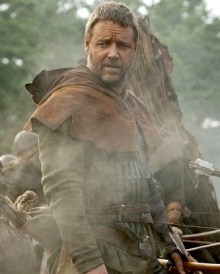 a likely-fictional creation, and so the style is suitably believable, whether it be precisely factual or not.
The problem isn’t the acting, either. Yes, numerous accents are suspect — though, if you think about it, we’re talking about characters living 900 years ago — did a Nottingham accent sound the same then as it does now? Personally (as a Southerner, I should perhaps mention) none of the accents bothered me greatly; I could hear Russell Crowe’s wandering, certainly, but after the first few scenes (when I was specifically listening out for it) I wasn’t distracted.
Whether the rest of his performance is fine is another matter. I think it’s safe to say it lacks the charisma required by Robin Hood, and not just because we’re all familiar with his atrocious real-life antics. Even if it’s not being swashbuckling fun, Robin needs to be a character who can convincingly convince a band of men to step outside the law and pursue ridiculous ends (because notions that the King needs his subjects as much as they need him, and that all men are equal, and that the rich owe the poor, are of course ‘ridiculous’ in context); there are flashes of this from Crowe, but nothing consistent.
The rest of the star-studded cast generally account well for themselves. Cate Blanchett’s Marion is, naturally, a strong-willed, modern, arguably anachronistic woman, but she nonetheless plays it well. As her father-in-law, Max von Sydow is about the only character to generate any significant sympathy, respect, or any other emotion. William Hurt may have overdone everything in Damages recently, but here he’s quite perfectly pitched. Eileen Atkins could probably turn in a good performance in her sleep; the same goes for 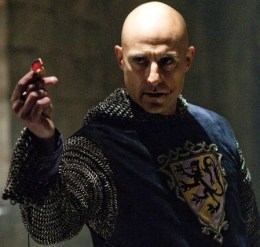 Mark Strong in a villainous role (it might be nice to see him play a good guy sometime, I’m sure he’s capable). Danny Huston’s King Richard is a nicely revisionist take — not the flawless hero we’re used to seeing — which sadly gets too little screen time. Oscar Isaac’s Prince/King John is suitably brattish and inconsistent, but by playing the part fairly straight he doesn’t come close to being as memorable as Alan Rickman, Keith Allen or Toby Stephens in the key villain’s role.
Almost every other role is under-represented — and here we’re beginning to get to the nub of the film’s problem. There are far, far too many characters. We never get a chance to know any of Robin’s gang, who merrily follow him around with little chance to differentiate themselves. The side of the devils have it worse, offering a shifting array that seems unsettled about who to settle on. The Sheriff of Nottingham, often the main antagonist, is a virtually needless inclusion when there’s King John masterminding things, Sir Godfrey riding about being nasty, and King Philippe of France behind him too. That’s not to mention the ancillary characters that clutter up proceedings.
This needn’t have been a problem — it’s possible to juggle multiple characters, of course it is, though a streamlined set of heroes and villains might’ve been more productive — but the film doesn’t know what to do with them all. Much of the time, what they do is engage in fairly inconsequential political wrangling. Scott makes sure to front-load a big action sequence, and slot in another two at the climax, but in the middle there’s a long stretch where it feels like not much happens. There’s a love story between Robin and Marion, and yet it never feels like we’re seeing them fall in love — 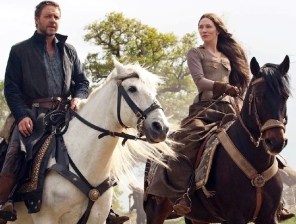 after numerous scenes of them doing stuff, they just are. King John ums and ahs about various things, and if we’re being charitable his chief characteristic is ‘changeable’; and if we’re not, he’s a weakly-written, inconsistent character. Do I believe he’d go charging into the fray during the climax? No, I don’t. If he’d gone in when it was virtually over, just so he could later claim he had? Yes, that would fit.
In short, the pace is off. It drags for most of the middle, waiting for something of genuine interest to occur. The climax feels slightly rushed, two action sequences piled on top of each other that, despite a certain scale to both the assault on Loxley and the beach battle, still somehow lack heft. That’s without noting the fact that Marion — predictably and implausibly — turns up for the final fight too. They should have taken a lesson from Peter Jackson shoehorning Arwen into Helm’s Deep only to remove her again — i.e. remove Marion.
Perhaps the pace was actually better in the theatrical cut — ‘character beats’ are the kind of thing that gets chopped out of blockbusters to make them audience-friendly and it’s the long ‘character’ stretches that slow down Robin Hood‘s middle. The Director’s Cut is 15½ minutes longer, a potentially significant chunk that could throw the whole centre of the film out of whack if it’s all piled in there. Still, based on where key sequences fall and so on, I struggle to imagine the theatrical version was that much sprightlier. I may well give it a spin at some point to see if I like it any better. (Unsurprisingly, I can’t yet find anywhere online that details differences between the two cuts.)
 I wanted the reviews to be wrong; for Ridley Scott’s Gritty And Realistic™ take on Robin Hood to be worth the potential of the concept. In places, it almost is — the era is evoked stylishly, the battles are largely well-staged if not perfect — but it drags, and ultimately Robin only becomes Robin Hood proper at the film’s end. (In fact, a surprisingly large amount of the trailer was taken from the film’s closing minutes, obviously to imply the usual Robin Hood story.) It’s copied Batman Begins and Casino Royale too precisely in this respect, perhaps. It also makes it feel like nowt but setup for a sequel, over-explaining how (this version of) Robin came to be where he was. As the final card says, “And so the legend begins”.
Scott & co are interested in a sequel, and despite my disappointment I hope they’re given the chance to make it: with all this needless business out of the way, the situations the characters are left in has the door open for a genuinely worthwhile Gritty And Realistic™ take on Robin Hood next time. But with the poor critical reception — and the distraction of two Alien prequels — (though, it should be noted, decent box office), I’m not sure we’ll get such a thing. Shame, because I think that might be the Robin Hood film I so wanted this to be.
Robin Hood is released on DVD and Blu-ray tomorrow.

 #90 Bhaji on the Beach (1993)
 Night at the Museum is fine. And by “fine” I mean less “of high quality… worthy of or eliciting admiration” and more “good; satisfactory”.
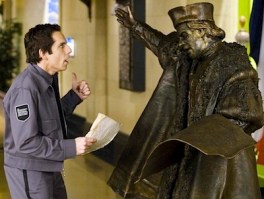 Perhaps it makes it a little disjointed — “here is our character-centric opening; here is the bit we actually wanted to make; here is an exciting climax” — but the tale still rattles by.
 The interest of the piece for us normal, sensible folk, then, lies in what it exposes about this world: the ludicrous lengths they go to; the shockingly inflated sense of self importance. As with The September Issue, it presents no narration and a lot of long takes of documentary footage, leaving the viewer to draw their own conclusions. But there are conclusions to be drawn. Wintour is as much a closed book here as in the main film, but there are moments — glances, affectations, turns of phrase — that reveal a little bit more of the truth behind her icy demeanour.
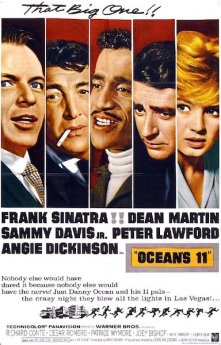 “Remakes are not as good as the original” is one of the rules of filmmaking. Of course there are plenty of exceptions, and everyone has their own opinion, and most modern remakes are expressly about making a quick buck from a US audience who can’t watch a film and read at the same time rather than making a better quality film — but, more or less, the rule persists. It may have won him an Oscar, but the consensus seems to be that
  It does have its moments: a couple of songs are shoehorned in (even if there’s only two or three and each gets two or three airings) and the cast do succeed in making some of their indulgences entertaining. Nonetheless, this would definitely be for Rat Pack fans only had it not been for the remake… and, really, there’s no reason the remake should change that.
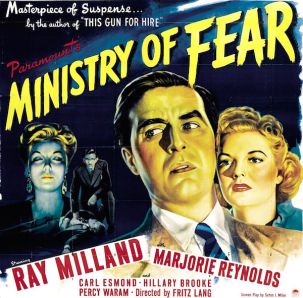 I like cake. It’s all soft and sweet and tasty. But I don’t like cake as much as Stephen Neale, the protagonist of Ministry of Fear.
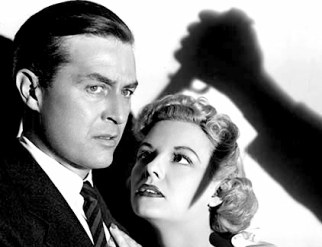 Ministry of Fear isn’t really about cake, but the opening 20 minutes or so plays out more or less as above and it is rather amusing. Less amusing — and, in fact, part of the film’s biggest problem — is a ‘humorous’ epilogue that returns to the cake theme. I found it hilariously funny, but unfortunately for all the wrong reasons. The other part of the problem is the abrupt ending that immediately precedes this brief coda. On the bright side, everything is resolved and you can imagine the post-climax resolution scene for yourself, but it still leaves the tale’s telling cut short.
 The train cake theft and chase, for instance, could be thoroughly laughable thanks to the cake element and what’s clearly a studio-built wood/wasteland, but it’s atmospherically shot and, in its main burst of genius, scored only by the drone of a Nazi air raid taking place overhead. It makes for a more tense and effective soundtrack than most musical scores manage.
 The debut feature from director Gurinder Chadha (of
 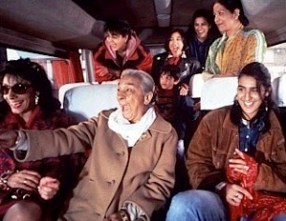 Indeed, there’s certainly evidence that the film was constructed with such an audience in mind: when the women settle down for a traditionally British ‘picnic on the beach’, we’re given a close-up to show they’re eating samosas and bhajis instead of sandwiches and what-have-you. If all the talk of pregnancies, abuse and racism sounds a bit serious, there’s also a good degree of humour and an appropriate lashing of sentiment.
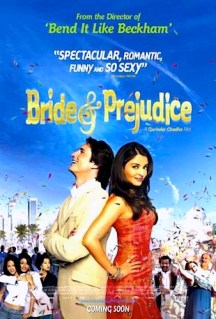 I don’t imagine Bride & Prejudice is going to convert many people who aren’t already predisposed to liking it in some way. That’s not to say it’s not good or doesn’t have potential crossover appeal, but it still has a whole list of things that will put certain viewers off.
 not to mention the numerous adaptations predating either of those, but Bride brings plenty that’s vastly different to the table. It converts the novel very accurately (as best I can tell, having only seen screen versions), retaining both the characterisation and the majority of the plot in a similar sequence of events.
 Little of the plot requires such modification, perhaps thanks to the culture it’s been grafted onto — the predominance of arranged marriages wouldn’t really work in a ’00s British setting — and those bits which are changed are relatively minor. Lydia (here, Lakhi) runs off with Wickham for an afternoon at the London Eye, rather than eloping; Georgiana (here, the slightly more modern Georgina) was impregnated at 16, less legally complicated than the novel’s 15.
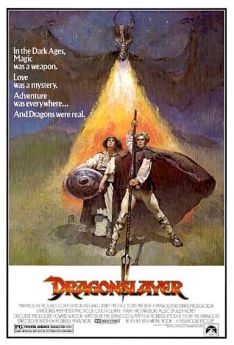 Back when he was still directing
 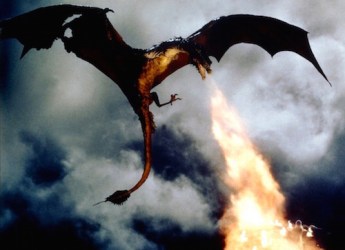 Vermithrax Pejorative is a long time coming, however, wisely kept off screen by director Matthew Robbins. It’s not that the monster shouldn’t be revealed, just that, like
 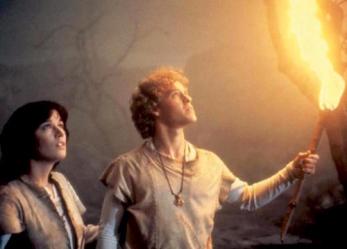 and giant monster than character development. Similarly, an interesting subplot about the move from The Old Ways of magic and superstition to The New Ways of Christianity feels like a good idea that hasn’t been fully integrated, made up of little more than a couple of passing nods and a negatively-inclined inclusion in the coda.
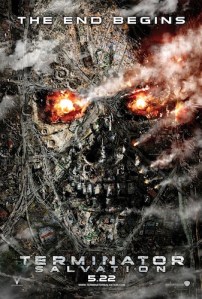 Terminator Salvation begins with a title sequence that displays the film’s title twice. I know you shouldn’t judge a book by its cover and all that, but somehow it just doesn’t bode well.
 sequences that could benefit from a wider perspective, for example Connor’s helicopter crash. That said (again), I’m a little torn what to think of that example: keeping the camera on Connor produces an unusual spin on a potentially familiar sequence, but it’s also a bit disorientating and, as I say, compounds this sense of watching someone else play a game.
 And even if you hadn’t seen it on the box or heard about it in all the film’s publicity, it’s obvious pretty early on that Marcus Wright will turn out to be a Terminator. To McG’s credit, he plays the ultimate reveal quite well — for those who know, it just about functions as a scene in its own right; for those who still hadn’t guessed, it works as a reveal — but if any filmmaker genuinely thought they’d kept it covered up they were sorely mistaken, and the first half could’ve done with a more knowing rewrite to compensate. Or just delete the prologue.
 He’s fine as ever, though his accent seems to waver between American and his native Australian. The same can’t be said of Helena Bonham Carter’s brief turn — her voice hits a constant fake American. Meanwhile, Arnie’s digitised cameo is just that. On the one hand it’s a nice touch, on the other it’s ultimately pointless — Connor doesn’t even react to the familiar face.
 More interesting than these slight tweaks is the behind-the-scenes story of a very different film, which I alluded to earlier. I don’t want to discuss it at length, but
  100Films.co.uk