Alien vs Predator – Part 2

Five weeks ago (crikey, time flies) I began my series of reviews of the Alien, Predator and Alien vs Predator franchises with my thoughts on Alien: The Director’s Cut and the original Predator, both of which I’d seen before. Over the past few days I’ve moved on to the remaining Alien films, all of which I viewed in their original theatrical cuts and all of which were new to me.

Here’s a handy summary of what you may’ve missed, then, if you somehow had something better to do on a sunny summer weekend than check blogs every day.

2009 #14
Aliens

“Where Alien is a Horror Movie — but in space — Aliens is a War Movie — but in space. The central characters are a team of marines, as opposed to the original’s ordinary guys; where the first film’s design was dark, shadowy and oppressive, here it’s all gleaming tech, tanks and guns and spaceships and the like; and, just to underline the point, the score is full of military drums.” Read more…

2009 #15
Alien³

“Even if in some ways 3 combines the first two — single Alien, claustrophobia, unarmed heroes; but there are lots of them, most with experience of killing — it adds enough variety, especially stylistically… it soon turns dark, dirty and decrepit, abandoning both the the military sheen of Aliens and the old tanker grime of Alien.” Read more…

2009 #16
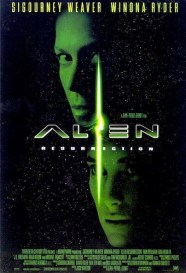
Alien Resurrection

“the most notable differences are its black humour, where the tastes of both [writer] Whedon and director Jeunet make their mark, and how grotesque it is — almost two extremes walking hand-in-hand. The deformed, perverted Ripley clones; the Hybrid; the Ripley-Alien sex scene — there’s nothing like this in the other films, and that’s a grand thing.” Read more…


In the third and final part of this series I’ll be setting my sights on the allegedly-underrated Predator 2 and the much-hated pair of AVP and AVPR.

Alien Resurrection (1997)

2009 #16
Jean-Pierre Jeunet | 104 mins | DVD | 18 / R

Alien Resurrection is much maligned, to the point that even screenwriter Joss Whedon has publicly disowned it. Which is interesting to me, because I really liked it.

While you clean up your beverage-of-choice that I’m sure you just spurted all over your monitor, let me reassure you that I’m not about to argue Resurrection is an undervalued classic on a par with the first two films; but, having heard nothing but bad things about it for over a decade, I found myself pleasantly surprised. As so many other reviews have sought to detail the film’s flaws I won’t dwell on them myself, but instead seek to explain why I liked it.

In my Alien³ review I applauded the franchise for taking each instalment in a new direction stylistically, and Resurrection doesn’t drop the baton on this. Structurally it’s the most straightforward of all four, slotting fairly neatly into a standard action-adventure/disaster movie template — especially once Ripley hooks up with the crew of the Betty — but this isn’t the most notable difference. No, that would be twofold: its black humour, where the tastes of both Whedon and director Jeunet make their mark; and how grotesque it is — almost two extremes walking hand-in-hand. The deformed, perverted Ripley clones; the Hybrid; the Ripley-Alien sex scene — there’s nothing like this in the other films, and that’s a grand thing. Even if you disapprove of most (or all) of that, the scene where two aliens kill a third so that its acid blood will burn through the floor, allowing them to escape, is a bit of genius that takes our existing knowledge about the species and does something gloriously new with it.

The Aliens themselves are very well realised. For fans who favour the first film to all others they undoubtedly spend too long in plain sight, but, while there is certainly some poor CGI (the underwater sequence being of particular note, though you can see how it seemed a good idea), the constantly slime-dripping practical creatures are excellent. The Aliens and the company (no longer Weyland-Yutani, for no good reason) are relatively revealed by the story too, which I’m sure is to its detriment for some. Personally, I considered it another sensible change: we’ve had three films of the company attempting to capture the Alien — what would happen when they succeeded? That the plot is still based around the company’s hunt for the Aliens (as significant chunks of the previous sequels were too) is also interesting — essentially, the whole franchise was launched because at some point during the first film someone decided Ash should be an android who wanted to capture this mysterious creature.

I can well imagine many hated all these additions and changes to the series’ mythology (especially the Hybrid — fans always hate things like that), but I found them to be an interesting attempt to further the franchise’s story rather than just rehash previous instalments. I won’t deny that some of it borders on the silly (or even crosses that line) and there are a few plot holes (which is disappointing, because many could have been explained away if someone had taken a bit of effort), but for the most part it’s fantastically creepy, grotesque, and more than a little weird… and all within the confines of a standard action-adventure plot! Plus, within that it also retains an unpredictability over who will die, something Alien³ managed to fudge. (That said, the top four names in the opening credits are the four survivors, so maybe I should just pay more attention.)

Resurrection marries the franchise’s most wonderfully grotesque imagery with a standard action-adventure plot, meaning anyone who comes to this looking for their average sci-fi action-adventure may walk away with their sensibilities shocked — or perhaps mutated beyond recognition. It’s certainly not the series’ best film, but I have a nagging feeling that it might turn into my secret favourite.

4 out of 5

Not so secret now I guess.

Alien Resurrection placed 9th on my list of The Ten Best Films I Saw For the First Time in 2009, which can be read in full here.

Alien³ (1992)

2009 #15
David Fincher | 110 mins | DVD | 18 / R

3 times the stupid taglines.We’re used to seeing big studio’s logos transformed at the start of films — Universal perhaps do it most often, having a handy globe, though others are far from immune — but I think Alien³ is the first instance I’ve seen where the logo is left untouched but the music is altered. Right from the disconcerting modification of the famous Fox fanfare you can tell this is going to be something a bit different and a bit edgy. Unfortunately, it’s also a bit rubbish.

At the very least the Alien franchise has to be applauded for giving each film a very different feel and tone. Even if in some ways 3 combines the first two — single Alien, claustrophobia, unarmed heroes; but there are lots of them, most with experience of killing — it adds enough variety, especially stylistically, to mark it out. This can probably be attributed to first-time feature director David Fincher, who, despite severe studio interference, still manages to quickly make the film his own. Though the story picks up directly from the previous film (as Aliens did from Alien), it soon turns dark, dirty and decrepit, abandoning both the military sheen of Aliens and the old tanker grime of Alien.

The sets and costumes have a Gothic feel, devoid of most of the franchise’s sci-fi trappings, and though the cinematography is glossier than either preceding entry (Aliens looks distinctly ’80s, whilst this has a distinctly ’90s look — I’m not well enough versed in technical details to know why this is) it manages to feel grungier. From style to story, the whole film is bleak and uncompromising, particularly with its brutal plot — from the start, only Ripley survives the crash, and soon after there’s a horrid autopsy performed on Aliens‘ lovable little Newt, who Ripley previously fought so hard to save.

Alien³ is very dark and very nasty — and these are by far the best things about it.

Put simply, the story — or the way the story is handled — lets everything down. It all goes well for the first 40 minutes or so, but then it begins to get scrappy, and gets steadily worse as the running time rolls on. Leaps in story and logic abound, either creating plot holes or doing nothing to hide them. Much of the middle is the worst, where the convicts’ plans are muddled and quickly discarded. That said, this is also true of the climax — something to do with running around corridors and a giant piston and… I have no idea. It’s a shame because someone clearly had plenty of fantastic ideas, plot twists and action sequences, but they’re all squandered either by weak editing or, even worse, simply by being in this film.

As for the Alien, it sadly has no real menace — it just turns up as and when it (or, rather, the plot) fancies, and goes away for the rest of the time. In the first film it could be anywhere, in the second they were constantly advancing, but this time it’s just around, somewhere, sometimes. It’s not helped by poor realisation, spending too much time either in the light or in clear shots, both of which show the shortcomings of the special effects in a way the previous two films fought to hide.

The total lack of weapons or monster-fighting skill on the part of the supporting cast exacerbate these problems, meaning that, even when the Alien does turn up, the result is always a foregone conclusion. Even worse, any characters we really care about — or can even identify, to be honest — are killed early on, leaving a bunch of faceless potential victims who weren’t invested with any character and so who we’re not invested in. This is worsened by using a fantastic, recognisable British cast, none of whom are given anything much to do. For all these reasons, almost the entire film is devoid of any genuine tension.

Alien³ isn’t irredeemable — it’s packed with good ideas and good direction — but that’s also why it hurts. Lumbered with a hatchet job on the plot, characters and editing, it feels like some very talented people made a good film before someone else hacked it up a bit. The result is quite bad but, even worse, it’s disappointing.

3 out of 5

Tomorrow, Alien Resurrection.

My review of the Alien³ Special Edition can now be read here.

Aliens (1986)

2009 #14
James Cameron | 132 mins | DVD | 18 / R

Once upon a time, sequels were universally regarded as Bad — the inferior product of a great original; most frequently a remake in continuation’s clothing. These days we regularly see sequels that continue and expand on their predecessor, frequently leading to higher praise and a better reputation. It’s almost become expected, in fact — look at the number of reviews of Star Trek that express more anticipation for the inevitable sequel than the one just released (my own included). The archetypical “sequel that betters the original” was always James Cameron’s Terminator 2: Judgment Day — though currently critics often seem to pick X2 — but long before either of these Cameron was ahead of even himself with this sequel to Ridley Scott’s acclaimed sci-fi/horror.

The difference here, perhaps, is that Scott’s movie was so well-regarded and well-known in the first place. But Cameron cannily marks his sequel out by making it totally different, much more so than X2 to X-Men or even T2 to The Terminator. Where Alien is a Horror Movie — but in space — Aliens is a War Movie — but in space. The story structure is somewhat reminiscent of Apocalypse Now, for example; the central characters are a team of marines, as opposed to the original’s ordinary guys; where the first film’s design was dark, shadowy and oppressive, here it’s all gleaming tech, tanks and guns and spaceships and the like; and, just to underline the point, the score is full of military drums. If Scott’s could have been translated to any modern-day industrial setting, Cameron’s could be in any modern-day war zone. It works because Cameron builds on the original without ignoring it, and it succeeds because he then makes a fine war movie in its own right.

The elements Cameron chooses to retain from the first film aren’t necessarily obvious, but all are very wise. He continues its believable, realist aesthetic: businessmen wear suits, for example, and while some of the military outfits and weaponry are clearly grounded in sci-fi, it’s all only one step removed from what we see in reality. He’s also not afraid of a slow build-up — thirty minutes passes before they even arrive at the planet, and, just like Scott, he keeps the Aliens off screen for almost an hour. Nor is he afraid of acknowledging the first film, something a less assured filmmakers might shy away from in the hope it would be forgotten and no comparisons would be made. There are many references back to it, but especially the first ten minutes, which are effectively a coda to Scott’s movie before Cameron’s can properly begin.

When it does, the title is apt: Scott’s film had one monster stalking his crew, Cameron has an army of them. Their first appearance is in a brilliantly directed epic skirmish, a solid burst of action that decimates the cast within minutes and helps pay off the slow build. Again learning from Scott, Cameron keeps the creatures in shadow, showing just enough to convey their horror but not enough to make them look silly or ineffectively realised. However, he ensures that when we do see more of them — such as the attack on the base, or the climax with the Queen — what we manage to glimpse still hides any technical shortcomings, resulting in a truly alien enemy that is flawlessly executed. In fact, despite the greater volume of Aliens surely creating a bigger effects challenge, they look even better than in Alien, shorn of such weakness as glove-like hands and keeping the awkward legs (nearly always a shortcoming of creature design) out of shot.

Are the Aliens even creepier and more menacing here? Maybe — there are more of them, which naturally increases the stakes, but we’re also shown even more of they’re capabilities. Despite the all-out battles, Cameron still relies on building tension. As Doctor Who fans will certainly be aware, the film becomes a classic Base Under Siege story once the remaining marines are holed up in the abandoned base, and most of the siege is done without any direct attacks — it’s all preparation, build up, waiting for the big moments. When it comes, it’s one huge attack that then leads straight into the climax — appropriately, the best bit of all. The Alien Queen is a clever invention, creating a Ripley vs Alien finale that mirrors the first film, but ups the ante in line with the new genre by making said Alien bigger and badder. The resulting Power Loader vs Queen battle is justly famous, a flawless marriage of writing (plot, dialogue, seeded elements), effects (without a pixel of CGI, of course), direction and choreography to create a perfect finale.

It’s easy to see why opinions are divided over which of the first two Alien films is better. Both are near-flawless sci-fi masterpieces, but for different reasons. It interests me that Scott’s original comes out top on lists like IMDb’s (though only by 15 places), because on the surface the action movie antics of Aliens would seem more crowd-pleasing. Personally, I’m going to cop out of a decision and merely reiterate that both are excellent and, by being so different but doing what they each do so well, make for a great pair.

5 out of 5

Tomorrow, Alien³.

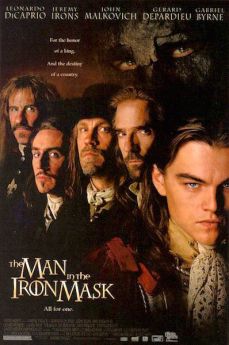
The Man in the Iron Mask (1998)

2009 #30
Randall Wallace | 132 mins | download | 12 / PG-13

The Man in the Iron MaskFrom the off it’s clear that The Man in the Iron Mask is not going to go well. It’s an adaptation of a tale of the Three Musketeers, so naturally is set in historical Paris… where everyone has a different accent and very few of them are French. It is, to be blunt, a horrid mishmash — much like the whole film.
Wordy political intrigue tries to coexist with broad comedy which is squashed against swashbuckling adventure. The latter two could co-exist, but the film feels like it wants to be the former and so suffers for it. The comedy jars too much to be effective, while instances of unintentional comedy unfortunately provoke more frequent laughs. It should at least be able to swash buckles effectively — these are the Three Musketeers after all — but entirely fails to achieve this until the climax. The plot, semi-faithfully adapted from one of Alexandre Dumas’ original novels, offers a level of complexity to which the film clearly aspires, but the adaptation and acting struggle to match it.

The majority of performances are marred by overacting — John Malkovich, especially, is woefully miscast, while Leonardo DiCaprio doesn’t appear to give a particularly good performance as either Louis or Philippe. In DiCaprio’s defence I suspect this is actually the script’s fault, because he manages to clearly differentiate the two when they are silent or pretending to be the other — it’s when they open their mouths that it all goes wrong. Gérard Depardieu is fine as the comic relief, though that relief is tonally misplaced, while Gabriel Byrne makes an interesting d’Artagnan — there’s nothing at all wrong with him, and yet he doesn’t feel quite right. Which leaves just Jeremy Irons among the main cast. He fares the best of the lot, even getting the occasional scene or speech that is genuinely quite good, though it’s clear he is far better than the material. To be fair, the same is also true of everyone else.

For all this, The Man in the Iron Mask is more disappointing then bad. The Bastille-set climax is occasionally brilliant and never less than entertaining, delivering on the film’s swashbuckling promise in a copious fashion. Throughout, there’s the occasional good scene — or even just a decent line of dialogue — and you can briefly understand what inspired such quality actors to sign on.

Something went wrong somewhere though, and the obvious culprit must be writer/director Randall Wallace. The story’s good, but that’s Dumas’, while the adaptation’s weak — and that’s Wallace’s. The actor’s are good, but battle the poor script — and that, obviously, is Wallace’s. They don’t seem to have been given any significant direction, they’re not helped by an uneven tone, and even the cinematography falls short, failing to make the spectacular locations and costumes look suitably beautiful on screen — and we know who’s ultimately in charge of all that too.

The Man in the Iron Mask desperately wants to be better than it is — it’s a great tale, packed with politics and swashbuckling, and this particular version has the high calibre cast to pull it off. But both are left floundering by a writer/director who isn’t up to either task — poor dialogue, a gyratingly uneven tone and lacklustre direction abound. A missed opportunity, and all the more disappointing for it.

2 out of 5

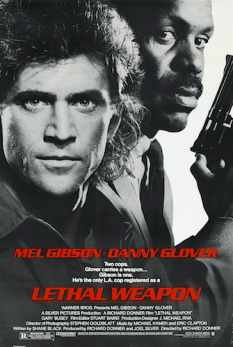
Lethal Weapon (1987)

2009 #8
Richard Donner | 110 mins | download | 18 / R

Lethal WeaponLethal Weapon comes from another era — an era in which R-rated films were still allowed to be blockbusters. One only needs to look at the classifications attached to the most recent instalments of formerly-R-rated ’80s franchises — primarily, Terminator 3: Rise of the Machines and Die Hard 4.0, both PG-13 — to see how things have changed. Of course, maybe they have just cause: Watchmen, the first proper R-rated blockbuster for a while, has been labelled a box office disappointment (because that’s what $150m worldwide in two weeks is these days).

I digress. Though, my mind frequently wandered during Lethal Weapon — often to Die Hard. This may predate the Bruce Willis franchise by several years, but it’s a testament to the fame of that film’s Christmas setting that my first thought was they’d ripped it off (Lethal Weapon, like Die Hard, begins with a classic Christmas song over an urban setting). And my next thought was, did they not have a costume budget? The film opens with a young girl, lazing provocatively with one tit out… at first, before Donner makes sure to show them both off thoroughly before she hurls herself from a building; and then we find Danny Glover’s Murtaugh in the bath and Mel Gibson’s Riggs wandering around showing his arse off. Nudity is fine in its place, of course, but here it’s so gratuitous that it sets a low tone — to be fair, one the film does little to belie.

More seriously then: the plot is full of holes with great gaps in its logic, especially as it heads towards the climax. There’s also no mystery — the investigation is just an excuse to string together action set pieces and comedic buddy scenes, neither of which are much cop, and most of the story is conveyed in a couple of info-dumps that supporting characters volunteer for no definite reason. The dialogue and performances are appalling — “may I remind you of some stuff you already know, that’s convenient exposition for the audience, thoroughly explaining the troubles of the main character and the scene you just saw”. I’ve seen better episodes of Murder, She Wrote. Their motivation makes about as much sense too — “tell me the truth!” “But they’ll kill my daughter!” “We can protect her!” “No you can’t!” “Tell me!” “Oh OK then.”

The villains aren’t just poorly drawn, they’re barely sketched at all. There’s an early scene where we see how Hard they are, then they just turn up in time for the climax and do little more than get chased around and die explosively, and in the wrong order to boot. At the very end, our heroes capture the one remaining bad guy… and then have a fight. Why? Because they do. And then all the police turn up and just watch this punch-up going on. It’s the thinnest excuse for a final fight ever put on film, and consequently the least tense — none of those officers are going to let the villain kill Riggs, and even if he did beat or kill him he’s not going to escape. There is literally no point to it. It’s appalling writing, and dire filmmaking to have left it in.

Oh, and Murtaugh smashes a car into his own front room for no reason.

Lethal Weapon probably wants to be a lot better than it is. Was it supposed to be a drama about these two cops with any old investigation plot stuck on, or a standard action-thriller with too much time spent on character? At best, it falls somewhere between the two — they’re not real characters (i.e. it wouldn’t pass as a drama if you cut out the thriller), each being made up of several stock Action-Thriller Hero traits; but nor is the plot the main focus, what with it being rather generic and not especially interesting or at all complex. The leads’ repartee and bonding is more interesting than the actual plot, and is surely the explanation for the film’s enduring popularity and three sequels, though to be honest I didn’t get it.

I’d always thought Lethal Weapon must be alright — after all, as I said, it’s had an enduring popularity and was written by Shane Black, who went on to both write and direct the thoroughly wonderful (and underrated) Kiss Kiss Bang Bang (with Robert Downey Jr being fantastic a good few years before his popularity resurgence in Iron Man) — but having seen it, I struggle to see why people like it to any significant degree.

2 out of 5

ITV1 are showing Lethal Weapon tonight at 10:15pm.
Lethal Weapon is on Watch tonight, Tuesday 23rd September 2014, at 10pm.

Glory (1989)

2009 #28
Edward Zwick | 117 mins | DVD | 15 / R

GloryEd Zwick seems to like war. More accurately, Zwick likes making films about war, but clearly isn’t a fan of the act itself. Since gaining attention with multi Oscar-winner Glory, about the first black regiment during the American Civil War, he’s directed a number of films concerned with wars and those that fight them: Courage Under Fire (“Army officer investigates female chopper commander’s worthiness for the Medal of Honor”), The Siege (“a wave of terrorist attacks in New York lead to the declaration of martial law”), The Last Samurai (“American military advisor embraces the Samurai culture he was hired to destroy”), Blood Diamond (a group of people battle for a diamond during the war in Sierra Leone), and most recently Defiance (“Jewish brothers in Nazi-occupied Eastern Europe escape into the forests”). Whatever the reasons for Zwick’s preoccupation, he certainly has a talent for it.
In Glory, Zwick is helped by a story that’s definitely worth telling, one which I imagine seemed even more pertinent on its original release, when Nelson Mandela was still in prison and the state of race relations in the US would contribute to riots in Los Angeles inside of 18 months. Still, it would be easy to slide into Issue of the Week melodrama in handling such a tale, but Zwick manages it without undue sentiment — there’s an appropriate realisation of the importance of events, perhaps even occasional reverence, but time is taken to show doubts and prejudices. It may get too sentimental for some tastes toward the end, but considering the importance of the story I don’t think it’s unwarranted or overplayed.

Similarly, most of the hero characters are less than perfect, with Matthew Broderick’s Colonel of particular note as a conflicted and initially cowardly commanding officer, more concerned with propriety than what is right — until he’s led to a change of heart, of course. His is just one of several excellent performances: Morgan Freeman does what Morgan Freeman does best as the Authoritative Elder, while Denzel Washington’s angry young man justifiably earnt him his first Oscar. The wider supporting cast hold their own against these leads, particularly Andre Braugher as the idealistic but ultimately unsuited volunteer Thomas Searles.

The handful of battle sequences are effectively staged, suitably tense and brutal, though these are really ancillary — the regiment only engaged in conflict a couple of times and so, appropriately, actual fighting makes up a relatively slender portion of the film. The unfamiliarity of the story helps keep things tense both in and out of battle — for obvious reasons, the majority of battles depicted on film are famous ones, often because of their outcome, so it makes for an agreeable change to not know where events will lead.

These elements all blend to create a film that is, at the very least, the sum of its parts: a significant historical story with strong performances and a convincing depiction of war, which negotiates the thin lines that surround sentiment and reverence. Zwick may not be a fan of war, but he certainly knows how to put its stories on film.

5 out of 5

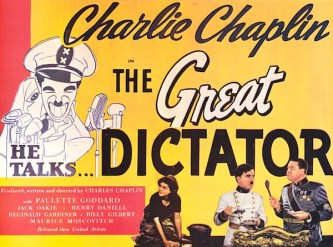
The Great Dictator (1940)

2009 #31
Charles Chaplin | 120 mins | DVD | PG* / G

One of the great things about doing 100 Films in a Year has been the number of firsts it’s either led me to or just been there to document: my first time watching films on Blu-ray and via legal download; my first time seeing films from directors as diverse as Woody Allen, Akira Kurosawa, F.W. Murnau and Krzysztof Kieslowski; my first time viewing such notable works as Breathless, Brief Encounter, Chinatown, Taxi Driver, This is Spinal Tap, The Wizard of Oz, and many more — including my first time seeing Citizen Kane. And here’s another for the list: my first ever Charlie Chaplin film.
The Great Dictator is one of Chaplin’s most widely-known films thanks to setting its sights on the Nazi regime and Adolf Hitler in particular. The general perception of silent comedians like Chaplin immediately suggests slapstick, but the real-world targets here make his work (on this film at least) satirical as well. I’m sure this made for great propaganda when it was released just a year into the war, but Chaplin’s skill and accuracy mean it works beyond that: like all good impersonations or spoofs it doesn’t make its objects silly for no reason, but instead takes what’s inherently laughable about them and exploits it. This would age some satirical humour, reliant as it can be on topicality, but the wide awareness even a modern audience has of Hitler means there are no comprehension problems today.

The style of humour can date nonetheless, but The Great Dictator remains funny — arguably the real test of a good comedy. It might not be to everyone’s taste, but that’s a problem comedy faces whenever it’s made. Chaplin loads the film with inventive and timeless routines, like the upside-down-plane, the coin-in-the-pudding, or the classic dance with an inflatable globe. Sometimes with comedy from decades previous, there’s the feeling you’re watching something that was funny at the time but no longer actually makes you laugh, thanks to changed conventions and expectations. For me, at least, there was no such problem here.

Surprisingly, there are some serious scenes too. While it doesn’t outweigh the comedy, there’s a degree of semi-factual drama in the plot that’s been well judged to help the humour cut deeper. The closing speech could come across as overly propagandistic but, again, it’s well pitched and therefore more galvanizing than inappropriately laughable. There are some bits, like this, that are sadly just as applicable to the modern world.

Chaplin allegedly said he wouldn’t have made The Great Dictator if he knew how bad things really were under Hitler, though some dispute this, arguing he knew and made it regardless. Some bits are slightly uncomfortable when one knows the reality, but whether Chaplin knew the truth or not these moments are fleeting. And, either way, Hitler and the Nazis were a worthwhile target: laughing at those who attempt to terrorise and dominate us is one of the most powerful weapons we have against them. That, certainly, is still true today.

5 out of 5

* For reasons known only unto the BBFC, The Great Dictator was classified U until 2003, when film and video reclassifications both made it a PG. ^

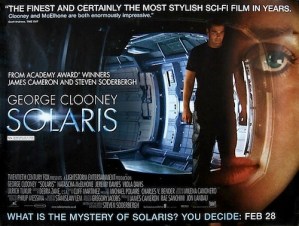
Solaris (2002)

2009 #13
Steven Soderbergh | 94 mins | DVD | 12 / PG-13

SolarisWhen Andrei Tarkovsky adapted Stanislaw Lem’s thoughtful science fiction novel in 1972, it took 165 minutes. When Steven Soderbergh did it 30 years later, it took just over 90. Lem hated them both, stating that he didn’t write about people’s “erotic problems in space”, but for those concerned with what the film is about rather than what it (perhaps) should have been about, it seems that an abbreviated running time is no barrier to loading any adaptation of Solaris with a weighty thoughtfulness.

Everyone knows Solaris is a sci-fi film — the title sounds that way, for one thing, and George Clooney in a space helmet on the cover certainly does the rest. It’s a shame that’s so well known, because if one came to this version cold it would take a good few minutes before there was any inkling it wasn’t just a drama. The underplaying of the scientific elements may have angered Lem, but Soderbergh uses them to create a backdrop to the emotional story he wants to tell — Solaris the sentient planet was the point of the novel, as far as Lem was concerned, whereas to Soderbergh it’s a device to explore relationships and grief.

In doing this the film merrily mixes genres: it looks very much like it’s Science Fiction, all futuristic TVs and space station settings, and there are a few scientific concepts touched on; but it’s also a Romance, occasionally; and a Drama about coping with death, amongst other things; and an ‘arthouse’ film about notions of God and memory and reality and humanity; and there’s a huge chunk of Mystery in what the hell is going on; and there are a couple of moments that wouldn’t be out of place in a Horror film… About the only conventions Soderbergh doesn’t bother with belong to Action-Adventure, which as the normal stomping ground of big-name sci-fi certainly makes for a change.

It’s likely this that explains its low rating on IMDb and the like. A slow pace and obtuse storytelling that leaves plenty of gaps for the audience to fill is not the experience implied by an advertising campaign showing a Space Movie starring Movie Star Heartthrob George Clooney. Obviously it doesn’t fulfill these expectations, and will likely have still been too slow and difficult for even more viewers. (As it makes for a slow hour-and-a-half, I wonder how they would feel if told there’s a version over an hour longer.) The question is, does it also deserve such a low rating from those ‘clever’ or accepting enough to ‘get’ it? That depends on your perspective. It’s either Deep and Meaningful, or a bit Pretentious and Pointless. In this respect it’s highly reminiscent of The Fountain (or, rather, The Fountain is reminiscent of Solaris) — an unusual sci-fi/romance angle, slow pace, and ambiguous to the last. As one character says, “there are no answers, only choices.”

Soderbergh’s direction, plus the performances of Clooney and Natasha McElhone on which the film relies, do have the power to hold you, but only if you’re prepared for — and, more importantly, open to — the sort of experience Solaris offers. Undoubtedly not for everyone.

4 out of 5

A pair of shorts for summer

Neither of these films, or their reviews, have anything significant to do with summer, but that pun was too good to resist.

I say “good”…

there’s no reason that any story shouldn’t be told in animated form… but sometimes, you have to wonder if it’s the best choice for the job. The Wraith of Cobble Hill is a perfect example for this debate as its modern, urban story seems to clash with the cartoonish style employed to bring it to the screen.

to attempt to describe the plot would be to give too much away, which would be a mistake because this is a beautifully shot (in grainy black & white) and performed tale with a distinct, yet subtle, character arc and an important, but not over-egged, moral message.


Both of these shorts are available on the Cinema16: American Short Films DVD.