
William A. Wellman | 144 mins | Blu-ray | 1.33:1 | USA / silent (English) | PG / PG-13
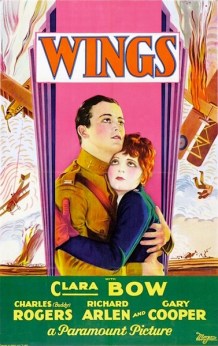 Students of the Oscars well know that, technically speaking, there wasn’t a single “Best Picture” award at the inaugural Academy Awards ceremony in 1929. Instead, there were two awards that covered that ground, seen (at the time) as being of equal significance. One was for “Unique and Artistic Production” — which I’d argue is more or less what most people think Best Picture represents today. That was given to F.W. Murnau’s Sunrise. The other was more generically titled “Outstanding Picture”. Presumably because of the more obvious similarity in its name, that’s the one the Academy have retrospectively decided was the first Best Picture award; and that’s why Wings is, officially speaking, the first Best Picture winner.
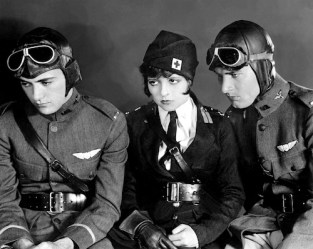
In small-town America in 1917, middle-class Jack (Charles ‘Buddy’ Rogers) and rich David (Richard Arlen) are rivals for the affections of city girl Sylvia (Jobyna Ralston). She’s actually only interested in David, though Jack’s too naïve to see it. He also doesn’t see that his neighbour, Mary (“It girl” Clara Bow), is infatuated with him. When both lads sign up for the air service, they find themselves in training together, where they eventually bond by having a punch-up. Boys, eh? Before you know it they’re on the front line of the First World War — via a brief encounter with Cadet White (a pre-fame Gary Cooper) — holding their own in dogfights against ace German pilots. Meanwhile, Mary has also joined the war effort, arriving in France as an ambulance driver. What are the chances she’ll run into Jack and their potential romance will have an opportunity to progress, I wonder?
So Wings is part rom-com, part war-action movie. On the ground, Jack and David’s interactions with Mary and Sylvia (the latter of whom barely features) are based around misunderstandings and almost-slapstick drunkenness. In the air, the picture comes alive in thrilling battle scenes, performed by fearless stuntmen and shot by bold cameramen. Well, most of the time: famously, Rogers and Arlen had to pilot themselves (in Rogers’ case,  he learnt to fly just for the film), and, mid-flight, had to film their own close-ups by switching on battery-operated cameras mounted in front of them. You wouldn’t know it from watching the film itself, though: even today, the action sequences carry a palpable air of excitement, aided (perhaps even created) by the knowledge that it was all done for real — including the crashes.
At the time of production, director William A. Wellman was pretty much unproven, having mainly directed B-level Westerns. Conversely, Wings was a risky proposition, with a remarkably high $2 million budget — not the most expensive silent film (that was Ben-Hur, at $4 million), but in the very top tier (according to this Wikipedia article, the average cost of an MGM feature at the time was $160,000). However, Wellman got the nod because he was an experienced combat pilot, having flown in World War One himself. This knowledge paid dividends for the film’s eventual quality, though caused some friction during production, as Wellman spent weeks on location not shooting as he waited for the right clouds. Sounds ridiculous, but the movie was shot in clear-skied Texas, and with no clouds there would be no sense of depth or speed for the planes.
Why Texas? It’s where the country’s largest military base was, with up to 10,000 troops stationed there. The military committed resources to aid a picture that was seen to cast them in a positive light, reportedly providing the production with $15 million worth of men and equipment. Yes, not 1.5 — fifteen. In today’s money, that contribution comes to around $200 million, which alone would put Wings among the top 50 most expensive films ever made. It was a remarkable undertaking. This included occupying a five-acre site where they “built France”, including an entire village and a trench-crisscrossed 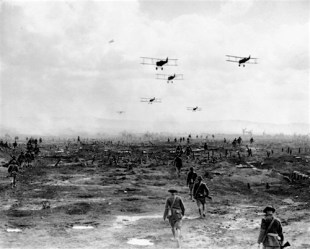 bomb-pockmarked battlefield. Those bomb craters were, in fact, genuine: the military spent a few days before filming using the location for target practice. The climactic battle that occurred on this site was filmed with up to 19 cameras at once, including some mounted on four towers, the highest of which reached 100ft. I know this is a review, not a catalogue of production numbers, but it’s quite incredible.
As is the movie it produced. Whatever Wellman’s status before and during production, the end result proves his skill as an action director. Unsurprisingly these sequences don’t have the adrenaline-fuelled fast-cutting of today’s action scenes, but they have a mind-boggling scale that armies of CGI will never replicate, and an accompanying sense of awe to match. It’s not exactly thrilling, because Wellman takes time to find asides that show the cost of combat — this isn’t just a Boy’s Own gad about in the jolly old First World War. Tragedy strikes, and Wellman makes it suitably affecting.
If the same can’t be said of the romantic storylines then, well, it could be worse. A mid-film sequence in Paris, where Jack gets plastered and starts imagining bubbles floating out of everything, wins bonus amusement points for actually showing those bubbles, though loses some for going on too long. It also doesn’t help matters that Jack’s actually a bit of a dick in the way he treats other people throughout the movie. He undermines and borderline bullies David thanks to their shared affection for Sylvia, while we know David’s being kind enough to not tell Jack that Sylvia’s actually in love with him. Even after they’ve made up, the same situation rears its head late in the film, when David tears up a photo of Sylvia to stop Jack seeing the love note jotted on it. That’s before we even get on to how completely ignorant he is of Mary’s affections.
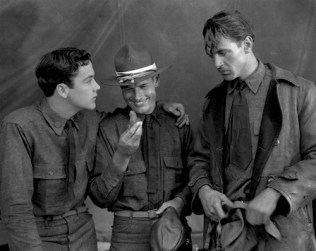 How much these factors affect the film’s quality seems to be very much a personal matter. Wings set the stall for many a Best Picture winner to follow by being not that well regarded by critics; indeed, more time and praise is given to its top-award compatriot, Sunrise. For the most part, I found the personal dramas passable enough, with a few outstanding scenes — David’s farewell to his stoical parents; Cooper’s scene; the bubbles (at first). However, the combat sequences, and in particular the aerial photography, are stunning; so impressive as to easily offset whatever doubts the other elements may engender.
At a time when silent movies are still routinely overlooked by the studios (and the best most labels outside the US seem to release is the canon of accepted greats (plus a few random outliers)), I think it’s safe to say Wings has only received extensive restoration and re-release thanks to its position as the official first Best Picture winner. Would it receive such royal treatment from Paramount without that accolade? I think we can be pretty certain that — even though it was both an extraordinarily expensive and extraordinarily successful film — it would not. On the bright side, it’s deserving of such attention for its inherent qualities, even if it remains a shame that other equally (or, arguably, even more) deserving silent pictures not only don’t receive the same love and attention from their rights holders, but don’t receive any attention whatsoever.
 But I digress. Wings is a film that deserves to be remembered as more than a mere footnote. It’s not just a trivia answer to “what was the first Best Picture?”, but a worthy winner of that prize; a movie that, almost 90 years after it was produced, still has the power to elicit excitement and awe. Wellman’s picture may not have been deemed unique or artistic, even though it’s definitely the former and possibly the latter, but it was deemed outstanding, and it’s definitely that.

This review is part of The Silent Cinema Blogathon. Be sure to check out the many other fantastic contributions collated by host In the Good Old Days of Classic Hollywood.
 Arguably the most famous clash of the First World War, the Battle of the Somme lasted four-and-a-half months from July to November 1916 and, with over a million men wounded or killed, is “
 The British press certainly believed they were seeing “the real thing at last” (the Manchester Guardian), feeling it showed “war, grim, red war; the real thing” (the Daily Sketch). The British public agreed, flocking to see the movie en masse: twenty million admissions were sold in the first six weeks of release. At the time, the battle still raged (the film debuted on 10th August 1916) — as Smithers notes, “to its original audience, the film was not history but a despatch from the front”. It is such an historical document now, but at the time it wasn’t even recent-history — it was produced as newsreel, a record of current events, designed to make people at home feel connected to the everyday lives of their family, friends and countrymen serving on the frontline.
 Equally striking is the scale of the operation. You know it was a monumental effort, but actually seeing so many men… You never see that scope in dramas because they don’t have the budget for all those extras, I guess, but here the crowds of soldiers just waiting around are remarkably large. And crikey, the heavy artillery! Even though you know these were real weapons, today they look more like some fantastical steampunk creation, so covered are they in rivets, and so damn huge.
 Speaking of the music, the Imperial War Museum DVD release offers up a choice of two scores: a newly-commissioned (in 2008) one by film composer Laura Rossi, and a recreation of the kind of music that would have accompanied the film in 1916. The film’s producer and distributor, William F. Jury, was also the editor of trade paper The Bioscope, and had columnist J Morton Hutcheson draw up a list of suitable pieces to be performed alongside screenings, which was published days before the film’s release. To quote Dr Toby Haggith (the Imperial War Museum’s film programmer), again in the DVD booklet
 Haggith summarises many of Hutcheson’s choices as “motivated wholly by the needs of propaganda… jaunty, martial and unashamedly heroic. Given the nature of the scenes recorded and the bloody history of this phase of the battle, the selection of such upbeat music seems deeply inappropriate.” However, other selections “reflect Hutcheson’s personal response to scenes that he found distressing on a universal level, and which led him to warn musicians that ‘they must realise the seriousness and awfulness of the scenes’… These contradictions suggest that Hutcheson had difficulty selecting music for the film because he was torn by the contrasting images and messages it conveyed. In this way the medley highlights the tension at the heart of the film.” Musician Stephen Horne, who leads the 1916 medley recreation, agrees that the film is torn “between a sense of propagandist duty and a desire to honour the reality that had not evaded the camera’s gaze.” It’s true that, however positive the final movie wants to be, it can’t completely escape reality. At one point it cuts abruptly from a jauntily-scored scene of men happily receiving post to “German dead on the field of battle”. A deliberate juxtaposition of happiness with the fate that awaits them with near inevitability? Seems a bit radical for a propaganda piece…
 But it can’t avoid drawing parallels: the film ends almost as it began, with artillery being moved up for the next assault and men marching to the front, waving merrily as they go. History repeats — probably not the lesson a propaganda film wants to impart, but one it can’t quite escape. And one that, even a hundred years later, we can’t quite learn.
 “The paths of glory lead but to the grave,” wrote Thomas Gray, and Stanley Kubrick — adapting from the novel by Humphrey Cobb — sets about proving him right.
 100Films.co.uk