
Joseph Kuo | 86 mins | Blu-ray | 2.35:1 | Taiwan / Mandarin | 12
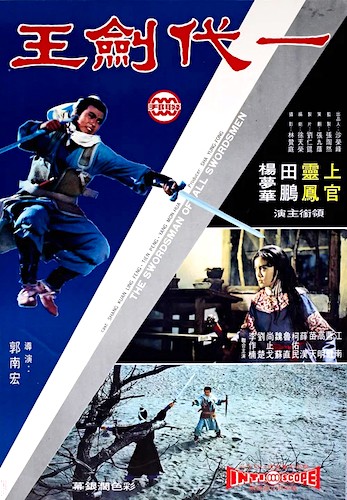
Revenge is a dish best served cold, according to the Klingons, and Tsai Ying-jie (Tien Peng) is the embodiment of that mantra. As a young child, he witnessed his whole family murdered by group of assassins who wanted his father’s legendary sword. As an adult, he’s a fully-trained expert swordsman, and the time has come for vengeance. As word of his victories spreads, he’s intercepted by Flying Swallow (Polly Shang-Kuan Ling-Feng), who tries to persuade him off his murderous path, and Black Dragon (Chiang Nan), who seeks to cement his reputation as the foremost swordsman by defeating Tsai in combat.
It’s pretty standard fare as wuxia plots go — I suspect that was as much the case in 1968 as it is today — but the art, as is so often the case, lies in the execution. Director (and co-writer) Joseph Kuo hits the ground running: we meet Tsai as he arrives in the town of his first target, and just minutes later they’re duelling. His motivations are only then revealed via flashback. The film runs a tight 85 minutes, and in that time manages to pack in seven sword fights and still find room for some honour-based moral conflict. The action comes thick and fast (that’s an average of a fresh duel starting every 12 minutes, maths fans) but remains thrilling throughout. That said, I do love a good sword fight, so I’m somewhat biased. While some of the direction almost borders on perfunctory (it’s fine, but nothing remarkable), other parts are glorious — the fights, in particular; and the finale, especially, is quite gorgeous.
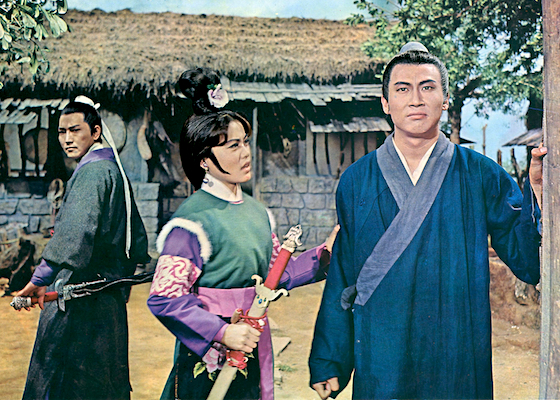
In between the action, the film pauses to consider the morals. It’s hardly a think-piece, but it does make a reasonable thematic argument against generational conflict… although Flying Swallow only tries to convince our hero to alter his course after he’s already taken revenge on four out of five targets, so it does come across as too little too late. Still, it matters because honour and rightness are major concerns in films like this, and those considerations have a key role in how the final two bouts play out. Kuo’s background was in romances and melodramas (before the success of King Hu’s Dragon Inn caused the Taiwanese film industry to shift focus), so perhaps he brought a greater understanding — certainly, a greater interest — in human emotion to the film than you’d get from your run-of-the-mill combat junkie. That the film doesn’t have excessive time to spend navel gazing means these quandaries add to the texture, rather than overwhelming it or making us feel too guilty for enjoying the spectacle of clashing blades.
Eureka’s blurb notes this is the first part of a trilogy about Tsai Ying-jie, followed by The Bravest Revenge and The Ghost Hill. They sound pretty cool and borderline insane (the third apparently involves Tsai and Swallow going to Hell), though Kuo wasn’t involved in them (contrary to what Eureka’s blurb claims). Still, I’d welcome Eureka bringing them to disc too.

The Swordsman of All Swordsmen is the 66th film in my 100 Films in a Year Challenge 2024. It was my Favourite Film of the Month in August 2024. It placed 13th on my list of The Best Films I Saw in 2024.
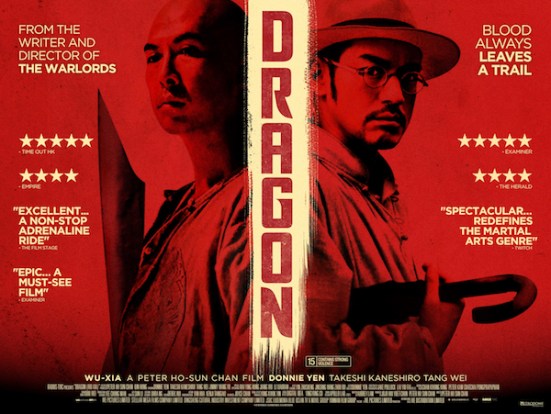


 In this lesser sequel to
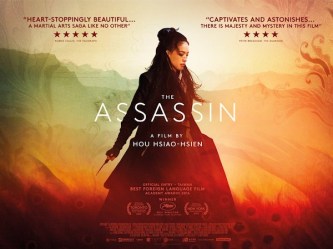 The Assassin is a martial arts drama about Nie Yinniang (Shu Qi), a woman trained since childhood to be a highly-skilled assassin. When her emotions lead her to renege on a mission, her master sets a difficult task for Yinniang to prove herself: she must return to her homeland and assassinate its leader, Tian Ji’an (Chang Chen) — her cousin, to whom she was once betrothed.
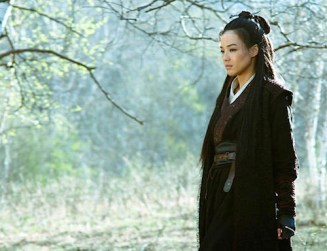 So little happens at times that it’s very easy to become disconnected from it. At one point my mind wandered to other films it reminded me of.
 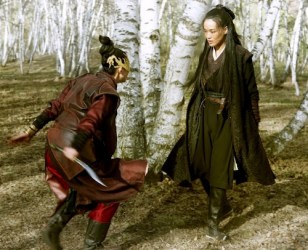 For all that, there is some action, but director Hou Hsiao-Hsien has said he’s more concerned about the before and after of a fight than the process itself — it’s about the mood, the tension, the ultimate outcome of winning or losing, rather than the choreography of the combat — so there’s a lot of build-up for very brief bursts of action. That’s certainly not an invalid way to handle it — it’s Leone-esque, in its way — but it does mean anyone looking for the detailed swordplay or fisticuffs you expect of a martial arts film will come away disappointed.
 After martial arts student Fang Cheng is killed protecting his master, the latter takes in Cheng’s infant son, Fang Kang, as his student. Years later, Fang Kang is bullied by his aristocratic classmates and treated as a servant by the master’s daughter, Pei, though he’s a better student than any of them. Eventually goaded into leaving, his fellows corner him, challenge him, accidentally lop off his sword arm, and leave him for dead. Kids, eh? Fortunately, Kang is found by orphan Xiao Man, who nurses him back to health. With the help of an old textbook, he learns to fight left-handed, which is handy because there’s a conspiracy underway to kill all of his master’s former pupils…
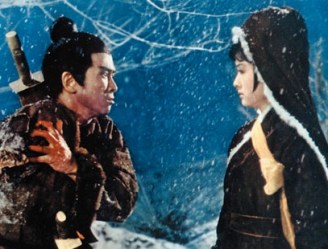 However, for me the film also worked very well as a drama, and even sometimes as a romantic drama. Fang Kang is an interesting protagonist. His lifestyle is torn from him, and rather than simplistically train to regain it or give up entirely, he battles with that decision. He returns to that way of life only to defend himself and his rescuer, and then out of a sense of loyalty to the master who raised him, but he’s also prepared to abandon the martial life to be a farmer… when the job is done, naturally. Jimmy Wang Yu, in a star-making turn, sells this character arc as well as anyone in a kung fu picture ever has. He’s also (somewhat) torn between two women, the kindly and supportive Xiao Man, and brat-with-a-heart Pei. While no one could truthfully call this a romantic picture, the love-triangle aspect also functions surprisingly well.
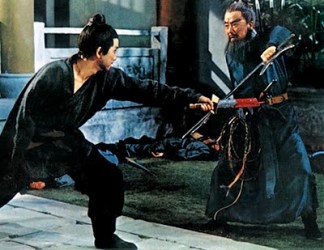 I disagree with that. Perhaps those lists are based on the abundance of action in these films, by which metric this probably has too much drama — though, as I said, it’s not devoid of fisticuffs and swordplay. Combine that with a solid story, engaging characters, and a brisk pace (even with its near-two-hour running time), and you have one of my favourite Shaw Brothers movies I’ve yet seen.
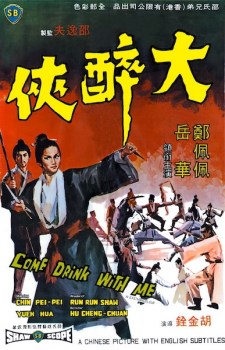 The first wuxia film directed by King Hu (King Chuan, that’s Hu! #MildlyRacistHomophoneJoke), the success of which allowed him to make his next even-more-significant movies in the genre, Come Drink with Me sees a gang kidnap the governor’s son to use him as leverage to release their leader. Instead, the governor sends his daughter, Golden Swallow (Cheng Pei-pei), to rescue her brother. She receives some help from local drunkard Fan Da-Pei (Yueh Hua), who may be more than he’s letting on…
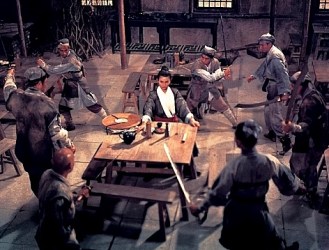 But this is a structural niggle, really. There’s so much else to enjoy — not just the action, but some amusing scenes, engaging characters, strikingly brutal villains (they not only kill a child (you wouldn’t get that in most movies) but they do it for no particular reason), and beautiful widescreen Technicolor cinematography — that it doesn’t grate too much.
 100Films.co.uk