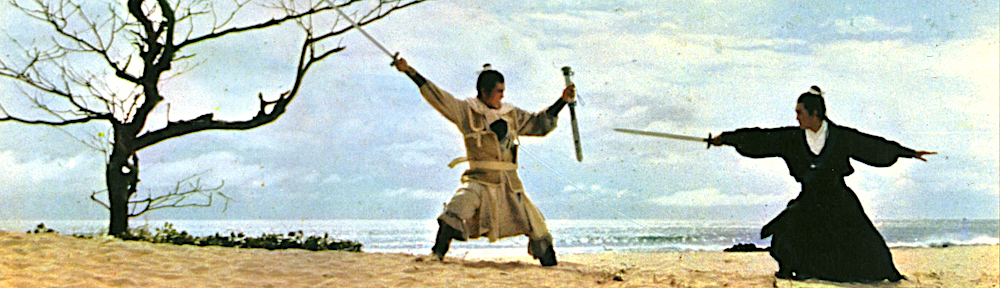
Joseph Kuo | 86 mins | Blu-ray | 2.35:1 | Taiwan / Mandarin | 12
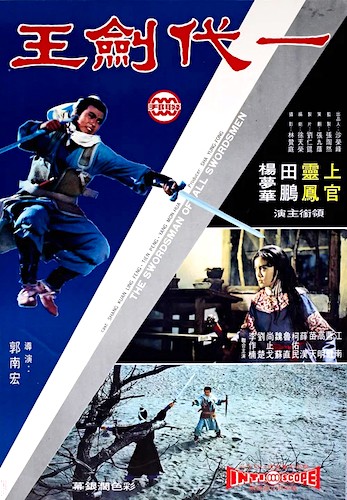
Revenge is a dish best served cold, according to the Klingons, and Tsai Ying-jie (Tien Peng) is the embodiment of that mantra. As a young child, he witnessed his whole family murdered by group of assassins who wanted his father’s legendary sword. As an adult, he’s a fully-trained expert swordsman, and the time has come for vengeance. As word of his victories spreads, he’s intercepted by Flying Swallow (Polly Shang-Kuan Ling-Feng), who tries to persuade him off his murderous path, and Black Dragon (Chiang Nan), who seeks to cement his reputation as the foremost swordsman by defeating Tsai in combat.
It’s pretty standard fare as wuxia plots go — I suspect that was as much the case in 1968 as it is today — but the art, as is so often the case, lies in the execution. Director (and co-writer) Joseph Kuo hits the ground running: we meet Tsai as he arrives in the town of his first target, and just minutes later they’re duelling. His motivations are only then revealed via flashback. The film runs a tight 85 minutes, and in that time manages to pack in seven sword fights and still find room for some honour-based moral conflict. The action comes thick and fast (that’s an average of a fresh duel starting every 12 minutes, maths fans) but remains thrilling throughout. That said, I do love a good sword fight, so I’m somewhat biased. While some of the direction almost borders on perfunctory (it’s fine, but nothing remarkable), other parts are glorious — the fights, in particular; and the finale, especially, is quite gorgeous.
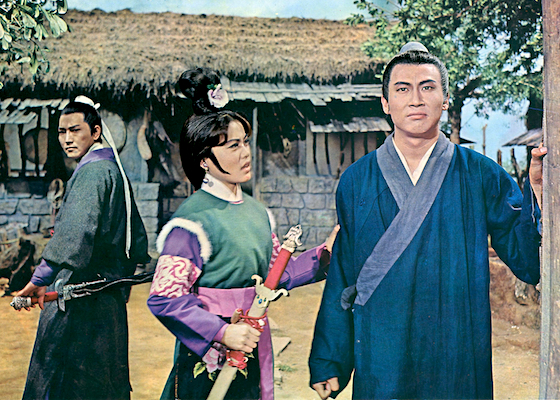
In between the action, the film pauses to consider the morals. It’s hardly a think-piece, but it does make a reasonable thematic argument against generational conflict… although Flying Swallow only tries to convince our hero to alter his course after he’s already taken revenge on four out of five targets, so it does come across as too little too late. Still, it matters because honour and rightness are major concerns in films like this, and those considerations have a key role in how the final two bouts play out. Kuo’s background was in romances and melodramas (before the success of King Hu’s Dragon Inn caused the Taiwanese film industry to shift focus), so perhaps he brought a greater understanding — certainly, a greater interest — in human emotion to the film than you’d get from your run-of-the-mill combat junkie. That the film doesn’t have excessive time to spend navel gazing means these quandaries add to the texture, rather than overwhelming it or making us feel too guilty for enjoying the spectacle of clashing blades.
Eureka’s blurb notes this is the first part of a trilogy about Tsai Ying-jie, followed by The Bravest Revenge and The Ghost Hill. They sound pretty cool and borderline insane (the third apparently involves Tsai and Swallow going to Hell), though Kuo wasn’t involved in them (contrary to what Eureka’s blurb claims). Still, I’d welcome Eureka bringing them to disc too.

The Swordsman of All Swordsmen is the 66th film in my 100 Films in a Year Challenge 2024. It was my Favourite Film of the Month in August 2024. It placed 13th on my list of The Best Films I Saw in 2024.


aha! A review! Thanks for the read- these really aren’t my kind of movies, so I’m not at all one to judge, although I have bought Radiance’s recent Tokijiro: Lone Yakuza disc if that counts as one of this genre of film? My ignorance abounds. I haven’t even seen The Seven Samurai yet, although next months 4K disc will surely change that.
LikeLiked by 1 person
I also bought Tokijiro and didn’t add it to my martial arts ‘qualifier’ list on Letterboxd, but re-reading the blurb I wonder if I should have. It’s not a wuxia, but it’s about a guy with a sword engaging in “blood-spurting action”, so that sounds pretty martial arts-y. I guess people’s definition/inclusions would vary; I mean, fundamentally, what’s the difference between “martial arts” and “action”?
Seven Samurai is on Wikipedia’s list of martial arts films, but it’s not in the same class as something like this. This is fun because it’s basically all sword fights — Seven Samurai is one of the greatest films of all time (which also happens to feature some fighting with swords occasionally).
LikeLike
Pingback: The Best of 2024 | 100Films.co.uk