
Christmas is on the horizon, with the usual glut of seasonal specials and high-profile miniseries/one-offs crammed into a couple of weeks. But that’s for my next TV column — this time, here’s a bit more of the usual stuff.

Doctor Who Series 11 Episodes 8-10
 The most recent season of Doctor Who went out, not with a bang, but with a whimper, in perhaps the most underwhelming “finale” the show has ever done. It wasn’t really a dramatic and exciting culmination of this year’s run of episodes, which is what a true “finale” is. Rather, it was just the last episode shown before the season… stopped. Fortunately, before that were two more episodes that proved this new era’s best stuff comes from its guest writers rather than its showrunner.
The Witchfinders saw the TARDIS Team head into the past for the third time this season, and once again brought up a heavy theme: after racism in Rosa and religious division in Demons of the Punjab, now it’s the misogyny of 17th century witch hunts. Fortunately it wore this somewhat more lightly than the previous two episodes, which meant it lacked their emotional weight. Instead, it was a fun adventure, revolving around an alien race reanimating the dead, and a broad, camp, but occasionally nuanced performance from Alan Cumming as King James I. I thought he was a lot of fun.
It Takes You Away set its scene as a “monster lurking near a remote cottage” tale, but pulled off a couple of twists to reveal something entirely different. It was an episode rich in science-fiction ideas — almost too rich, arguably, as the emotional impact they led to was powerful but perhaps not given enough screen time to be fully processed. But with some typically Doctor Who quirkiness thrown in, this was one of my favourite episodes of the season. Even if the execution sometimes faltered, I admired its ambition.
Which brings us back round to the finale, the stupidly titled The Battle of Ranskoor Av Kolos. It’s such a dumb, unpronounceable title that I don’t think I was alone in suspecting it was a cover for something else (in the same way the classic series used to hide the return of the Master by crediting the actor by an acronym in the Radio Times, for instance). But no, that sadly was the title. Even worse, it had barely anything to do with the episode itself — the titular conflict is over, with the Doctor and co arriving to help the few remaining survivors defeat the big bad. Or, rather, get a bunch of exposition from the survivor (with a few hoops jumped through to make sure that exposition is gradually doled out rather than received all at once), then virtually ignore him while they set about some other storyline.
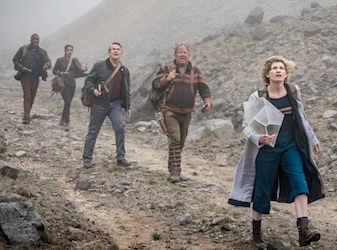 Typically for showrunner Chris Chibnall, it was a half-thought-through tale, with regular logic gaps and narrative dead ends, and none of the impact you expect from a season-ender. Kinder viewers may say that’s because there’s a New Year’s Day special imminent which is the real finale, but I think that’s just being optimistic. Certainly, the BBC haven’t seen fit to include the special in the season box set (even though it’s released a fortnight after the special airs), which I’m sure is partly a shameless cash grab, but also indicates its separate status.
With that in mind, we can already take an overview of the season as a whole. It’s been a mixed one for me, with a lot of stuff I really liked, but frequently undercut by dodgy execution. I’m not at all convinced Chibnall has the necessary skills to be in charge of the show — even the best scripts exhibit a lack of polish that Russell T Davies or Steven Moffat would’ve brought. And considering there are niggling faults across the board (the direction is rarely terrible, but pretty much every episode has some odd shot or editing choices), the blame must surely lie at his door. The next season won’t materialise until sometime in 2020 — hopefully that’ll be long enough to get things more in order. But with pretty strong ratings and praise in some quarters, I’m not convinced the production team will see where they need to improve.
Crisis on Earth-X
I ended up finally quitting all Arrowverse shows just before this crossover event aired last November, though I’d intended to make it through these episodes first (I fell behind and just never picked them back up). The crossover itself seemed to go down well, and with a new one having recently aired that I also intend to watch (to see how they’ve handled Batwoman), I thought I’d first catch up on last year’s.
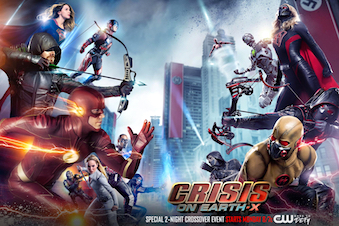 Whereas the previous four-show crossover failed to really coalesce into a successful single narrative, Crisis on Earth-X manages to lose the sense of hopping about across different series to play more like a single four-part story. I suppose that’s not the only way to do a crossover, but for someone tuning in just for the event who isn’t interested in the ongoing storylines of each individual series, it’s more entertaining this way. That said, it’s not as if those elements go away: the story is kicked off by everyone coming together for the wedding of Barry Allen (aka the Flash) to his longtime love Iris West. The nuptials are eventually interrupted by Nazi doppelgängers from another dimension (I do love how outright comic booky these shows can be), but it takes most of the opening episode to get there — I’d forgotten how much time these shows spend on soapy stuff like weddings and relationship woes. In that regard, they’ve certainly been designed to fit their US network (The CW, more associated with teen-girl content until these series came along). From there it goes full superhero show, with large-scale action sequences and dimension hopping antics. It may not transcend its genre roots to be objectively high-quality premium TV, but it’s pretty fun.
Agatha Christie’s Poirot Series 2 Episodes 4-6
 One day I’m going to watch all of Poirot from the start, but I happened to see these few episodes this month. They’re from the series’ early days (obviously), when episodes were an hour long and based on short stories (as opposed to the feature-length novel adaptations they did later). What’s remarkable is how different they are, structurally and tonally, from those later episodes, with which I’m more familiar. The feature-length ones each feel like a standalone movie, whereas these early episodes do feel like a TV series, with “case of the week” plots. For example, there’s a regular recurring cast (alongside the titular detective there’s his sidekick Captain Hastings, his housekeeper Miss Lemon, and trusty Inspector Japp), who all appear every week and each get some kind of subplot, even if it’s not tied to the main storyline — in one episode, while the other three are away solving a jewel theft, Miss Lemon has to hunt for her missing keys. And that’s another thing: there’s not always a murder. And there’s not always a pile of suspects, either — none of these episodes feature the famous “gather all the suspects in one room and explain what happened”-style finale, so synonymous with the series. So, in many ways it feels quite strange, but still entertaining.
Things to Catch Up On
 This month, I have mostly been missing Death by Magic — not a high-profile show, maybe, but a new Netflix thing that seems up my street. Other than that, I’ve been conspicuously failing to get around to a bunch of “box sets” (I hate calling digital collections “box sets” — there’s no “box” involved) that I’ve been meaning to get to for varying amounts of time: The Little Drummer Girl, Killing Eve, The Haunting of Hill House, Lost in Space, the Netflix years of Black Mirror, Ash vs Evil Dead, Chilling Adventures of Sabrina (which even added a new Christmas episode), Riverdale, Mindhunter, Inside No.9… Not to mention everything that’s on my long-term back-burner, like Breaking Bad, The Wire, The Sopranos, The Shield, The X Files, things that don’t begin with a definitive article… There’s no doubt many more that are currently slipping my mind, anyway. With an abundance of Christmas specials incoming, I guess whichever series I dive into next will have to wait until January.
Next month… is January, but expect an overview of Christmas telly before that.
 The 37th season of Doctor Who begins with the show’s biggest soft-reboot since at least 2010; arguably, since 2005; arguably, ever. With a new showrunner comes a new broom, and so we have a new Doctor, a new TARDIS, a new set of companions — sorry, they’re “friends” now — new locations, new monsters, and a new style (thanks to a raft of behind-the-scenes changes, including a new effects company, swish new cameras and lenses, and a new aspect ratio). It’s the perfect jumping-on point… and it worked, with the premiere achieving the show’s highest ratings for a decade; or longer, depending how you count it.
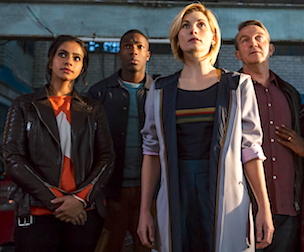 Indeed, even as it’s open-armed and newbie-friendly, Chibnall’s era already seems as Who-literate as you’d expect from such a long-time fan (somewhat (in)famously, as a teenager in the ’80s Chibnall appeared on TV criticising the then production team). His sense of what Who should be is at once indebted to the modern era (in particular the years of Russell T Davies, who I suspect may’ve been something of a mentor to Chibnall at one point) and also seeks to reintegrate elements long absent. For example, there’s the expanded TARDIS team, which calls to mind that of the series’ very first group of travellers; though whereas 1963 gave us a teenage girl and two middle-aged teachers, 2018 offers two teenagers and one middle-aged bloke. Such are the changing times. And for dedicated Whovians, the plot of episode two, The Ghost Monument, also had an air of early Hartnell serials, with its episodic trek across a danger-filled alien world. It was a brisk, entertaining 50 minutes, but stop and think about it too much and the cracks begin to show (read
 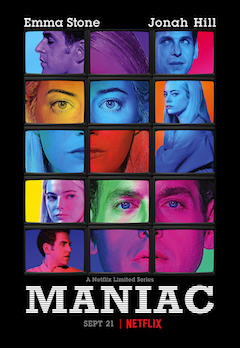 Netflix continue to blur the line between movies and TV with this limited series starring Oscar winner Emma Stone and Oscar nominee Jonah Hill, co-created and directed by Cary “director of the next Bond film” Fukunaga. Well, I mean, it’s a line that other TV producers have blurred plenty in the past — movie stars on TV is far from a new thing at this point, and there’s no doubting this is a TV series rather than a movie (it’s 6½ hours long, for one thing) — but, still. And they bend the rules of TV, too, with individual episodes running everywhere from 26 to 47 minutes. (Does that matter when Netflix’s release-it-all-at-once strategy means you choose how much to watch at any one time? Maybe not. But if you’re the kind to still watch one episode at a time, a word to the wise: I recommend double-billing the ultra-short should-be-one-episode pair of episodes 7 and 8.)
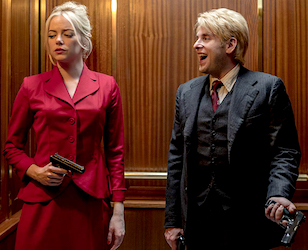 A significant amount of the series’ offbeat likability is down to idiosyncratic direction by Fukunaga, I suspect — the way he’s shepherded the visual creation of this world, the leftfield performance choices across the cast, and so on — but Emma Stone is definitely the MVP. While the aforementioned chemistry between her and Hill is important, and a lot of the rest of the cast get to excel at being quirky and funny, it’s Stone who really brings heart and emotion to the piece, making it more than just a zany fantasy.
 Having just
 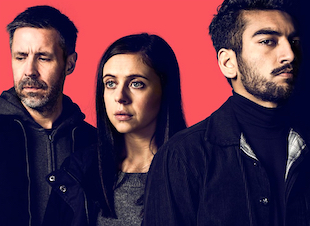 This month, I have mostly been missing Informer, BBC One’s new thriller. Well, it only started on Tuesday, so that’s fair enough, right? I guess I’ll save it up and see how it goes down — I’ve managed to avoid wasting time on a few initially-promising-but-ultimately-poorly-received series with this method; though, equally, it led to
 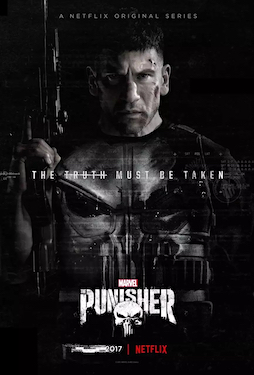 The fourth live-action iteration of Frank Castle, Marvel’s murderous anti-hero (and people moan about Spider-Man reboots), debuted in
 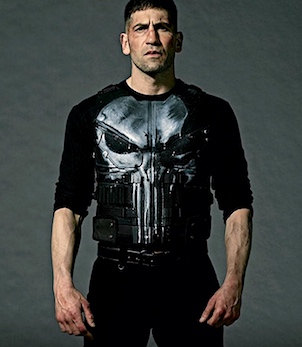 In the title role, Jon Bernthal is fantastic. You can absolutely believe him as a revenge-driven psychopath capable of killing anyone and everyone, but also as a kind-of-charming strong-but-silent type with a heart and moral code who will definitely do the right thing. I’ve seen some critics and viewers opine that now is the wrong time for a series about a hero who just murders indiscriminately. I say those people definitely haven’t watched this Punisher. Although the plot is a conspiracy thriller, the series invests a lot of time in the emotional world of Frank Castle, making him human and moral rather than just a single-minded murder-machine. Bernthal makes what could be a very one-note role into a plausible human being; one who you believe might be able to find redemption and leave someday. And maybe that makes him even more tragic — he could find it; it’s possible… but likely? There’s the rub. As it’s also trying to engage with issues facing combat veterans once they return home, it makes for a clearly different, more serious flavour for an MCU production. How successfully it explores these weighty issues is more debatable.
 The third and final series of BBC Four’s sitcom about a couple of mates whose hobby is metal detecting was every bit the equal of the first two runs, which saw the show place on my list of
 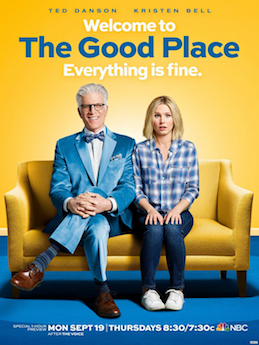 I only heard about this after its Big Twist was much-discussed online, so starting it was an exercise in knowing there was a big reveal awaiting. Fortunately, that knowledge doesn’t overshadow everything that comes before it. For those who still aren’t aware of it (especially as it’s only on Netflix on this side of the pond), it’s about a woman (Kristen Bell) who dies and goes to Heaven only due to an admin error, so she tries to better herself so that she’s deserving of her place. Other complications emerge as the season goes on, but that’s the premise. There’s a lot of plot for a sitcom — although it’s not necessarily immediately obvious, it tells a 13-episode story; this makes Netflix quite a natural home for it, actually, as it’s not your typical “every episode is fundamentally standalone” sitcom. But it’s also very funny in amongst all that, mining not only the characters and their foibles, but also the uncommon situation they’ve found themselves in. The shocker in the finale is just the icing on the cake. I hear season two has gone off the boil somewhat, but I’ll find out for myself once it’s all wrapped up.
 This month, I have been missing so much stuff. There’s been the fourth series of Peaky Blinders on BBC Two (which concludes this week, so we’ll whizz through it sometime in the new year); the second season of The Crown on Netflix (also waiting for the new year now); the same streamer’s first ever miniseries, Godless; the immensely acclaimed Blue Planet II (now available in UHD on iPlayer, too!); and I’m behind on Arrow and The Flash so haven’t reached the four-show Arrowverse crossover. And those are just the ones I can remember right now.
 100Films.co.uk