
Daniel Craig’s final turn as Bond, James Bond, parachuted into cinemas just in time to make the cut for this monthly overview. But there was a whole month before that, so let’s look back at it.

#160 Boss Level (2021)
#161 The Birth of a Nation (1915)
#162 Daughters of Darkness (1971), aka Les lèvres rouges
#163 Futureworld (1976)
#164 Memory: The Origins of Alien (2019)
#165 La Dolce Vita (1960)
#166 Terje Vigen (1917), aka A Man There Was
#167 David Lynch: The Art Life (2016)
#168 The Current War (2017)
#168a Scenes with Beans (1976), aka Babfilm
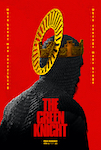
#169 The Green Knight (2021)
#170 No Time to Die (2021)


- I watched 12 feature films I’d never seen before in September.
- Not a terrible showing (it’s not the worst month of 2021), but far from spectacular (it’s joint second worst).
- It fell just short of the September average (previously 12.54, now 12.50), and well below the average for 2021 to date (previously 19.75, now 18.89) and the rolling average of the last 12 months (previously 18.7, now 18.0).
- One notable success, however, came in my Blindspot viewing: after missing one in August, I caught up by watching two this month — and two of this year’s longest, at that. They were the 193 minutes of D.W. Griffith’s silent racist epic The Birth of a Nation, and the 175 minutes of Federico Fellini’s depiction of the high life in 1950s Rome, La Dolce Vita. I was no fan of the first Fellini I watched, 8½, but I quite liked this one. The Griffith, however, should be consigned to the bin of history.
- From last month’s “failures” I watched Boss Level and Memory: The Origins of Alien.

The 76th Monthly Arbitrary Awards
 Favourite Film of the Month
Lots of enjoyable flicks this month, some unexpectedly so, but perhaps the greatest was David Lowery’s divisive adaptation of The Green Knight. I can see why it turned some people off, but it hit just the right tone for me.
Least Favourite Film of the Month
This is an easy one, because I liked all of the film I watched this month, with one glaring exception: The Birth of a Nation. As I wrote above, D.W. Griffith’s once-acclaimed silent epic is so horrendously racist that it deserves to be forgotten. Actually, there’s a more nuanced discussion to be had there about remembering the misdeeds of the past — it merits viewing on such an academic level — but the old “yeah, it’s racist, but if you ignore that it’s really good” arguments can get in the bin. It does have some decent stuff, but the racism is so awful that it completely overshadows any other merits.
First Film I’ve Seen in the Cinema for 19 Months
After a very long wait, it was finally time to not die of COVID from watching No Time to Die.
Most Surprising Sequel of the Month
I wasn’t the biggest fan of the original Westworld (it’s fine), and the sequel has a rep for being much, much worse. So it was a delightful surprise to me that I really enjoyed Futureworld. Whereas the first film basically hangs out in the park until there’s a bit of robot-on-human violence, Futureworld takes the time to have more of a plot, latching itself to the ’70s vogue for conspiracy thrillers. I reckon it might be worth a reappraisal.
The Audience Award for Most-Viewed New Post of the Month
I’m not sure how much point there is keeping this particular award going until I get back on my reviewing horse. Highlighting the most viewed overall post of the month worked at first, but (based on history) it’s going to be my 15th TV column most of the time (as it was this month, and last month), with only the occasional other old TV column pipping it to the post.

My Rewatchathon continues to tick along, although another month just off pace means I’m falling ever-further behind where I should be to reach my goal of 50 this year. Who knows how things will pan out, but at this rate I’ll be pleased to make 40.
#27 Bill (2015)
#28 Pan’s Labyrinth (2006)
#29 Spectre (2015)
Bill was 2021’s #1 back in (obviously) January. I liked it first time, but I enjoyed it even more on a rewatch. Quite the other end of the rewatch timeline was Pan’s Labyrinth, long-overdue a revisit because I last watched it 14 years ago. My review (linked above) is a brief 2007-style one… though that’s better than what I post currently, eh? Anyway, some fresh thoughts on Letterboxd.
Spectre was also rather overdue a revisit: it was the only Daniel Craig Bond I’d only seen once, and that was six years ago at the cinema. I was fairly positive about it on Letterboxd, but, I must say, it gets worse the more I reflect on it. Blofeld is horrendously mishandled — underwritten and underused — meaning Waltz is wasted, and I think he knows it, just giving another slight variation of his usual Tarantino performance. It really undermines the entire third act of the film, which is kinda crucial. Still, the film as a whole definitely has some high points.

This month’s big release at the cinema… doesn’t get a mention in this section, because I saw it. Wonders will never cease. Although, as things edge towards normal, there were a couple of other noteworthy titles too, like Disney’s “theatrical only” ‘experiment’ release of Marvel’s latest, Shang-Chi and the Legend of the Ten Rings, and Sopranos prequel The Many Saints of Newark. I’ve never seen all of the The Sopranos, though I mean to, so it may be a while before I get round to that one…
Perhaps the most-discussed direct-to-streaming release of the month was not a Netflix title, for once, but Amazon’s new version of Cinderella. Unfortunately for them, that was because it looks terrible. And apparently it is terrible. It’s not on my watchlist. They also generated a few column inches with erotic thriller The Voyeurs, but I didn’t see many people talking about Everybody’s Talking About Jamie, though I did pick up that it’s quite good. Meanwhile, on Netflix, the only new title I’ve noted is actioner Kate. I don’t actually know what the reviews have been like — “Mary Elizabeth Winstead leads an action movie” was enough to get it on my list. And talking of female-driven action, Sky Cinema grabbed the UK release of Gunpowder Milkshake.
Among the never-ending parade of old(er) titles coming and going and jumping from one streamer to another, standouts to me included Minari on Sky Cinema, as well as the Russian remake of The Raid, cannily titled Russian Raid. Leaving Sky to popup on Netflix was the new Charlie’s Angels; and, having left Amazon a while back, The Farewell is now on Netflix too. As for Amazon, they now have Chaos Walking (in 4K, too), and also Selma, which I think has been available on every streamer at one time or another (even iPlayer) and I really should get round to. And talking of iPlayer, they had a seemingly-rare chance to watch The Graduate this month, so I should do that too. They also had Whiplash, which I ought to rewatch — I liked it a lot, but don’t really understand why it seems to have become an Instant Classic in the past few years.
Finally… I say “finally”: this is going to take more than half the section. Yes, my bank balance is sobbing once again — as is my shelf space — as new purchases flowed through my letterbox like water. Where to begin? Indicator’s Columbia Noir series reached its fourth iteration, adding six new films to my unwatched noir pile. Similarly, Master of Cinema’s Early Universal range is just getting underway (I hope), with Volume 1 bringing me three silent titles I’d never heard of before. Fun times. Other new releases included an MoC edition of Johnny Guitar; Eureka’s release of Duel to the Death, billed as “one of the greatest swordplay movies of all time”; an Aussie Imprint import for Terrence Malick’s Days of Heaven; and Anime Ltd’s release of the first CG Lupin III film, Lupin III: The First.
My 4K collection also got a considerable boost this month, between brand-new releases like Black Widow (the first Marvel film in yonks I’ve not been able to buy in 3D — boo!); archive releases in fancy box sets, like The Thing and The Servant; semi-random sale pick-ups, like Shadow and Full Metal Jacket; and the kind of titles you might once have never believed you’d see on Blu-ray, never mind 4K, but nowadays all bets are off as indie labels go for the new tech but studios remain wary — by which I specifically mean a bundle I imported from Vinegar Syndrome including The Beastmaster, Daughters of Darkness, and SexWorld — which, if you’ve not heard of it, is a porno riff on Westworld and Futureworld. It sounds surprisingly good. I also bought Eleven Days, Eleven Nights and Robotrix this month, which as a set make my glad Blu-rays don’t come through the post in transparent boxes…
But I’m still not done! I caved to a bunch of gialli and other international semi-oddities in a recent 88 Films sale on HMV, snaffling the likes of The Bloodstained Shadow, Eyeball, Harlequin, Ironmaster, Seven Blood-Stained Orchids, and Watch Me When I Kill. Throw in The Blood Spattered Bride with that VS order, and there’s clearly a lot of the red stuff waiting to spray from my Blu-ray player. Finally, helping round out my classic 3D collection was Dynasty (nothing to do with the TV series), and I completed Richard Lester’s Musketeers trilogy with The Return of the Musketeers.
And that’s not even mentioning the TV Blu-rays I bought.

We’re off to Arrakis. Hopefully it’ll be a return ticket.

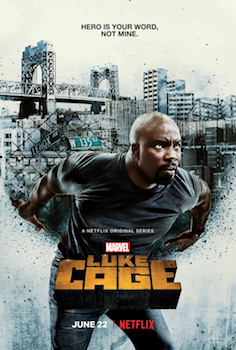 The ninth season of the MCU on Netflix takes us back to Harlem for the continuing adventures of the eponymous bulletproof black man. It’s hard to imagine a more timely superhero for America (maybe if he was an immigrant too), not that the series’ is actually all that concerned with such issues, aside from passing nods and references. Instead, it’s more of a gangster crime drama: the still-standing
 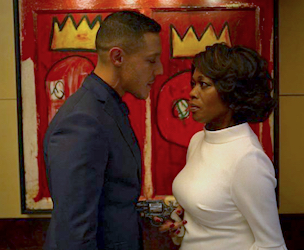 Mike Colter remains a likeable lead, but, again, it’s a villain who steals the show: as Mariah, the brilliant Alfre Woodard is perhaps the best thing about the whole series. Her performance is consistently fantastic, selling every twist and turn of character the writers throw at her. The season is as much about what events do to her as it is about Luke. She isn’t entirely alone, though: there are plenty of great performances, and scenes to showcase them, throughout the season. Occasionally there are some really bloody terrible ones though, like the time detective Misty Knight and her captain argue loudly about a shared secret while they’re in a room full of other cops. Is that bad writing, bad acting, bad direction, or all of the above?
 The flip side to all that is that this interconnectedness will perhaps be comic book fans’ favourite thing about the show — the way it casually references other series, or suddenly brings their characters in for a guest spot, is just like how comic books operate. It’s pretty constant too: barely an episode goes by without a significant reference to or cameo appearance by someone from another Marvel/Netflix show; and these aren’t all mere Easter eggs, but sometimes quite important or vital pieces of plot or character development.
 And so Westworld’s sophomore run rides into the sunset, and I think it’s left behind more questions than answers.
 Exhibit A is the “Hale was Dolores all along” revelation. It’s a neat twist, almost up to season one levels, were it not undermined by the season’s own structure: Hale hasn’t been Dolores all along, and the muddled timelines make it hard to recall how many scenes we’ve had with “Halelores” (as the writers apparently dubbed her). In fact, one of the ways they hid her in plain sight was to limit her screen time: apparently she only popped up in episodes three and seven. Those scenes are littered with
  This month, I have mostly been missing Preacher’s third season, which started this week. Well, I only watched
 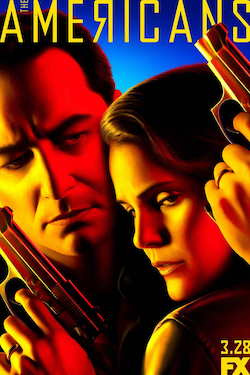 That song was released in 1987, the same year as the final season of The Americans is set. The show has typically avoided featuring well-known music in favour of cult favourites and obscurities, but R.E.M.’s classic would’ve been an appropriate number to hear during one of the series’ trademark music montages in the finale. (That said, it did contain both Dire Straits and U2, so they weren’t above using big hits.) Maybe it would’ve been a bit on the nose, but it certainly was applicable: it was the end of the world as the characters knew it, and so too for fans, as six incredible seasons came to a final end. But do we feel fine? That depends how you define “fine”. The show will be missed terribly, but goddamn if it didn’t stick the landing to cement itself as one of the greatest TV series ever made.
 given texture or sometimes affected by the relationships, whereas by this point the relative importance and impact seems reversed. I guess you could still enjoy it as “just a spy show”, but I don’t think you’d want to — the stuff you’re invested in has shifted. That was always the programme’s genius, of course: it’s not about spies who happen to be married, it’s about marriage through the prism of people who are spies.
 As a commenter on
  I wrote
 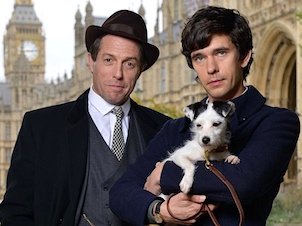 This month, I have mostly been missing A Very English Scandal, the Russell T Davies-penned drama about the real-life case of a ’60s politician and his secret homosexual lover. It seems to have gone down exceptionally well, and anything by RTD is always worth watching. Other than that, it feels like there’s a bunch of stuff on streaming I’ve been meaning to get round to and still haven’t. That list would keep us here all day, though.
 The first screen adaptation of a novel by acclaimed British sci-fi/fantasy author China Miéville, The City & the City is a police procedural set in the unique location of twin cities Besźel and Ul Qoma, which occupy the same geographical space but inhabitants (and visitors) are forbidden from seeing the city they’re not in. When I first heard the pitch I assumed it was a Doctor Who-y sci-fi thing — that the cities were slightly out of step in time or something, and literally existed in the exact same space. Instead, they’re side by side, sometimes overlapping — there are places where the left-hand side of a road is in Besźel, the right-hand side in Ul Qoma. Residents are trained from birth not to see the other city. Apparently it’s partly an analogy for how we mentally block out unsavoury things in our own cities, but that doesn’t really come across in the screen adaptation, which is more focused on the murder mystery and its implications — it’s connected to a mythical third city, Orciny. In this respect it reminded me of Thomas Pynchon’s The Crying of Lot 49: our hero ends up investigating a very-secret, potentially dangerous organisation that may or may not exist, and whether or not they find it… well…
 The BBC’s latest Agatha Christie adaptation finally reached our screens after a delay for extensive reshoots (to remove a cast member accused of sexual misconduct, not on this production). It’s a grim tale of abuse and, of course, murder, but classy work by director Sandra Goldbacher kept it more in the tone of the Beeb’s excellent
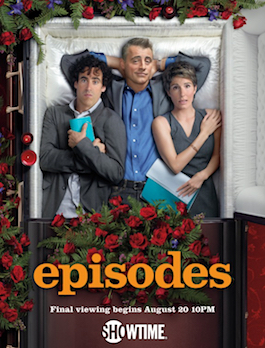 A whole seven months after its US airing (and nearly three years since we saw the last series), the final run of this UK-made UK/US-coproduced sitcom finally reached British screens (a far cry from the days when that took less than 24 hours). Originally about a pair of UK sitcom writers struggling to remake their successful British series for the US market, Episodes is fairly removed from that format at this point — it’s just about the characters now, and mainly their trials and tribulations with each other rather than the whims of the US network TV system.
 There was drama to spare at this year’s Eurovision. Firstly, China were banned from showing it due to messing around with the semi-final broadcast (they censored tattoos, homosexual dancing, and Pride flags); then, on the big night itself, the jury voting was neck-and-neck right to the final country… before being completely upended when the public votes were added.
 Cancellation season has been and, I think, gone in the US, and this year was a particularly bloody one. The big news as far as Twitter was concerned was Brooklyn Nine-Nine, which caused such a ruckus that multiple other networks were interested and it found a new home within 24 hours. Lucifer also caused a bit of a stir, though there’s no sign of hope for that yet. Similarly afflicted were Designated Survivor (which was decently addictive enough that I binged through
 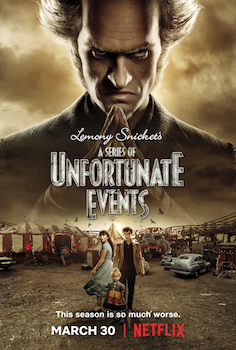 Abandon your vapid, facile distractions and set aside your very fine dramas, because it’s time to indulge in some vicarious fearsome disaster with the return of Netflix’s venerable family delight — a phrase which here means: A Series of Unfortunate Events is back.
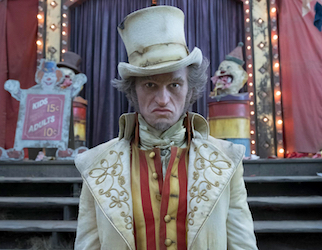 Neil Patrick Harris is having a whale of a time as Olaf and all his varied aliases, while the apparent earnestness of child actors Malina Weissman and Louis Hynes is clearly well measured for effect rather than poor work. There’s an array of memorable guest performances this season as well, from Kitana Turnbull, fantastically horrid as Carmelita, a little-goody-two-shoes teacher’s-pet bully the Baudelaires encounter in the opening two-parter; to Lucy Punch as an obsessive fashionista; to Sara Rue as a new inductee into the secret organisation trying to help the Baudelaires. Best of all is Nathan Fillion, born to play the fast-talking dashing hero who gets a ton of the best lines. If there’s a downside, it’s that we don’t see enough of some people. Unlike most kids’ fare (and, let’s be honest, some stuff made for adults), this isn’t a show where good is always rewarded and bad behaviour always punished, and that means some people may be shuffling out before we’ve had as much as we’d like. I guess the clue was in the title…
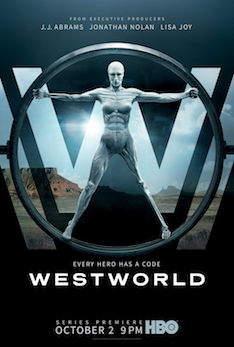 With season two imminent (it begins tomorrow, people!) I finally got my behind in gear (it’s only taken 18 months) and missioned my way through the first season of HBO’s reimagining of
  During its production Westworld hit the headlines because they shut down production for a while to retool the scripts and hone the story. Maybe this was why. If so, it paid off, because from the fifth episode things pick up considerably. Developments and twists really kick the mysteries into gear. Scenes between characters begin to carry more meaningful dialogue and affecting emotion. There’s even some action to give it a nice adrenaline kick at times. Rather than feeling like it’s ambling nowhere in particular, you feel like showrunners Jonathan Nolan and Lisa Joy have some very particular things in mind, but good luck guessing what they are because there are many surprises in store: however close you think you are to uncovering Westworld’s games, someone always has something else up their sleeve. It develops an almost
  The other most striking thing about the show are the performances. It’s like an acting masterclass: there are numerous fine performers here, and they’re all doing their best work. Ed Harris, Anthony Hopkins, Thandie Newton, Evan Rachel Wood, Jeffrey Wright… they’re all so magnificent that I don’t know who to single out without going on forever. And that’s not to undersell the rest of the cast either, many of whom would be said to excel in most other shows, but here there’s just so much raw talent on display.
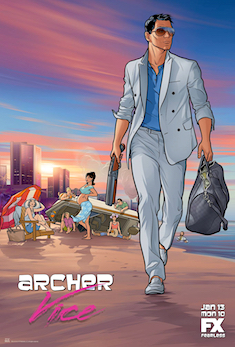 Here in the UK, animated spy-comedy Archer originally aired on Channel 5, until they started really titting about with the scheduling, which is what led me to drop off watching. It’s all on Netflix nowadays though, so I’m finally getting back into it.
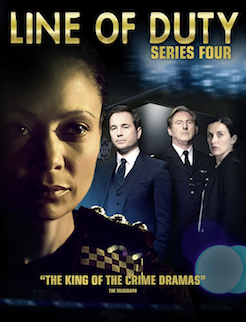 Another superb performance from Thandie Newton here, as the subject of AC-12’s latest internal affairs investigation. She’s convinced she’s arrested a notorious serial killer known as “Balaclava Man”; our faithful heroes reckon she’s cut corners, overlooking serious concerns about the evidence; the higher-ups who were exerting pressure on her to close the case would rather it all just went away. And as is the Line of Duty way, some shocking early developments send things spiralling in different directions. After the programme had become increasingly mired in its multi-season meta-arc
  While I very much enjoyed
 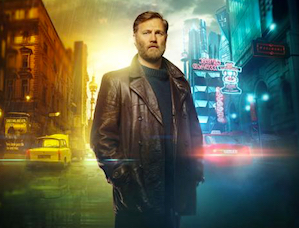 This month, I have mostly been missing the BBC’s miniseries adaptations of China Miéville’s The City and the City and Agatha Christie’s Ordeal by Innocence, both of which I’ve been saving up to watch in a more condensed fashion once they’re finished. The Christie ended on Sunday but the Miéville is only halfway through. Anyway, I imagine I’ll cover both next month. Also released this past month was Netflix’s big-budget reboot of Lost in Space, which I would’ve watched if I hadn’t been missioning my way through Westworld this past week. That might be here next month also. And finally, the last-ever season of The Best Show On TV™, The Americans, is underway in the US. Again, I’m saving it all up ’til it’s done, but I do intend to watch it promptly so as to avoid finale spoilers — my real hope is to time it just right so that I can watch the finale the day after it airs in the US, but we’ll see. Said finale isn’t until May 30th, so whatever happens I won’t be reviewing that until June.
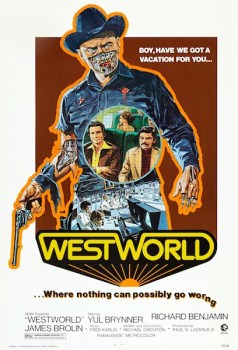 When writer-director Michael Crichton hit upon the notion of a theme park where the future-science star attractions broke free of their shackles and endangered the lives of the guests, it was so good it served him twice: he replaced the initial murderous AI-powered robot cowboys with rampaging genetically-engineered dinosaurs and sparked
 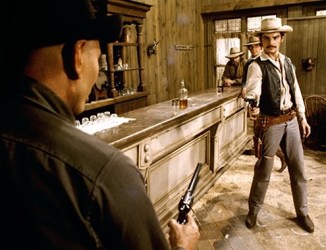 under $76,000, or about £58,200. The potential threat of the robots malfunctioning is built up gradually here and there, in asides from what our ostensible heroes are up to, and isn’t explained. There are nods to the fact the human staff don’t actually know how the robots work, but why should that be? Some of them were apparently designed by other robots, but how did the designing robots come about? Rather than explore any of its science fiction themes, the film just uses the basic idea to have the robots go on a killing spree right at the climax. This is something Crichton definitely turned around for
 100Films.co.uk