The New-Look Monthly Update for June 2015

Say hello to the new-look, bigger-than-ever 100 Films monthly update! Well, partially new look — much is the same, but there are some exciting new regular categories, and image-header-things. I had some ideas; I’ve introduced them all at once. (They excited me, anyway.)

First new regular: a contents list!


What Do You Mean You Haven't Seen…?

Just one WDYMYHS film watched this month (so I’m still two behind) — it’s Martin Scorsese’s beloved boxing biopic (that I should’ve watched in 2013 but failed to), Raging Bull. I would make a brief comment on what I thought of it, but we’ll come to that in the Arbies…


June's viewing

Kingsman#75 Changing Lanes (2002)
#76 Kingsman: The Secret Service (2015)
#77 The Expendables 3 (Extended Version) (2014)
#78 Ladyhawke (1985)
#79 Now You See Me (2013)
#80 The Interview (2014)
#81 Safety Not Guaranteed (2012)
#82 Superman vs. The Elite (2012)
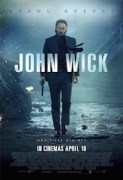
John Wick#83 Rush (2013)
#84 Whiplash (2014)
#85 Meet the Robinsons (2007)
#86 Before Dawn (2012)
#87 The Guest (2014)
#88 Raging Bull (1980)
#89 John Wick (2014)
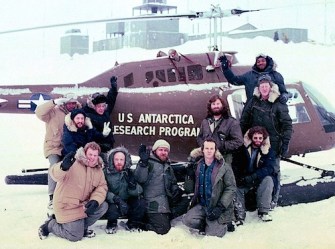
#90 Fury (2014)


Viewing Notes

  • Meet the Robinsons is the 47th official Walt Disney Animated Classic, and the 39th I’ve seen. 15 to go…
  • I have a whole new format and I make this entire section look pointless with one “oh, by the way” bit of trivia, which is less than I normally have to say here, I feel. Ah well, what can you do?


Analysis

2015 continues apace with 16 new films watched this month. That smashes the June average of 7.14 — indeed, reaching #90 singlehandedly drags it up over a whole film, to 8.25. It’s the highest June ever, which also means it’s the 8th month in a row to beat last year’s equivalent (June 2014 had 11). It’s the 13th month in a row in which I watched more than 10 new films, and is tied with January as both the highest month of 2015 and the third-highest month ever (also tied with May & August 2010). That means that, at 2015’s halfway point, its monthly average is exactly 15.

Most excitingly of all, however, is that I’m now all but guaranteed to reach #100 in July. I’d have to fail my ten-films-per-month goal not to, and I’ve been doing really well with that so have plenty of incentive not to let it slip. More on what reaching #100 in July ‘means’ next month (hopefully!)

Over in Prediction Corner: assuming I uphold my ten-per-month minimum, this year will reach at least #150, which would be my best year by some 14 films. In other words, we should know if 2015 is a new Best Year Ever by November at the latest. (Unless I mess up ten-per-month but then still pass 136 in December, of course.) Meanwhile, in the world of averages… well, we’re halfway through the year, so such a prediction would see my tally exactly double, clocking in at a quite extraordinary 180. (Extraordinary for me, anyhow — stow it, you “365 films in a year” people!)

I’ve been posting these regular monthly updates for over five years now, and in all that time they’ve been very much focused on numbers and stats — how many films have I watched, how does that compare to the past, what does it suggest for the future, etc. And that’s fair enough — as progress reports, it’s kinda their point to report my progress. But I’ve decided it’s about time to introduce some opinion into the mix, to liven things up a bit. So I proudly present…


The Arbies
The 1st Monthly Arbitrary Awards

So named because what I watch in any given month is pretty arbitrary, so the pool of contenders is a total whim rather than a genuine competition. Plus, each month two of the five categories are going to be arbitrarily chosen, just to compound the point. You’ll get the idea as we go along.

That’s Arbie on the right, by-the-way. In case that wasn’t obvious. (Turns out Arbie is also the name of the mascot of the Royal Bank of Canada. I don’t think anyone’s going to get us confused though, so on I go.)

For June 2015, the awards go to…

Favourite Film of the Month
I watched a number of very good films this month, several of them strong contenders for my year-end top ten, but when it came to the crunch there was a clear winner here: as anyone who read my review yesterday likely suspects, it’s The Guest.

Least Favourite Film of the Month
Although there were a couple of weak and/or disappointing movies amongst my viewing this month, and some I certainly liked less than this winner (or, rather, loser), for the greatest discrepancy between “expectation” and “what I actually thought of it”, this goes to Raging Bull.

The Most ’80s Soundtrack You’ve Ever Heard
Most months The Guest would have this sewn up, but oh no, not when Ladyhawke’s around. Can you imagine anyone doing a fantasy movie without a Howard Shore-esque orchestral epic soundtrack nowadays? Me either. In the ’80s, on the other hand… well, they sure did love their synthesisers.

Most “Oh, I Didn’t Know They Were In It” Cameo Appearance
If all you’ve seen of John Wick is the Keanu Reeves-centric posters, it’s probably riddled with moments such as these. Me, I somehow knew most of them, so this award goes to Jason “should’ve played James Bond at some point” Isaacs popping up in Fury as some kind of commander for a little bit. The Blu-ray has nearly an hour of deleted scenes; to my surprise, “the rest of Jason Isaacs’ role” doesn’t seem to be among them.

The Audience Award for Most-Viewed New Post of the Month
Because if I didn’t limit it to new posts, this would be Harry Potter every month (across 2014 and 2013 (the year they were first published), my reviews of Philosopher’s Stone and Chamber of Secrets accounted for 33.5% of all my page views).
This month: thanks primarily to being retweeted by a Keanu Reeves fan twitter, the victor is Man of Tai Chi.


from around the blogosphere…

I am shockingly bad at getting round to reading other people’s blogs, and when I do it’s often in fits and starts (as anyone who’s ever received half-a-dozen ‘likes’ from me on things they posted a month ago can attest). In the interest of being a better human being, then, I thought I’d start collating particularly interesting pieces from elsewhere and share them here, for whatever that’s worth.

There’s no particular rhyme or reason to my choices, just a handful of pieces that struck a particular chord for me this month. For one thing, there’s a pair of coincidently-thematically-similar pairings from the same two blogs. One of those is up first:

1976, the year it all started… @ the ghost of 82
ghostof82 tackles the emotions of what makes us love movies in the first place, through his own experience with Jaws in ’76.

Jurassic Park (1993) @ Films on the Box
Mike touches on a similar topic from a different angle: how films that are cinema-defining for a generation can appear to those outside said generation.

Evangelion June 22, 2015 @ Heather Anne Campbell
Monday 22nd June 2015 was “Evangelion Day”, the day on which the first episode of anime series Neon Genesis Evangelion takes place. In this write-up, Heather Anne Campbell explains what the series means to her and, in the process, outlines some of the reasons it’s so good and has endured for so long.

Ten of the Best – Noir Directors @ Ride the High Country
Whenever I read Colin’s blog I come away with a raft of new films I want to see. You can only imagine how many got added to my list after this well-considered overview.

Miracle Mile (1988) Review @ Cinema Parrot Disco
Who doesn’t love stumbling across something they’ve never heard of that turns out to be right up their street? No idea if I’d like Miracle Mile, or even if/when I’ll have a chance to see it, but table9mutant’s review has me suitably intrigued. And is it just me or are the ’80s everywhere at the minute?

Movies Silently’s Top Ten Talkies @ Movies Silently
Talking of, a) recommendations, and b) the ’80s, silent cinema doyenne Fritzi took a detour from her regular stomping ground with this list (technically from last month, but rules were made to be bent). Any list of favourites that includes Mystery Men is a good’un in my book, but the aforementioned ’80s recommendation is her #2 choice, medieval fantasy Ladyhawke. As you may’ve noticed above, it even managed to find its way to the top of my “must watch” pile (a rare feat). Full review in due course, but for now suffice to say I very much enjoyed it. I even thought the score had its moments.

RIP Christopher Lee @ Films on the Box
Finally, the second pairing I mentioned, on a sadder note. First, Mike pays fitting tribute to one of the great screen icons.

Remembering the Music of James Horner @ the ghost of 82
Last but not least, a personal tribute to composer James Horner.


Reviews


Archive Reviews


5 Iconic Music Themes

Film music has changed a lot down the years, but it’s been a pretty constant important element. Plenty of it is forgettable background noise, but some stands out so much it becomes famed in its own right. I recently re-watched the original Star Wars trilogy, inspiring this month’s top five: three film themes — plus two from other mediums — that, to me, are some of the most iconic of all.

  1. Doctor Who by Ron Grainer
    Doctor WhoDiddly-dum diddly-dum diddly-dum ooo-weee-ooo… For generations of British children, that’s the sound of Saturday night adventure. I guess to some people it’s just a children’s TV theme, but they’re wrong: it was a genuinely pioneering, important example of burgeoning electronic music (honestly). As a composition it’s surprisingly versatile: Delia Derbyshire’s original arrangement is still chillingly unsettling 52 years on; Murray Gold’s 2005 version (arguably perfected in the Series Four version) is an equally-perfect orchestral blockbuster.
  2. Star Wars (Main Theme) by John Williams
    Star WarsDooo-dooo dododo-dooodo dododo-dooodo dododo-doo… You could probably fill this list twice over with John Williams compositions — Indiana Jones, Jaws, Superman, Jurassic Park, more recently Hedwig’s Theme from Harry Potter, and so on — but undoubtedly the most iconic of them all is his main theme to George Lucas’ space-fantasy saga. Running it a close second is the same series’ Imperial March, perhaps the greatest villain’s theme ever. All together now: dum dum dum dum-dudum dum-dudum…
  3. James Bond Theme by Monty Norman
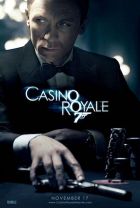
    Casino Royale teaserDang da-dang-dang da-da-da dang da-dangdang da-da-da daa-daa da-da-daa… A 53-year-old surf rock tune should by all rights be horribly dated, but I guess true cool endures. While the version used in the films has barely changed, there are an abundance of variations for trailers, etc. My personal favourite is the one created by Pfeifer Broz. Music for the Casino Royale trailer in 2006. The climactic use of a choir is one of those “how did it take someone 43 years to think of this?!” moments.
  4. The Fellowship Theme by Howard Shore
    FellowshipDooo-dooo dododooo, do-do-doo do-do-doo do-do-doo do do doo… The only one here that isn’t a title theme, but it’s indelibly part of the Lord of the Rings franchise — it has no reason to appear in The Hobbit trilogy, but I spent most of those eight hours missing it. It reoccurs throughout the trilogy (of course it does), but perhaps the purest version can be found in The Ring Goes South from the Fellowship soundtrack. “Only Peter Jackson and Howard Shore can make 9 people walking past a rock look epic.”
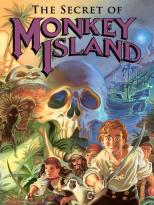
  5. The Secret of Monkey Island by Michael Land
    The Secret of Monkey IslandDoo-doo dodododo-doo do-do-do-doo… I’m certain this will be less familiar than any of the above to most people but, honestly, to me (and, I think, many other people who played the LucasArts games) it’s as iconic as anything else I’ve mentioned, including all of those other John Williams ones. The original was rendered in the style of its era — a digital MIDI thing — but it endured throughout the series and was transformed into some lusher orchestral versions. Try the version from the 2009 special edition, for instance.

I’m already full of incredulousness at myself for leaving out Indiana Jones. Or Back to the Future. Or Mission: Impossible. And it may’ve been composed by committee, but I love the main theme from Pirates of the Caribbean (find it cleanly in the first film’s He’s a Pirate). And if we’re allowing TV themes, what about Games of Thrones? I mean, this is pretty much what I hear every time I watch the show. And also… oh, we’ll be here forever. What are you favourites?


Next month…

#100! Probably. Hopefully.

Persona (1966)

2015 #7
Ingmar Bergman | 79 mins | DVD | 4:3 | Sweden / Swedish | 15

Since that debate [between New York critics Susan Sontag and Andrew Sarris when the film was first released], writing about Persona has been for film critics and scholars what climbing Everest is for mountaineers: the ultimate professional challenge.

Oh dear.

PersonaThat quote comes from Thomas Elsaesser in the introduction to his Criterion essay “The Persistence of Persona”. He goes on to add that, “Besides Citizen Kane, it is probably the most written-about film in the canon. [Every major critic has] written with gravity and great insight about Persona, not counting several books and collections entirely devoted to the film.” Well, I can’t promise gravity or insight. In fact, practically the opposite, because I think that Persona is almost wilfully obtuse.

That’s not because the film is stupid, but because it’s “slow to understand” in the sense that the viewer can’t understand it — people have been debating its meaning for almost 50 years now, and it seems that still no one really knows what it’s about or what it’s trying to say. Obviously that’s some people’s bag, but it leaves me slightly baffled how it can gain such acclaim as to be well-regarded outside of the circles that decide Sight & Sound’s decennial list — I mean, it’s on the IMDb Top 250! There are some great bits, in particular some gorgeous cinematography, but the artistic indulgences (shall we say) and the complete lack of any clarity of meaning by the end make it an unlikely populist choice.

Summer holidayThe plot, such as it is, concerns an actress (Liv Ullmann) who has decided to become mute and her nurse (Bibi Andersson), who travel to a seaside summerhouse to attempt recuperation. After we’re told how they grew closer, events concern the breakdown of the relationship between the two women… or is there only one woman? We might end up inside one of their heads… but whose? Or is it both of their heads? Or…

In his Amazon.co.uk review (which can be found on this page only), David Stubbs reckons that the film is “an occasionally cryptic but overwhelmingly powerful meditation on the parasitic interaction between Art and Life… about the helpless incapacity of art to ‘say’ anything in the face of grim reality.” He may well be right. What the women’s odd relationship/symbiosis has to do with that, I have no idea.

On the bright side, as I mentioned, it is beautifully shot. Some of it is on the surface unexceptional, but carries a simple beauty; other images, however, are strikingly composed and lit. There’s a particular shot that merges the faces of the two actresses together. Even though the similarity of their features is supposedly what gave Bergman the entire idea for the film, he didn’t come up with that shot until the edit. I personally didn’t think Ullmann and Andersson looked that alike, but, nonetheless, the merged shot could not be achieved any better with today’s photo-editing technology — it looks like one, wholly different, person. I’m sure there’s a deep philosophical meaning there, but I was just impressed by the technological wizardry.

Lesbian vampires?The film’s other most famous bit is a monologue Andersson delivers one night about a foursome she found herself in. As with most of the film its exact meaning is debatable, but it’s another unusual behind-the-scenes story: it was nearly cut, apparently, even though it’s in many respects the pivotal scene. It’s where the nurse opens up the most, leading to the actress’ ‘betrayal’ by repeating the story in a letter, which is what leads to the disintegration of their relationship and all the confusion/weirdness/’deep psychological filmmaking’ that follows. Later, Bergman lets a monologue (yes, another one) play in full twice. The meaning? He had intended to cut back and forth between the two actresses, but couldn’t decide which shots to discard, so just let it all run twice. At least that’s some confusion cleared up, then.

Clearly some people get a lot out of Persona. That’s nice for them. For me, it has moments of brilliance, but the stunted attempt to artistically portray the futility of portraying an idea through art is unenlighteningly ironic.

3 out of 5

Persona was viewed as part of my What Do You Mean You Haven’t Seen…? 2015 project, which you can read more about here.

Rear Window (1954)

2014 #119
Alfred Hitchcock | 112 mins | Blu-ray | 1.66:1 | USA / English | PG / PG

Rear WindowAdrenaline-addicted photographer L.B. “Jeff” Jefferies (James Stewart) finds himself house- and wheelchair-bound during a New York heat wave. Whiling away time spying on his neighbours around their shared courtyard, he begins to suspect the man opposite, travelling salesman Lars Thorwald (Raymond Burr), has committed a murder and is trying to cover it up. Jeff persuades his high-society girlfriend Lisa (Grace Kelly), visiting nurse Stella (Thelma Ritter) and police detective friend Doyle (Wendell Corey) to help investigate, but no hard evidence is forthcoming. Is Jefferies just bored and paranoid?

The end result of this, as a film, is a heady mix of suspicion, tension, voyeurism, and a light romantic subplot — Hitchcock through and through. It’s one of his best-regarded films, too: Vertigo may gain the Sight & Sound plaudits, but Rear Window is second only to Psycho on the IMDb Top 250; and, as I write, they sit precisely side by side, which on a list that long is tantamount to equality. (Not that S&S ignored Rear Window: it’s at #54 on their last list.)

At its most basic level, Rear Window is an incredibly effective thriller. The setup is intriguing, followed by a drip feed of facts and clues that invite us to play detective too, joining in with the characters’ speculation. Jeff believes Thorwald’s guilt almost unequivocally, but not all his friends and associates agree, which gives us permission to doubt the movie’s ostensible hero. Maybe this isn’t the story of a well-executed murder uncovered by a right-place-right-time layman, but instead the narrative of an adrenaline junkie driven half-mad by being cooped up at home? The final reveal might turn out to not be the truth of the crime, but the truth of Jeff’s paranoia. The romantic subplot, which pivots around the vastly differing lifestyle desires of the pair (Lisa loves being a fashionable New Yorker, Jeff desires to explore the dangerous parts of the world), only emphasises the notion that Jeff may just be unhappy being ‘settled’.

The titular portalHitchcock certainly didn’t consider Jeff to be an out-and-out hero, even aside from the very real possibility that he may be wrong — as he put it in one interview, “he’s really kind of a bastard.” After all, what right does he have to be poking his nose so thoroughly into other people’s business? Not only to spend his time spying on all and sundry, which in many respects is bad enough, but to then investigate their lives, their personal business, even break in to their homes. If he’s right, they’ve caught a murderer, and the methodology would be somewhat overlooked; if he’s wrong… well, who’s the criminal then?

So Jeff is a voyeur, a position that one can interpret the film as implicitly both condoning and condemning; perhaps not in equal measure, but there are pros and cons. Through his directorial choices, Hitchcock makes us into one as well. In a genius move, we’re limited to Jeff’s perspective: we only see inside his apartment and the view from his window, pretty much as he sees it. If he falls asleep, we most often fade to black. We don’t have the advantage of knowing much that he doesn’t (as is sometimes the case in this kind of movie), but we do know exactly what he does, no less. The only difference is we can consider the possibility that he’s fooling himself — we have slightly more objectivity. Nonetheless, placing us in his shoes so thoroughly makes us consider the feeling of being a voyeur too. For some it’s uncomfortable; for others, probably a thrill; for many, I suspect, it’s a bit of both.

All of this is made possible, in part, by the movie’s incredible set, which has to be one of the greatest ever constructed. To quote from IMDb’s trivia section:

The entire picture was shot on one set, which required months of planning and construction. The apartment-courtyard set… consisted of 31 apartments, eight of which were completely furnished… some of the buildings were the equivalent of five or six stories high. All the apartments in Thorwald’s building had electricity and running water, and could be lived in.

Rear Window courtyardClick to enlarge.

It’s an incredible toy box for Hitchcock to play in, and every technical element rallies to use it to its full effect. Virtually the entire movie is shot from within Jeff’s apartment, the camera panning from apartment window to apartment window as we follow Jeff’s voyeuristic gaze. (This choice has, decades later, led to at least one striking re-working.) In every film the camera’s lens is our window on the world, of course, but you rarely feel it so much as you do here. We share in Jeff’s frustration about not being able to get a closer, better look; at only being able to watch as his friends imperil themselves, so close — only the other side of the courtyard! — yet so far away. Nonetheless, he’s afforded something of the same perspective we get as film viewers: late in the film, as Lisa searches the suspect’s apartment, Jeff can see Thorwald returning home, but he has no way to warn his girlfriend — just like us in so many moments of movie suspense. (These days he’d just send her a text, of course. Though I suppose you could still milk that: He can’t handle predictive texting! Autocorrect’s got it all wrong! He’s dropped the phone! How did he load a Chinese keyboard?!)

There’s the sound design, too. The heat wave means windows are open, letting the sounds of parties and whatnot drift to all ears. It’s not as meaningful a commentary on the viewer’s experience, I don’t suppose, but it lends a veracity and sense of immersiveness to the situation, Suspense!further enhanced by the almost total lack of a score (only present in the opening few shots).

In crafting both a suspenseful thriller and a commentary on the audience’s perspective, Hitchcock created the kind of movie that can be appreciated by both the casual movie fan and the analytical cineaste alike. Whatever one’s reasons for appreciating Rear Window, it’s certainly a masterpiece.

5 out of 5

Rear Window was viewed as part of my What Do You Mean You Haven’t Seen…? 2014 project, which you can read more about here.

The Shining (1980)

2014 #80
Stanley Kubrick | 120 mins* | Blu-ray | 1.85:1 | UK & USA / English | 15 / R

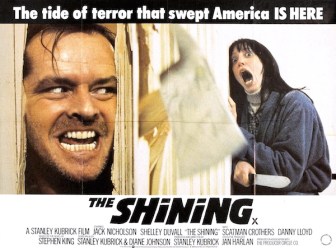
The ShiningFêted director Stanley Kubrick turned his hand to horror for this Stephen King adaptation. Poorly received on release (it was nominated for two Razzies: Worst Actress and Worst Director) and reviled by King (he attempted his own version as a miniseries in 1997. It didn’t go down well), it has since been reassessed as a classic. I’ve never read the novel, so have no opinion on the film’s level of faithfulness or (assuming it isn’t true to the book) whether that’s a good thing or not. As a movie in its own right, however, The Shining is bloody scary.

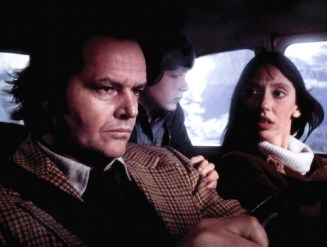
The plot sees Jack Nicholson, his wife and young son travelling to a remote hotel to be its caretakers while it’s closed over the winter. As the weeks pass by, strange things begin to happen. Nicholson begins to go a little stir crazy… or is it something worse? As the hotel becomes cut off by a snowstorm, everything goes to pot…

It’s somewhat hard to summarise The Shining because, in a way, nothing much happens. There are some mysteries, but few (if any) answers. That prompts plenty of wild theories — there’s now a whole film about them, even — but whether any of those are right or not… well, you know what wild theories are normally like, right? Really, story is not the order of the day. Kubrick seems to have set out to make a horror movie in the truest sense: a movie to instill fear. And that it does. And then some.

But you're not called JohnnyGradually, inexorably, the film builds a sense of dread; a fear so deep-seated that it feels almost primal. There are few jumps or gory moments, the easy stomping ground of lesser films. There’s just… unease. It’s a feeling that’s tricky to put into words, because it’s not exactly “scary”; even “terrifying” feels too lightweight. There are undoubtedly sequences of suspense, where we fear what’s coming or what will happen to the characters (everyone knows the “Here’s Johnny!” bit, for instance), but that’s not where the film’s impact really lies.

I guess some find it slow and aimless. There are certainly fans of King and his original that are just as unimpressed as the author by the way it supposedly shortchanges Nicholson’s character. There may be some validity to both of those arguments. Nonetheless, I found Kubrick’s realisation to be probably the most excruciatingly and exquisitely unsettling film I’ve ever seen.

5 out of 5

The Shining placed 3rd on my list of The Ten Best Films I Saw For the First Time in 2014, which can be read in full here.

It was viewed as part of my What Do You Mean You Haven’t Seen…? 2014 project, which you can read more about here.


* The Shining was initially released at 146 minutes. After a week, Kubrick cut two minutes off the end. Following a poor reception, he cut even more for the European release (some say 31 minutes, but that doesn’t add up). He maintained the shortest version was his preferred cut, though it’s not the one released in most territories… except the UK. ^

Requiem for a Dream (2000)

2014 #136
Darren Aronofsky | 97 mins | DVD | 16:9 | USA / English | 18 / NC-17*

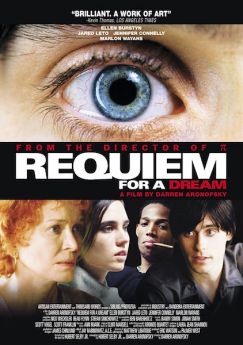
Requiem for a DreamOn Coney Island, the faded and decrepit one-time pleasure place of New York City, four people — Harry (Jared Leto), his girlfriend Marion (Jennifer Connelly), his best friend Tyrone (Marlon Wayans), and his mother Sara (Oscar-nominated Ellen Burstyn) — find themselves accidentally drawn into a whirlwind of drug addiction. Not to put too fine a point on it.

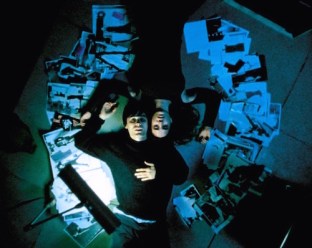
A lot of people say that Requiem for a Dream is the bleakest or most depressing movie ever made, and you kind of think, “yeah well, we’ll see — how bad can it be?” For most of the film, that notion is indeed misleading. Not that it’s a happy-clappy affair, but it’s a very watchable drama, not a gruelling slog through misery. However, I’m not sure you can quite be prepared for what comes later. Even if you were told what happens, or see some of the imagery, or feel like you can see worse stuff on the internet without even looking too hard (which, of course, you can)… that’s not the point. It’s the editing, the sound design, the sheer filmmaking, which renders the film’s final few minutes — a frenzied montage that crosscuts the climaxes of all four characters’ stories — as some of the most powerful in cinema. It’s horrendous. It’s brilliant.

The rest of the film may not be its equal in terms of condensed impact, but it’s of course vital in leading you to that point. These characters lead relatively normal lives — not exceptionally bad, certainly not exceptionally good, but pretty humdrum and bog standard. They all try to better themselves in some way — Sara through diet pills, Harry and Tyrone by getting rich through selling drugs — and it all goes horrible awry.

It may be a descent into misery, then, but director Darren Aronofsky keeps it watchable through pure cinematic skill. The editing, camerawork, lighting, sound design, and special effects are all incredible throughout. There’s a surfeit of ideas and innovations from everyone involved. And yet they are never show-off-y for the sake of it — this isn’t a Guy Ritchie movie. None of the tricks or striking ideas are put there to render the film Cool, even in the way they are in some equally brilliant films (Fight Club, for example). No, everything that is deployed is done so in aid of emulating a real-life feeling or experience, or conveying a concept or a connection. At times it’s breathtaking.

I must also make special mention of the score by Clint Mansell. The primary theme is arguably most famous for being used in The Two Towers trailer a couple of years later (that’s certainly where I discovered it). Something that works fantastically on the trailer for an epic fantasy war movie might not sound like it sits well in a junkie drama, but it really works.

Requiem for a Dream may have a bit of a reputation at this point; one that might put you off viewing it, or possibly only deigning to attempt it in a certain frame of mind. While there is an element of truth to that, it is a brilliant film — not “enjoyable” in the easily-digested blockbuster sense, but as a mind-boggling and awe-inspiring feat of filmmaking, yes. Incredible.

5 out of 5

Requiem for a Dream placed 8th on my list of The Ten Best Films I Saw For the First Time in 2014, which can be read in full here.

It was viewed as part of my What Do You Mean You Haven’t Seen…? 2014 project, which you can read more about here.


* After the film was given an NC-17, it was decided to release it Unrated — so, technically, it’s not NC-17, it’s Unrated. Ah, the quirks of the US classification system. (There’s also an R-rated version, which is the same except for some shot removals and replacements during the ending.) ^

Oldboy (2003)

aka Oldeuboi

2014 #123
Chanwook Park | 115 mins | DVD | 2.35:1 | South Korea / Korean | 18 / R

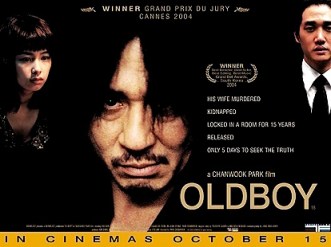
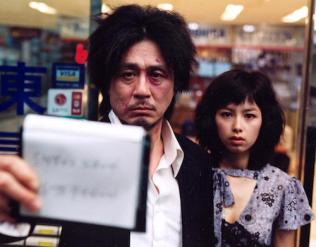
OldboyPerpetual drunkard, but also loving husband and father, Oh Dae-su (Min-sik Choi) is snatched off the street and imprisoned in a shabby bedsit without explanation. He learns that his wife has been murdered and he’s being blamed. His daughter lives, but he doesn’t know where. Then, 15 years later, and equally inexplicably, he’s released. He befriends a sushi chef, Mi-do (Hye-jung Gang), before being contacted by Woo-jin (Ji-tae Yoo) who claims to have been his captor. Dae-su is given just five days to discover why he was locked up. If he succeeds, Woo-jin will kill himself; if he fails, he will kill Mi-do. Dae-su’s investigations lead him to dark secrets, shocking revelations, and violent retribution.

It’s hard to summarise the effect of Oldboy without just watching it. As its premise hopefully conveys, it’s not wholly set in a world you can believe as our own, but nor is it an outrageous fantasy — maybe someone somewhere does run a kind of boarding house for illegal imprisonment? Stranger things have happened. It’s a film predicated on mysteries, but one that doesn’t rely on remaining mysterious — there are answers for every question, you just have to follow the strange path it leads you on and wait for the answers. Try not to get spoilered. (That said, it does have a (deliberately) ambiguous final end, but at least by then it’s answered the questions it started out with.)

Oh Dae-su and Mi-doChoi is excellent in the lead role, deserving of all the praise he’s garnered. It’s a highly unusual role with a lot of different and sometimes conflicting facets, but he pulls it all off with aplomb. He maintains a sense of mystery and unknowableness throughout, whilst also being a plausible human being in an implausible situation. As his adversary, Yoo makes for an excellent villain: calm, businesslike, always with the upper hand. The final confrontation is a scene to be savoured, calling to mind everything from James Bond to David Fincher (for me, at least) in terms of the villain’s slick lair and the twisted events that unfold in it.

Director Chanwook Park has a sure handle on proceedings, guiding the viewer through a sometimes tricky narrative. There’s also a distinct visual flair, exhibited not least in the infamous corridor/hammer fight sequence. Shot in a single-take from a vantage point that emulates side-scrolling computer games, it’s justly famed. The film as a whole is frequently gorgeously shot by DP Jung Jung-hoon, though at times it’s hard to tell if the DVD encode was obscuring some visual majesty or if it was just the film’s unusual look. May be one to get on Blu-ray, then.

Having garned acclaim in the West, it was inevitable we’d see a Hollywood remake of Oldboy. Bizarrely, Steven Spielberg and Will Smith were attached for a while, but it ended up coming to fruition in 2013 under the guidance of Spike Lee and starring Josh Brolin. It seemed to pass by almost unnoticed. Without having seen it (yet), it’s a little difficult to understand how a remake might work. Some people would say that about all remakes, but personally I don’t think it’s an automatically worthless or artistically unjustified process to engage in. Woo-jinIn Oldboy’s case, however, so much of what makes it special, unique and exceptional lies in the direction. So do you copy that wholesale? If you do, what’s the point — just watch the original. But if you don’t, what’s the point — you’re losing a large chunk of what’s special. I guess this is why the US version didn’t go down so well — whichever path it took, it was on a hiding to nothing. I look forward to seeing it to judge for myself.

Oldboy — original flavour — is kinda crazy, kinda disturbed, but kinda brilliant for it. It’s exactly the sort of thing that would never, ever pass “what would make a good film?” focus grouping, for so many reasons, and yet the result is quite incredible.

5 out of 5

Oldboy placed 7th on my list of The Ten Best Films I Saw For the First Time in 2014, which can be read in full here.

It was viewed as part of my What Do You Mean You Haven’t Seen…? 2014 project, which you can read more about here.

12 Angry Men (1957)

2014 #44
Sidney Lumet | 96 mins | Blu-ray | 1.66:1 | USA / English | U

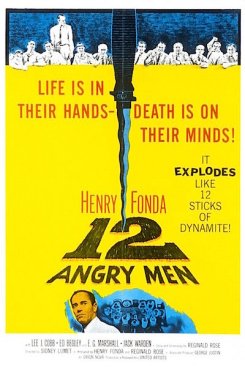
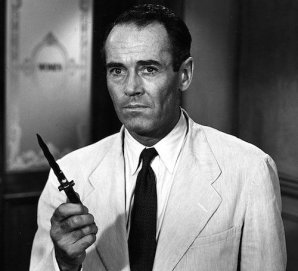
12 Angry MenTwelve people sit around in two rooms and talk for an hour and a half in more or less real time — sounds like a recipe for dull pretension, and yet 12 Angry Men is anything but. In fact, it’s probably one of the most gripping thrillers ever made.

The men in question are jurors in a trial we never see — we join the narrative as they retire to the jury room to debate their verdict. Except no debate is necessary: the kid in the dock, charged with murdering his father, is definitely guilty and destined for the electric chair. Or so eleven of the men think, because an initial count throws up one objector: Juror Eight, Henry Fonda. He doesn’t think the boy is innocent, he just thinks they should do their duty and discuss the evidence.

So discuss they do, much to the chagrin of the other men. It’s a burning hot day in New York City, we’re in an era before ubiquitous AC, and the cramped room they’re shut in doesn’t even have a working fan. The men want to get home, or to events they have tickets for, or what have you. But they have no choice, because Fonda won’t just change his vote. It’s through their deliberations that we begin to learn the facts of the case, though really these are neither here nor there: this isn’t really a trial of some minority teenager, but instead of the American justice system and these twelve men.

As the ghost of 82 discusses so well in his review, this is a film filled with first-rate performances. Fonda may be the only ‘name’, but there’s a host of recognisable faces, and every one of them is an essential cog in the film’s well-oiled machine. Screenwriter Reginald Rose has nearly doubled the length of his 51-minute teleplay*, but seems to have accomplished the extension effortlessly. The movie doesn’t feel padded, as other films with limited characters in a limited space can do, but like it’s precisely the correct length for the amount of material it needs to cover.

Killer evidenceSlowly, steadily, surely, Fonda’s juror leads a recap of the evidence, analysing it, picking it apart, challenging presumptions and suppositions. Gradually, other jury members begin to be won over. This could be trite — of course our hero has to start convincing the others — but this is where the writing and cast shine again, because even men who seemed unswayable have their minds changed in a plausible fashion. Even then, the outcome rarely seems certain, each victory hard won, so that the film holds you rapt, desperate for sense and reason to prevail. There are moments of tension which may literally push you to the edge of your seat; moments of exultant success which may elicit an exclamation of approval similar to a point scored in a sports match.

In his Criterion essay “Lumet’s Faces” (online here), law professor Thane Rosenbaum discusses the film’s groundbreaking and unique perspective on the legal system (how many other jury-room thrillers can you think of, before or since? Not many, I bet). The film has been seen by some as a defence of the jury system: even when a defendant has a poor defender in the courtroom (as, it seems, has been the case here), or an exceptionally gifted prosecutor, the truth will out among the jury. Rosenbaum disagrees:

The presumption that jurors are impartial is dashed within the first ten minutes of the film. … The virtues of the legal system are presented through the prism of its dark side. A jury is empowered to remedy the mistakes made by the defense… but will the jurors be able to overcome the imperfections of their own humanity[?] 12 Angry Men sends a warning to be careful in courtrooms. The custodians of the system make mistakes, and the corrective possibilities may be no better than a crapshoot.

Using the evidenceFor all that 12 Angry Men seems to show justice being served in the face of adversity, what it actually shows is justice being served thanks to blind luck: if Juror Eight had been a weaker-willed man, or another who was just as prejudiced as his eleven compatriots, then the debate would never have occurred, the teenager condemned to death in the blink of an eye. What are the odds on every jury room containing a Henry Fonda? I don’t fancy them myself.

Whatever (truthful) messages the film carries about the flaws of the legal system, there’s no denying its power as a thriller. You don’t have to debate its significance to the process it depicts, you can just be engrossed by the twists and turns of its story, be captivated by the twelve three-dimensional people it presents, complete with their own ideas, desires, and prejudices. Legal dramas are a dime a dozen on TV, but most still avoid the jury room. The unbetterableness of 12 Angry Men is probably why.

5 out of 5

12 Angry Men placed 5th on my list of The Ten Best Films I Saw For the First Time in 2014, which can be read in full here.

It was viewed as part of my What Do You Mean You Haven’t Seen…? 2014 project, which you can read more about here.


* Trivia time! Sidney Lumet directed over 40 episodes of television before this, his debut feature, but the original 12 Angry Men wasn’t among them. That was helmed by Franklin Schaffner. A lesser-known name than the acclaimed Lumet, I’d say, Schaffner went on to direct Planet of the Apes and Patton, and for the latter won a Best Director Oscar — something that, despite four nominations, Lumet never managed. ^

What Do You Mean You Haven’t Seen…? 2015

Six of One & Half a Dozen of the Other


My challenge-within-a-challenge (in which I must attempt to watch 12 renowned films within the next 12 months) returns for a third year, this time with a natty subtitle — or for short, WDYMYHS:SoOaHaDotO.

Yeah, let’s not call it that.

Why the unwieldy subtitle? Well, since its inception (in the distant past of two years ago), WDYMYHS has been torn between recommending critically-acclaimed must-sees and widely-popular must-sees — the first year erred towards the former, in reaction the second year skewed to the latter. This year, I had an epiphany: why make a list that tries and fails to serve two masters, when you could just make two lists?

No, I’m not going to try to watch 24 specific films (I know my own limits. Well, I don’t, but that’s one I know is doomed), but rather two lists of six — one of critically-acclaimed films, one of more populist movies. Hence the Clever subtitle.

As with last year, we’ll get straight to the two lists, and follow it up with not-for-everyone analysis of how they compare to previous years and an overlong explanation of how they were devised.

The Critical List

Raging Bull (1980)
Score: 608
TSPDT #21 | Sight & Sound 2012 #29 | featured on 1001 Movies to See | Academy Awards Best Picture nominee

The Passion of Joan of Arc (1928)
Score: 599
TSPDT #15 | Sight & Sound 2012 #12 | featured on 1001 Movies to See

L’Atalante (1934)
Score: 589
TSPDT #17 | Sight & Sound 2012 #14 | featured on 1001 Movies to See

Persona (1966)
Score: 587
TSPDT #24 | Sight & Sound 2012 #16 | featured on 1001 Movies to See

Le Mépris (1963), aka Contempt
Score: 554
TSPDT #38 | Sight & Sound 2012 #27 | featured on 1001 Movies to See

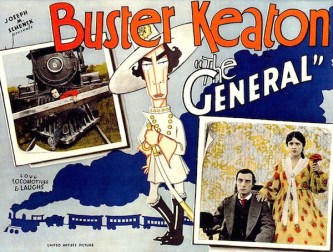
The General (1926)
Score: 553
TSPDT #36 | Sight & Sound 2012 #43 | featured on 1001 Movies to See


The Populist List

A Clockwork Orange (1971)
Score: 1,116
IMDb #75 | Empire 500 #37 | Empire 301 #54 | iCM Most ✓ed #83 | Reddit #50

City of God (2002)
Score: 782
IMDb #22 | Empire 500 #177 | Empire 301 #132 | Reddit #58

To Kill a Mockingbird (1962)
Score: 587
IMDb #81 | Empire 500 #180 | Empire 301 #132 | Reddit #121

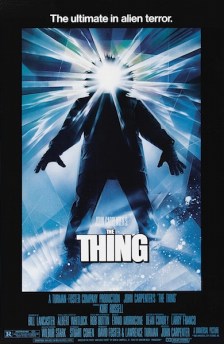
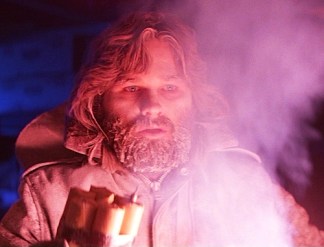
The Thing (1982)
Score: 501
IMDb #167 | Empire 500 #289 | Empire 301 #64 | Reddit #118

Brazil (1985)
Score: 483
Empire 500 #83 | Empire 301 #106 | Reddit #154

Princess Mononoke (1997)
Score: 480
IMDb #72 | Empire 500 #488 | Empire 301 #203 | Reddit #91


(All rankings were correct at the time of compiling and may have changed since.)

Good lists? Bad lists? Please do share any and all opinions. As per normal, my progress will be covered as part of the monthly updates.

Now then:

Stats

I’ll come to how all of that was compiled in a minute, but first a few (well, quite a lot, because you know I like these bits) observations.

First, those scores — pretty meaningless without knowing the method, I know (we’ll come to that, jeez!), but you can’t help but notice how high A Clockwork Orange’s is. Here’s the best I can do for perspective: what I’m calling “the theoretical maximum” for the Populist List is 1,636 points (it’s actually possible to score more, but let’s not get into that). Compared to that, A Clockwork Orange scored 68.2%. Sound low? The film in second place, City of God, comes to 47.8%, while the last included film, Princess Mononoke, has just 29.3%. The world really wants me to watch A Clockwork Orange. The Critical List is much closer: the “theoretical maximum” there is 908, from which Raging Bull has 67%, whereas last-place The General has 60.9%.

Long-time readers will surely have remarked on the inclusion of Raging Bull. It was part of 2013’s inaugural list, but I failed to watch it. It was excluded from re-inclusion in 2014’s, but I intended to watch it of my own accord (as it were)… and failed. I decided a year was long enough to hold out — especially as it topped the Critical List and came second on the Populist List — so it’s back in. I think this will be a new rule going forward: if I fail to watch a film, it has to ‘sit out’ the next year, but is eligible for inclusion the year after.

I have to say, the Populist List didn’t really turn out the kind of films I was expecting — I thought it would be an entire list of movies like The Thing and Brazil. I suppose it proves a point I’ve made in the past: despite their reputation among cineastes, lists like the IMDb Top 250 and Empire’s reader polls aren’t completely stuffed with blockbusters. OK, you’re not getting the depths of arthouse on there (i.e. the stuff the Critical List has selected), but A Clockwork Orange and City of God are hardly Transformers 4. Well, I haven’t seen them, so I suppose maybe they are…

I actually tried to make both lists skew ‘newer’ (not because I dislike older films, but because some of these lists tend to be a bit biased against them — TSPDT admits they ‘punish’ newer films), but it barely came out at all in the final 12: the newest film is 2002’s City of God, which is 13 this year; the next is Princess Mononoke, which is 18. I suppose that’s better than 2013, when the most recent film was from 1984. The effects were felt further down the chart, but that’s of little relevance to me now; though if I’d locked out Raging Bull entirely, 2011’s The Tree of Life would have nipped in. (More on this later.)

For what it’s worth, The General and The Passion of Joan of Arc are the two oldest films to have featured in WDYMYHS, and L’Atalante is fourth (third being City Lights from 2013’s lot). That extreme aside, this year’s list are quite spread around: whereas 50% of 2013’s were from the 1950s and 50% of 2014’s were from the last 20 years, no such pithy evaluation can be made this year. The ’60s and ’80s present three films each; there’s the two from the ’20s already mentioned; and then one apiece from the ’30s, ’70s, ’90s and ’00s. The 76 year gap between the oldest and newest pips 2013’s 53 years and 2014’s 73 years.

It’s also worth noting that there’s a greater variety of languages and countries of production included this year. Non-English films made up three in 2013 and two in 2014, but this year it’s six — half the list! That said, The Passion of Joan of Arc is actually silent, and I may well watch the Neil Gaiman-penned English dub of Princess Mononoke, both of which would take the wind out of these sails a bit.

The countries of origin are undeniably spread, though. Ignoring co-production technicalities, last year only offered two non-American movies, and the year before four (the three foreign language ones plus Lawrence of Arabia, which I’ve got down as a US/UK co-production but am counting as British). This year, the US is still highest, but only with four films — there’s France thrice and the UK twice*, as well as Brazil, Sweden, and Japan.

As for directors, Kubrick’s back again, in the form of A Clockwork Orange (obviously). No surprise there, as it was ranked very highly in each previous year but eliminated under the “no repeat directors” rule. Full Metal Jacket and Barry Lyndon also made their way into the Top 6s (the former for Populist, the latter for Critical), but were similarly eliminated. I guess one will end up on 2016’s list (unless I drastically change how I do this… which I might). After sitting out last year, there’s a return for Bergman, in the shape of Persona. For the first time, no Hitchcock or Charlie Chaplin — they both had multiple entries near the top in previous years, but this time Chaplin managed 18th on the Critical list with The Gold Rush, while Hitchcock’s first appearance is on the same but way down at 70th. 70th! On the Popular list, it’s not until 84th. Have I seen all the great Hitchcock movies already? There’s an awful lot of his films I’ve not seen, and I thought some were well-liked (whither The 39 Steps?**), so I’m quite disappointed about that.

Other noteworthy directors included are John Carpenter, Carl Theodor Dreyer, Terry Gilliam, Jean-Luc Godard, Buster Keaton (taking Chaplin’s place?), Hayao Miyazaki, Martin Scorsese (for the second time… with the same film), and Jean Vigo. The list is rounded out by City of God’s Fernando Meirelles, who made the excellent The Constant Gardner before seeming to slip back into obscurity, and To Kill a Mockingbird’s Robert Mulligan, who I don’t know anything about and (to be frank) doesn’t seem to have helmed anything else noteworthy.

The curious among you may be wondering (by which I mean, I wanted to know so thought I may as well tell you) what other films would have been included if I’d taken all 12 from either list? Well, the next six eligible films on the Critical List would have been, in rank order, Barry Lyndon (re-included because of no Clockwork Orange), The Tree of Life (as mentioned), Ugetsu Monogatari, Shoah, The Wild Bunch, and The Magnificent Ambersons. (Fanny and Alexander and Wild Strawberries also scored enough to qualify, but Persona rules them out.) On the Populist List, what I was saying about “films like The Thing and Brazil” would have been borne out: the extra six would have been Raging Bull (having not been blocked by the Critical List), Drive, Rocky, District 9, The Sting, and Black Swan. (I know those films aren’t like the others, per se, but hopefully you see what I’m driving at.)

Process

This year’s scoring system is heavily based in last year’s, with some tweaks and changes, for various reasons.

The most obvious is that there are two lists, using two completely separate sets of contributing lists. The basic principles are the same for both, though: I took the top 250 entries on each contributing list and those films received a score out of 251 for their position — so #1 would score 251 points, #2 would score 250, and so on down to #250 scoring 2 points. Many of the lists go past 250 entries, however, so any film lower than that (but which came to my attention by being in the top 250 of a different list) received a single bonus point just for appearing.

There was a further 50 point bonus for appearing in the top 250 of more than one list. Last year that was an extra 50 points for each additional list; this year it’s a one-time deal. As with last year, there was an additional bonus based on the number of ‘official lists’ a film appears on at iCheckMovies.com — i.e. A Clockwork Orange is on 30 lists, so got 30 points.

With the basics established, let’s get list-specific:

The Critical List was compiled from:

Finally, to help swing the list further in favour of recent films, the top 100 of the 21st Century’s Most Acclaimed received another 25 points. Fat lot of good it did any of them.

WDYMYHS 2015 Critical Top 50Now, here’s an interesting thing: I very quickly got bored doing the maths on all this. The previous two years, I’ve worked it all out in my head as I went. Year One, very easy (A+B ÷2); Year Two, more complicated, but doable; Year Three, two whole sets of rules and so many films…! So I spent an afternoon learning a bit more about how Excel works and got it to do it all for me. Imagine an evil laugh here.

To work out the scores for the Critical List, then, here’s the code (is it code? It looks like a code. Let’s call it code) that I wrote:

=SUM(IF(B2=0,0,(IF(B2<251,252-B2,1))))+(IF(C2=0,0,(IF(C2<251,252-C2,1))))+(IF(D2=0,0,(IF(D2<251,252-D2,1))))+(IF(E2="Y",50,0))+(IF(F2="Y",25,0))+(IF(G2="Y",50,0))+H2+(IF(D2=0,0,(IF(D2<101,25,0))))

That does everything I just described, automatically, when the correct values are entered in the correct columns — i.e. the ranking for each list, plus Y or N for 1001 Movies and Oscar noms. I’ll be frank, this is one reason there’s only the single multi-list bonus this year — that’s what I wrote into the code, and when I remembered later that it wouldn’t be adding another 50 for the third, fourth, etc, lists, I frankly couldn’t be bothered to work out how to do that. I’d wager it can be done, though.

The Populist List has even more constituent elements — and an even longer (though, technically, less varied) code to work it out. First, the contributing lists were:

  • The IMDb Top 250 — aka the movie list. Well, until TSPDT came along. Now I guess it depends on your personal preference which is more relevant. This changes all the time, so was very much the version hosted by iCM on 5th January 2015.
  • Empire’s The 500 Greatest Movies of All Time, commonly known as the Empire 500. Supposedly “the most ambitious movie poll ever attempted”, it was conducted by Empire magazine in 2008 and features the opinions of “10,000 Empire readers, 150 of Hollywood’s finest and 50 key film critics”.
  • Empire’s The 301 Greatest Movies of All Time, aka the Empire 301. Technically the new version of the above, held last year to mark Empire’s 300th issue. Arguably not as good. As you can see from the numbers up above, some films have moved around a lot.
  • iCheckMovies’ Most Checked, being the movies the greatest number of iCM users have seen. I think one of my most-complete lists, as I’ve seen 209 of the 250.
  • The All-Time Worldwide Box Office chart, not that it had any bearing on the final selection (you’ll note none of them are on it).
  • The Reddit Top 250, in which Reddit users have picked their favourite movies. Constantly updated a la the IMDb version, I believe.

As mentioned before, those were all initially limited to the top 250 entries and weighted equally. Following that, however, there were 25 bonus points to be had for being in IMDb’s top 100, the Empire 301’s top 50, or iCheckMovies Most Checked’s top 50. All of that made the Excel code look like this:

=SUM(IF(B34=0,0,(IF(B34<251,252-B34,1))))+(IF(C34=0,0,(IF(C34<251,252-C34,1))))+(IF(D34=0,0,(IF(D34<251,252-D34,1))))+(IF(E34=0,0,(IF(E34<251,252-E34,1))))+(IF(F34=0,0,(IF(F34<251,252-F34,1))))+(IF(G34=0,0,(IF(G34<251,252-G34,1))))+(IF(H34="Y",50,0))+I34+(IF(B34=0,0,(IF(B34<101,25,0))))+(IF(D34=0,0,(IF(D34<101,25,0))))+(IF(E34=0,0,(IF(E34<101,25,0))))

I don’t expect you to understand or have a use for that, I’m just showing off.

WDYMYHS 2015 Populist Top 50In the end, there were 121 films on the Populist long list and 82 on the Critical one. If you want to have a look at the top 50 of each, as featured in the small pictures earlier and to the right, you can find full-size versions here and here. You’ll note the Critical List isn’t filled out in full. At the end of a long day of list-making and code-writing, I couldn’t be doing with scouring the 1001 Movies and Oscar nominees lists for films that, even with those bonus points, couldn’t make the top 12 (never mind the top 6 that actually mattered). The reason some further down are filled out is because they were done incidentally as I went, for one reason or another. (You’ll also note that the row numbers are out by one from the ranking numbers, which is thanks to the Title row. Sadly I don’t know how to change that, if you even can.)

The End

And so there we have it! It felt less complicated a system than last year to me when I set out, I think because last year I was working out/making up all the rules and this year just tweaking and re-applying them. Making Excel do the heavy lifting for me, though, that was new and tricky, but worth it.

Now all I’ve got to do is actually watch the films…


* These numbers are somewhat debatable. For the record, I’ve counted A Clockwork Orange as British. ^

** I did a quick test to find out, and it should actually be in the mid-50s on the Critical list. Why wasn’t it included? Because the only numbered list it appears on is TSPDT, at 511th, and I only went up to 250th when first compiling from there. Its appearance on 1001 Movies gives it a big points boost after that. This does slightly concern me: how many other films am I missing that would have scored just as well? However, I don’t think it’s possible for anything like that to have cracked the Top 6, so in the end it doesn’t really matter. ^

Modern Times (1936)

2014 #55
Charles Chaplin | 83 mins | DVD | 1.33:1 | USA / English | U / G

Modern TimesCharlie Chaplin satirises technology and modernisation in arguably the last film of the silent era. It actually has a synchronised soundtrack, primarily for music and effects, but also dialogue — though “we hear spoken voices only when they come from mechanical devices, a symbol of the film’s theme of technology and dehumanization.” The irony is it was that technological progress which rendered Modern Times the last hurrah for the era Chaplin remains most identified with.

Stand-out sequences include Chaplin and co-workers battling a speedy production line, and him being the test subject for a new machine designed to feed workers quickly.

4 out of 5

Modern Times was viewed as part of my What Do You Mean You Haven’t Seen…? 2014 project, which you can read more about here.

In the interests of completing my ever-growing backlog, I decided to post ‘drabble reviews’ of some films. For those unfamiliar with the concept, a drabble is a complete piece of writing exactly 100 words long. You’ve just read one.

Seven Samurai (1954)

aka Shichinin no samurai

2013 #110
Akira Kurosawa | 207 mins | Blu-ray | 1.33:1 | Japan / Japanese | PG

Seven SamuraiSeven Samurai used to be a striking anomaly amongst the top ten of IMDb’s user-voted Top 250: it’s a three-and-a-half-hour subtitled black-and-white movie. These days it sits at #21, presumably through a mixture of IMDb tweaking the voting rules and it being rated lowly by people keen to see all of the Top 250 but who don’t typically like three-and-a-half-hour subtitled black-and-white films. Nonetheless, it has a claim to wide popularity (alongside its critical renown) that is rarely achieved by three-and-a-half-hour subtitled black-and-white movies.

In 16th Century Japan, rural communities are terrorised by gangs of bandits stealing their crops, raping their women, and all that other nasty to-do. One village has had enough and, knowing they can’t defend themselves, sets out to employ a band of samurai to defend them when the bandits come again the next year. Samurai aren’t cheap, but the villagers have no money, so they’ll have to make do with what they can get. Managing to snag Kambei (Takashi Shimura) to lead the defenders, he assembles a team, including wannabe Kikuchiyuo (Toshiro Mifune) and five others (Daisuke Katō, Isao Kimura, Minoru Chiaki, Seiji Miyaguchi, and Yoshio Inaba), who then set about preparing the villagers for battle…

Despite its epic running time, Seven Samurai isn’t really an epic film — this isn’t the story of a war, or even a battle, but of a skirmish to defend one village. How does it merit such length, then? By going into immense detail, by having plenty of characters to fuel its narrative and its subplots (and if you think there’d be plenty of time to explore seven characters in over three hours, turns out you’d be wrong), and by using the time to familiarise us with these people, so that when the final fight comes — and that’s a fair old chunk of the film too — we care what happens. Plenty of other films make us care in a shorter period of time, of course, but here we feel truly invested in the outcome.

The titular seven (well, six of them)It’s also unhurried. As Kenneth Turan explains in his essay “The Hours and Times: Kurosawa and the Art of Epic Storytelling” (in the booklet for Criterion’s DVD and Blu-ray releases of the film, and available online here), the film “unrolls naturally and pleasurably… luxuriating in its elongation — it takes an entire hour just for the basic task of choosing the titular seven.” As a viewer, I think you have to be mentally prepared for that pace, in a way. Most other films would use a snappy montage to collate the team, with key scenes or moments later on being used to highlight their personalities — witness any number of Hollywood (and Hollywood-esque) ‘men on a mission’ movies that do exactly that. Kurosawa’s expanded version makes the film more a marathon than a sprint, with only some of the negative connotations describing something as “a marathon” entails.

In truth, this is not the most fascinating portion of the film, but nor is it without merit. As discussed, it’s establishing these characters in full so that we are more attached to them later, but it’s also commenting on, perhaps even deconstructing, the image and role of the samurai. In “A Time of Honor: Seven Samurai and Sixteenth-Century Japan” (again in Criterion’s booklet, and available online here), Philip Kemp explains how Kurosawa’s depiction of the samurai overthrows some simplistic ideals that had become associated with them, and shows them instead as normal human beings, more likely to run away to save their own skin than pointlessly fight to their death. The villagers have indeed managed to employ professional combatants, but they’re not so different to the villagers themselves, just better trained.

The rain in Japan falls mainly on the actionThe length ensures our investment in the village, too, just as it does for the samurai. They’re not being paid a fortune — in fact, they’re just being paid food and lodging — so why do they care? Well, food and lodging are better than no food and lodging, for starters; and then, having been in the village so long in preparation, they care for it too. It is, at least for the time being, their home. You can tell an audience this, of course, but one of the few ways to make them feel it is to put them there too — and that’s what the length does. To quote from Turan again,

The film’s length works in its favor in ways both big and small: It allows the samurai leader, whose head is shaved in an opening scene, to gradually grow his hair back. It allows the eternally uneasy bond between the samurai and the villagers, as well as the villagers’ martial confidence, to grow believably over time. … When the bandits finally do attack, our hearts are in our throats — we know the defenders so well, and we can sense that not everyone will survive.

It can seem like a blind alley to go on about a film’s length — many an epic is long just because it has a long, or large, story to tell — but in Seven Samurai, the sheer size, and the way it uses that, are almost part of the point.

The film ends with a melancholic note. That “eternally uneasy bond between the samurai and the villagers” comes to an end — with victory won, the surviving samurai are no longer required. The farmers return to farming, the samurai return to… what? They are not really at home in the village, they were just guests; nor are they rich, because there was no pay — so what have they got out of the conflict? As Alain Silver notes in “The Rains Came: Kurosawa’s Pictorial Approach to Seven Samurai” (in Criterion’s booklet, of course, but not online), The final shotthe final scene, the way it’s edited and framed, ties the remaining samurai to their deceased comrades, the living and thriving farmers a distant and separate group. Fighting is the way of the past, perhaps, and peaceful farming the future. Or is the samurai’s only purpose to be found in death, because other than that they are redundant?

Even if you don’t want to get into the film’s philosophical underpinnings, there are plenty of other, more visceral thrills to enjoy. The characters provide humour as well as emotional depth; there are scattered “action sequences” throughout; and the big climax may technically only be a skirmish, but it’s one played out in detail, to epic effect. There’s not the choreography that viewers used to modern blockbusters or Hong Kong fisticuffs might expect, but that doesn’t meant the rough and realistic fighting isn’t exciting or well-constructed. Drenched in rain and covered in mud, it’s messy and, in its own way, beautiful. The whole film is visually stunning, as you’d expect from a Kurosawa picture. You may not realise it at the time, but many a familiar type of shot actually originated here, and then was copied down the ages.

It might seem difficult to credit now, but Seven Samurai was only fairly well received in Japan on its initial release: as Stuart Galbraith IV reveals in “A Magnificent Year” (also in Criterion’s booklet (where else?)), most of the awards for Best Picture went elsewhere, and at the box office it was comedies and romances that were the big crowd-pleasers. 'I can't believe Toho cut our movie'And it wasn’t as if it was overseas viewers who hit on the magic: as Turan reveals, “Toho Studios cut fifty minutes before so much as showing the film to American distributors, fearful that no Westerner would have the stamina for its original length.” The more things change the more they stay the same, I suppose — how many Great Films from Hollywood are ignored by awards bodies and audiences, only to endure in other ways?

Seven Samurai is definitely a case of the latter. Its standing on the IMDb list may have slipped with time (and rule changes, no doubt), but it’s still a trend-bucker — a three-and-a-half-hour subtitled black-and-white film that can appeal, if not to the masses, then to some people who wouldn’t normally go in for that kind of thing. A marathon but not a slog, requiring investment rather than passive absorption, Kurosawa’s epic rewards the viewer with one of cinema’s most enthralling, gorgeous, and vital experiences.

5 out of 5

Seven Samurai placed 1st on my list of The Ten Best Films I Saw For the First Time in 2013, which can be read in full here.

It was viewed as part of my What Do You Mean You Haven’t Seen…? 12 for 2013 project, which you can read more about here.

This review is also part of the 100 Films Advent Calendar 2014. Read more here.