
Christmas is properly over now: adults are back at work; kids are back at sch— wait, what? Another lockdown?
Well, the festive season is over either way, isn’t it? So it’s time for my annual look back at some of the TV highlights. Or what was on, anyway.

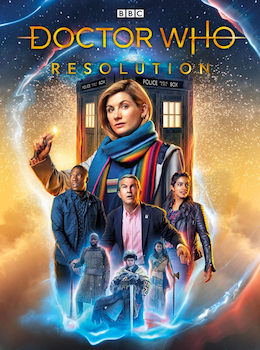
Doctor Who Revolution of the Daleks
 This year’s Doctor Who special felt like a bid by showrunner Chris Chibnall to keep fans happy. Popular character Captain Jack Harkness is back, properly this time — after a cameo-ish appearance last season, this is his first major role in the show since 2008. And the proper Daleks are back, too — we got a sort-of-Dalek two years ago in the last special, but, after that’s used as the model for an army of “security drones”, the real Daleks turn up to exterminate them, with the 2005-style bronze Daleks making their first full appearance since 2015 (yes, it’s been that long).
Of course, the one thing most fans would really like Chibnall to do is bugger off and let someone better write the show. He hasn’t given us that gift yet, sadly, but at least this is one of his better episodes. It’s suitably romp-ish for a seasonal special, with plenty of running down corridors, exploding enemies, and the odd gag or two. There’s even some political satire, albeit fairly familiar, heavy-handed, and underdeveloped. Well, that’s Chibnall’s whole style, isn’t it? He can’t seem to escape it, or doesn’t want to (there are surely other writers or script editors he could employ to help point him in the right direction).
The other big news this episode is the departure of regulars Ryan (Tosin Cole) and Graham (Bradley Walsh). The latter has been one of the highlights of this era, but is given short shrift here. He barely has anything to do all episode — with a cast this big there’s no time for everyone to get emotional subplots (or what Chibnall thinks passes for them), and here they’re shared between the Doctor, Ryan, and Yaz… plus returning villain Robertson, of all people, who is arguably the episode’s main character. What a shitty way to write out two of your leads. And when it comes down to it, Graham only decides to leave the TARDIS because Ryan wants to go, and he wants to spend time with Ryan. Walsh is a fine actor when given the chance, and he deserved better. Ryan’s reasons for leaving aren’t quite as underwritten, but Cole does most of the heavy lifting, injecting a lot into unspoken moments to convey what Ryan’s feeling. A bit of screenwriting advice I once read asserted that, if you don’t bother to give your characters subtext, a good actor will invent their own regardless — it feels like that’s what’s happened here; or, at least, Cole has expanded well on the thin material Chibnall gave him.
In any other recent era, Revolution of the Daleks (an inaccurate title — it should’ve been called something like Purity of the Daleks, or even Security of the Daleks) would be a middle-of-the-road episode, at best. At present, it’s probably going to be remembered as of the highlights of the era. There are now rumours that Jodie Whittaker is planning to leave the show after her next run, having completed the more-or-less standard three series. Well, the wrong person is going: she’s a fine Doctor let down by poor writing, and we’d all be better off if Chibnall would go and let someone else have a crack at giving Whittaker the material she deserves.
Cinderella A Comic Relief Pantomime for Christmas
 With theatres mostly shut this November and December due to Covid restrictions, the UK’s traditional pantomime season was a write-off. But where there’s a will there’s a way, and so an all-star bunch of actors and entertainers (including the likes of Olivia Colman, Helena Bonham Carter, Tom Hollander, and Anya Taylor-Joy, plus multiple surprise cameos) came together over Zoom to record this hour-long panto in aid of Comic Relief. (FYI, there are two versions available: a 60-minute one that aired on BBC Two, and a slightly extended 63-minute cut available on iPlayer.)
I imagine it would’ve been easier logistically to film everyone separately (and would we have been any the wiser?), but instead they seem to have wrangled all these stars together on the same Zoom call and performed it in more-or-less real-time. That ‘almost live’ aspect adds an element of unpredictability to proceedings — there’s the occasional tech issue, and a fair degree of corpsing and improvisation. Looking at other reviews, I guess this wasn’t to everyone’s taste (“a poor effort when better productions were hidden online”), but I thought it added to the do-it-yourself charm. It’s not a slick production by a bunch of pros, but has an air of fun similar to a bunch of mates doing their best and having a ball. The end result is very silly, of course, but all in the right spirit.
Roald & Beatrix: The Tail of the Curious Mouse
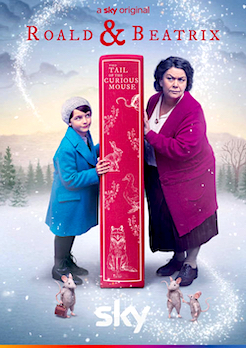 Sky’s big special this year was this based-on-a-true-story tale of when a young, bereaved Roald Dahl went on a trip to meet an ageing Beatrix Potter. Two of the great British children’s authors meeting up at very different points in their lives? It’s a wonder no one’s thought to film this before. Although, based on the evidence here, the meeting was fairly short and inconsequential — that they met is an interesting bit of trivia, not a defining moment in either’s life. To get this anecdote up to barely-feature-length (it’s just over an hour without ads), there’s a lot of expanded backstory on both sides. The Roald side feels like it must be broadly true — it’s all about him (and his mother) struggling to cope with the deaths of both his sister and father — but the Beatrix side feels dreamt up to balance it out — it’s just about her arguing with an agent about the contents of her latest book. Eventually, these threads converge on the eponymous pair’s brief meeting… and that’s the end. It’s a slight and gentle film, but it made for moderately charming Christmas Eve fare.
Comedy Specials
 As usual, the schedules were full of sitcoms and panel shows offering half-hour doses of festivals merriment. Highlights included a fourth Christmassy edition of The Goes Wrong Show, in which the accident-prone Cornley Polytechnic Drama Society turned their attention to The Nativity, with predictably disastrous — and hilarious — results. I get that Goes Wrong is too silly for some, but it hits just the right note for me. A more heartwarming tone was struck by the Ghosts special, in which Mike’s overbearing family coming to stay (clearly not set this Christmas, then). In keeping with the style of the recent second series, their presence prompted flashbacks to the life of horny MP Julian, which, via a series of kinky sex parties, delivered a message about appreciating your family while you can.
Meanwhile, Shakespearean sitcom Upstart Crow very much engaged with the current situation in an episode entitled Lockdown Christmas 1603, which imagined Will and his landlady Kate stuck at home during a plague-induced lockdown. Naturally this was a vehicle for observations about present-day life. It would be too kind to call it satire, but it was moderately amusing. After several years of Christmas specials, Not Going Out instead turned its attention to that other major end-of-December event: New Year. A show already fond of gathering its whole cast in a single location for basically a one-act play was perfect fodder for lockdown-constrained filming, and that’s what we get here: everyone gather for New Year’s Eve. Cue their inevitable sniping at one another — but when that gets too much, the assignation of New Year’s resolutions turns into some kind of group therapy session. It’s quite bold of a sitcom to deconstruct its characters’ defining foibles so explicitly, especially when there are more series on the way. One suspects the life lessons learnt won’t last…
Things to Catch Up On
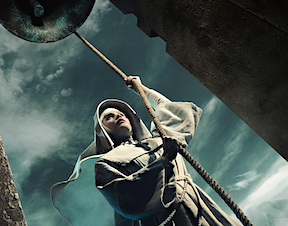 This Christmas, I have mostly been missing Black Narcissus, the BBC’s three-part re-adaptation of a novel most famous for being adapted into a film by Powell & Pressburger. It’s on iPlayer in UHD now, which is usually an incentive for me to catch it. Talking of three-part re-adaptations, I also didn’t watch Steven Knight’s version of A Christmas Carol — that was on last year, when I didn’t have time for it until after Christmas had passed. “Guess I’ll have to try to remember to watch it next year, then,” I said. Oops.
Next month… Perhaps Cobra Kai. After loving season one, I deliberately didn’t rush on to season two so that I didn’t burn through it too fast before season three. Then Netflix announced season three for early January, and then moved it forward to January 1st, and now instead of nicely spacing it out I just feel very far behind. Must resist the urge to burn through two seasons now instead…
 Now, that’s more like it! After the damp squib of alleged-finale
  Once upon a time it seemed implausible that anyone would ever try to play Poirot ever again, given how iconically (and thoroughly) David Suchet had embodied the Belgian detective during the 25-year series in which he starred. But I suppose it was inevitable that it would happen someday, and so following
  The BBC and Netflix teamed up for this £30 million CG animated adaption of Richard Adams’ children’s novel, perhaps most (in)famous for its 1978 film adaptation that is said to have traumatised all who saw it (I never have). I guess most of that money went on the all-star cast (seriously, the number of well-known names is mad — far too many to list here, so you can check out
  Normally I’d fold this into the comedy roundup (see below), but I enjoyed it so much I’m singling it out. As the title implies, this was a live edition of the long-running sitcom. What inspired that, I don’t know, but it paid off with the series’ best episode for years. The storyline didn’t necessitate the live-broadcast format in the same way as
 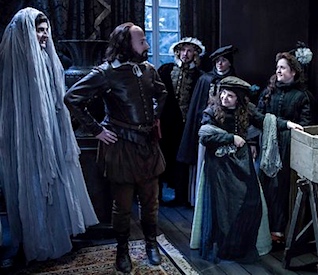 Also tickling my funny bone this season were a new Upstart Crow Christmas special, given a prime Christmas Day slot. It riffed off A Christmas Carol, which was unfortunate because I saw rather too many version of that this year (see below for another). I can’t say Crow’s take was particularly special, but I’m fond of the sitcom anyway so another episode is always welcome. The night before that (Christmas Eve, for those not keeping up), BBC One had one-off comedy-drama Click & Collect, with Stephen Merchant as a dad who must travel to the other end of the country to collect that year’s most-wanted toy for his daughter, accompanied by his irritatingly over-friendly neighbour. It’s the kind of fluff that would feel a bit too daft most of the time, but hits the right light-entertainment note at Christmas. A bit more cutting edge was Goodness Gracious Me: 20 Years Innit!, marking the 20th anniversary of the groundbreaking British-Asian sketch show with a special that used some of the series’ funniest sketches as examples to discuss what made the show so important. It was a subtly clever way to be both “greatest hits” clip show and retrospective documentary at once. Sadly, the repeat of an overlong old Christmas special that followed wasn’t quite as vintage. And, as I’m rounding things up, there were also seasonal editions of panel shows Mock the Week (the usual clips and outtakes), Have I Got News for You (more compiled clips), and Insert Name Here (actually a new edition! I’m fond of it and was happy to see back on our screens). Several others I’m yet to catch up on (Would I Lie to You, The Imitation Game), though I did see both new episodes of Mrs Brown’s Boys. I know I “should” hate it, but the Christmas Day one, at least, made me laugh.
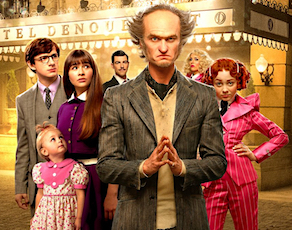 This Christmas, I have mostly been missing A Series of Unfortunate Events season three — the final one! Okay, it only came out yesterday, but I was with family and couldn’t watch it (ugh!) Not that I’d want to rush through it, anyway. By the time you’re reading this I’ll have made a start, and it’ll be reviewed next month. The same is true of Luther season four, which also started yesterday and which I’ll watch sometime later.
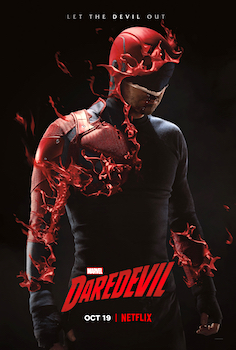 For the 11th season of Marvel Cinematic Universe TV shows on Netflix, we make a long-awaited return to the hero who started it all: the Man Without Fear… the Devil of Hell’s Kitchen… Matt Murdock, Attorney at Law… Daredevil.
 There’s a lot more to this season than that, though. New showrunner Erik Oleson has crafted a narrative for his 13 episodes that is better formed than most Marvel Netflix shows — heck, than most streaming series fullstop. It doesn’t seem to drag things out or go round in circles just to fill its episode count, but has a clear sense of pace and purpose. Okay, it’s still a streaming series — it still feels it can afford to devote entire episodes to things a network show might dash through in one sequence — but often that works to add depth. Spending a whole episode on Matt’s convalescence at the start of the season might seem indulgent, but it’s also important to his mindset for the rest of the season, which makes a big point of his morality, his religion, and his relationship with God — always a key aspect of the character, and foregrounded here without becoming objectionable to those of us with a less Catholicly inclined view of the world. The structural accomplishment really pays off in the final few episodes, too, with an array of surprising and game-changing twists and developments. My notes for later episodes were full of things like “shocking climax” and “oooh, twist!” and “ohhh shit!” At times Fisk feels genuinely unbeatable and you actually wonder how the heroes can win this one.
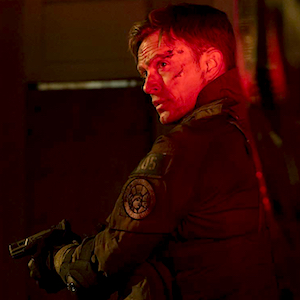 A good example of this is FBI Agent Benjamin Poindexter, who will turn out to be the villain Bullseye. Sorry if you think that’s a spoiler, but one of his first scenes shows off his mind-blowing marksmanship, so you ought to guess, really. In the comics, Bullseye has no backstory — he’s just a psychopathic killer — which is the kind of shit you can get away with if you’re being cartoonish. In the interests of psychological realism, however, Oleson wanted to give him one, to explore his origins, and they were basically free to do what they liked. They even spoke to psychiatrists and the like to make it genuinely realistic. I guess some may think this is unnecessary detail for what is still fundamentally a superhero-action show, but it has its rewards. It’s the same with giving the season a thematic weight to consider. According to Oleson, that was “fear” — how we’re all constrained by our fears and can’t be free until we face and overcome them. This applies to every character, hero and villain alike. Well, it’s a particularly pertinent choice for Daredevil, considering his sobriquet of “the man without fear”.
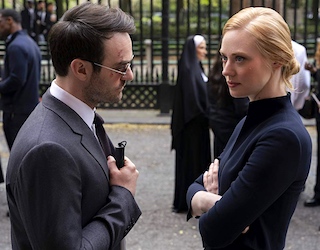 well-told story shouldn’t have to bear, and one that could have been easily remedied.” With Punisher season two on the way it’s possible this apparent plot hole could still be explained and/or retconned (whether they’ll bother is another matter, although Karen was a major character in Punisher season one so they ought to at least reference it), but it’s a shame it went unexplained in Daredevil itself.
 I let this post slip a week, so there are five episodes of Doctor Who to look back over. First up, the new team’s first historical adventure, Rosa (whew, it feels like more than a month since this aired!) I wrote
 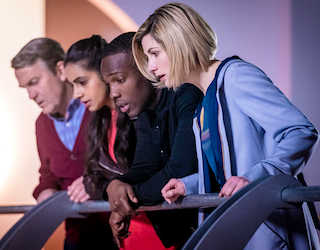 Episode six and seven say “no”. Well, a bit — the actual villain did survive the first. I still hope they’re going somewhere with this, because otherwise it’s very sloppy. Anyway, episode six itself, Demons of the Punjab, was one of the highlights of the season. Like Rosa, it sees the Doctor and co going into history and facing up to the real issues of the day, with the aliens popping in to add some spice rather than properly drive the story — like Rosa, you can imagine a not-that-different version of this episode without them. Preventing the Doctor from interfering and being ultra-heroic is certainly a change of pace from the “heroic god” version of the character we’ve had since the 2005 revival, but it’s not an unheard of vision — again, it harks back to the Hartnell era.
 I’ve never watched Inside No. 9 before, though I’ve always meant to get round to it. For those equally in the dark, it’s a comedy-horror anthology series from writers Steve Pemberton and Reece Shearsmith, aka half of the League of Gentlemen, with each half-hour episode a self-contained tale. The reason I’ve jumped in here was because this was a live Halloween special. For some reason I’m always intrigued by live TV drama (I even watched episodes of Eastenders and Coronation Street just because they were going out live), and Inside No. 9’s standalone nature made just dropping in feasible. Anyway, the episode itself was a typically playful endeavour — many fans switched off halfway through, genuinely duped by one of the episode’s tricks. The episode also managed to genuinely integrate the fact it was live, roping in a news broadcast from another channel and having one of the characters tweet. That means it played better live than it would, say, on iPlayer (where
  I always wondered if this day would come. As many (though I would guess not all) viewers must know, Shakespeare’s son Hamnet died in childhood. Not exactly traditional material for a multi-camera sitcom, so I wondered if the series would just never go there; equally, it’s by Ben Elton, co-writer of the famously tragic final episode of Blackadder Goes Forth, a work of unequivocal genius. And so in the final episode of this series, Go On and I Will Follow, Upstart Crow does go there… eventually, in the final moments of an episode that’s mostly fluff about theatre awards. It makes for a somewhat bizarre ending. Hamnet was never much of a character in the show, so while his passing’s effect on the characters is obvious, it has little meaning to us viewers. Then there’s the dedication to him at the end, which just reads like a spoof. The only bit that truly worked for me was the final lines: read in solemn voiceover, a passage by Shakespeare himself about grief. Perhaps that’s fitting. Perhaps if the whole episode had been about it in some way, then it would’ve worked — it’s part of why that Blackadder finale is so effective: the whole episode is about going “over the top”, or trying to avoid it, and so the unity of plot and theme and character and historical fact builds to an emotional gut punch of an ending. But rather than do that, Hamnet’s untimely end is just one scene tacked onto the end of some achingly obvious satire about something inherently vacuous. Well, maybe that was Elton’s point, but I don’t think the contrast was sharply enough drawn if so. Without that consistency across the whole episode, the ending just feels… odd. Ah well, at least we know there’s definitely a Christmas special to look forward to.
 This month, I have mostly been missing The Little Drummer Girl, the BBC’s new John le Carré adaptation from the makers of The Night Manager, their last (and very successful) John le Carré adaptation. As regular readers may know, I have a proclivity for saving series like this up and watching them back-to-back over about a week once they’re done — truly, I am of the Netflix generation. Dammit. Anyway, I’m looking forward to it, so expect me to get right on it and review it next month.
 The 37th season of Doctor Who begins with the show’s biggest soft-reboot since at least 2010; arguably, since 2005; arguably, ever. With a new showrunner comes a new broom, and so we have a new Doctor, a new TARDIS, a new set of companions — sorry, they’re “friends” now — new locations, new monsters, and a new style (thanks to a raft of behind-the-scenes changes, including a new effects company, swish new cameras and lenses, and a new aspect ratio). It’s the perfect jumping-on point… and it worked, with the premiere achieving the show’s highest ratings for a decade; or longer, depending how you count it.
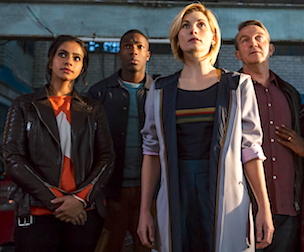 Indeed, even as it’s open-armed and newbie-friendly, Chibnall’s era already seems as Who-literate as you’d expect from such a long-time fan (somewhat (in)famously, as a teenager in the ’80s Chibnall appeared on TV criticising the then production team). His sense of what Who should be is at once indebted to the modern era (in particular the years of Russell T Davies, who I suspect may’ve been something of a mentor to Chibnall at one point) and also seeks to reintegrate elements long absent. For example, there’s the expanded TARDIS team, which calls to mind that of the series’ very first group of travellers; though whereas 1963 gave us a teenage girl and two middle-aged teachers, 2018 offers two teenagers and one middle-aged bloke. Such are the changing times. And for dedicated Whovians, the plot of episode two, The Ghost Monument, also had an air of early Hartnell serials, with its episodic trek across a danger-filled alien world. It was a brisk, entertaining 50 minutes, but stop and think about it too much and the cracks begin to show (read
 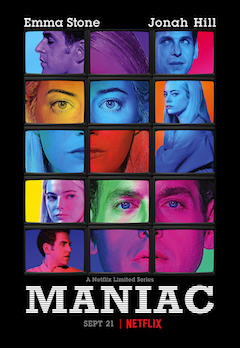 Netflix continue to blur the line between movies and TV with this limited series starring Oscar winner Emma Stone and Oscar nominee Jonah Hill, co-created and directed by Cary “director of the next Bond film” Fukunaga. Well, I mean, it’s a line that other TV producers have blurred plenty in the past — movie stars on TV is far from a new thing at this point, and there’s no doubting this is a TV series rather than a movie (it’s 6½ hours long, for one thing) — but, still. And they bend the rules of TV, too, with individual episodes running everywhere from 26 to 47 minutes. (Does that matter when Netflix’s release-it-all-at-once strategy means you choose how much to watch at any one time? Maybe not. But if you’re the kind to still watch one episode at a time, a word to the wise: I recommend double-billing the ultra-short should-be-one-episode pair of episodes 7 and 8.)
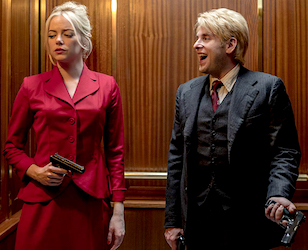 A significant amount of the series’ offbeat likability is down to idiosyncratic direction by Fukunaga, I suspect — the way he’s shepherded the visual creation of this world, the leftfield performance choices across the cast, and so on — but Emma Stone is definitely the MVP. While the aforementioned chemistry between her and Hill is important, and a lot of the rest of the cast get to excel at being quirky and funny, it’s Stone who really brings heart and emotion to the piece, making it more than just a zany fantasy.
 Having just
 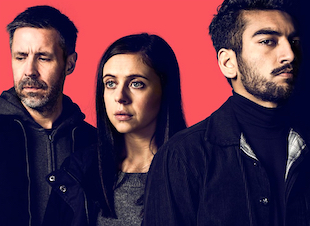 This month, I have mostly been missing Informer, BBC One’s new thriller. Well, it only started on Tuesday, so that’s fair enough, right? I guess I’ll save it up and see how it goes down — I’ve managed to avoid wasting time on a few initially-promising-but-ultimately-poorly-received series with this method; though, equally, it led to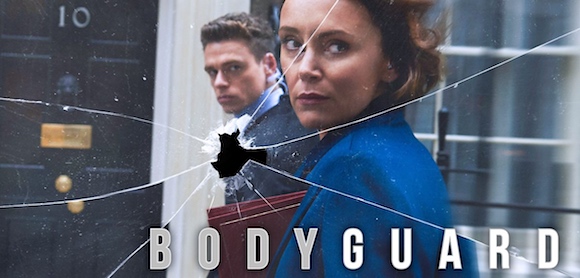
 Some have criticised the series for being OTT, implausible, or having too many plot holes. Well, individual mileage will vary on that. It’s not a slice-of-life drama, after all — the larger-scaled storytelling is a genre thing, not an inherent flaw. It’s no more implausible than hundreds of other thriller TV series and movies, just perhaps not the kind we make much in the UK anymore. I’m always wary of accusations of plot holes — it’s a term that gets thrown around too liberally nowadays by, frankly, people who either don’t know what they’re on about or have a failure of imagination (“we didn’t see that happen on screen so how can it have happened” is, genuinely, the root of one prominent complaint about Bodyguard’s finale).
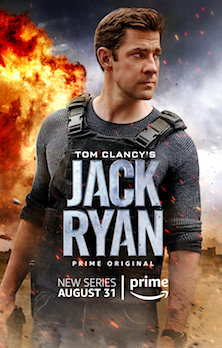 The latest reboot of Tom Clancy’s CIA hero sees him get the TV treatment, which is perhaps the best place for a hero who is more about solving problems with his mind than his gun, and a storytelling style that cuts between lots of concurrent plots before later revealing how they interrelate. That’s something this season has done rather well, incidentally — it’s an original story, taking Clancy’s characters but not directly adapting any of his novels, but they committed to trying to emulate his “mosaic storytelling style”. I’ve never read any Clancy, so I’m not an expert on this, but they seem to have evoked it well. (Considering there are multiple Ryan novels that haven’t been adapted, it seems a shame to abandon them entirely. Maybe in a future season.)
 An advantage the show has in this regard is its short length: with just eight episodes, the plot moves at a fair lick. It gets better as it goes on, too, as the various plot lines and characters begin to build and resonate with one another. Indeed, it’s something very rare, possibly unheard of, in direct-to-streaming series: one where I wished the season was a couple of episodes longer. Not that it’s rushed per se, but one or two subplots might’ve been even better with just a little more room to breathe; the main stories might’ve been even better with just a beat or two more in them. But in an era where streaming/prestige series are gaining a reputation for being bloated and not having enough story to fill their running time, maybe it’s better to leave people wanting more.
 The first season of Iron Fist attracted a lot of criticism, and, thankfully, the people behind the Marvel/Netflix series have listened. This second season doesn’t suddenly revamp the show into the best thing on TV or something, but it is a big improvement. They were hamstrung to an extent — as new showrunner M. Raven Metzner has said in interviews, you can’t reboot something like this: it has to keep to the continuity of what happened in season one, and in
  Ironically, while the MCU movies became renowned for their poor villains, that’s the area the Netflix series have always excelled in. This season the star turn comes from Alice Eve as a version of Daredevil villain Typhoid Mary, who (spoilers if you don’t know the character!) has dissociative identity disorder (DID), aka multiple personality disorder — so she can be both sweet, timid, kind Mary, and hard, stern, violent Walker. It’s the kind of role that’s a gift for any actor, of course, and Eve is fantastic. Similarly, Danny’s childhood friend Davos gets to combine many of the traits I’ve described in other characters: motivated by past events; complex relationships to other characters (not only Danny, but, as the end of season one teased, Joy). He’s the kind of villain whose goal is almost relatable; where you almost side with him over the hero.
 (via a whole load of fighting, natch) and then the second half to what happens after — not just the necessary “wind down” type aftermath stuff, but also a fair chunk of time into establishing where things will go in season three. Netflix hasn’t commissioned that yet, but I hope they do because I’m actually looking forward to it. Wonders will never cease.
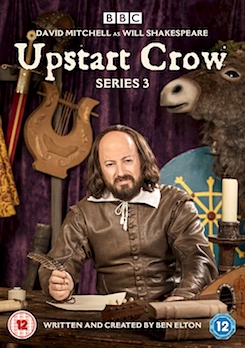 Ben Elton’s Shakespearean sitcom commences its third run as funny as ever, if not more so — I’ve always enjoyed it, but it feels particularly on point this series. I guess its on-the-nose satire of modern life by transposing it to Elizabethan society (e.g. Will’s woeful carriage journeys between London and Stratford are an unsubtle riff on the problems with British railways) won’t find favour with everyone, mainly because it seems a little easy and there’s a monologue about it pretty much every episode, but I still find that stuff amusing. When Elton applies the same strategy to other aspects of modern life, it’s similarly as rewarding/obvious, depending on your predilections. But there’s also a solid vein of mining Shakespeare’s own works for humour, the best one so far this series being an extended bit about how all of Will’s friends think Hamlet is a comedy due to its farcical plot. There’s also a running subplot about Will’s nemesis, Robert Greene, trying to discredit him by making people think he doesn’t write his own plays, which nicely pillories those ridiculous theories, and includes a guest appearance by Ben Miller doing an amusing riff on Mark Rylance.
 This month, I have mostly been missing Killing Eve, BBC America’s critically-acclaimed, Emmy-nominated thriller about an MI5 officer hunting for an assassin. It aired in the US back in April, and it feels like ever since I’ve been hearing praise for it flowing across the Atlantic. It finally made its way to this side of the pond this month (for an organisation with “BBC” in their name, BBC America productions do take their time getting over here). As I’ve only just (as in “as of last night”) finished making my way through 24 episodes of Jack Ryan, Iron Fist, and Bodyguard back-to-back, maybe that’ll be up next.
 Another year, another divisive Doctor Who Christmas special. It’s the third time that the Christmas Day spectacular has to serve double duty by writing out the programme’s lead actor, and it follows the format set out by David Tennant’s swan-song The End of Time and Matt Smith’s finale The Time of the Doctor by being a very inward-looking fan-focused edition. I’m not sure that’s the right tack to take on Christmas, quite frankly, when the show’s playing to a wider audience of more casual viewers than normal. Former showrunner Russell T Davies and immensely popular leading man Tennant had earnt that kind of indulgence by the time they exited, and the series was pretty much the biggest thing on British TV at the time, so most of those so-called “casual viewers” were actually regular watchers of the show anyway. I’m not convinced exiting showrunner Steven Moffat and departing Doctor Peter Capaldi are quite in the same position.
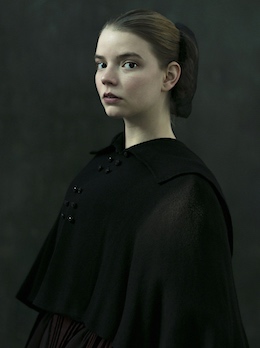 The BBC’s two-part adaptation of Jessie Burton’s 2014 bestseller promised to be a supernatural treat, though in that respect the trailers were somewhat misleading. Set in 17th century Amsterdam, it’s about a girl who marries a wealthy merchant, but finds his strict and secretive household is not all she’d hoped. He buys her a dolls house as a wedding gift and she commissions a miniaturist to produce items for it, but she soon starts to receive things she didn’t order — things which suggest the miniaturist somehow knows people’s secrets, and can possibly see the future… In actuality, The Miniaturist is more of a period drama, albeit one with lashings of Gothic that were right up my street. It was beautifully made, with a fantastic eye on the costumes and locations, and cinematography that evoked painting of the era. There were strong performances too, particularly from Anya Taylor-Joy (yes, her out of
 “Oh God, I’d forgotten,” says one character early in the first instalment for almost 15 years of BBC Two’s pitch-black comedy series. He’s been confronted with some other returning characters, but I have to say that the sentiment kind of sums up my reaction to a lot of this revival, in two ways: firstly because I had to keep rummaging in my memory to make connections back to a series I haven’t watched for a decade and a half, and secondly because the hilarious grotesquery of the League came crashing back. Revivals of once-great comedies can be a mistake — they’re often little more than an exercise in nostalgia; and this one is certainly aimed at fans, as the vast majority of it continues or riffs off stuff from before — but, in spite of that, it still felt fresh and edgy, not like a gang of middle-aged men reliving past glories (the other thing that goes wrong with revivals). So it was all really rather good, and it’s gone down very well too. Officially it’s a 20th anniversary special rather than a fourth series, but might we see more? I think it would be welcomed.
 So much comedy, so much of it a passable time-killer that I have little else to say about. The highlight was probably 300 Years of French and Saunders, an excellent celebration of the comedy double act, reminding us of many of their greatest hits alongside a few nice additions. It made me want a whole highlights series repeating all their many hilarious film spoofs. Shakespearean satire Upstart Crow offered a neat riff on one of the better-remembered storylines from modern Christmas classic Love Actually, which it executed with surprising subtly (or, at least, I had to point out the references to my fellow viewers, which was followed by half-an-hour of scouring through Richard Curtis’ film for the relevant scenes). I enjoyed the pilot for Tim Vine Travels Through Time back in
  Black Mirror series four was released last Friday, but I haven’t even watched series three yet. Well, I did only watch
 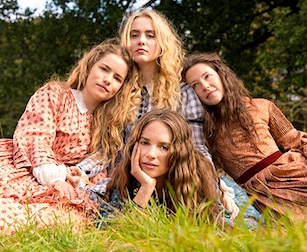 I may’ve watched 26 different programmes, but there’s still an awful lot I’ve missed. Like the BBC’s new three-part adaptation of Little Women — I’ve never read it or watched another version, so here’s my chance to get cultured. Less worthy but no less lovely, there’ve been a couple of Great British Bake Off specials featuring contestants from the BBC years even though it’s now on Channel 4. Gasp, indeed. And despite that long list up above, there’s still a handful of comedy specials I’ve got to catch up on, like Not Going Out, Would I Lie to You?, and even some not featuring Lee Mack. There’s bound to be something else I’ve forgotten — I’ll have to go through the Radio Times, again…
 Everyone was a bit surprised when they announced a second series of Doctor Foster. The
 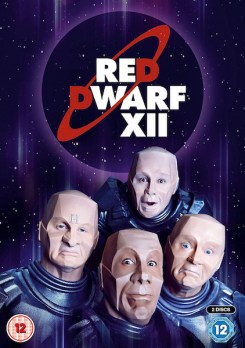 I still think of Red Dwarf as a programme that’s popped back for a bit of a revival, but I guess at this point it counts as just an ongoing show: since Dave brought it back in 2009 they’ve produced four series, half as many as the entire original run on the BBC. Give it another five or six years and they may equal, or perhaps even surpass, that number. It’s been a long time since I actually watched any of those old episodes that made the show’s name, so I can’t offer an opinion on whether the new runs are of the same quality — some say they are, some say they aren’t. Personally, I still think it’s funny overall, and (as I often say) that’s really all you need from a comedy. That said, one thing Dwarf has always done, and continues to do, is draw from actual science and science-fiction concepts to drive its plots and many of its gags. That makes it a proper sci-fi-comedy, rather than just a regular sitcom that happens to be set on a spaceship. Hurrah for that.
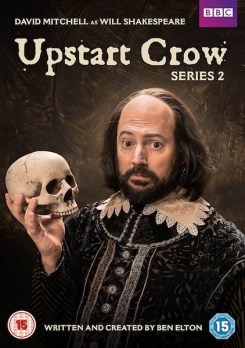 Talking of funny sitcoms, this series of Upstart Crow has been hilarious. Okay, I could do without Harry Enfield turning up as Shakespeare’s dad — almost every scene featuring him sees the humour take a turn towards the puerility of the toilet — but the rest of it is often pretty clever, riffing on Shakespearean plots and trivia. There was even a screenwriting joke in one episode that I guess would pass most people by. It also has a nice line in almost anachronistic humour, where characters comment on a fact of the day that is actually a commentary on modern life. It’s not subtle, and perhaps writer Ben Elton returns to that comedy well too often, but it’s always funny. And as I often say…
 It’s funny coming to The Thick of It for the first time now. It was so cutting-edge when it aired, and yet politics has got so much barmier since — these specials debuted a whole decade ago now, when the idea that Trump might be President was the kind of thing no one but sitcom gag writers thought about. That’s not to say the show’s lost any of its bite, just that it’s not as timely as it once was. These two hour-long specials, The Rise of the Nutters and Spinners and Losers (plus 15-minute bonus episode Opposition Extra, which follows some characters from Rise of the Nutters during the events of Spinners and Losers), set their satirical sights on the transition of power from Tony Blair to Gordon Brown. Don’t worry if you don’t remember that — there’s no reading up required, because The Thick of It is a fiction loosely inspired by real political events, rather than a straight riff on reality. It’s every inch the 21st century’s answer to Yes Minister in that respect. Although there’s an ensemble cast, all of whom are very amusing, the unmistakable star is Peter Capaldi’s Malcolm Tucker. With a regime change in the offing, Tucker risks being thrown out as part of the old guard, and so is on the back foot trying to manipulate things to his advantage. After three seasons of Capaldi as the Doctor, witnessing him here use his brain to run rings around other people to get the result he desires now feels like watching a somewhat evil — and much swearier — version of everyone’s favourite Time Lord.
 This month, I have mostly been missing The Gifted, the new TV show set definitively in the X-Men universe — unlike the last one, Legion, which apparently wasn’t. As you might infer from that use of “apparently”, I still haven’t got round to Legion either. I also haven’t seen the other new Marvel Comics-related show, Inhumans, which is part of the MCU. After the terrible reviews it’s received, I’m not sure I’ll bother.
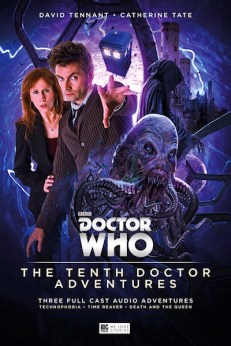 One of Doctor Who’s most popular eras is revived this week, as David Tennant returns to the headline role for the first time since
  The first is Technophobia by Matt Fitton, which is set in our recent past (and therefore Donna’s near-future) when the new M-Pad tablet computer seems to be causing the populace to forget how to use technology. Tennant and Tate hit the ground running — it’s a cliché, but it really does sound like they’ve never been away. Their sprightly performances contain little of the stilted “I’m reading this script aloud for the first time” acting that sometimes plagues audio drama. Fitton captures the style and tone of their single TV season to a tee — if they’d done a second year together, you can well believe this as its first episode. Even Howard Carter’s incidental music is a mostly-fitting substitute for Murray Gold’s iconic work.
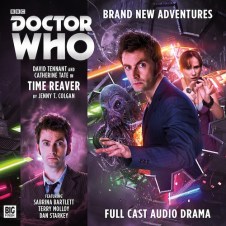 The middle tale is sci-fi adventure Time Reaver by Jenny T. Colgan, a best-selling romantic novelist who’s turned her hand to multiple Who projects (including a 10th Doctor and Donna novel published last week to tie-in with these dramas). For me, this was the weak link of the trilogy, though it’s by no means bad. There are some fantastic ideas, but at times their inspirations show through too clearly, and the execution is sometimes lacking. This was Colgan’s first audio drama, and dare I say it shows. Sequences like an action-packed barroom brawl are a little too ambitious to convey in an audio-only medium, and the dialogue is regularly forced to describe what’s going on. On the bright side, Mr Carter offers more magnificent sound design — the noises made by cephalopod villain Gully are immensely evocative.
 The final episode is the group’s historical outing, Death and the Queen by James Goss, and it may be the best of the lot. Our intrepid duo find themselves in the kingdom of Goritania in 1780, when it comes under siege from a destructive cloud that contains Death himself. Goss mixes comedy with peril in just the right quantities to create a story that is an entertaining romp but also manages to expose different facets of the Doctor and Donna’s relationship. If Fitton has bottled the essence of RTD, here Goss evokes Steven Moffat, with a time-jumping opening ten minutes that you can well imagine on TV, but which also work perfectly in audio. Things slow a bit later on, with the dialogue sometimes going in circles — a fault of all three of these plays, actually. They could’ve benefited from a trim to fit within the TV series’ 45-minute slot, rather than allowing the freedom of not having to conform to a schedule let them to slide to 55-ish.
 Ah, love a bit of Eurovision, even if the songs weren’t as good this year. Ok, you might say they never are, but there’s often one or two half-decent ones (I still listen to Conchita Wurst’s Rise Like a Phoenix sometimes, mainly because it’s the best Bond theme released in the last decade). Even then, the winner wasn’t the best of that middling bunch, though it probably had the best message. In fact, the best song of the night was the Swedish hosts’ half-time number, Eurovision-spoofing Love Love Peace Peace (watch it
 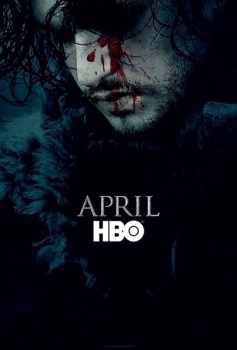 Good luck to you if you’re not watching Game of Thrones but still trying to avoid spoilers this year, with the huge and widely-covered news that [REDACTED] was [REDACTED], or that [REDACTED] killed [REDACTED], or when [REDACTED] and [REDACTED] were [REDACTED] for the first time since [REDACTED], or when [REDACTED] was [REDACTED] but [REDACTED] the [REDACTED] and [REDACTED] of [REDACTED] in the process — even if more people seemed interested in discussing her [REDACTED]s.
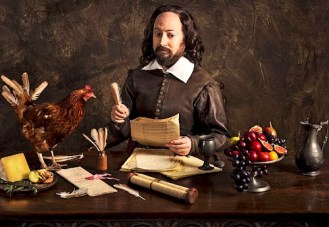 I can’t remember the last time I saw a new multi-camera sitcom that wasn’t either, a) a bit meta (like Miranda or Mrs Brown’s Boys), or b) a revival (like Red Dwarf X). I don’t know if that says more about the current TV landscape or the kind of things I watch, but either way it surprised me when that was the form Upstart Crow took. It’s just one element that gives it the feel of Blackadder, which I don’t mean as a criticism. Even if it feels a little dated in its execution, there are plenty of laughs — some easy, some clever — and, really, what more do you want from a comedy than to laugh? It may not be up to Blackadder’s highest highs (yet — there’s still time; you never know), but I’d wager it stands fair comparison to the classic’s comparatively-lesser instalments… which I mean to be a less critical assessment than it sounds.
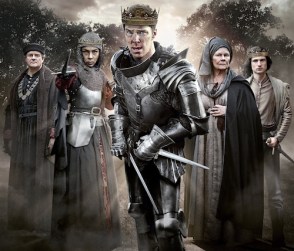 This month, I have mostly been missing the second run of The Hollow Crown, the BBC’s all-star adaptation of Shakespeare’s War of the Roses plays… though as I still haven’t got round to watching the first run from 2012, that’s no real surprise. In fact, Upstart Crow aside, I’ve not yet watched any of their still-running
  100Films.co.uk