
Steven Spielberg | 105 mins | TV | 16:9 | USA / English | PG / PG
 Steven Spielberg’s second feature (or “first” if you’re American) is based, loosely, on a true story. The fictionalised version sees Lou Jean (Goldie Hawn) breaking her husband (William Atherton) out of prison so they can travel cross state to liberate their baby from foster care. Everything goes smoothly until they accidentally kidnap a police officer (Michael Sacks), hundreds of police cars begin to follow them, and a multi-day slow-paced chase ensues.
It’s probably not obvious from the whole prison break/kidnap/true story thing, but The Sugarland Express is more of a comedy than a thriller. The ludicrousness of the situation is ramped up, though Spielberg keeps it grounded enough that you can believe it was real, and with an undercurrent of potential violence from the police that suggests a tragic ending may be unavoidable. Credit also to the cast for maintaining this balance, in particular Hawn, for who this was a breakout role. She’s naïve and optimistic without being too annoying, her comedic airheadedness weighed against an earnest belief that she’s doing the right thing for her child and that it’s all going to work out in the end.
Spielberg makes full use of the 2.35:1 frame’s width, which means that, viewed on broadcast TV at 16:9, it’s often noticeably cropped (this having been made before the time  when filmmakers became contractually obliged to keep their compositions “TV safe”). The camerawork is frequently extraordinary, including at least one unbroken shot where the camera moves around inside and outside the car, like something out of Children of Men — only done for real in a moving vehicle, unlike Alfonso Cuarón’s soundstage-based hidden-cuts version.
Largely overlooked these days, I guess because it doesn’t obviously fit with Spielberg’s renowned sci-fi, adventure, and worthy-historical pictures, The Sugarland Express merits more attention. Tonally, and in terms of the level of directorial skill it exhibits, it fits right amongst the pack of his better-remembered works. Not his best picture, but able to stand confidently alongside his numerous very-good ones.

The Sugarland Express is released on standalone Blu-ray (as are the three other films previously available exclusively in the Steven Spielberg Director’s Collection box set) next Monday, May 4th.
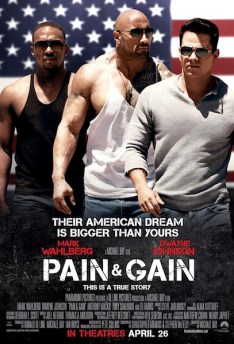 For his first non-sci-fi movie in a decade, divisive action director Michael Bay channels Tarantino (kinda) for this based-on-a-true-story crime comedy. Dwayne “The Rock” Johnson, Mark “Marky Mark” Wahlberg and Anthony “
 Bay is aided by leads who are surprisingly adept at comedy. Johnson is the best thing in it, consistently hilarious as his conscience battles former addictions and newfound religious convictions. I noted down some of his best lines to quote in the review, but they lose something without his delivery.
 After he’s become so sidetracked making the
 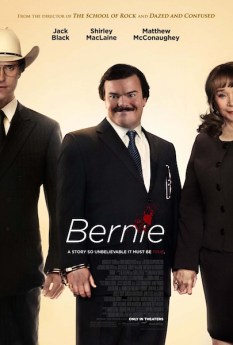 I seem to vaguely remember dismissing Bernie as just ‘Another Jack Black Comedy’ back whenever it came out (in the UK, that wasn’t until April 2013), and essentially forgot about it until earlier this month when it came up on
 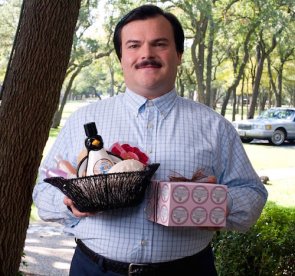 (If you’re observing similarities to Midnight in the Garden of Good and Evil there, you’re not the first: the magazine article that inspired Bernie, published around the same time as
 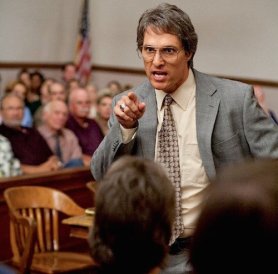 The local attorney seeking Bernie’s prosecution is played by man-of-the-moment Matthew McConaughey. I don’t know when we’re meant to deem the start of his “McConaissance”, but I’m not sure this really qualifies as part of it. Not that he’s bad, but it feels like the kind of played-straight comedy Southerner I’ve seen him do a few times now; indeed, it’s how he comes across in real life, from what I’ve seen. It fits the role like a glove, but doesn’t make for a remarkable performance.
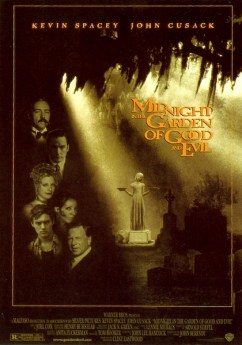 Sent to write “500 words on a Christmas party” in Savannah, Georgia, journalist John Kelso (John Cusack) instead finds himself covering a murder trial where he’s become friendly with the accused (Kevin Spacey).
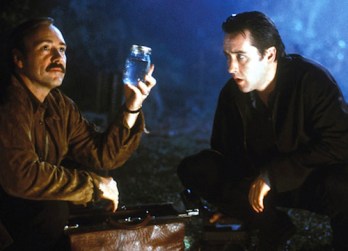 Like many an “adapted from a bestseller!” movies, I guess Midnight in the Garden was a big deal in its day that’s faded to semi-obscurity since (see:
  2007 #23
 100Films.co.uk