
Country: USA
Language: English
Runtime: 117 minutes
BBFC: 15
MPAA: R

Original Release: 12th July 2002 (USA)
UK Release: 20th September 2002
First Seen: DVD, March 2003
Stars
Tom Hanks (Forrest Gump, Bridge of Spies)
Paul Newman (Cool Hand Luke, Butch Cassidy and the Sundance Kid)
Daniel Craig (Lara Croft: Tomb Raider, Casino Royale)
Jude Law (Gattaca, Closer)
Tyler Hoechlin (Everybody Wants Some!!, Fifty Shades Darker)
Director
Sam Mendes (American Beauty, Skyfall)
Screenwriter
David Self (Thirteen Days, The Wolfman)
Based on
Road to Perdition, a graphic novel by Max Allan Collins and Richard Piers Rayner.
The Story
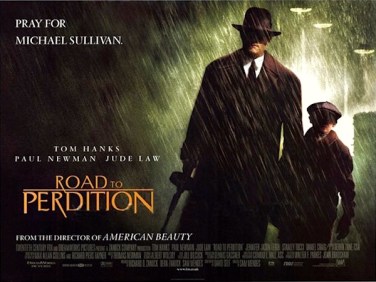
1931: Michael Sullivan is an enforcer for mob boss John Rooney, who thinks of him like a son. When Sullivan escorts Rooney’s unstable real son, Connor, to a meeting, the guy snaps and the other side are murdered — an event witnessed by Sullivan’s own son, Michael Jr. In an attempt to cover it up, Connor kills Sullivan’s wife and other son, while Michaels Sr and Jr escape, and begin a journey to take revenge.
Our Heroes
Michael Sullivan Sr is, on paper, not much of a hero: a mob hitman, his trade is death. But when half his family is murdered, he’ll do what’s necessary to protect his surviving son and get justice — his kind of justice, anyway. In the process, he bonds with Michael Jr, finally developing the relationship they never had before. Perpetual nice guy Tom Hanks tones that way down to give what I think must be one of his best performances, which brings out the heart in Sullivan without tipping over into regular Hanks territory, in the process allowing the viewer to empathise with a man who in lesser hands would just be a cold-blooded murderer.
Our Villains
Connor Rooney is a liability, a deranged coward and crook who wishes he was a hard man. But he’s no threat — his father, mob boss John Rooney, is the one with the power and means. At heart he’s no villain to Michael Sullivan — he’s essentially his father — but after Connor murders Sullivan’s family, Rooney feels he must protect his own blood, despite caring for him less than Sullivan. With an actor of Paul Newman’s quality in the role, every nuance of Rooney’s complex emotional position is subtly explored.
Best Supporting Character
To try to stop Sullivan, the mob set hitman Maguire on his trail. He’s a crime scene photographer who uses his job to cover his crimes, and is a nasty, rat-like creep. Jude Law rejects his frequent pretty-boy-ness to really inhabit that part. (Basically, everyone is fantastic in this film.)
Memorable Quote
John Rooney: “This is the life we chose, the life we lead. And there is only one guarantee: none of us will see heaven.”
Michael Sullivan: “Michael could.”
Memorable Scene
Heavy rain falls as Rooney and his men cross an empty street to his car. When they reach it, the driver inside is dead, the door locked. They spread out across the street, guns ready, but there’s no one to be seen… Then a muzzle flashes and the men are slowly cut down — leaving only Rooney standing. As the shooter emerges from the shadows, the camera tracks in on Paul Newman, his posture and expression saying it all: he knows who it is, he knows his time has come, and he’s resigned to it. All of this set to just the sound of Thomas Newman’s mournful piano-and-strings soundtrack. Only when Rooney turns around does the rain begin to bleed onto the soundtrack, and we see the man is (of course) Michael Sullivan. “I’m glad it’s you.” With tears in his eyes, Sullivan finishes his job.
Technical Wizardry
There are several reasons the above scene works so well — the pace of the editing, the sparse sound design, the music, the performances — but one of the biggest is the cinematography. The work of Conrad L. Hall, this is just one of the most obviously beautiful sequences in a film full of gorgeous imagery. He won a well-deserved posthumous Oscar for his work, his third from a career that garnered ten nominations.
Making of
One of the locations found was considered physically perfect but the wrong way round, with room only to shoot from right to left and not vice versa. Rather than, say, find somewhere else, production designer Dennis Gassner and his team dressed the location to be flipped, not only reversing street signs and car number plates, but even changing the side of the steering wheels on all the vehicles.
Awards
1 Oscar (Cinematography)
5 Oscar nominations (Supporting Actor (Paul Newman), Score, Art Direction-Set Decoration, Sound, Sound Editing)
2 BAFTAs (Cinematography, Production Design)
1 BAFTA nomination (Supporting Actor (Paul Newman))
2 Saturn nominations (Action/Adventure/Thriller Film, Performance by a Younger Actor (Tyler Hoechlin))
Despite some initial build-up, Road to Perdition wound up an awards season also-ran, losing out to that well-remembered classic Chicago and everyone’s desire to try to give Martin Scorsese an Oscar for Gangs of New York.
What the Critics Said
“The greatest gangster film since The Godfather.” — News of the World
“To call this the greatest gangster film since The Godfather would be an overstatement, though not by much. It is, however, the most brilliant work in this genre since the 1984 uncut version of Sergio Leone’s flawed but staggering Once Upon a Time in America. Road to Perdition, a less sprawlingly ambitious movie, is without major flaws.” — Eric Harrison, Las Vegas Sun
 Score:
 81%
81%What the Public Say
“In a film about the mob and hitmen, the violence is generally kept to a minimum. And when it is done, it’s either very quick, or it’s shown partially offscreen or via a reflection. […] Throughout the film, the violence is never glorified as something heroic. But instead, it’s something that’s done only when it is necessary, and the weight of it is always felt. During the first killing in the film, the first one that Michael sees through a crack in the wall, it’s done unexpectedly and the victim falls to the ground in slow motion. When Mike brings out his Tommy Gun, it’s not something he does with glee, it’s something very deliberate as he solemnly takes the pieces out of the briefcase to assemble it.” — Bubbawheat, Flights, Tights, & Movie Nights

Road to Perdition feels like a film that didn’t get its due at the time, and has become almost something of a cult favourite since. Not “cult” in the traditional “gaudy fun B-movie” sense, but in that it has a dedicated following of people who realise its power. On the surface it’s a revenge thriller, replete with ’30s mob style and Tommy Gun massacres, but under that is a more emotive tale about masculinity as it pertains to the father/son dynamic. It’s all handled with sensitive artistry by director Sam Mendes, supported by first-rate technical merits across the board (the design and music are particularly noteworthy, in addition to the cinematography I already mentioned), and career-best-level performances from a strong cast. It lacks the sheer scale and scope to go toe-to-toe with The Godfathers as the definitive gangster movie, but as a smaller, personal tale, it’s exceptional.

#75 will be… Bayhem.

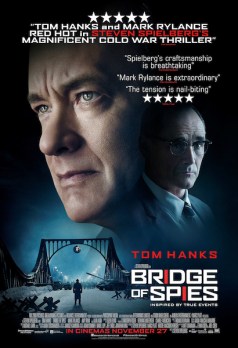 Steven Spielberg’s true-story Cold War drama stars Tom Hanks as insurance lawyer James B. Donovan, who is tapped to defend captured Soviet spy Rudolf Abel (Mark Rylance). After Donovan insists on doing his job properly, he manages to spare Abel the death penalty — which comes in handy when the Soviets capture spy-plane pilot Francis Gary Powers (Austin Stowell) and a prisoner exchange is suggested, which the Russians want Donovan to negotiate.
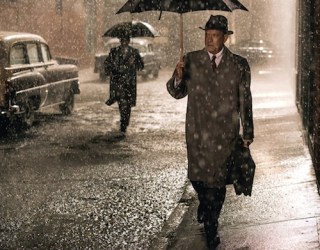 If we’re talking storytelling oddities, another is the manner in which Powers’ backstory is integrated. As Donovan continues to defend Abel, the film suddenly becomes subjected to scattered interjections, in which we see pilots being selected and then trained to fly secret reconnaissance missions in a new kind of plane. Any viewer who has read the blurb will know where this is going, but it’s so disconnected to the rest of the narrative that it felt misplaced, at least to me. The same is true when we suddenly meet Frederic Pryor (Will Rogers), an American student in Berlin who’s mistaken for a spy and arrested by the East. It turns out we need to know about him because Donovan attempts to use his negotiations to get a two-for-one deal, exchanging Abel for both Powers and Pryor. Knowing the stories of the men Donovan will be negotiating for is not a bad point, but I can’t help but feel there was a smoother way to integrate them into the film’s overall narrative.
 hints at emotions under the surface rather than declaiming them. A lesser film would’ve made a point of this — would’ve had Hanks’ lawyer struggling to understand and relate to his client’s low-key nature — but, instead, Donovan is a man who can identify with this mode of being, at least to an extent. There’s a reason they talk a couple of times about the ‘stoikiy muzhik’.
 allows the whole film to be equally as subtle, even as it remains gripping and entertaining. However, the storytelling quirks are a mixed success, the pace they sometimes lend offset by the almost non sequitur style of the captured Americans’ backstories. Nonetheless, this is a classy but still enjoyable dramatic thriller, which takes a seat among Spielberg’s better works.

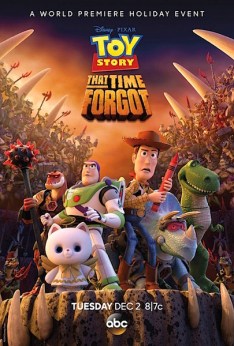 The second Toy Story TV special, and the fifth short adventure for the characters that perhaps should have had their last hurrah in
  The whole thing just feels undercooked. Apparently it took three years to make, with two of those dedicated to development. The Battlesaurs toy line was imagined in full, for example. There’s evidence of that on screen, but it’s just an impression that there’s a lot of background work we’re not getting to see. A TV special gives them limited time to explore the new world they’ve created, of course, but
 Tom Hanks is Walt Disney and Emma Thompson is author P.L. Travers in “The Making of Mary Poppins: The Movie”. Disney has been desperate to turn Travers’ fictional nanny into a movie for years after he made a promise to his daughter; Travers has resisted, but now needs the money. She’s brought to LA to consult on the script, and proceeds to make life miserable for screenwriter Don DaGradi (Bradley Whitford) and songsmiths Robert and Richard Sherman (B.J. Novak and Jason Schwartzman). At the same time, we see the story of a family in Australia from the eyes of a little girl Ginty (Annie Rose Buckley), as they struggle with the whims of her father (Colin Farrell), a bank manager who’s a little too fond of the bottle. Guess what the connection is!
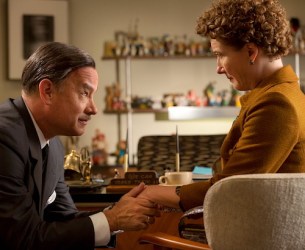 Similarly, Hanks’ part seems to be little more than a cameo at first, but he steadily appears often enough to make it a supporting role. Reportedly he has perfectly captured many of Disney’s real traits and idiosyncrasies, and who are we to doubt the word of people who knew the man? His performance is not just a shallow, simple impersonation, but there’s not that much meat to Disney’s character arc either.
 Some will find the story lacking in dirt, particularly when it comes to the portrayal of Disney. But it’s not whitewashed either, and do you really think the Disney Corporation would have allowed a movie to go ahead that depicts their founding father in a negative light? For that, I don’t think it’s as twee as it could have been — there’s definite conflict over what’s being done with Poppins, and, even with the film having turned out to be a solid-gold classic, we often find ourselves sympathising with Travers.
 Back in this blog’s early days, I established the rule that where a different cut of a film was not significantly different to the original version it wouldn’t be counted towards my total (assuming I’d seen the original, that is — if it’s the first time I’ve seen any version of the film, it still counts). There’s no hard criteria for what counts as “significantly different” though. A couple of additional minutes? No. A lot of additional minutes? Yes. Where’s the line between “a couple” and “a lot”? No idea. Thus far, I’ve left it up to “a feeling”, perhaps not always correctly (the
  but other than that if you’d told me this was the cut I watched in cinemas I’d believe you. This longer cut doesn’t make the film better or worse, just less suitable for younger viewers.
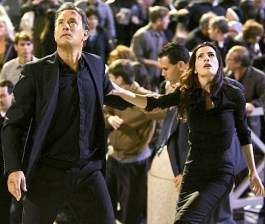 It’s still riddled with flaws, mind. Some of the dialogue is fairly atrocious (but at least it’s only some); exposition is often blatant and repetitive (we’re told what the preferiti are three or four times in as many minutes); some of the deductive leaps are a bit much; and the whole antimatter bomb still seems scientifically suspect. It all depends how much you’re willing to forgive, really. In a similar vein, one of the most contentious issues of Dan Brown’s novels is his use of “truth”. He mixes well-researched fact with his own creation at will, often leaving you to wonder if what you’re hearing is pure truth, truth bent to the plot, or a total fabrication. But then this isn’t a history or art lesson, it’s a mystery thriller, and if one wants to know more I’m sure there are books to read and documentaries to watch.
 100Films.co.uk