Spider-Man: No Way Home (2021)

Jon Watts | 148 mins | Blu-ray (UHD) | 2.39:1 | USA / English | 12 / PG-13

Spider-Man: No Way Home

I’m currently both behind and out of sync with my viewing of the Marvel Cinematic Universe. I’ve seen Black Widow, but overleapt Shang-Chi and Eternals to get to this widely-discussed and already-beloved instalment. And that’s without discussing the various canonical TV series there now are, which I think some of us still thought would be treated as ‘side projects’ but seem to be being used to introduce and explore key elements that underpin Phase Four. Which is another way of saying: hopefully this film makes sense without having seen Loki. (It does, assuming you know what a multiverse is — and as that was also discussed in the previous Spidey film, I think we’re good.)

No Way Home picks up at the exact moment the last Spidey movie, Far from Home, left off: Peter Parker’s identity has been revealed to the public, and he’s accused of murder. Rather than make a whole story from the fallout, No Way Home uses it as a jumping off point. As revealed in the film’s own trailers, Peter asks Dr Strange to magic things back to how they were before, but the spell goes awry and drags in villains from alternate realities. As the trailers didn’t give away — but was, frankly, inevitable (and has been widely used in post-release promos, so I’m not counting it as a spoiler anymore) — it also pulled through alternate Peter Parkers, as played by Tobey Maguire and Andrew Garfield.

And that’s not the half of it! It feels like they’ve gone out of their way to crossover with everything possible: as well as the two previous Spider-Man film series, there’s something from spinoff Venom, and even the MCU Netflix series, which were previously of dubious canonicity (of course, now they’re on Disney+ so they’re allowed to count again). About all that’s missing is Into the Spider-Verse, and there’s even an oblique reference to that. With all of that in the mix, it plays kinda like Fan Service: The Movie. Normally that would be a criticism, but it does it so entertainingly — and it’s so much the movie’s very raison d’être — that I think it works, in its own way. It feels similar to X-Men: Days of Future Past in the way it mixes different eras and facets of the same franchise together to create an ‘anniversary special’ kind of feel. That also means it doesn’t just feel like “The MCU: Episode 27”, but instead a climax to all the Spider-Man movies. That’s a pleasant change of pace, and one befitting such a storied superhero.
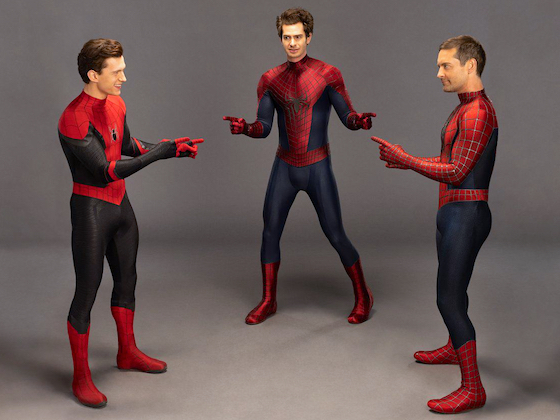
Your friendly neighbourhood Spider-meme

Keeping the appearance of the other Spideys out of the marketing may have seemed daft — of course we all knew they’d be in it — but it at least means we hadn’t already seen their best interactions in the trailer(s). How rare is it for a blockbuster nowadays to actually keep some of its biggest thrills for the film itself, rather than blowing them in advance! Indeed, my favourite bit of the whole film was the Spideys just hanging out and chatting while they waited for the villains to show up for the climax. It’s mostly fan service again — their discussion is almost entirely framed in references to previous films — but it’s nice as a moment of calm. And, like all of the film’s fan service, it tickles the nostalgia glands in those of us who get the references.

It’s notable that each of the Spider-Men has a distinct personality. We’re now familiar with Tom Holland’s childlike, motormouthed take. Garfield brings the earnest, kinda skater/surfer dude feel that he sometimes has in real life — witness the moment he pauses mid action sequence to tell the other two Spideys, quite sincerely, that he loves them. Maguire, on the other hand, is very quiet and still. He only speaks if he needs to, and that doesn’t seem to be too often. It’s an innate calmness — perhaps also maturity — but it goes beyond that. It’s not that you feel he doesn’t want to be there, more like he’d feel exactly the same way if he wasn’t there — whatever; it’s all fine. If that sounds like “laidback” might be the right label, it isn’t. It’s almost that he’s doing… nothing. But that would be a rude thing to say to an actor, because of course he’s not doing nothing. It’s a bit of an odd one; or odd within the context of the hyperactive MCU, at any rate.

The (literal) cheers that greeted No Way Home on its release have led to it being labelled a Great Movie by some (there was even a campaign to get it Best Picture recognition). Part of that is the regular thing of certain MCU fans apparently not watching anything other than MCU movies and so not having a proper frame of reference. But it’s also how the movie works: it tickles certain pleasure glands in such a way that, for some people, there’s confusion between “this is a lot of fun” and “this is a genuinely superb piece of cinema”. Heck, maybe, for some people, those are the same thing. Not for me. I don’t even think it’s the best Spider-Man film. But let’s not end on a negative, because it is a highly entertaining and, in its way, rewarding couple of hours of entertainment.

4 out of 5

Spider-Man 2 (2004)

100 Films’ 100 Favourites #86

A man will face his destiny.
A hero will be revealed.

Country: USA
Language: English
Runtime: 127 minutes | 135 minutes (2.1 extended cut)
BBFC: PG (cut, 2004) | 12A (2004) | PG (uncut, 2009)
MPAA: PG-13

Original Release: 25th June 2004 (Lithuania)
US Release: 30th June 2004
UK Release: 16th July 2004
First Seen: cinema, July 2004

Stars
Tobey Maguire (Pleasantville, The Great Gatsby)
Kirsten Dunst (Interview with the Vampire, Melancholia)
James Franco (City by the Sea, 127 Hours)
Alfred Molina (Frida, An Education)

Director
Sam Raimi (The Evil Dead, Drag Me to Hell)

Screenwriter
Alvin Sargent (Gambit, Ordinary People)

Story by
Alfred Gough (Lethal Weapon 4, The Mummy: Tomb of the Dragon Emperor)
Miles Millar (Shanghai Noon, Herbie Fully Loaded)
Michael Chabon (John Carter)

Based on
Spider-Man, a comic book superhero created by Stan Lee and Steve Ditko; in particular the story Spider-Man No More! by Stan Lee and John Romita, Sr.

The Story
Peter Parker battles problems in his personal life while his superhero alter ego Spider-Man battles the machinations of evil scientist Dr Otto Octavius.

Our Hero
Spider-Man! Spider-Man does whatever a spider can — spins a web any size, catches thieves just like flies. Is he strong? Listen bud, he’s got genetically-modified blood. Wealth and fame he’s ignored, action is his reward… though he’s having doubts about if it’s worth it. With great power comes great responsibility, and neither sit well with a kid who wants a normal life.

Our Villain
Doc Ock! Guy named Otto Octavius winds up with eight limbs, four mechanical arms welded right onto his body — what are the odds?

Best Supporting Character
Before he won an Oscar for Whiplash, or posted photos of his insanely ripped body on social media, J.K. Simmons brought himself to everyone’s attention as the hilariously irascible editor of The Daily Bugle newspaper, J. Jonah Jameson. He was so good, they haven’t even bothered to recast the character for any of the three live-action Spidey films that have come since the first reboot.

Memorable Quote
“So here I am, standing in your doorway. I have always been standing in your doorway.” — Mary Jane

Quote Most Likely To Be Used in Everyday Conversation
“With great power comes great responsibility.” — Uncle Ben may be dead, but they manage to have him say it in this one too.

Memorable Scene
The elevated train fight between Spidey and Doc Ock. It was the first major sequence filmed, before the screenplay was completed, but Raimi had dreamt it up personally. It was shot in Chicago because New York no longer has an elevated railway, but Raimi was seeking to create an idealised version of the city.

Technical Wizardry
The sound effects for Doc Ock’s tentacles were created using motorcycle chains and piano wires, while the sound of him ripping open the bank vault was a hubcap scraping along the floor. The designers consciously didn’t include the noise of servomotors, to enhance the idea that the tentacles have become a part of Ock’s body.

Truly Special Effect
Doc Ock’s tentacles were built practically. Each one was 13ft long, made up of 76 pieces, fully articulated, and controlled by four people. Obviously some of their appearances are CGI, especially when Ock’s using them to move around, but every scene was first filmed using the real props to see if CGI was truly necessary

Making of
Tobey Maguire injured his back before filming began, to the extent that Jake Gyllenhaal (at the time only really known for Donnie Darko) was tapped to replace him, and even began preparing for the shoot. Ultimately Maguire recovered enough to participate (obviously). A couple of years later Gyllenhaal was one of the final contenders for Batman in Batman Begins, but didn’t get to do that either. I’m sure Marvel will find a superhero for him eventually — they do for most people.

Previously on…
Ignoring the many and various animated series and failed attempts to bring Spidey to the screen, there was the first Sam Raimi-directed Spider-Man, which was the first film to gross over $100 million on its opening weekend. Also, MTV animated series Spider-Man: The New Animated Series is technically set after Spider-Man and therefore before Spider-Man 2, but I don’t think anyone remembers it…

Next time…
Spider-Man 3 concluded the trilogy with a whimper thanks to behind-the-scenes clashes, which also scuppered plans for Spider-Man 4. The series was rebooted with the unpopular The Amazing Spider-Man, which was followed by the even-more-unpopular The Amazing Spider-Man 2, leading to the character being rebooted again and integrated into the Marvel Cinematic Universe. The latest version debuted in Captain America: Civil War before starring in a solo movie, Spider-Man: Homecoming, next summer.

Awards
1 Oscar (Visual Effects)
2 Oscar nominations (Sound Mixing, Sound Editing)
2 BAFTA nominations (Sound, Visual Effects)
5 Saturn Awards (Fantasy Film, Actor (Tobey Maguire), Director, Writer, Special Effects)
3 Saturn nominations (Supporting Actor (Alfred Molina), Music, DVD Special Edition Release)
Nominated for the Hugo for Best Dramatic Presentation Long Form
1 World Stunt Award (Best Overall Stunt by a Stunt Man (Peter Parker falling into clothes lines))
2 World Stunt Awards nominations (Best Work with a Vehicle, Best Speciality Stunt (Doc Ock waking up))

What the Critics Said Then
“a sequel that not only outstrips its predecessor but has a perversity and quick-wittedness that hardly seem to belong in a comic-book movie. […] It’s unusual and gratifying to find a multimillion dollar movie that’s been put together with some thoughtfulness, that doesn’t neglect subtlety in between delivering the smash-bang-wallop. […] It’s the interest in human fallibility that sets this movie apart. The superhero who bridles at his own responsibility may not sound an especially gripping prospect, but his dilemma is explored with a conviction that, within the fantasy genre, feels almost groundbreaking.” — Anthony Quinn, The Independent

Score: 93%

What the Critics Say Now
On placing the film in his top ten for BBC Culture’s 100 Greatest Films of the 21st Century: “First of all, the 21st century is the century of superheroes. To approach the history of this era without acknowledging that is to miss the story. Many of my peers opted to make The Dark Knight the film that represented superheroes for them, but while I like that movie it’s a crime film in superhero drag. Spider-Man 2 is an unabashedly comic book superhero movie, a film that is pulsing with the vibrant four color life of the best comic book panels and that is soaked in the sudsy soap opera of the best comic book word balloons. It’s a movie that is a perfect fusion between filmmaker and material, and it is, without a doubt, the best example of superhero filmmaking ever attempted.” — Devin Faraci, Birth. Movies. Death.

What the Public Say
“The most interesting relationship that gets explored in Spider-Man 2, however, is with Spider-Man himself. In the first Spider-Man, Peter basically became Spider-Man the instant he decided to live his life by Uncle Ben’s last few words and donned on the Spidey suit, and that was that. Here, Peter Parker basically breaks up with Spider-Man and with Uncle Ben, as he says he is “Spider-Man, no more,” and has to start over and re-bond with the hero inside of him. [The] movie makes use of this psychological relationship to refine its definition of a hero as established in the first film. It isn’t just about responsibility. It argues that the hero is inherently sacrificial. They give up even their dreams to salvage yours. This definition is much more mature and sophisticated […] It goes to show that a big budget doesn’t have to translate into senselessness. Spider-Man 2 is the intellectual experience I was looking for in a Spider-Man film with all the action that I always imagined was possible.” — Kevin Tae, Taestful Reviews

Elsewhere on 100 Films
Just before Spider-Man 3 came out they released an extended cut of the first sequel on DVD, dubbed Spider-Man 2.1 (remember when they briefly called extended cuts things like that?) At the time I concluded “it’s still a 5-star film because it doesn’t ruin the original — but it’s not at all essential”, though I later added a postscript to note that “I probably should have rated this lower. It may still be a good film, but the fact is the original cut’s better — even if just for the superior version of The Lift Scene. I rather doubt I’ll ever watch it again.”

Verdict

In a simpler time before every superhero movie was connected to every other superhero movie, filmmakers were free to only have to tell one story and develop the ongoing life of their lead characters (rather than juggle everyone else’s lead characters for cameos, too). Spider-Man 2 is a pinnacle of this. It takes the seeds sown by the first movie and nurtures them into more interesting and complex emotional dilemmas, without losing sight of the fact it’s a movie based on a comic book about a man who swings around the city in a red-and-blue onesie fighting crime. Nonetheless, it’s as memorable for Peter and MJ’s up-and-down relationship as it is for the stunning action sequences, which become icing on the cake rather than the raison d’être.

#87 is… no kid’s game.

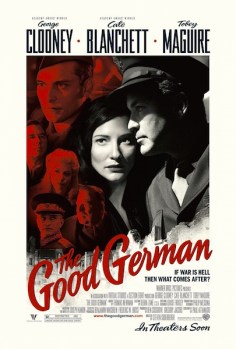
The Good German (2006)

2010 #103
Steven Soderbergh | 103 mins | TV (HD) | 15 / R

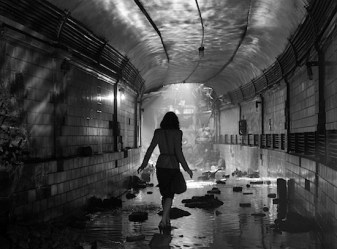
The film was shot as if it had been made in 1945. Only studio back lots, sets and local Los Angeles locations were used. No radio microphones were used, the film was lit with only incandescent lights and period lenses were used on the cameras. The actors were directed to perform in a presentational, stage style. The only allowance was the inclusion of nudity, violence and cursing which would have been forbidden by the Production Code.

So says the IMDb trivia page for The Good German, Steven Soderbergh’s delightfully thorough attempt to create a 1940s-style film noir in the ’00s. It’s even in 4:3, donchaknow.

But is this a case of style over substance? Some critics accuse it of just that, saying it concentrates more on the look & feel than the characters. They do have a point, but the style is, if not incidental, then still not the sole purpose. The tale is more about the mystery — indeed, mysteries — than the characters. Films like The Third Man and Casablanca spring readily to mind; tales where characters cross and double-cross, where you can’t be certain who’s on whose side, or why, or when, or for how long. Though, yes, The Good German does lack the depth of character found in either of those examples.

Still, this isn’t merely a pastiche — or at least not as much of one as it could have been in lesser hands — but instead is a work that conforms to the genre conventions and the filmmaking style of the era it’s both set in and sets out to emulate. It’s very believably done too, so much so that the very modern levels of violence, sex and swearing are uncomfortably incongruous. Perhaps this was Soderbergh’s intention, but you can’t help but think that it’s a misstep. If you’re going to all that trouble to recreate The Good Rainthe visual, audio, acting and plot styles of the era, why not ensure the dialogue and action follow suit? There’s no need for the violence, sex and swearing in this particular tale; at least, no need for it in a way that couldn’t be conveyed as effectively using Production Code-friendly methods. I’m uncertain if I like the film less for failing on this measure, but it does add to its inherent oddness.

Thematically the film is quite strong, though thanks to an assortment of almost red-herring-ish mysteries it might take more than one viewing to tease them all out. The setting, in both place and time, gives away the central issues: Berlin, after the war, as the Allies decide who will be prosecuted for the atrocities Germany committed and who will be allowed to escape without a trial. Who was responsible — the ringleaders, their underlings, ordinary people? Every character is connected to this somehow, every one has their morals tested or examined.

We’re certainly given a fair look at each of the three leads, as the film switches its focus between them around-about each act break, signalled by a brief voiceover from the new central character — one of which casually reveals the answer to what had, for a while, seemed to be the central mystery. The Good BlanchettBut how much do we get to know them, really? It’s easy to see why critics said “not very well”, because they’re too busy uncovering the conspiracies and revealing their part to actually show us much about themselves. But then why should that be a problem? It’s a noir thriller, not a character drama. Surely it’s about the mysteries and, if you like, the themes, rather than letting us understand the people caught up in them?
Indeed, the array of mysteries distracts from thematic pondering, or the wider conspiracies that the tale is ultimately concerned with. To list them would spoil plot twists, but each in turn seems to be the Main Story — until all is revealed and we have a chance to see the bigger game that’s been played all along. I suppose in that respect it’s like some of the best classic noirs — The Big Sleep springs to mind in this field, not that The Good German is quite as unknowably complex.

Soderbergh’s exercise in era-recreation can be deemed a success: if you can ignore the famous modern cast and the pristine visual quality of a recently-produced film, it looks and sounds exactly like something from the ’40s. Is that enough to sustain a feature? No. But the accompanying story — which, as this is an adaptation, surely inspired Soderbergh’s The Good Referencesproduction intentions rather than being invented to slot into them — provides meat on the stylistic bones.

And yet, having seen it, I can’t help but feel that The Good German is little more than an interesting curio; one that deserves to be seen but, following that, viewers would be better off sticking to real noirs.

3 out of 5