
2022 may be rushing headlong towards its final stretch (only one month ’til Christmas, people!), but my reviews are lagging behind somewhat: this update takes us all the way back to July and August.
That said, there’s quite a long spread covered here, because I only watched one film in each of these weeks: 45 Years in week 29, The Bucket List in week 30, previously-reviewed Prey in week 31, and Tintin and the Lake of Sharks in week 32. That’s definitely not the right way to go about watching 100 films in a year, but there we go.
45 Years
(2015)
Andrew Haigh | 95 mins | digital (HD) | 1.85:1 | UK / English | 15 / R

Charlotte Rampling and Tom Courtenay star as a couple preparing for their 45th wedding anniversary party, when their comfy relationship is rocked by news that brings to the surface events from his past.
What could have been a histrionic drama about the nature of trust in a relationship instead takes its cue from the characters’ advanced age, and so is a more understated consideration of the same. The length and passage of time is relevant, too: if something happened a long time ago but you only just learnt about it, does that change how you react to the news? Should it? And is the real revelation not the news itself, but the realisation that, even if you’ve lived closely with another person for decades, you can never be truly sure you know them. Another person’s true self is fundamentally unknowable, for any one of us.
All of which might sound a bit highfalutin, but 45 Years is the kind of film that revels in ambiguity, with characters who never let on their true feelings — in that sense, it feels like a deliberate Acting Showcase for Rampling — and a vague ending, all of which invites you to draw your own conclusions. The final moment feels pointed, but the openness of what went before means it’s up to you what it means. There’s something truthful about that, but also something frustrating.

The Bucket List
(2007)
Rob Reiner | 97 mins | digital (HD) | 16:9 | USA / English | 12 / PG-13

I may have written before (but not recently, so let’s do it again) about how Rob Reiner’s directorial career baffles me. He had an incredible run in the ’80s and ’90s — almost back to back he helmed This Is Spinal Tap, Stand By Me, The Princess Bride, When Harry Met Sally, Misery, and A Few Good Men — but then his career suddenly nosedives into a bunch of stuff you’ve mostly never even heard of. What happened? Is there some “John Landis on Twilight Zone“-style ‘secret’ I’m unaware of?
One of the very few exceptions in his later career (which certainly didn’t lead to that being revived) was this, a breakout hit 15 years ago (yes, it’s 15 years old) of the kind they don’t make so much anymore: a mainstream comedy-drama aimed at adults. It’s about two old men (pure star power in Jack Nicholson and Morgan Freeman) with only months left to live, who decide to spend their final days going on a tour of… green screen studios and kinda-low-res stock footage, apparently. I guess you didn’t get location filming on the kind of budget a film like this was made for even back in 2007.
Cheap production values aside, it has an insistent sentimentality — undercut with just a big enough dose of snark to stop it becoming too saccharine — that, unsurprisingly, played well with general audiences but, equally unsurprisingly, doesn’t seem to be to the taste of many cinephiles (just look at the middling-to-low scores on Letterboxd, especially of the most-liked reviews, and contrast with its sturdy 7.4 score on IMDb). While I wouldn’t go quite as harsh as many of my fellow Letterboxd users, I do think it’s not that good — it’s broadly likeable, a generally pleasant way to pass 90 minutes, rather than in any way exceptional.

Tintin and the Lake of Sharks
(1972)
aka Tintin et le lac aux requins / The Adventures of Tintin: The Mystery of Shark Lake
Raymond Leblanc | 74 mins | DVD | 4:3 | Belgium & France / English | U

Having adapted several of Hergé’s Tintin books for TV and film, Belgian animation outfit Belvision for some reason opted to create an original story for their second big-screen outing with the character (it was later retrofitted into book form, using frames from the film as the illustrations). Written not by Hergé but his friend, fellow Belgian comics creator Greg (aka Michel Regnier), Lake of Sharks feels like exactly what it is: an imitation of a Tintin adventure rather than the real deal.
Events start out in a typically Tintin fashion, with some crooks after an invention of Professor Calculus’s; but later things take a turn for the Bondian, including an elaborate underwater lair that owes a debt to the imagination of Ken Adam. Eventually it all gets a bit silly, with stuff like an ever-expanding bouncy 3D photocopier, or the villain’s elaborate “you will die in one hour” execution method for Tintin. That kind of adventure serial writing has been so widely mocked at this point (the Austin Powers movies took aim at it 25 years ago; others may have done so before then) that it’s hard to remember there was ever a time when it was still played with a straight face.
The animation is mostly of a slightly higher quality than Belvision’s previous efforts, but the quality of the designs is variable. The regular cast feel faithfully copied from Hergé, and most other characters are in the right style; but there are a couple of major child characters who look out of place, along with their pet dog. It’s a bit like when you were a kid and mixed action figures from different ranges into the same game: yeah, they’re all still plastic figurines (or, in the case of the film, hand-drawn 2D characters), but stylistically they don’t line up.
The English dub is an American effort, and far from ideal. None of the voices are great, but most suffice once you get used to them. The exception is Captain Haddock, who is egregiously bad throughout. That said, we’re also subjected to the kids singing a song about a donkey that is unspeakably awful. Couldn’t they have cast actors who could sing? At least that would’ve taken the edge off it.
Tintin and the Lake of Sharks is the 50th film in my 100 Films in a Year Challenge 2022.





 Favourite Film of the Month



























 #1
#1  #9 Kingdom of Heaven: Director’s Cut (2005)


















 By 1947, Hergé’s boy reporter/adventurer Tintin had already been around and increasingly popular for nearly two decades; had survived World War 2 and the controversy of being published in a Nazi-controlled newspaper; and the release of his adventures had recently been transferred to a dedicated magazine, Le Journal de Tintin. What better time to bring the character to the big screen?
 In
In 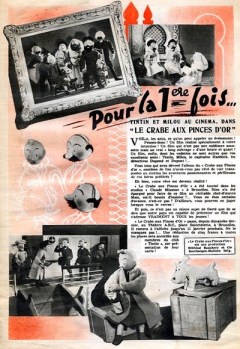 makes it look as if he’s permanently shocked by everything.
 1981: Steven Spielberg reads a French review of his movie
  Apparently some Tintin purists weren’t so keen on the actual adaptation — elements of The Crab with the Golden Claws have been mixed in to a plot primarily taken from The Secret of the Unicorn, the sequel/second half of which, Red Rackham’s Treasure, is reportedly used sparingly. Plus, in the original tale Sakharine is a minor character who wasn’t responsible for much, apparently. As someone who’s only read one of those three volumes, and even then not since I was young, such things didn’t trouble me. What superstar screenwriters Steven “
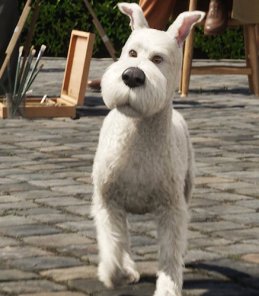 The slapstick is mainly hoisted by Simon Pegg and Nick Frost as the physically-identical Thomson and Thompson — a true advantage of animation, that. I imagine some find their parts tiresome because of their inherently comic role, but they’re likeable versions of the characters. Even more joyous is Snowy, though. Well, I would like him, wouldn’t I? His internal monologue, such a memorable part of Hergé’s books, is omitted (as it is from every film version to date, I believe), but he’s full of character nonetheless. Some of the best sequences involve Snowy running in to save the day. I don’t think they quite got the animation model right (the one glimpsed in test footage included in behind-the-scenes featurettes looks better, for my money), but his characterisation overcomes that.
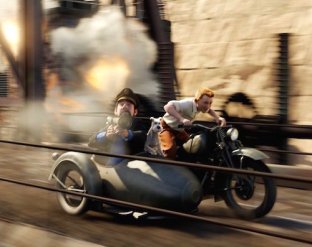 Of course, one very important person is neither British nor Belgian: Spielberg. The screenplay’s balance between peril and comedy is spotlessly enhanced by his peerless direction. In a world stuffed to the gills with lesser blockbusters that palely imitate the groundwork Spielberg and co laid in the ’70s and ’80s, work like this should remind people why he’s still the master of the form. The film is shot with an eye for realism (so much so that some viewers have been convinced it was filmed on real locations with real actors, with some CG augmentation for the cartoonish faces, of course), which helps lend a sense of plausibility and also genuine jeopardy. It’s easy to get carried away when working in CG animation, but often the most impressive works are ones that behave as if they’ve been shot largely within the limitations of real-world filmmaking technology.
 The tone on the whole is resolutely PG — actually, like many an action-adventure blockbuster used to be before everything went slightly darker and PG-13. So, for example, Tintin wields a gun on occasion, but never at another human being. The focus is on the story, which happens to lead to some adrenaline-pumping sequences, rather than a lightweight excuse to link together a bunch of punch-ups and chases. Ironically (though, for anyone who knows what they’re talking about, entirely expectedly) this makes the action all the more exciting. It also mean there’s a lighter touch than many current blockbusters offer; a greater presence for humour, including among the action. I guess that’s not fashionable these days, when everyone’s become so po-faced about their big-budget entertainment. However, with the likes of
  but some viewers would have seen it (even subconsciously) as more of a “real movie”.
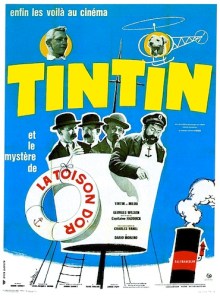 Steven Spielberg and Peter Jackson weren’t the first to bring Hergé’s journalist-adventurer to the big screen, oh no… though you have to go quite far back — and much more obscure — to find the previous efforts.
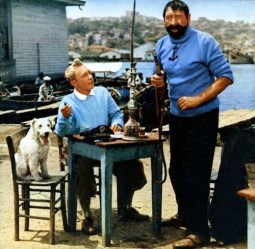 (I don’t know if the BFI DVD includes the original French, Turkish and Greek soundtrack, but on TV it was entirely dubbed into English. There’s a French Blu-ray, but it doesn’t look to be English friendly.)
 100Films.co.uk