When I mentioned in September’s monthly review that I hadn’t posted a TV column that month, I was intending to get one up within a few days. As it turned out, for various fundamentally unimportant reasons, it’s taken until now — so, really, this one covers two months.
Much like my film viewing, my TV watching hasn’t been as prolific as normal, including some regulars falling by the wayside (no Twilight Zone again). But there are still a few things worth talking about.

Stranger Things 3
 On what you might unkindly call a superficial level, the third season of Netflix’s signature series was thoroughly entertaining — it’s frequently funny and exciting, with cool moments aplenty (especially in the last couple of episodes), and many enjoyable callbacks to both ’80s pop culture and within the show itself. But dig any deeper and it begins to seem less surefooted, with what felt to me like muddled themes and character arcs, and a sense that the mythology was treading water. I don’t particularly object to the way any characters were treated, nor the destinations any of them reached (especially as a fourth season was inevitable, so wherever this run finished up was only ever temporary), but I didn’t feel like they were being guided anywhere with any real purpose. There’s something to be said for storylines like that, but when you’re trying to play some kind of redemption arc, or a coming-of-age tale about burgeoning independence (or whatever), I feel like you need to be a bit clearer-eyed. But hey, I still enjoyed it a lot — it’s a fun watch, and I imagine even more so if you have nostalgic memories of an ’80s childhood — I just think there’s still some room for finessing.
Watchmen Season 1 Episode 1
 Alan Moore and Dave Gibbons’s graphic novel Watchmen is a seminal work of the form — I’m sure you don’t need me to tell you about that at this point. Over the past decade it’s been adapted into a film, and both prequelised and sequelised (I think? I dunno, I stopped paying attention) in comic books, to varying degrees of success and controversy. So when HBO announced they were bringing it to TV, there was much trepidation. Early promises that it wasn’t a remake or prequel or sequel, but instead a ‘remix’, just added to the confusion.
Now it’s finally here, it’s clear that such bold reports were perhaps a bit of an exaggeration. Well, I say “clear” — I’ve only watched the first episode (two have aired, out of nine) so there’s plenty of room for things to change, but (so far at least) it seems to be definitively set in the world of the comic book (and not the movie, which made some significant modifications to the climax) and in 2019 (whereas the comic is set in the ’80s). So it is a sequel… but it’s not a direct sequel, because very few of the original characters have a part to play (yet, anyway). So it’s a new story set in the same world… albeit one where the events of the first story have had a massive impact, and some of the same thematic concerns are coming into play — not to mention a load of familiar iconography. Okay, maybe “remix” wasn’t a wholly terribly epithet after all.
Anyway, it’s early days, but there’s a lot of promise and potential here. Reading the original before viewing may not be essential, but it’s going to help a lot (besides which, it’s a damn good book). And if you want to go even further down the rabbit hole, be sure to check out the tie-in Peteypedia website, which provides a lot of extra info to help bridge the gap between book and series.
Catherine the Great
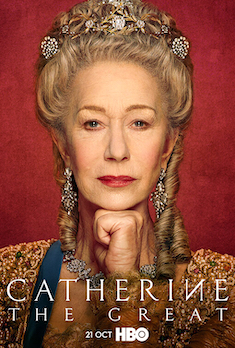 HBO and Sky Atlantic have teamed up for this lavish four-parter about the life of the famous Russian ruler, conceived by and starring Helen Mirren. The big bucks those broadcasters are known for are all over the screen here — it looks suitable sumptuous, with grand locations that positively shine, especially in UHD. Unfortunately, nothing else about the production is up to scratch. The writing is thoroughly mediocre — it most reminded me of The Tudors, although that seemed to know it was a bit of trashy fun, whereas I think Catherine the Great wants to be taken very seriously. But the dialogue is uninspiring, the characters uninteresting and underdeveloped (we’re told the relationship between Catherine and Potemkin is some great love affair, but they strop around like moody, jealous teenagers), and the flat performances do nothing to elevate any of it — and despite her general acclaim, Mirren is probably the weakest of the lot. Pretty, then, but vacant.
Dad’s Army: The Lost Episodes
 The BBC’s 1970s policy of junking programmes because they supposedly no longer had commercial value is a familiar topic for Doctor Who fans, who’ve spent decades hoping and hunting for copies of missing episodes. But it was an organisation-wide policy, so Who was far from the only show that suffered — Dad’s Army was another. It’s a perennially popular sitcom here (even today repeats land among the most-watched programmes of the week), so you can see why it made commercial sense to invest in recreations of the missing episodes — especially as there’s only three of them.
The pre-broadcast press and ads emphasised heavily that these were intended as a tribute (presumably because that attempt at a feature film revival from a couple of years ago went down so badly). The sense of affection for the original seeps off the screen, from the faithfully recreated set to the performances, which ably tread the fine line between flat impersonation and respectful imitation. By that I mean the cast were clearly trying to play the roles as they were originally performed, but without getting stuck in a rut of mere emulation, instead injecting a reasonable amount of their own interpretation of the characters.
So, taking the project as it was intended — as a loving salute to the original programme, which also plugs a gap in its record — The Lost Episodes should be classed as a success.
Next month… the golden compass leads us to the northern lights as His Dark Materials is readapted for TV.






 Favourite Film of the Month










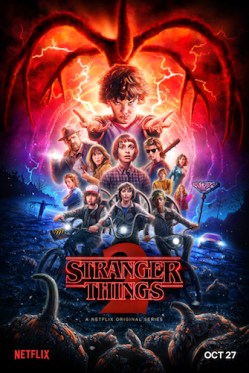 Netflix’s most talked about show (well, unless you count House of Cards for all the wrong reasons) returns wth a second season that isn’t just a continuation, it’s a sequel — note how it’s officially called Stranger Things 2 (which
 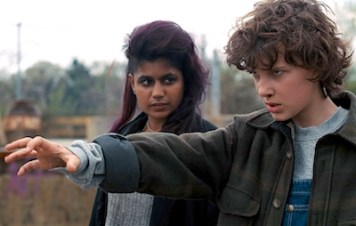 Now, you can’t discuss Stranger Things 2 without mentioning the infamous Chapter Seven. If you’ve missed the internet’s collective exclamation of disappointment and/or annoyance, IMDb has it in a nutshell: on there, the user ratings of all the other episodes (from both seasons) range from 8.5 to 9.5, a spread of 1.0 (obviously), but Chapter Seven has 6.2, a full 2.3 marks below the next lowest score. Ouch. It’s not great, but I didn’t think it was that bad. It’s a total aside from the main action, and placed where it is seems designed just to delay the pay-off to Chapter Six’s cliffhanger for another 45 minutes (in a regular programme it’d be two weeks, but this is Netflix). I don’t really hold with that being an actual problem, though — that’s just taste. No, the real problem is that it rushes through a character arc for Eleven that would’ve been better presented over multiple episodes. Considering before that she’s spent several episodes just sat around watching TV, there were surely better ways to structure her role this season.
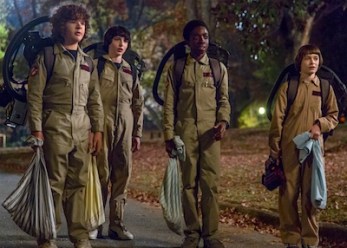 Even though it has all the big action stuff you’d expect, Chapter Nine still devotes a serious chunk of time to a character-focussed epilogue; reminding you that, as with most loved shows, the heart of it is the characters and their relationships. Indeed, although the season as a whole didn’t have the same effectiveness as the first, I thought the finale was a better climax. In fact, it would be a perfectly valid place to leave the entire series… but there are (at least) two more seasons to go. It might be nice if season three opened up the timeline a bit, because so far Hawkins seems to be a place where Crazy Terrible Shit happens over a couple of days and then everything’s fine for a whole year.
 I had nice things to say about the first half of Red Dwarf XII in
 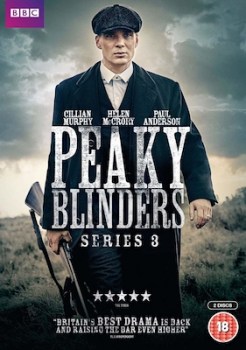 Beginning with a significant time-jump and monumental change in circumstance worthy of a Mad Men season premiere, the third series of Peaky Blinders soon sees everyone’s favourite Brummie gangsters embroiled in espionage and counter-espionage as they’re enlisted to help exiled Russian aristocracy launch a bid to reclaim their country. There’s so much more going on than that, but I won’t get into it here because we’ll be here all day — Peaky Blinders is a complexly plotted series; right up the final episode, which contains revelations that turn the previous six hours on their head. Even with all that narrative to get through, it still finds plenty of time to give most of its large-ish ensemble cast some strong character arcs. There are a few streaming series that could learn a thing or two from that…
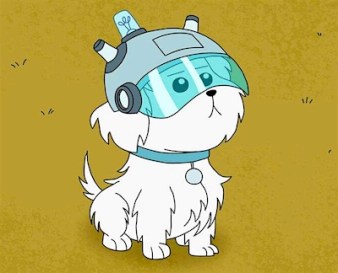 I confess: I started watching Rick and Morty fully expecting to hate it. I’d always thought it looked and sounded annoying, so I paid it no heed… but then it seemed to keep coming up — people referring to it in excited tones, and it ranking 7th on
 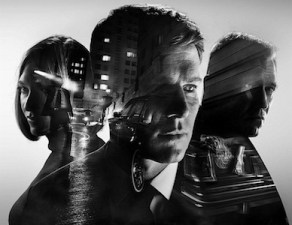 This month, I have mostly been missing Mindhunter, David Fincher’s new Netflix series about the early days of criminal psychology and criminal profiling at the FBI. It was actually released before my last TV post, but I didn’t have Netflix at the time so I didn’t bother to mention it. I would watch it next, but The Punisher is out tomorrow. Maybe after that…
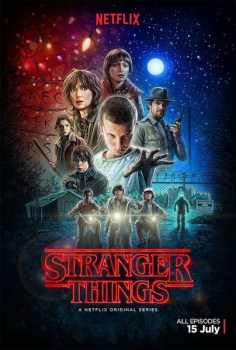 Hype — it’s a funny old business. It’s hard to have avoided hearing something about Stranger Things, Netflix’s summer hit that went down like gangbusters, its ’80s nostalgia perfectly calibrated to target the kind of people who run entertainment news websites these days — just to be cynical about it. Or truthful. Then there came the backlash, which attested there was nothing more to the show than those callbacks and tributes; a hollow experience of copying and “hey, remember this? That was good, wasn’t it?”
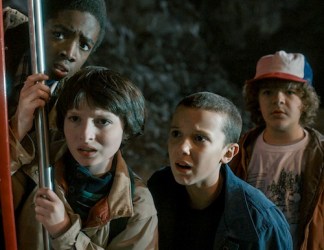 Without wanting to get into spoiler territory (despite what the media would have you believe, not everyone has Netflix all the time and not everyone watches every new zeitgeisty series immediately. Apologies if you write for an entertainment site and I’ve just given you palpitations), everything comes together nicely for a barnstorming pair of climactic episodes. For my money, the penultimate chapter is the best one: with a bunch of revelations out of the way (some of them easily guessed but finally confirmed), the series kicks off a run of long-awaited fan-pleasing events (as in many a drama, it takes this long for everyone to finally start talking to each other; also, the bit with the van!) The finale is less accomplished, with some characters wandering around for a bit in a way that feels designed to pad the running time. Still, it’s a satisfying conclusion… to season one, anyway.
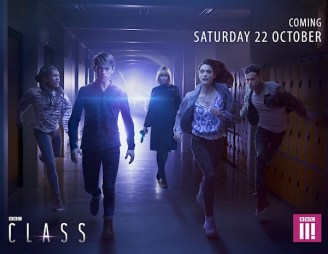 Ten years to the very day since the launch of the original dark, sexy BBC Three Doctor Who spin-off,
  The CW’s raft of superhero shows restarted on UK TV this month. I’ve given up on Legends of Tomorrow and am still not joining Supergirl (though I got hold of the opening episodes, co-starring Superman, to maybe make time for at some point); but, five seasons in, Arrow has me suckered for the long-haul, and The Flash tempted me back with the intrigue of adapting Flashpoint. I’ve never got on the bandwagon with Flash, which attracted a lot of praise during its first season that I simply didn’t agree with, leading it to outshine Arrow in ratings and people’s affections. Arrow has long been off the boil, and season five certainly hasn’t got it back up to temperature so far, but The Flash had plenty of issues of its own. It’s not problem free now, but I actually really liked the first couple of episodes of the new season. It’s still a long way from the top tier of TV superheroes (Netflix have that sewn up), but it’s likeable.
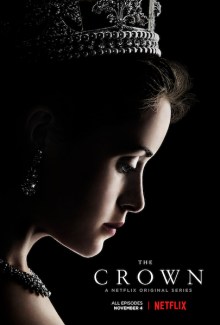 This month, I have mostly been missing the most expensive TV show ever made*, Netflix’s much-discussed The Crown. I don’t know if they’ve been pushing it as much in the rest of the world as they did in the UK, but it certainly felt like it was everywhere… for about a week, as is usually the way with Netflix series. Also missed: the equally-discussed Netflix-exclusive new run of Black Mirror. Both of these are because I don’t keep up a permanent Netflix subscription, but between them, the forthcoming Gilmore Girls revival, and the Series of Unfortunate Events remake in January, I will be signing up again late in December (using the free month voucher they had in the Radio Times, hurrah!)
























 100Films.co.uk