2014 #134
Steven Spielberg | 107 mins | Blu-ray | 2.35:1 | USA & New Zealand / English | PG / PG
 1981: Steven Spielberg reads a French review of his movie Raiders of the Lost Ark. His high-school-level French serves him well enough, although there’s repeated use of one word he doesn’t know: Tintin.
25 years later: Spielberg has been struggling to make a film version of Hergé’s character for quarter of a century. While developing a live-action version that would feature actors under heavy prosthetics so as to resemble their comic book counterparts, he realises Tintin’s famous dog, Snowy, will need to be computer generated. He reaches out to Peter Jackson and Weta, fresh off their ground-breaking work on The Lord of the Rings. Their test footage is so successful, it gives Spielberg another idea…
2011: after 30 years, Spielberg finally brings the boy reporter to the big screen as a motion-captured animation. Reviews and public reception are mixed, particularly in the US, but they’re all daft because The Adventures of Tintin: The Secret of the Unicorn is bloody brilliant.
Combining events from three of Hergé’s original albums, the story sees Tintin (Jamie Bell) purchase a model ship that is highly desired by the mysterious Sakharine (Daniel Craig). A riddle hidden inside the model sets the ever-inquisitive reporter on a quest to find out what nefarious deeds Sakharine is planning, along the way bumping into drunkard Captain Haddock (Andy Serkis), who holds the key to the entire mystery. Cue a globetrotting adventure that, yes, is very much in the Indiana Jones mould.
 Apparently some Tintin purists weren’t so keen on the actual adaptation — elements of The Crab with the Golden Claws have been mixed in to a plot primarily taken from The Secret of the Unicorn, the sequel/second half of which, Red Rackham’s Treasure, is reportedly used sparingly. Plus, in the original tale Sakharine is a minor character who wasn’t responsible for much, apparently. As someone who’s only read one of those three volumes, and even then not since I was young, such things didn’t trouble me. What superstar screenwriters Steven “Doctor Who” Moffat, Edgar “Cornetto trilogy” Wright and Joe “Attack the Block” Cornish have captured is the spirit of Tintin: an engrossing mystery-adventure, laced with gentle satire and smidgens of slapstick comedy, but with real stakes and peril too.
A talented cast are up to the task. Bell adopts a posh-ish accent for the titular hero, and while some of the accusations of blandness aren’t wholly misplaced, he’s plucky and determined enough to make for an appealing lead. The king of mo-cap, Serkis, is able support as Haddock, while Craig makes for a very effective villain — I hope his post-Bond career, whenever that arrives, sees him playing villainous roles more often. Interestingly, it was his mannerisms that have survived the animation process the most. I mean it in an entirely non-critical way when I say every other character could have any actor behind the mo-cap baubles, but Sakharine’s face and body move with all the recognisable movements and expressions of his actor.
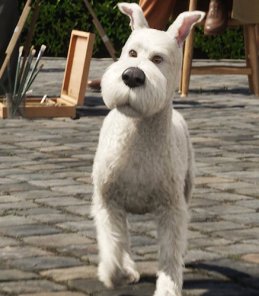 The slapstick is mainly hoisted by Simon Pegg and Nick Frost as the physically-identical Thomson and Thompson — a true advantage of animation, that. I imagine some find their parts tiresome because of their inherently comic role, but they’re likeable versions of the characters. Even more joyous is Snowy, though. Well, I would like him, wouldn’t I? His internal monologue, such a memorable part of Hergé’s books, is omitted (as it is from every film version to date, I believe), but he’s full of character nonetheless. Some of the best sequences involve Snowy running in to save the day. I don’t think they quite got the animation model right (the one glimpsed in test footage included in behind-the-scenes featurettes looks better, for my money), but his characterisation overcomes that.
Bit of an aside, but I think there’s something notable about almost everyone mentioned so far: Moffat, Wright, Cornish, Bell, Serkis, Craig, Pegg, Frost… All British. I know that’s because we’re awesome ‘n’ all, but I think it’s also indicative of Tintin’s status in the English-speaking world — which more or less boils down to “unknown in America”, but also “pretty darn popular in Britain”. At least Spielberg, the man who wanted to cast an American as Harry Potter, seems to know this (further evidence: they’ve hired another British screenwriter for the sequel). For whatever reason, Tintin has never clicked in America, while the books remain very popular over here. It therefore feels like there’s a better chance for the films’ fidelity by using Brits (who have the correct tone and style almost ingrained) than by using people coming to the stories entirely for the first time, and perhaps bringing a more generic blockbuster sensibility. On the other hand, this might just be a horribly xenophobic way of interpreting a coincidental appearance by so many Brits in key roles — after all, Tintin’s Belgian, so it’s not like using Brits is “true to source”.
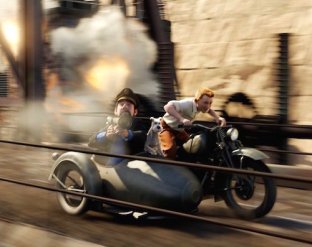 Of course, one very important person is neither British nor Belgian: Spielberg. The screenplay’s balance between peril and comedy is spotlessly enhanced by his peerless direction. In a world stuffed to the gills with lesser blockbusters that palely imitate the groundwork Spielberg and co laid in the ’70s and ’80s, work like this should remind people why he’s still the master of the form. The film is shot with an eye for realism (so much so that some viewers have been convinced it was filmed on real locations with real actors, with some CG augmentation for the cartoonish faces, of course), which helps lend a sense of plausibility and also genuine jeopardy. It’s easy to get carried away when working in CG animation, but often the most impressive works are ones that behave as if they’ve been shot largely within the limitations of real-world filmmaking technology.
That said, Spielberg isn’t afraid to make use of the freedom afforded by working in a computer-generated realm when appropriate: there are some spectacular individual shots, the most obvious being a single-take chase sequence down a hillside through a town. Even better are some of the transitions, which would be literally impossible to realise in live-action — without resorting to effects work, anyway. They’re hard to accurately describe, especially without ruining them, in part because each instance is different; but they do all look incredible, and, again, serve the story rather than being flashy for the sake of it.
 The tone on the whole is resolutely PG — actually, like many an action-adventure blockbuster used to be before everything went slightly darker and PG-13. So, for example, Tintin wields a gun on occasion, but never at another human being. The focus is on the story, which happens to lead to some adrenaline-pumping sequences, rather than a lightweight excuse to link together a bunch of punch-ups and chases. Ironically (though, for anyone who knows what they’re talking about, entirely expectedly) this makes the action all the more exciting. It also mean there’s a lighter touch than many current blockbusters offer; a greater presence for humour, including among the action. I guess that’s not fashionable these days, when everyone’s become so po-faced about their big-budget entertainment. However, with the likes of Iron Man and Guardians of the Galaxy proving immensely popular, perhaps the tide is turning, and maybe the still-on-the-cards Jackson-helmed sequel will find itself better received because of that.
I genuinely don’t understand the muted reaction to this first Tintin, though. It perhaps shows where blockbusters have gone awry in the last decade or two, and perhaps the incidental disdain animation is viewed with among some — I wonder: if the same movie had been produced in live-action, would some of those critics have been better disposed to it? I don’t think it would have actually been a better film, and perhaps it would even have been slightly worse (some of the visual impact would be lost),  but some viewers would have seen it (even subconsciously) as more of a “real movie”.
As I said at the start, those people are Wrong. The Adventures of Tintin is a fantastic adventure movie, and should prove to anyone who doubted Spielberg after Kingdom of the Crystal Skull that, when it comes to globetrotting action-adventures, he’s still the man to beat.
The UK network TV premiere of The Adventures of Tintin: The Secret of the Unicorn is on BBC One today at 4:25pm.
It placed 2nd on my list of The Ten Best Films I Saw For the First Time in 2014, which can be read in full here.

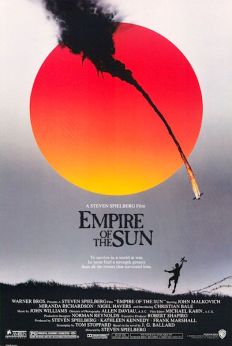 Steven Spielberg’s adaptation of J.G. Ballard’s semi-autobiographical novel stars a 13-year-old Christian Bale as Jim, the son of British ex-pats in China when the Japanese invade during World War II. Separated from his family as they try to flee, Jim encounters born survivor Basie (John Malkovich) and, when they wind up in an internment camp for the rest of the war, a cross-section of the rest of the left-behind. To Jim, a somewhat naïve but capable, confident and determined endurer, the whole thing is a big adventure; we can see the truth, though: that it’s a grim slog of life and death, and most succumb to the latter. The reality of the situation gets to Jim in the end, too… but maybe I’m getting ahead of myself.
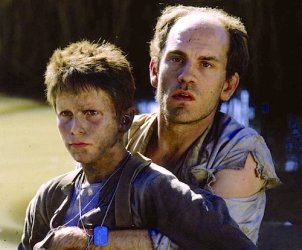 As it stands, the film is a fascinating insight into a less-often-covered aspect of the war. Even in small roles, the quality cast keep it watchable and relatable. Bale’s performance comes in just the right side of annoying — quite an achievement for a character who seems inherently brattish and prone to irritate.
 Steven Spielberg’s second feature (or “first” if you’re American) is based, loosely, on a true story. The fictionalised version sees Lou Jean (Goldie Hawn) breaking her husband (William Atherton) out of prison so they can travel cross state to liberate their baby from foster care. Everything goes smoothly until they accidentally kidnap a police officer (Michael Sacks), hundreds of police cars begin to follow them, and a multi-day slow-paced chase ensues.
 when filmmakers became contractually obliged to keep their compositions “TV safe”). The camerawork is frequently extraordinary, including at least one unbroken shot where the camera moves around inside and outside the car, like something out of
  Released the same year as
  Even with the undercurrents of grief and the difficulties of moving on, this is fundamentally a light, amiable romance.
 Cult comedy musical, with a more-than-healthy dose of the surreal, about two brothers on a mission from God, here watched in the extended DVD version (full details at
  I’ve grown up with Indiana Jones around. Not in the way Harry Knowles may have (
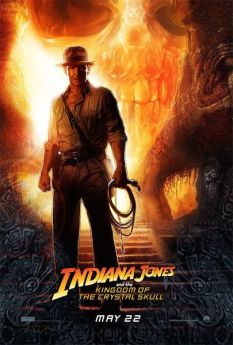 I couldn’t make it to the local midnight showing of
  100Films.co.uk