

Here we have the kind of film that gets branded as “science-fiction”, simply because it’s set in space; but, as an opening title card is at pains to point out, the actual setting is the present day. Mankind has a permanent presence in space on the eponymous International Space Station — that’s not sci-fi, that’s reality. Any speculative elements here are no more implausible or futuristic than in, say, a Jack Ryan story. Heck, James Bond films have routinely featured more impossible, fictional gadgets than anything seen here, and no one’s seriously describing those as “sci-fi” — except maybe Moonraker, and that’s really only because it’s set in space. That said, if we take the genre at face value — fiction about science — well, space exploration is pretty sciencey, and the I.S.S.’s crew are scientists, so, yeah, I guess maybe it is science-fiction, in a literal sense.
Anyway, as I said, the film is set in the present day, with the I.S.S. currently crewed by three American and three Russian astronauts. Is that often the case? I think they’re the two primary countries to crew the station, but astronauts of various nationalities end up on there; I’m just not sure how regularly. It certainly simplifies the film’s plot to keep everyone distinctly on one of the two sides, because of what happens next: down on Earth, war breaks out between the US and Russia, and each trio’s commander is instructed by their respective ground control to secure the station as a key asset. (Why would a war on Earth care about a scientific research space station at a time when space is hardly a key battleground? The film does have an explanation for that.)
It is, in my view, an enticing setup; indeed, it’s what sold me on watching the film as soon as I heard about it. Unfortunately, it doesn’t have any fresh ideas beyond that inciting incident. What unfurls over the next hour-or-so (after a bit of character establishment and plot setup — the film runs under 90 minutes before credits) is a moderately tense “who can be trusted?” thriller, with both sides dubious of the other’s intent, as well as degrees of distrust within their own camps. But it never manages to take that anywhere surprising, with every twist feeling first-idea obvious. It’s not that the film telegraphs these narrative turns, but if you’ve seen a thriller before, you’ll likely expect every one.
Perhaps if the sides hadn’t been so neatly divided — if there had been crew members from other countries, with conflicting loyalties — the film would’ve had more juice. Part of the problem is a limited cast size: the crew is just six people; teams of three are already quite limited for generating internal conflict, so if you cut that down to two with two floating (pun semi-intended) members… Well, now we’re perhaps getting into the territory of judging the film for what it isn’t than for what it is. Nonetheless, it feels like maybe those involved could or should have spent more time exploring those possibilities themselves.

Presumably this was a relatively low-budget endeavour, given the shortage of marketing push (its UK release, three whole months after its US bow, seems to be fairly limited) and lack of major star wattage — though there’s a fair chance you’ll recognise most of the cast, depending what else you consume. The lead is Ariana DeBose, of West Side Story and “Angela Bassett did the thing” fame. Her commander is the generally-recognisable Chris Messina, with the American side rounded out by John Gallagher Jr, who I always remember from The Newsroom, but has also been in the likes of Westworld and 10 Cloverfield Lane. The Russians are led by The Americans’ Costa Ronin, alongside the prolific Pilou Asbæk (Borgen, Game of Thrones, Ghost in the Shell, etc) and the only cast member I didn’t recognise, Masha Mashkova (maybe you’ll know her if you watched McMafia).
Despite the limited cost, the realisation of space and weightlessness is decent — don’t expect Gravity when one crew member sets off on a spacewalk, but the effects are more than serviceable. I’m even curious how they achieved weightlessness — I presume they didn’t have the budget for Apollo 13-style “vomit comet” flights, nor Interstellar’s complex rigs, and sometimes you do suspect the actors are just bobbing around a bit, but it mostly works. Sadly, the current Blu-ray release is entirely extras-free (not even a trailer), so it remains a mystery to me for now.
It’s a shame that I.S.S. doesn’t offer something exceptional enough to elevate it to the ranks of those other space films I just mentioned. Personally, however, I just fundamentally enjoy seeing films set in the present-day/near-future of real-world space exploration, so I’m still glad it exists.

I.S.S. is in UK and Irish cinemas from tomorrow, Friday 26th April 2024. It’s the 29th film in my 100 Films in a Year Challenge 2024.




 Score:



 2014 Academy Awards
 On its theatrical release, a commonly-cited recommendation was to see Gravity in 3D on the biggest screen possible. Obviously, I didn’t bother. Some say it isn’t as effective on a small screen in 2D. Maybe it isn’t as effective, but it’s still a damn fine film.
 quick editing has always been a way of creating excitement in that arena), the never-ending shots serve to make you feel closer to events, right alongside Bullock, almost wishing it would stop. Plus there’s skill in being able to show us what we need to see from a single vantage point, without the easy option of being able to cut to a different angle to clarify a detail.
 The most high-profile jobs — the actors, the studio — may be American, but everything else is pretty darn British. Rather than cry “that’s ridiculous! Give it to a proper British film!”, we should be keen to point out that, actually, this surprise global mega-hit wasn’t made in America, but in Britain, by all the talented filmmakers we have here. Rule Britannia, etc etc!
 While I sympathise with the idea that it’s not A Science Fiction Movie, but instead A Thriller (That Happens To Be Set In Space), you can’t really deny its SF-ness. OK, if we’re classing this as SF then so too should be films like
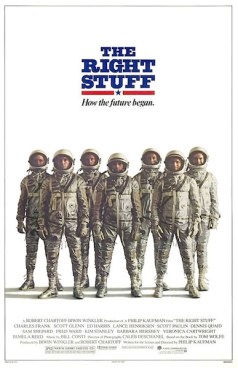 The Right Stuff ostensibly dramatises the story of the ‘Mercury 7’, America’s first group of astronauts, but in fact equally concerns itself with the tale of test pilot Chuck Yeager. But I’ll get to him.
 100Films.co.uk