
Tokuzô Tanaka | 86 mins | Blu-ray | 2.35:1 | Japan / Japanese
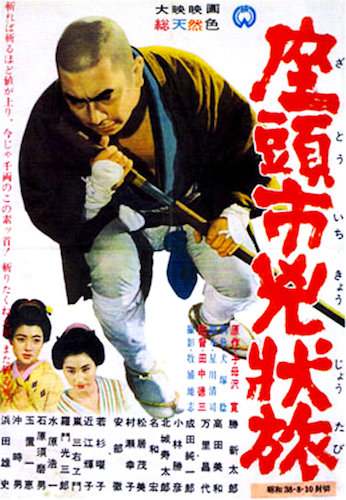
“His sword is shiny and ice-cold. The only thing it won’t cut in this whole wide world is oil and the bond of lovers.”
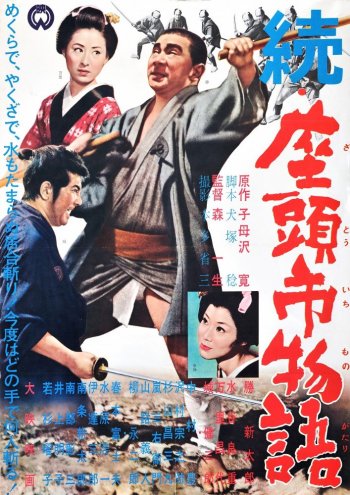
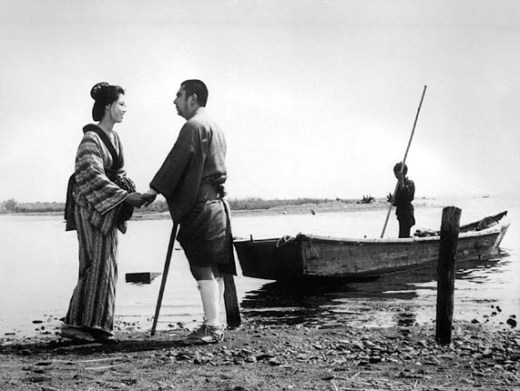
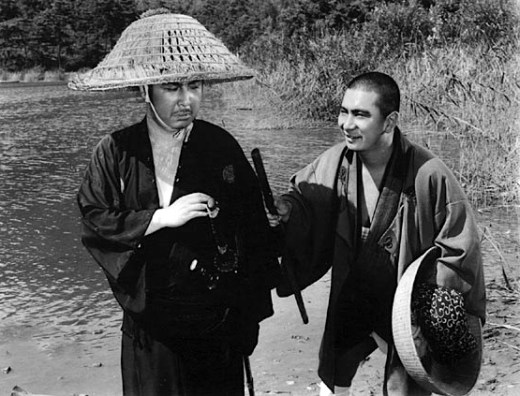
The fourth film in the Zatoichi series finds the blind masseur (Shintaro Katsu) with a bounty on his head, which only increases when he kills the first person who tries to claim it. Travelling to a nearby village to apologise to the guy’s mother, Ichi finds himself in the middle of a yakuza scheme to grab territory from a young boss. There’s also the small matter of a ronin (Jutarô Hôjô) and his companion, Ichi’s old love Otane (Masayo Banri).
That’s the straightforward version — much of the plot is an overly complex account of yakuza plotting that, frankly, I sometimes struggled to follow. Especially at the start, there are so many bosses to keep track of, with broadly similar names, all of whom are more often referred to in dialogue than established on screen. I got my head round it eventually, but it took some work. It makes stretches of the film a bit dry and awkward, however.
Fortunately, that’s not all that’s going on. Otane is back from films one and two, but she’s different to how Ichi remembers her. Rather than just bringing back a familiar face for the sake of it, the film uses her to make a point about how people aren’t always who we think they are — a bit like Ichi himself, in fact. I imagine this would be even more effective if I’d watched The Fugitive closer to when I watched her previous two appearances, but there’s enough information recapped within the film to get the gist. It also continues what seems to be a definite theme of the Zatoichi films (at least so far) about past people and actions coming back to haunt our hero.
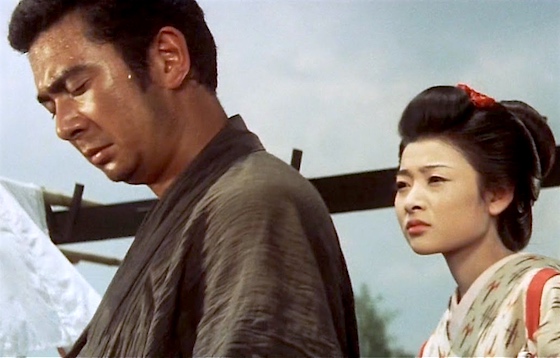
However, the best part of the film is the final 20 minutes, a tour de force of emotion and action that sees Ichi surrounded and, enraged into action, taking down an army that stands between him and vengeance. Said vengeance comes in the form of a one-on-one sword duel, of course. Obviously we know our hero will triumph, but it’s still a tense scene, especially as it seems to be a rare occasion when Ichi’s been out-fought. This third act elevates the whole movie, its very existence justifying everything that came before.
Reading other reviews, I’ve seen The Fugitive described as both “one of the weaker installments in the series” and “thus far the best [of the series,] a spectacular action-packed entry that deftly showcases why this series matters so much.” I think this stems to which you weigh heavier between the first-rate climax (plus a few choice sequences before that) and the occasionally dry plotting earlier in the movie. For me, the way it eventually comes together and concludes makes it all worth it.

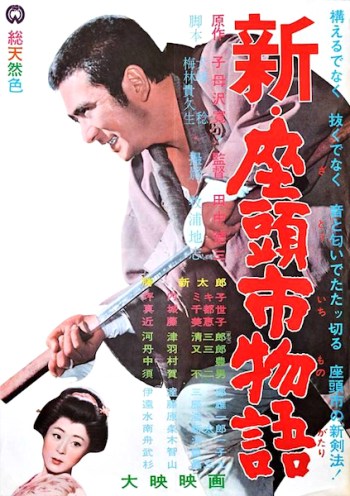

 Adapted from a short story by Kan Shimozawa, The Tale of Zatoichi was a low-key release for its studio, Daiei: despite being helmed by “a topflight director”
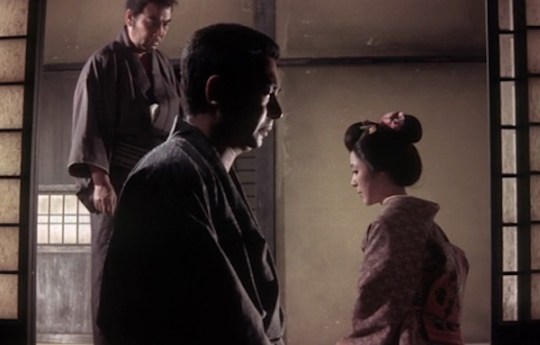
 But enough hyperbole — what about The Tale itself? The story sees blind masseuse Zatoichi accepting an old invitation to visit an acquaintance, Sukegorô (Eijirô Yanagi). But Sukegorô is a yakuza boss, and he presses Zatoichi to join his side in a brewing war with rival Shigezô (Ryûzô Shimada) — because although he’s blind, the masseuse has legendary sword skills. On Shigezô’s side is a hired samurai, Hirate (Amachi), who Zatoichi encounters by chance. Despite the mutual respect between these two coerced warriors, the eventual gang battle comes down to a duel between them…
 Those prepared for a calmer, more considered film may find much to like, however. Katsu’s understated style holds your attention and makes you want to learn more about the character; not his past, necessarily, but his qualities as a man. The same is true of Amachi, in some ways even more appealing as the doomed ronin. You get a genuine sense that Zatoichi and Hirate would have had a great, long-lasting friendship if they’d met under better circumstances, which makes the manner of their encounter all the more tragic. For all the bluster about a big gang war on the horizon, it’s the relationship between these two men that forms the heart of the film.
 Reportedly this opener is “not the best of [the] series”, but remains “a grand introduction to the character and a touchstone for many of the themes and gags presented in the later films”.
 100Films.co.uk