
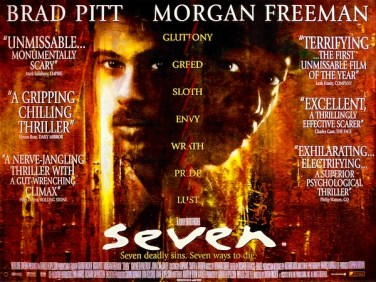
Also Known As: Seven

Country: USA
Language: English
Runtime: 127 minutes
BBFC: 18
MPAA: R
Original Release: 22nd September 1995 (USA)
UK Release: 5th January 1996
First Seen: TV, 12th June 2001 (probably)
Stars
Morgan Freeman (The Shawshank Redemption, Million Dollar Baby)
Brad Pitt (Legends of the Fall, The Curious Case of Benjamin Button)
Kevin Spacey (The Usual Suspects, American Beauty)
Gwyneth Paltrow (Sliding Doors, Shakespeare in Love)
Director
David Fincher (Fight Club, Zodiac)
Screenwriter
Andrew Kevin Walker (8MM, Sleepy Hollow)
The Story
In an unnamed city, two homicide detectives investigate a series of grim murders inspired by the seven deadly sins.
Our Heroes
William Somerset is a detective who works calmly and methodically, and cares more than most. Serving out the last few days before his retirement, he lands a helluva final case. His new partner is David Mills, a hotheaded but idealistic new transfer who’s keen to prove himself. Despite their chalk-and-cheese temperaments, or perhaps because of them, the pair may be ideally suited to catch the elusive killer.
Our Villain
John Doe, a proper psychopath, and on a mission too. I say the detectives are ideally suited to catch him, but, well (major, major spoilers…) they technically don’t and he essentially wins.
Best Supporting Character
R. Lee Ermey’s police captain, purely for the moment when he answers a phone. I love that bit of humour far more than it probably warrants.
Memorable Quote
“What was in the box? What’s in the box? What’s in the fucking box?!” — Mills
Memorable Scene
The climax — just Somerset, Mills, and John Doe, alone in the middle of nowhere… and then a deliveryman shows up. “John Doe has the upper hand!”
Technical Wizardry
The film’s visual style really helps to sell the tone — dark, foreboding, grim. This is in part because it’s always raining, a decision made to increase the sense of dread, and because of Darius Khondji’s cinematography, which employed bleach bypass (see also: Minority Report), a process that serves to deepen shadows. Additionally, for the film’s Platinum Series DVD release it was rescanned from the original negative, meaning the whole film had to have its colour grading re-done. Some of the changes were quite extensive (as detailed in the DVD/Blu-ray’s special features, if you’re interested).
Truly Special Effect
A serial killer thriller might not sound like a special effect showcase, but John Doe’s extreme methods lead to some pretty unusual and gruesome corpses — rendered with suitably sickening prosthetics, of course. ‘Sloth’ is particularly harrowing, though ‘lust’ is so bad it’s left almost entirely to our imagination — though, again, someone had to design and build the… instrument.
Making of
John Doe’s shelves of handwritten notebooks were real and created especially for the film. They took two months to create at a cost of $15,000.
Next time…
Screenwriter Andrew Kevin Walker originally thought of 8MM as a sequel, and David Fincher was interested, but it didn’t happen and we wound up with the only-half-decent Nicolas Cage-starring Joel Schumacher-directed version instead.
Awards
1 Oscar nomination (Editing)
1 BAFTA nomination (Original Screenplay)
2 Saturn Awards (Writing, Make-Up)
5 Saturn nominations (Action/Adventure Film, Actor (Morgan Freeman), Supporting Actress (Gwyneth Paltrow), Director, Music)
Places with more taste (i.e. where it won Best Film): Empire Awards, Fantasporto International Fantasy Film Awards, MTV Movie Awards; plus Best Foreign Language Film at Blue Ribbon Awards, Hochi Film Awards, Sant Jordi Awards (Audience Award)
What the Critics Said
“designer unpleasantness is a hallmark of our era, and this movie may be more concerned with wallowing in it than with illuminating what it means politically. Yet the filmmakers stick to their vision with such dedication and persistence that something indelible comes across — something ethically and artistically superior to The Silence of the Lambs that refuses to exploit suffering for fun or entertainment and leaves you wondering about the world we’re living in.” — Jonathan Rosenbaum, Chicago Reader
 Score:
 80%
80%What the Public Say
“The rain never ends. There is seldom any sunlight, or any warmth. The city feels like a city of the damned, as if its denizens are souls trapped in some circle of hell from which there is no escape. A feeling of dread pervades everything; there is never any inclination that anything remotely like justice or hope or salvation is even possible here. […] it’s all style and atmosphere but… to criticise the film for that, almost feels like missing the point — it’s so integral to the piece, the atmosphere is actually one of the film’s characters” — the ghost of 82

Elsewhere on 100 Films…
I reviewed Se7en quite thoroughly (and, if I do say so myself, quite well) as part of a retrospective on Fincher’s films back in 2011, concluding that “some would claim that Se7en is no more than a standard murder thriller with a stock mismatched pair of detectives. In some respects they’re right, but in enough respects they’re wrong. There’s a killer high concept behind the crimes, but it’s really the execution of the film that makes it so much more. It’s in the performances, the way those stock characters are written, their subplots, the story’s pace, the cinematography, the music, individual sequences like Somerset in the library or the climax that rise not only to the top of the genre but to the top of the very medium of film itself.”
When asked, I normally say Se7en is my favourite movie. That’s partly pre-picked just to prevent any such conversations turning into a dreary slog where I um and ah through hundreds of options, but naturally there’s some truth in it. On the surface it’s merely a police procedural, but it’s the way it handles that material that elevates it. It’s a dark film about terrible deeds, which both suits its subject matter (murder isn’t really just a fun little mystery to solve, is it?) and presents a worldview that makes us consider who’s really right and who’s really mad — John Doe is clearly an evil psychopath, but does he have a point? It’s also made with supreme artistry by director David Fincher and his team — I’ve already mentioned DP Darius Khondji, but it’s also superbly edited by Richard Francis-Bruce. And I’d argue it has one of the greatest climaxes ever filmed. There are more easily enjoyable movies in my 100 Favourites, but there are none that are any better made, nor any that better expose the dark heart of humanity.

#82 will be… a big damn movie.
 John Cusack stars as literary giant (figuratively) Edgar Allan Poe in this wannabe-Victorian-
 That they didn’t tone it all down just a smidge to match, and so go for the box office-friendly PG-13, is a surprise in these days.
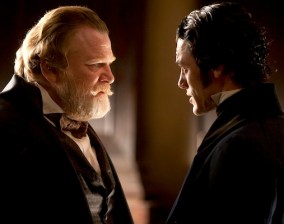 The rest of the cast are from Hollywood’s usual go-to for period tales: Brits; if not entirely then mostly so. (The film was shot in Hungary and Serbia, so I suppose our thesps have the additional advantage of being geographically favourable to Americans.) You know you’re getting a level of quality there, then, though for me Kevin R. McNally lets the side down (again). He’s only a supporting character and is fine most of the time, but there’s one bit when he’s talking to the lead detective and just rattles off his line… It’s not the world’s greatest speech, but you can hear there was meant to be more nuance and quiet in there.
 Se7en is probably my favourite film ever made, but criticisms that it’s quite a standard detective mystery are not invalid. It’s enlivened by Andrew Kevin Walker’s writing (great dialogue, engrossing structure, etc), some top-drawer performances (Freeman, Pitt, a loopy-calm Spacey), and, probably most of all, David Fincher’s inestimable touch. In making such a comparison it’s easy to see that The Raven lacks any of these, which renders it a solid period mystery, but no more.
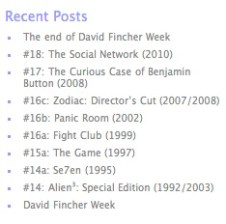 One thing this week has achieved is re-confirming that Fincher is one of my favourite directors. Another is to remind me that I’ve not seen a single one of his films at the cinema.

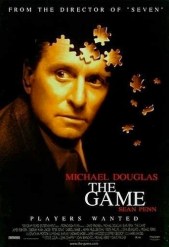
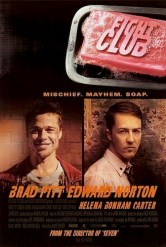
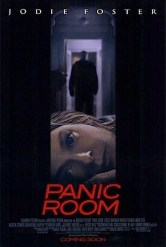
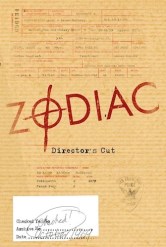

 I usually say that Se7en is my favourite film.
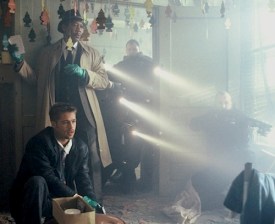 Black seems to be its default position — everything else is cut out of the darkness with as little light as possible. Often backgrounds and locations are better lit than foregrounds or actors, making the viewer focus on silhouettes with minimal light offering splashes of detail. Even the scenes that occur at daytime (most, anyway) do so in the middle of ferocious, ceaseless rain that ensures it never gets too bright.
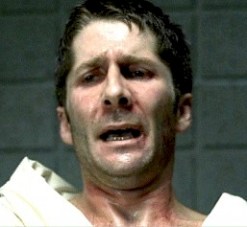 all but one of
 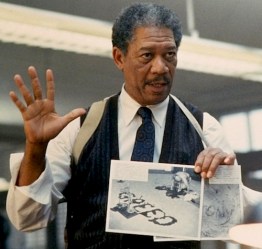 Mills delivers his riposte with greater hyperbole — of course, because that’s the character — perhaps bedded in a form of naivety and idealism, ending with a repetitious “I do not agree. I do not.” Then we see Freeman’s face, completely static, but you can read in it everything you need to — his anger at Mills for making him realise that it’s all a lie he’s been telling himself, and anger at himself for believing the lie. That’s one scene; Freeman is incredible throughout.
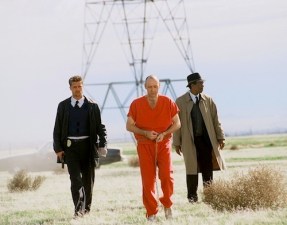 This is where liking the characters pays too, because we are on Somerset’s side and we’re on Mills’ side and we agree with both and disagree with both and don’t necessarily know who’s right or what to do or what we would do. I can spend the whole film anticipating this scene, knowing exactly what will happen in it, how great a piece of filmmaking it will be, yet it still makes my hair stand on end.
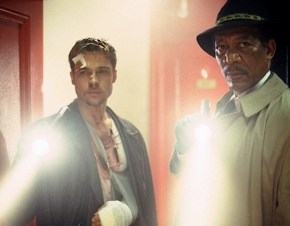 The quality of a crime thriller is often so tied to its mystery that the film can only sustain so many viewings — sometimes, only one — before you know it too well. I have seen Se7en at least seven times now, which for me is a lot — a helluva lot, even — and yet I still get something from it every time. That’s a rarity, that’s a reason to love it, and that is why it may well be my favourite film.
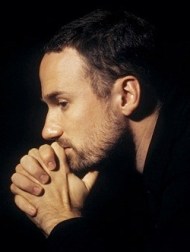 David Fincher’s multi-Oscar-nominated latest,
  My viewing starts tonight, for a week running Friday to Friday — I’m relying on HMV to get The Social Network to me in timely fashion for that to work. I intend to start posting reviews on Sunday night — technically, Monday morning — which gives me a couple of days to write them, for a week running Monday to Monday. Neatness in both watching and reviewing, then.
 So the week begins with a film I’ve seen in a cut I haven’t, ends with two films I’ve never seen, and along the way takes in several of my favourite-ever films. Lovely.
 First, a little note on that aka: technically — and, I believe, legally — no such title is attached to this project. However, the initial idea was developed by Koontz and, after he left the project, adapted into his Dean Koontz’s Frankenstein series of novels. Despite the ‘creative disagreement’ (or whatever they chose to call it) that led him to walk away, the film retains significant similarities to the first book. More on these in a moment.
 100Films.co.uk