
That title is massively simplified (and therefore technically wrong), but still seems long, doesn’t it? Yeah, wait ’til you see the proper name of that subsection.
Oh, also, I watched some films and stuff. Y’know, what this blog is actually about.
What Do You Mean You Haven’t Seen…?
Continuing apace, this month’s WDYMYHS film is quirky French comedy Amélie.
 July’s films in full
#56 Transformers: Dark of the Moon (2011)
#57 A Late Quartet (2012)
#58 The Raid (2011), aka Serbuan maut
#59 We’re the Millers (2013)
 #60 Video Nasties: Moral Panic, Censorship and Videotape (2010)
#61 Ghost Rider: Spirit of Vengeance (2011)
#62 Pacific Rim (2013)
#63 Cloudy with a Chance of Meatballs 2 (2013)
#64 Frozen (2013)
#65 Amélie (2001), aka Le Fabuleux Destin d’Amélie Poulain
I’ve come over all Modern this month, with all but one film being from the 2010s — to put it another way, that means that all but one come from the last five years; and 40% are from last year alone, too. Well, I do have a lot of catching up to do. And the only film from outside this decade is still from this millennium. Ah well.
In terms of the history of Julys, I’m forming a new pattern: this year I watched ten new films, year before it was four, year before that it was ten, year before that it was four… Funny how these things happen, ain’t it? Year-to-date, ten films puts July precisely in the middle of things: it’s both my fourth-best and fourth-worst month of 2014.
As for having reached #65, that finally puts me ahead of last year, when I’d ‘only’ reached #62 by this point. I say ‘only’ because the goal for the end of July is 58, so both years remain ahead of expectations — indeed, I only need to watch one film next month to reach August’s target.
100 Films has changed home multiple times (deviantART, Blogger, FilmJournal, WordPress), and each time I’ve brought all my old content along with me. The move to WordPress has proven the most awkward in that regard: by the time I made the shift, I’d accumulated something like 700 posts. I’ve been here a couple of years now, regularly reposting old reviews as and when, but still fewer than half of those have made the transition. It’s time for a change… which is why early this month I began a concerted effort to repost at least one archive review every day. I don’t imagine I’ll keep it up full time (I think I’ve missed a day or two already), but it remains an overall goal; one that should see me fully transferred in a year or so — finally!
Each month I’m going to highlight the mass of reposts in this round-up, just in case you missed them. So, the inaugural selection of 24 are…






















My Ranking of the 5 Hugo Best Dramatic Presentation (Long Form) Nominees
The Hugos are the prestigious science fiction and fantasy awards handed out by the World Science Fiction Society at whichever convention is Worldcon that year (this year, it’s LonCon 3), voted for by attendees and members of that convention. This year, I’ll be among those voters… well, by the time this has been posted the deadline will have passed, so I am among those voters. I signed up for two reasons, really: the “voter packet” of free ebooks, which this year included the complete Wheel of Time series (price of membership vs. value of the ebooks more than covered itself); and the chance to give everything Doctor Who-related a boost, as of course these awards are for last year, i.e. Who’s big 50th anniversary. Biased, me? Um…
The Hugos are primarily a literary award, with a dozen categories related to the writing and editing of fiction at various lengths; but in addition to those there are two Dramatic Presentation awards: Short Form (mainly, TV) and Long Form (mainly, films). As a good voter, I’ve made an effort to see all of the latter (and all but one of the former), and as two of them are amongst this month’s viewing, and (as I mentioned) the deadline for voting has just passed, I thought I’d share my final ranking. From best to worst, then…
- Gravity
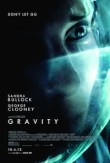 Set in the immediate future using technology that largely exists or is about to exist, some contend that Gravity isn’t a science fiction film at all — it’s a present-day thriller, just one that happens to be set in space. And they’re right, really — there are plenty of “real-world present-day” type thrillers that have more science fictional happenings than Gravity. But it’s on the ballot and it’s an incredible film, so pish, it wins.
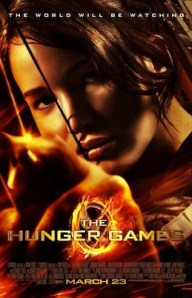
 - The Hunger Games: Catching Fire
 The decision between second and third was a tough one for me — I’d’ve tied them if I could. However, I haven’t posted a review yet for Catching Fire and am still debating my score — does it stretch to a 5? It still could — not only did I really enjoy it, but I think it has a lot more thematic/dramatic heft than your average blockbuster. Anyway, the next film’s locked at 4 stars, so Catching Fire wins the toss.
 - Iron Man 3
 Some people seem to really, really dislike Iron Man 3. Not sure why — it may well be the best entry in what’s an all-round enjoyable trilogy (I still maintain Iron Man 2 isn’t so bad), a different-from-the-norm superhero tale that excites and entertains. It works as a trilogy-capper too (it’s almost a shame he’ll just be back in Avengers 2.) I’d quite like to rank it first… but, sadly, not in this year.
 - Frozen
 Disney’s all-conquering version of The Snow Queen is the only fantasy film on this year’s ballot (seems to me the Hugos skew more SF than F. I suppose they are awarded by a Science Fiction society). I didn’t find it as incredible as the audiences who made it the fifth highest grossing film of all time, but it’s a fine film, whose initially-bland songs improve with re-listening (he says, listening to Let It Go as he writes).
 - Pacific Rim
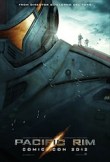 Guillermo del Toro’s Westernised riff on a very Japanese subgenre flopped Stateside — it just crossed $100m, which once would’ve been remarkable, but on a budget of $190m is poor. Internationally, however, it stormed past $300m and so will be sequelised. Del Toro apparently aimed it at 11-year-old boys, and it’s better than most other super-budgeted movies aimed at that demographic.
And the one thing I reviewed as a film but the Hugos count as Short Form…
- Doctor Who: The Day of the Doctor
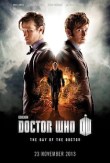 Well, of course they do — it’s a TV episode really, isn’t it? But it is feature-length (long enough to qualify for Long Form) and was released in cinemas, so I maintain you could count it as a film. Still, in Short Form it stands a strong chance of winning — I ranked it #1. My #2 and 3 was another tough decision, but I put Peter Davison’s hilarious spoof The Five(ish) Doctors Reboot in second and, in third, Mark Gatiss’ incredible An Adventure in Space and Time (another feature-length production that could hold it’s own against movies). Neither of those are strictly SF/F, but I guess as they’re Dramatic Presentations rather than books it was felt they belonged here rather than in the Related Works category. In fourth was Game of Thrones episode The Rains of Castamere. It is great as an entire episode, but let’s face it, it’s here because of the Red Wedding, which is the last, what, 10 minutes? Any other year it would probably win, but against four Doctor Who nominees (it’s a transferable vote, so more nominees means a better chance of one winning) at a convention held in Britain? We love Thrones here (more than the US, according to some stats I saw), but Hugo voters everywhere love Who. Finally, unranked by me, were Doctor Who finale The Name of the Doctor (it underwhelmed me — I won’t advocate “no award” above it, but I don’t feel it deserves to beat any of the above nominees), and Orphan Black mid-season ep Variations Under Domestication, which I’ve simply not seen.
Have I been a crazy person and put these in all kinds of the wrong order? And what about the Hugo nominators — are there any science-fiction/fantasy films (or TV programmes) from 2013 that they were fools to leave out? Lemme know.
Next month on 100 Films in a Year…
It’s the summer! Though blockbuster season is almost over already, isn’t it? Never mind. Perfect time of year to stay inside where it’s cool, anyway.
Oh, and watch some films. Which I shall list next time. But you knew that.
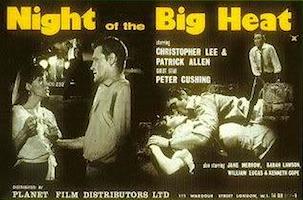 These days largely sold as a horror movie (the old Collector’s Edition DVD is branded as part of a “Masters of Horror” series), probably thanks to its cast (Christopher Lee and Peter Cushing), director (Terence Fisher, of many a Hammer Horror, including five with Cushing and Lee), and rating (an X originally, a 15 now), Night of the Big Heat is not really anything of the sort. Well, maybe a little; but you’re more likely to get scared by a contemporaneous episode of
 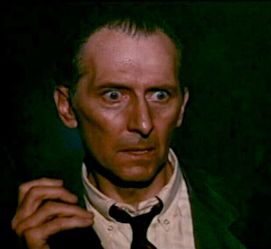 the pair were brought in to redraft because the original screenplay’s dialogue was “unsayable”. Anyone familiar with their ’80s work on Doctor Who, and their associated reputation, will find that highly ironic.) However, when the sci-fi stuff does roll in it’s a bit of a damp squib, leaving the scenes relating to the affair, whether it will be discovered, and what various characters do about their various feelings, as some of the more unique and interesting elements.
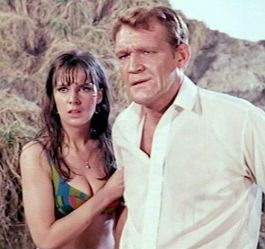 which considering it was shot in February and March is a real achievement. During night shoots the cast had to suck ice to stop their breath being visible, while running around in wet clothing to look like they were drenched in sweat. Poor sods. Said night scenes are a mess of genuine and atmospheric nighttime shooting, alongside the kind of day-for-night filming where everything’s extremely dark except for the sky, and also the kind of day-for-night filming where it’s day and… um… shh!
 Seen by some as a
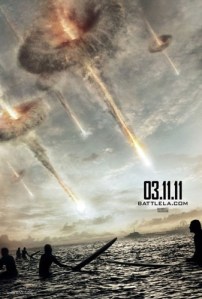 Battle Los Angeles (on screen; Battle: Los Angeles on posters — c’mon, let’s have some consistency with punctuation! Punctuation matters) seemed to come in for a wall of criticism when it hit cinemas way back whenever. For my money, though, it wasn’t that bad.
 This kind of gung-ho militarism is laid on too thick. It seems fine for much of the film, but then as it heads into the second half and, especially, the third act, we have to suffer all manner of speeches and Emotional Moments that lack weight due to characterisation issues. The latter is badly handled for all kinds of reasons. All of the marines are entirely clichéd; so too are their story arcs; too much time is wasted trying to make us care about them — there are too many and they’re too shallowly drawn; things are worsened when a couple of civilians are added to the mix, who suffer from all the same problems… except they’re perhaps under- rather than over-developed. As we reach the third act, anything approaching plausible characterisation is jettisoned. Like the small-scale focus, what begins as naturalistic ends up with Big Speeches and all manner of Emotional Moments.
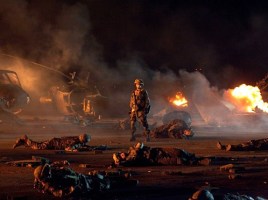 evoking the likes of the aforementioned as well as Black Hawk Down and
  They may take a little while to get to, but they’re relatively worth the wait.
 I’ve
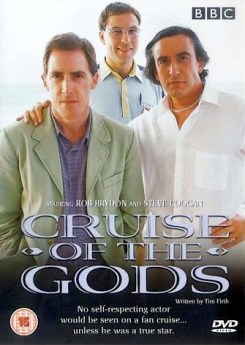
I’ve 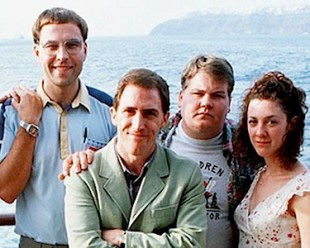 Though the film pokes fun (fairly good-naturedly) at sci-fi obsessives, the underlying story here is about a man overshadowed by his past. In this Brydon gives a strong performance — I think he’s a better actor than he’s normally given credit for — and he’s ably supported by Corden in particular, though to say what gives his role such quality might spoil a twist. He’s another one who’s actually a very good actor, but it gets hidden beneath a public persona that led to such dross as that sketch show with Mathew Horne.
 without ever realising all those disparate things were penned by the same human being. Poor writers.) Lowney, meanwhile, has stuck to TV, with episodes of
  Sometimes, at least for me, films improve in retrospect. My opinion while watching may be different to when I look back days, weeks, months, or even years later. Films I thought I disliked may benefit from a kind of nostalgia; some films just gain something from extended reflection, even if that isn’t conscious; films I underrated may improve when I gain perspective on their qualities relative to other works; in some cases, it’s just that I’m getting older and wiser.
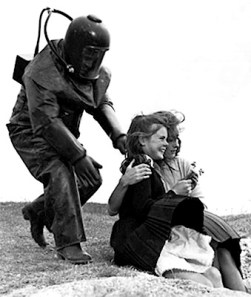 Not necessarily a bad thing, but it has that kind of disconnect from reality that’s markedly ’60s. In
 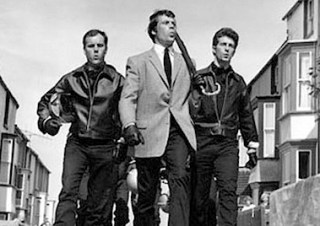 and the kind of inhumanity that might be reached in the quest to survive nuclear war.
 It’s quite understandable if you haven’t heard of Browncoats: Redemption (well, other than for
  The characters are, thankfully, not carbon copies of Firefly’s cast — some effort has clearly been made to differentiate the line-up, and that goes beyond inverting most of the genders. They’re surely cut from the same cloth though, but that’s understandable: this isn’t trying to be radical with Whedon’s ‘verse, it’s trying to emulate it for the fans, and the fans like what they’ve already seen. Ironically, despite being the most obviously gender-swapped, it’s Redemption’s female captain who’s most like her Serenity counterpart: Laura is, to be blunt, Mal with breasts. Her backstory is at least completely different, but the end result — the character we meet in the film — is more or less the same. When your leads are too similar it can override how different the rest of the cast may be.
 The rest of Browncoats’s direction is a typical fan film minefield. Dougherty’s work is awkwardly flat: it’s all master shots and few close-ups; some sets are shot from the same two angles (and no more) in every scene; it ignores basic rules, like the 180 degree line; the camera is handheld or mounted indiscriminately; it’s loosely framed and poorly lit. And it’s loosely edited too, with some bits allowed to run indulgently long. There may be some places where it’s not so bad, but generally this is the work of someone who knows how to point a camera and press record, rather than direct.
 I’ve seen many people online flat-out slag Browncoats off, which is patently unfair. Maybe it’s a generational thing: having been a
  If I scored films for effort, or for heart-in-the-right-place-ness, then this would be an easy 5/5. I just hope no one involved is hoping they can launch a career in ‘real’ film or TV off the back of it, because it doesn’t make that grade. (They’re trying the same thing again, at least, this time with an original zombie movie (because there aren’t enough of those) called
 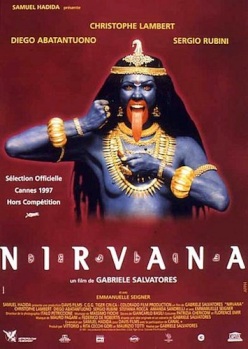 The Radio Times film section may be steadily going down the drain, but when anyone
  The most obvious point of reference for Nirvana is
  interacting with Solo merely though a series of screens on his journeys (and, one presumes, a series of microphones too). Cronenberg’s film was made a couple of years after this, so commending it for not doing the same thing would obviously be a bit rich. It is to be commended for not descending into a needlessly twist-strewn third act though, which I had thought was coming — there’s plenty of bits along the way that could be used to build a ‘surprise’ or two. There’s some ambiguity in the ending, but not too blatantly (unlike later versions of Blade Runner, for instance), and Emmanuelle Seigner’s ex-girlfriend character is never quite used in the way I expected.
 and I imagine subtitles could be easier to follow than this dubbed version, in which everyone’s covered by either the original actors straining with English (based on the accents) or the typically bad voice actors employed for such dubs. The
 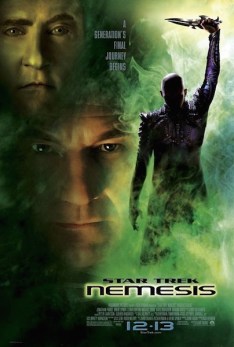 After the widespread disappointment with
  though the knowledge of better things to come means his presence somehow lifts his scenes a notch.
 There’s probably a worthwhile biopic to be made about Verity Lambert. In 1963, she became not only the youngest-ever producer of a BBC television programme, but the first female one too; the programme she was charged with launching was
  Before I set off really critiquing the film, let’s just remember this: it’s a student effort. In that context, I’ve seen far worse — heck, I’ve been involved in the production of worse. Cowell and Guy have set themselves an almost Herculean task by choosing a period tale, which obviously necessitates all sorts of extra effort in terms of costumes, locations, dialogue… And to make it worse, they’ve chosen the ’60s, evoked so faultlessly in almost 40 hours (and counting) of
  which he accepts with merely a muttered “damn” when she leaves. Sorry, what? There’s nothing believable in that scene, never mind accurate.
 Technically, the piece is just as much a mixed bag. Stephen Cheung’s direction picks out some decent angles, avoiding the flat point-and-shoot trap some student filmmakers are apt to fall into, while the sepia-ish wash helps the period tone and adds a small amount of welcome gloss. The editing is a little rough around the edges, particularly at scene changes and toward the end. YouTube claims it’s viewable in 1080p — whether something went wrong in shooting, editing or at YouTube’s end I don’t know, but it isn’t that high quality. (This last point doesn’t impact on my score at all, it’s just an observation.)
 100Films.co.uk