aka Zatôichi monogatari / Zatoichi: The Life and Opinion of Masseur Ichi
2013 #92
Kenji Misumi | 96 mins | DVD | 2.35:1 | Japan / Japanese
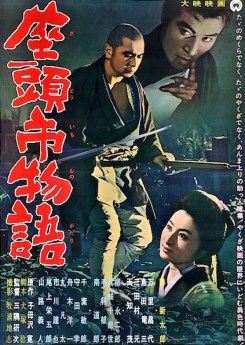 Adapted from a short story by Kan Shimozawa, The Tale of Zatoichi was a low-key release for its studio, Daiei: despite being helmed by “a topflight director”*, it was shot in black and white, its leading man, Shintarô Katsu, “was not really a huge star”, and his co-star, Shigeru Amachi, “had been one of the main stars at Shintoto studios before it went bankrupt and ceased production” — surely a mixed blessing. And yet it was “a surprise hit… touch[ing] a nerve with Japanese audiences, who loved to root for the underdog.” Despite the fact our hero gives up his sword at the end of the film, Daiei produced a sequel, and… well…
Some things are created as film series (all those ’30s and ’40s Hollywood mysteries; Cubby Broccoli and co always intended to do multiple James Bond movies), others just turn into them. The Tale of Zatoichi was the latter. Far from a low-key one-off, it would go on to be a huge touchstone for Japanese culture, spawning 24 sequels over the next 11 years, followed by a 100-episode TV series in the ’70s, and a revival film in 1989 — all starring Katsu. Although he passed away in 1997, Zatoichi has lived on through several remakes and spin-offs in the past decade. Although the character and series has a cult following in the West (brought into sharper focus by the well-received 2003 remake), added significance has been imbued by the incredible, beautiful, 25-film, 27-disc, dual format Criterion Collection box set released last year.
 But enough hyperbole — what about The Tale itself? The story sees blind masseuse Zatoichi accepting an old invitation to visit an acquaintance, Sukegorô (Eijirô Yanagi). But Sukegorô is a yakuza boss, and he presses Zatoichi to join his side in a brewing war with rival Shigezô (Ryûzô Shimada) — because although he’s blind, the masseuse has legendary sword skills. On Shigezô’s side is a hired samurai, Hirate (Amachi), who Zatoichi encounters by chance. Despite the mutual respect between these two coerced warriors, the eventual gang battle comes down to a duel between them…
Though Zatoichi is best (or quickest) defined as a series of samurai films, those taking that to mean copious swordplay will leave with their expectations unmet after this first movie (I can’t speak for the others yet). Tale is more of a dramatic piece, exploring the dilemmas faced by Zatoichi and Hirate — honour and what is right vs. money and misplaced promises — as well as the fatal romantic entanglements of a couple of other characters in Sukegorô’s camp. Even at the climax, the final (well, only) confrontation between the two warriors is an ‘action sequence’ more in the vein of Sergio Leone than Michael Bay: the characters face each other, they wait, the tension grows, and then there’s a couple of short bursts of to-the-point violence.
 Those prepared for a calmer, more considered film may find much to like, however. Katsu’s understated style holds your attention and makes you want to learn more about the character; not his past, necessarily, but his qualities as a man. The same is true of Amachi, in some ways even more appealing as the doomed ronin. You get a genuine sense that Zatoichi and Hirate would have had a great, long-lasting friendship if they’d met under better circumstances, which makes the manner of their encounter all the more tragic. For all the bluster about a big gang war on the horizon, it’s the relationship between these two men that forms the heart of the film.
Also worthy of note is Misumi’s direction, including some choice angles and compositions. There’s the restraint to not always be showy: at times, the bulk of a scene plays out in one static but immaculately framed take. At others, however, the camera is shifted around into positions that are never distracting but always beneficial to the storytelling or beautiful to the eye. Credit to cinematographer Chishi Makiura too, of course, especially for some magnificent lighting. Many a shot here would challenge the best of film noir for shadow-drenched beauty. (I should say, I picked up on none of this from the crummy old DVD I first saw the film on, but a re-watch from Criterion’s Blu-ray was glorious.)
 Reportedly this opener is “not the best of [the] series”, but remains “a grand introduction to the character and a touchstone for many of the themes and gags presented in the later films”.** To me, that suggests much promise for the 24 further instalments: what The Tale of Zatoichi lacks in action, it more than makes up for in character and, perhaps surprisingly, emotion. I thought it was excellent.
Reviews of further Zatoichi films will follow next year.
* All quotes in the opening paragraph from Chris D.’s notes in the Criterion booklet. ^
** According to The Digital Bits. ^

 When it comes to hitman movies, I’d’ve said there’s Léon and then there’s everything else. Now, I’d happily slot Ghost Dog in that gap.

 One has to wonder if
  100Films.co.uk