
Tim Burton | 127 mins | Blu-ray | 1.85:1 | UK, Belgium & USA / English | 12 / PG-13
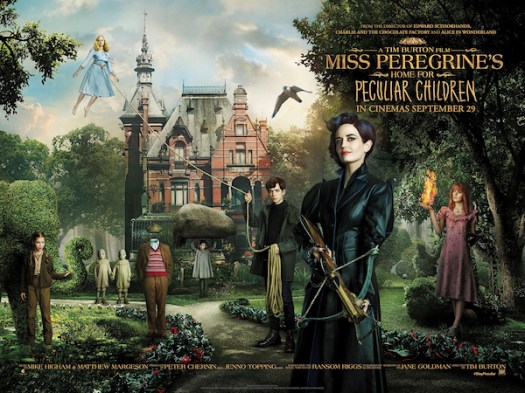
After his beloved grandpa Abe (Terence Stamp) dies in mysterious circumstances, Floridian teen Jake (Asa Butterfield) seeks closure by visiting the children’s home in Wales where his grandpa was raised. As a child, Abe regaled his grandson with tales of the home’s other residents and their fantastical abilities — tales which were completely true, as Jake discovers when he meets Miss Peregrine (Eva Green) and her peculiar wards.
The quickest route to defining the experience of watching Miss Peregrine is by referencing other films, if only in a broad sense. For starters, it’s adapted from a young adult fantasy-adventure novel, and there’s a definite shape to things which reflects other entries in that genre — the whole “ordinary kid discovers a fantasy world of incredible powers and approaching danger” type thing.
It’s also directed by Tim Burton, and does feel like a Tim Burton movie. However, what’s incredibly pleasant about that is it doesn’t feel aggressively Burtoneseque. As if in reaction to the blandness of his Planet of the Apes remake, much of Burton’s output since then has slipped towards self-parody, and suffered for it. Miss Peregrine has recognisable flourishes, undoubtedly, but is a little more restrained with how it deploys them. Some have criticised it for this, citing it as another example of Burton removing his unique stamp from the picture, much as he did with Apes, but I disagree.

The final other work I would reference is the X-Men; in any incarnation, but the most relevant filmic one is probably First Class. Or not, because that was all about the establishing of Xavier’s school and the equivalent establishment here is already established. Nonetheless, it’s about a country house owned by a British matriarch-figure who cares for a gaggle of misfit kids with special powers. Rather than the X-Men’s potentially-violent array of action-ready skills, however, the ones on display here are a little more whimsical — like Emma (Ella Purnell), who’s lighter than air, or Horace (Hayden Keeler-Stone), who can project his dreams through his eyes.
Also like X-Men, the threat comes from within this secretive world. The starter X-baddie is, of course, Magneto, a mutant seeking to use scientific methods to turn the whole world into mutants. Here, the baddie is Barron (Samuel L. Jackson), a peculiar seeking to use scientific methods to grant immortality to himself and his cronies. Part of their thing is eating people’s eyeballs, which has benefits for them — again, that’s quite Burtonesque… though a mite less whimsical.

Being on board with this whole milieu is important to enjoying Miss Peregrine, because the film does spend a lot of time establishing it. For those not interested in world-building, the action-packed third act must be a long time coming. There is a lot to marvel at along the way though, and Burton keeps things pleasingly real in his filmmaking techniques: there’s a fight between two creatures that was created with stop-motion, while another sequence involved constructing underwater rigs, and the vast majority of Emma’s floating was achieved by dangling Purnell on wires. That’s not to say there’s no CGI — ironically, the foremost example is a sequence that could otherwise be considered a tribute to Ray Harryhausen — but Burton’s filmmaking encapsulates varied techniques to lend a satisfying physicality to much of the film.
On the whole Miss Peregrine seems to have received a rather muted response, but I thoroughly enjoyed it. It might be best to qualify that by reiterating that it’s playing with a lot of things I enjoy — “X-Men by way of Tim Burton” sounds fantastic to me, and that’s not a bad definition of this movie. I’d even go as far as saying it’s his best work this millennium (though, in fairness, I still haven’t seen Big Fish. Well, it’s only 14 years old.) The shape of the story is no great shakes, but it’s built from magical elements and fantastical imagery, and a game cast of quality thesps hamming it up magnificently and eager youngsters with a slightly earnest likeability.

Actually, in many ways it reminds me of another heightened, stylised young-adult adaptation that suffered from a mixed reception. See you in 2029 for the Netflix re-adaptation, then?

Miss Peregrine’s Home for Peculiar Children is released on DVD & Blu-ray in the UK tomorrow.


 Score:



 Deep Blue Sea is Terence Davies’ adaptation of Terence Rattigan’s play about the wife of a judge getting caught in a self-destructive love affair with an RAF pilot.



 Hailee Steinfeld stars as a teenage girl raised from childhood by a top-secret government organisation to be an expert agent, but who has always longed for a more normal experience. When the organisation thinks she’s died on a mission, she uses it as a chance to have that normal life. Researching the high school experience from teen movies, she heads off to a typical US high school… and finds life isn’t quite like the movies. Though it is a bit, but it’s allowed to be so long as you keep referencing the movies you’re riffing off… right? Oh, and of course her old life keeps intruding, in the form of people wanting to kill her ‘n’ all that.
 then I think there’s a fair chance you’d find it to be a frequently amusing, occasionally very funny, and sometimes quite sweet high school comedy — with added doses of action comedy for good measure. There’s even one great scene (which is more than many a “very good” film can claim); the kind of scene that, when it happens, is so right it feels like kind of an obvious idea, but I’ve never seen it done before (it kinda requires a premise like this to even work) and is pretty faultlessly executed.

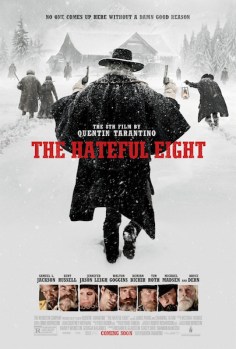 Quentin Tarantino hadn’t made a film in the same genre as his preceding movie for almost 20 years when The Hateful Eight came out — his second go-round with the Western genre, after the Spaghetti-ish thrills of
 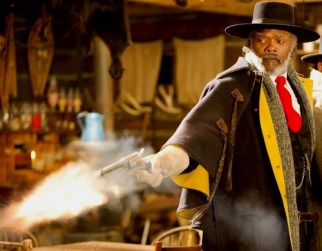 And it’s all in a remote, isolated location which has been cut off by weather, and every character is hiding some nefarious past — so far, so And Then There Were None. All of this comes dressed in QT’s famed dialogue, unfurled at the somewhat languorous pace he’s gradually been cultivating for a few movies now, and topped off with a few doses of the old ultra-violence.
 Ultra Panavision 70 produces an ultra-wide 2.76:1 frame (for those not in the know, your widescreen TV is only 1.78:1), which for such an intimate story has struck people as odd ever since it was announced. In fact, it pays off in (at least) two ways: firstly, all the scene-setting scenery looks magnificent; secondly, for a lot of the film there’s stuff going on in the background or at the edge of frame — it’s not just a series of close-ups or two-shots where the ancillary detail is either non-existent or doesn’t matter, but one where that ‘background’ detail is sometimes very instructive to what is going on. Tarantino also uses the full width a lot of the time, placing two figures at either edge of the image — this really isn’t a film you could crop (thank goodness it doesn’t exist in the pan & scan era!)
 as if to bring the point home (and that’s far from the only thing about The Hateful Eight that’s indebted to The Thing, but I’ll leave that for someone else to dig into another time). Even though this is the first time he’s had a full score composed for one of his films, Tarantino still sources a couple of well-selected songs from elsewhere, including a very apt credits track by Roy Orbison.
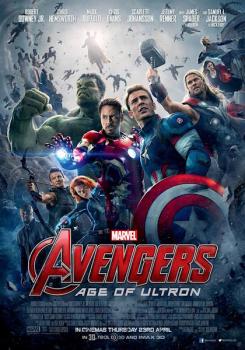 It feels kind of pointless reviewing Avengers: Age of Ultron, the written-and-directed-by Joss Whedon (and, infamously, reshaped-in-the-edit-by committee) follow-up to 2012’s “third most successful film of all time” mega-hit
 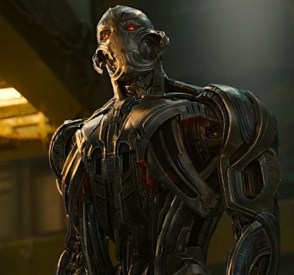 Even though the first half of that is still three years away, we’re still very much on the road to it. Heck, we have been practically since the MCU began, thanks to those frickin’ stones (if you don’t know already, don’t expect me to explain it to you), but now it’s overt as well as laid in fan-friendly easter eggs. The titular threat may rise and be put down within the confines of Age of Ultron’s near-two-and-a-half-hour running time, but no such kindness is afforded to the myriad subplots.
 (not just obvious stuff like the Hulk, but digital set extensions, fake location work, even modifying Stark’s normal Audi on a normal road because it was a future model that wasn’t physically built when filming) that stuff they genuinely did for real looks computer generated too. All that time, all that effort, all that epic logistical nightmare stuff like shutting down a capital city’s major roads for several days… and everyone’s going to assume some tech guys did it in an office, because that’s what it looks like. If you’re going to go to so much trouble to do it for real, make sure it still looks real by the time you get to the final cut. I’ll give you one specific example: Black Widow weaving through traffic on a motorbike in Seoul. I thought it was one of the film’s less-polished effects shots. Nope — done for real, and at great difficulty because it’s tough to pull off a fast-moving bike speeding through fast-moving cars. What a waste of effort!
 The really daft thing is, Whedon specifically added Scarlet Witch and Quicksilver… wait, are Marvel allowed to call them that? I forget. Anyway, Whedon added the Maximoff twins because, as he said himself, “their powers are very visually interesting. One of the problems I had on the first one was everybody basically had punchy powers.” I know Hawkeye’s power is more shoot-y than punchy, and we all know
  At the end of the day, what does it matter? Age of Ultron isn’t so remarkably good — nor did it go down so remarkably poorly — that it deserves a reevaluation someday. It just is what it is: an overstuffed superhero epic, which has too much to do to be able to compete with its comparatively-simple contributing films on quality grounds, but is entertaining enough as fast-food cinema. Blockbusterdom certainly has worse experiences to offer.
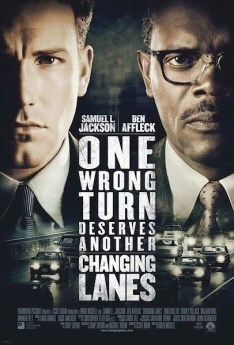 Hot-shot lawyer Ben Affleck and down-on-his-luck Samuel L. Jackson are involved in what Americans like to assonantly call a fender bender, making the latter miss a custody hearing and the former lose an important document worth millions… which Jackson happens to pick up. Cue a game of tit-for-tat retaliation, as Affleck tries to recover the file by ruining Jackson’s life further, and an increasingly-desperate Jackson enacts increasingly-violent revenge.
 I don’t know why they bothered). The worst offender is David Arnold’s score — all turn-of-the-millennium club-y electronic-drum-kit-y beats, for a character-driven drama/thriller? Ugh.
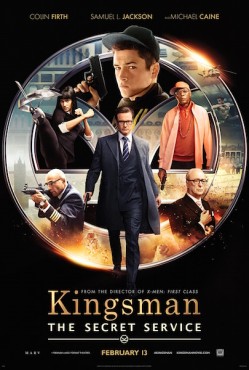 The team behind
 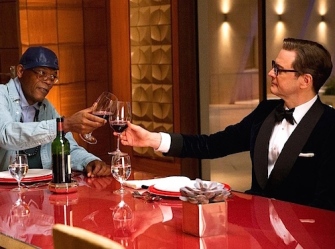 An even bigger part of the film’s triumph, and what likely led it to over $400 million worldwide in spite of its higher-than-PG-13 classifications (it’s Vaughn’s highest-grossing film to date, incidentally; even more so than
 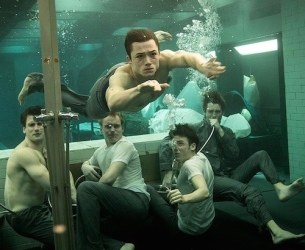 rather than the supposed real-world universe of spy movies. What the worldwide success of Kingsman proves is that audiences don’t need the set-dressing of superpowers to accept an action movie that’s less than deadly serious. It’s a place I don’t think the Bond movies could go anymore — not without accusations of returning to the disliked Moore or late-Brosnan films — but it’s one many people clearly like, and Kingsman fulfils it.
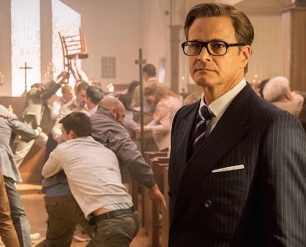 Criticisms of the film tend to pan out to nought, in my opinion. Is there too much violence? There’s a lot, certainly, but part of the point of that church sequence (for instance) is just how long it goes on. Other excellent action sequences (the pub fight you might’ve seen in clips; the car chase in reverse gear; the skydiving) aren’t predicated on killing. Similarly, Samuel L. Jackson’s baseball-capped lisping billionaire is a perfect modern riff on the traditional Bond villain, not some kind of attack on Americans or people with speech impediments. Some have even attempted a political reading of the film, arguing it’s fundamentally conservative and right-wing because the villain is an environmentalist. Again, I don’t think the film really supports such an interpretation. In fact, I think it’s completely apolitical — just like its titular organisation, in fact — and such perspectives are being entirely read into it by the kind of people who read too much of this kind of thing into everything.
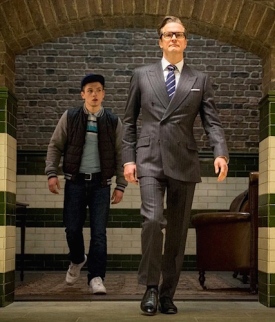 Not everything hinges on being wall-to-wall groundbreaking, though, and Kingsman has so much to recommend it. It ticks all the requisite boxes of being exciting and funny, and some of its sequences are executed breathtakingly. The plot may move along familiar tracks — deliberately so — but it pulls out a few mysteries and surprises along the way. There’s an array of likeable performances, particularly from Firth, Egerton (sure to get a lot of work off the back of this), Jackson and Strong, and Sofia Boutella’s blade-legged henchwoman is yet another why-has-no-one-done-that great idea.
 100Films.co.uk