
Bill Kroyer | 73 mins | streaming (HD) | 1.85:1 | USA & Australia / English | U / G

I remember ignoring FernGully when it came out (probably when it hit rental video rather than at the cinema) because it looked a bit rubbish. I mean, it was an animated movie but it wasn’t made by Disney — “could such things even exist?”, wondered little me (probably). As the years went by, I kinda assumed everyone else had ignored or forgotten it, leaving it as some curio I vaguely remembered from video shop walls. But fastforward to 2009 and suddenly everyone was talking about it, because it had been remade as a big-budget 3D sci-fi epic by James Cameron. Okay, Avatar wasn’t actually a FernGully remake, but the disparaging comparison came up a lot. Fastforward another decade to now (a time when Cameron’s four–film remake of FernGully 2: The Magical Rescue (yes FernGully got a sequel) is still over two years away (provided they don’t push it back again)), and on a whim I finally watched FernGully to see this supposed likeness for myself.
So, what’s FernGully actually about? Well, not blue creatures on an alien moon, although it’s equally as fantastical. It’s set in the Australian rainforest, where fairies live in isolation, believing humans to have gone extinct… that is until loggers turn up to destroy their home. Fairy Crysta (Samantha Mathis) shrinks human Zak (Jonathan Ward) down to her size to save him from a falling tree, at which point he learns about their way of life — oh, right, Avatar here we are. Anyway, many years ago an evil entity called Hexxus (Tim Curry) was trapped inside a tree, which the loggers cut down, and suddenly everyone’s at threat.
If it’s not obvious already, FernGully is pretty heavy on the environmental messaging (it’s even dedicated to “our children and our children’s children”, and there’s a note at the end of the credits about donating proceeds to the Smithsonian for environmental work). I seem to remember this was all viewed as being kinda-loony eco stuff back when the film came out. Now, of course, acceptance of those views is much wider, and what the film has to say seems a little obvious. Though we’re still destroying the planet, so I guess we’ve not learned that much in the three decades since.

Even more of-its-time are the musical numbers. They’re very 1992, and not in a good way. That said, although it’s a terrible song, If I’m Gonna Eat Somebody (It Might As Well Be You) is one of the best titles ever.
One of the people lumbered with an awful tune is Robin Williams, playing a mentally-deranged rapping bat. Nonetheless, he’s definitely one of the best things in the film — not as much as his Genie was in Aladdin, but he does occasionally bring a similar irreverence. It’s needed when the rest of the film is being a bit po-faced about the magic of nature. The other vocal standout is Tim Curry, who always gives good villain. He’s supported by nice design and animation, with Hexxus visualised as a dripping oil-creature, plus a couple of other forms as the film goes on, all of which look pretty effective. Like the rest of the movie, his characterisation and motivation are very underdeveloped, and Curry’s given little to do after his initial birth/song sequence, but the character looks good.
All in, FernGully is a decent little animated adventure — a tad earnest perhaps, but not too bad — but it’s held back by weak music and a thin plot.




 Score:



 Mumble and his penguin pals return for another adventure, in a series the Australian film industry are reportedly inordinately proud of.
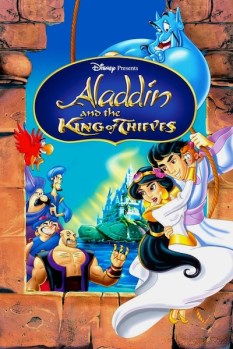 For most of the ’90s and ’00s, Disney churned out direct-to-video sequels to many of their most beloved animated classics. They have a reputation for being unremittingly awful, hence why Pixar’s John Lasseter put a stop to their production after he became Disney’s Chief Creative Officer in 2006. Despite that reputation, however, there are those who say one or two are actually quite good. One of those (and the only one I’ve previously seen) is
  are to be found with the forty thieves… I expect you can guess where that’s going. Fortunately the film gets there pretty quickly, then transitions into a story about the possible redemption (or not) of Cassim alongside the quest for the Hand of Midas, capable of turning whatever it touches into gold (natch).
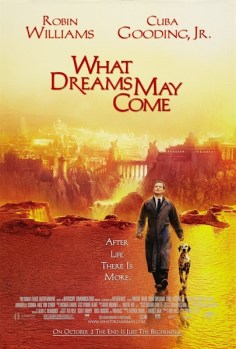 When What Dreams May Come first came out, the reviews seemed to conclude that it was rubbish, but at least visually splendid. Back in 1998, that put me off — “it’s not meant to be very good” was the takeaway thought there. As the years have gone on, for some reason those reviews (or possibly just one I extrapolated into a consensus, who knows?) stuck with me; and as my temperament as a film fan grew, that it was visually extraordinary (even if nothing else) began to seem reason enough to watch it. It lingered in the back of my mind, never quite becoming a “must see”, especially as the opportunity rarely (if ever) presented itself. So that’s more or less how I come to it now, 17 years since its release and those reviews — a long-awaited scratch of a long-lingering itch. (Perhaps this gives some insight into why/how it takes me so long to get round to watching recommendations/things I’m quite keen to see/etc.)
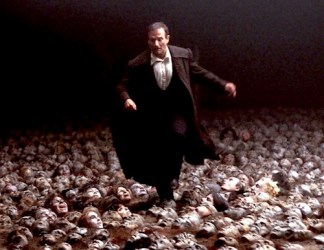 Hell, incidentally, also looks incredible, as do the various locales visited by Chris and his companions (played by Cuba Gooding Jr and Max von Sydow) on their way there. Director Vincent Ward and his team have created a rich, engrossing visual space here. It’s not just the Oscar-winning visual effects either, which create Chris’ initial realisation of Heaven as a kind of living painting, but also the locations, their decorations, and some fantastic sets. The design work is brilliant, and the vast majority of it still holds up today. Even the CGI doesn’t look glaringly like 17-year-old graphics, and in many cases what I presume is a mix of live action, models and some CGI is far more effective than the all-CG look it would likely have if made today.
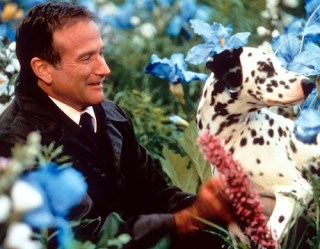 Nonetheless, some will identify with the sentimental “love transcends death”-type message more than others, and there’s a chance those who like (or don’t mind) their films to be at the soppier end of the spectrum will genuinely love it. For the rest of us — for anyone who likes visual splendour in their movies, anyway — it does indeed merit a look for the imagery alone.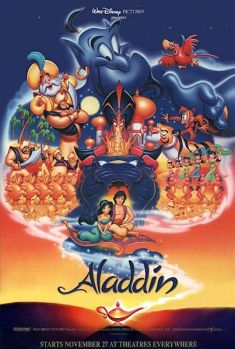

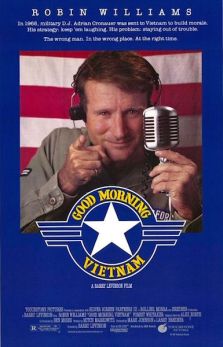 Inspired by the true story of a US Army DJ in Vietnam during the war, the resulting film is a showcase for star Robin Williams — reportedly, his antics aren’t even close to what really happened.
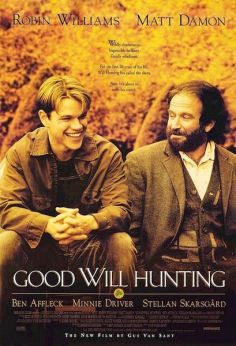 I’d say Good Will Hunting is famous for two things: one, being written by Matt Damon and Ben Affleck when they were young actors after some good roles; and two, Robin Williams’ Oscar-winning supporting actor performance. Such is the power of these two facts that I didn’t even know what it was about until I actually watched it.
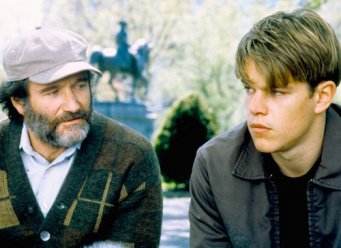 The film is perhaps most enjoyable as an acting showcase. Damon and Williams have numerous incredible scenes together; encounters that feel like genuine slowly-evolving therapy, rather than the simplistic and implausible series of repeated revelations and breakthroughs that such treatment is often reduced to on screen. They run the emotional gamut, too, being not just instances of soul-searching but also moments of wider insight, or intense humour — that’s what you get when you have Robin Williams at your disposal, of course. His Oscar is well earnt.
 Their promising relationship suffers through inexperience and, to be frank, unwarranted daftness, lending it a melancholic air (or is that just me again?)
 Then, slowly, almost imperceptibly, a slight wry grin curls his mouth. Yes, Will has actually done it; and yes, it is what he wanted. It’s all good. Only then does he turn around, and simply announce to his waiting friends that Will isn’t there. It’s a pretty subtle moment, massively over-explained here, but it’s so much more realistic a reaction than the almost-clichéd one we’re expecting to see. In a film full of incredible, powerful performances, speeches and moments, it’s one that stood out to me.
 Besides, it’s the characters and the performances that shine. It’s no surprise that a pair of actors wrote an “actors’ movie”, but it is an achievement that they wrote one that displays genuine people and genuine emotions, rather than just showy performances. Credit to an exceptional cast — and, this once, an exceptional director — for bringing that so beautifully to life.
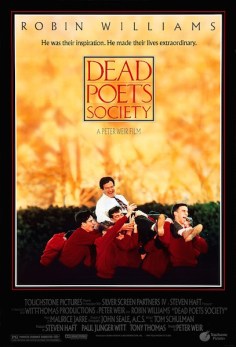 At an oppressive private school (is there another kind?), a gaggle of disenchanted students are invigorated by teacher Robin Williams; until his methods, and the independent thought they inspire, attract the ire of parents and faculty.
 100Films.co.uk