
 Ridley Scott’s Crusades epic is probably best known as one of the foremost examples of the power of director’s cuts: after Scott was forced to make massive edits by a studio wanting a shorter runtime, the film’s summer theatrical release was so critically panned that an extended Director’s Cut appeared in LA cinemas before the end of the year, reaching the wider world with its DVD release the following May. The extended version adds 45 minutes to the film (and a further 4½ in music in the Roadshow Version), enough to completely rehabilitate its critical standing.
The story begins in France, 1184, where blacksmith Balian (Orlando Bloom) is something of a social pariah. Offered the chance to head off to fight in the Crusades, Balian… refuses. But then something spoilersome happens and he thinks it might be a good idea after all. When he eventually arrives in Jerusalem, he finds a kingdom divided by political squabbling, quite apart from the uneasy truce with the enemy. You know that’s not going to end well.
Kingdom of Heaven is, in many respects, an old-fashioned epic. It’s a long film not because the director is prone to excess and didn’t know when to cut back, but because it has a lengthy and complicated story to tell. It isn’t adapted from a novel, but the structure feels that way, spending a lot of time on characters and what some might interpret as preamble — it’s a long while before the movie reaches Jerusalem, ostensibly the film’s focus, and it completes the arcs of several major characters along the way. The scale of such stories isn’t to everyone’s taste, but, well, what can you do.
 A strong cast bolsters the human drama that sometimes gets lost in such grand stories. Bloom is a perfectly adequate if unexceptional lead, but around him we have the likes of Michael Sheen, David Thewlis, Alexander Siddig, Brendan Gleeson, and Edward Norton (well done if you can spot him…) There are even more names if you look to supporting roles. Most notable, however, are the co-leads: both Liam Neeson, as the knight who recruits Balian, and Jeremy Irons, as the wise advisor when he gets to Jerusalem, bring class to proceedings, while Eva Green provides mystery and heart as the love interest. Of everyone, she’s best served by the Director’s Cut, gaining a whole, vital subplot about her child that was entirely excised theatrically. It’s the kind of thing you can’t imagine not being there, and Scott agreed: it seems the chance to restore it was one of his main motivators for putting together a release of the longer version.
It is very much a Ridley Scott film, too. The way it’s shot, edited, styled… you could mix bits of this up with Gladiator or Robin Hood and you might not realise you’d switched movie. As a student of film it frustrates me that I can’t put my finger on exactly what qualities define this “Scott style” — and it’s a specific one to his historical epics, too, because it’s less present (or possibly just in a different way) in his modern-day and sci-fi movies — but I’m certain it’s there. I guess it’s the way he frames shots, the mise-en-scène, the editing, the richness of the photography… The quality of the end result may vary across those three movies, but Scott’s technical skill is never in doubt.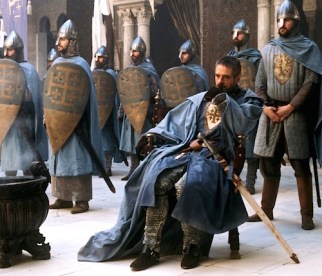 (I’d wager Exodus is the same, but its poor reception hasn’t exactly left me gagging to see it.)
Similarly, I can’t quite identify what’s missing from Kingdom of Heaven that holds me back from giving it full marks. It’s a je ne sais quoi edge that I just didn’t feel. I do think it’s a very, very good film, though; one that would perhaps well reward further viewings.

A version of Kingdom of Heaven is on Film4 tonight at 9pm. Their listings suggest it’s the theatrical cut, though if that’s true then they’ve put in an hour-and-a-half of adverts…
* For what it’s worth, I actually watched what’s now called the “Director’s Cut Roadshow Version”. This was released as the Director’s Cut on DVD, but in the early days of Blu-ray it couldn’t all fit on one disc, so they lopped off the overture, intermission, and entr’acte and still labelled it the Director’s Cut. As of the 2014 US Ultimate Edition, however, those missing bits have been optionally restored, with the set containing ‘three’ versions of the movie. ^
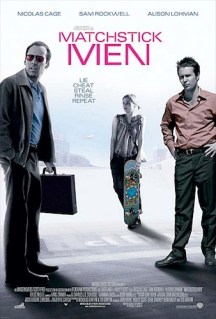 Matchstick Men ends with a twist. One of those great big changes-everything-you’ve-just-seen numbers that have a habit of making a film notorious. Yet I’m almost loath to mention it, because I’ve never read a review, preview, summary or what-have-you of the film that mentions there’s a twist. Maybe I’ve just been reading the wrong pieces; maybe no one cares; maybe they’re all just playing along trying to keep it secret. But not me, because I bloody hated it.
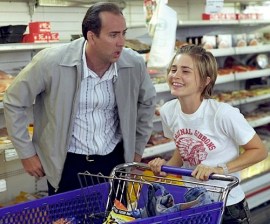 Twists are fine. Twists can be great. As I said, you can guess a twist is coming and it can still work. A really good twist works even when you know for certain it’s coming; its existence raises what you’ve seen, makes it all work even on repeated viewings when the element of surprise is obviously gone. Matchstick Men doesn’t have that kind of twist. It has the kind of twist that undermines everything you’ve just seen. Not because it’s illogical — it isn’t in the slightest — but because it tramples over the film’s emotional resonance, in my opinion.
 Alison Lohman is also exceptionally good as a 14-year-old girl. It took a scene or two to convince me, but after that I was plenty on board with it. It occasionally takes some effort to remind yourself she was 24. As the third lead, Sam Rockwell plays a typical Sam Rockwell part. He does it very well, naturally, and there’s nothing to fault him on, but he’s been better elsewhere. The rest of the cast are absolutely fine but not exactly called on much — this is Cage’s film, and to a lesser extent Lohman’s. They have the emotional journey, the film’s heart-and-soul around its long(-ish) con ‘plot’ (which could just be lifted from any episode of Hustle… except it’s not even that complex).
 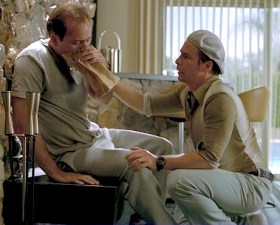 Matchstick Men was a lot better than I’d expected, because most of the coverage I remember shoved it aside as a middle-of-the-road side project for Scott. It’s definitely better than that, if still not the “sweep the Oscars” success
  So many consumers hold off for the DVD these days, especially with the added quality offered by Blu-ray, that the old answer of “what was released in the cinema” doesn’t necessarily hold true any more. Filmmakers know some will be waiting for the DVD, so are less concerned with releasing a studio-mandated, shorter, mass audience friendly cut into cinemas when their fuller vision can be found on DVD. Equally, the PR people know that “longer cut!” and “not seen in cinemas!” and other such slogans can help sell DVDs, and so may be forcing needless and unwelcome extensions onto filmmakers. Then there’s all those older directors who think they’re doing a good thing finally getting to tamper with their film 30 years on, who may well be misguided.
 There remains one argument for clarity, I think. How does one guarantee that, in the future, the ‘correct’ version remains accessible? With new formats always coming along, there’s no assurance that every cut of a film will be released; with TV showings, there’s no assurance the preferred version will always be the one shown (though there’s another argument for how much the latter matters considering they already mess around with aspect ratios and edits for violence/swearing/sex/etc.) But then, even if a filmmaker makes it clear that their preferred version is the one that only came out on DVD/Blu-ray, what chance is there that unscrupulous disc / download / unknown-future-format producers or TV schedulers won’t just revert to the theatrical version by default?
 100Films.co.uk