
Sam Mendes | 119 mins | cinema | 2.39:1 | UK & USA / English & French | 15 / R
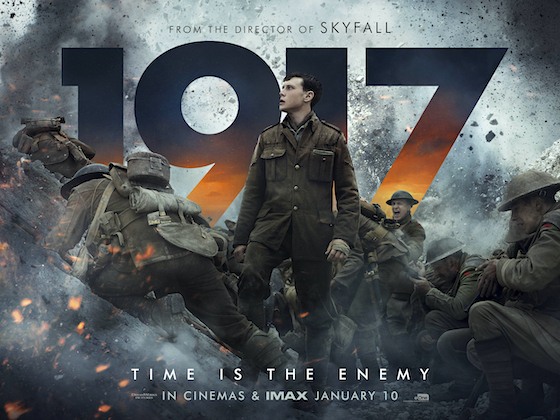
 British Academy Film Awards 2020
9 nominations
I haven’t been following awards season too closely this year, but from the snippets I have picked up here and there it seems to be quite a variable race — every time a frontrunner emerges, something else wins some other award and suddenly the field is open again. 1917 was one of the early tips, and now has several wins under its belt to back that up. It may not be a lock at the Oscars, where the latest works by American auteurs like Martin Scorsese and Quentin Tarantino will give it a robust run for its money (plus the six other contenders, several in with a shot), but tonight it’s BAFTA’s turn. The British Academy may seem to be more focused on being counted among the major Oscar forerunners than anything else, but they do still have a penchant for rewarding British films — and 1917 isn’t just “a British film”, it’s a British film about a key event in British history with an all-star cast of cameos from great British actors. So, as it’s a season-wide contender anyhow, if 1917 doesn’t win the big prize this evening it’ll be a genuine surprise.
Does it deserve it? Take a sample of social media and you’ll get different answers. As with any big, much-discussed film nowadays the initial reception has been followed by waves of backlash — or maybe that’s too grand a term for it; maybe it’s just been different ‘sides’ expressing their opinion in turn. If it wins, there’ll be a vocal contingent about how it didn’t deserve it. As someone observed the other day, literally the only way to avoid such a negative reaction nowadays is to literally take the award out of the incorrectly-named winner’s hands. (If you think that’s facetious, think about it for a second: do you remember any significant backlash to Moonlight winning? I don’t. Every other winner in recent years? Yep. I’m not saying it should’ve had one — it’s a great film — but it is unique in avoiding it.)
Personally, having seen 60% of this year’s BAFTA Best Film nominees, 1917 would be my pick (the others I’ve seen are Once Upon a Time in Hollywood and The Irishman; the remainder are Joker and Parasite, which is only out in UK cinemas next week so probably doesn’t stand a chance). My view may very well change once I’ve ticked all the boxes (Parasite is supposedly the greatest film ever made, after all), but that doesn’t lessen 1917 as an achievement.

Famously, the film is a single take… sort of. That caveat comes for two reasons. First, because it isn’t a single take, because there’s a fade-to-black in the middle. It’s an effective, well-timed event — basic filmmaking technique as narrative twist, because this is so famous as “a single-take film” and, by that point (it comes fairly late in), we’re so embedded in the technique that the sudden blackness comes as quite a surprise. Second, because it isn’t a pair of single takes, because there’s no way you could shoot a film of this scale and complexity in a genuine single shot. Rumours abound of how many hidden cuts are in the movie. One said there were as many as five. Editor Lee Smith refuses to confirm the exact number, but makes a very sensible point: the film was shot over 65 days — you can’t put together 65 days’ worth of footage with only five cuts. But that shows how well it was achieved: people thought that, gasp, there could be as many as five, when actually there are far more.
“Wait, this film had an editor? That must’ve been a quick job!” Yeah, there’s been a lot of that on social media. People have been quick to dismiss it — people who should know better, quite frankly. As with so many things in life, just because it looks easy doesn’t mean that it was. There’s more to editing than just “sticking shots together”, and planning a film as complicated as this involved Smith’s input throughout shooting, not just in post-production. Plus, they didn’t just do one take that worked for each setup and call it quits — the job still involves choosing which take has the best performances, the right lighting, making sure it matches exactly enough for the transition to the next shot, and so on. The least number of takes for any individual shot was “five or six”, the most 39, so there’s plenty for an editor to do with choosing. I’m getting this info from an interview with Smith by Catherine Springer at AwardsWatch, which is worth a read if you’re interested in getting some insight into why there is actually a lot of difficult, impressive editing work going on here. One further titbit: some of the cuts were ‘improvised’, in that there are some cuts where a cut hadn’t been planned. You can’t do that kind of thing without a skilled editor, surely.

And it makes it all the more impressive that the end result is so seamless — you can buy that you’re watching a single take (okay, two single takes) rather than dozens strung together in pretend. Well, I say it’s seamless — yeah, sure, any Tom, Dick, or Harry can spot places where there are surely cuts (they walk through a dark doorway; someone/thing passes in front of the camera, blocking the view for a split second; etc). But unlike other faked single cuts I’ve seen, where the action doesn’t flow perfectly across a hidden cut, it’s at least conceivable that some of 1917’s hidden-cut-opportunities don’t actually mask a cut at all. Plus, as that interview suggests, there are actually dozens of cuts in the movie, and there aren’t that many glaring opportunities (which is probably how whoever it was arrived at their total of five).
The fact I’ve spent most of this review so far talking about the film’s single-take-ness is some people’s problem with 1917 — that it’s a filmmaking stunt and nothing more; that it’s a technical achievement at the sacrifice of character or narrative or anything but “look what we can do”. I don’t agree with that assessment. I think the single take serves a purpose beyond showing off. At the most basic level, it puts us on this mission with the characters, attaching us to them and their fate in a very intimate way. The camera rarely strays far from their side, choosing to remain at eye level and near to them when it could float off to give us a godly overview. Some have taken to describing it as “like watching a video game” for that reason, but I bet those people also refer to CG effects as “graphics” and, basically, spend too much time watching/thinking about computer games and conflating them with films (I’ll move on before I get distracted into a wholly different argument…) There are plenty of other ways for filmmakers to attach you to characters, of course, but that doesn’t invalidate this method.
The other thing it brings is a tangible sense of time. Our heroes are on a time-sensitive mission, and we’re with them every step of the way — they don’t get to jump from one side of a field to the other with the magic of editing, we must walk across it with them. (The film is certainly not as boring as “watching characters walk across a field” makes it sound — there’s plenty of action and incident.) Again, you don’t need a single take to create real-time — 24 proved that over ten seasons and a movie (not that all of those seasons take their real-time conceit wholly seriously, in my opinion) — but it does emphasise and enhance it.

Regular readers will know I love a bit of real-time, so that was right up my street. I have similar feelings about single takes (fake or not), so I loved that aspect too. Plus I’ve got a long-standing interest in World War One, which I don’t feel is represented well enough on film (at least, not as well as its sequel), so getting a big-budget high-profile movie about it is something else I welcome. And I love the work of cinematographer Roger Deakins, who is absolutely on fine form here (when isn’t he?) The long and the short of it is, 1917 was always a movie almost tailored to things that interest me. Fortunately, it lives up to them. Is it the very best picture of 2019? I dunno, I’ve not seen Parasite yet. Will it be a worthy winner nonetheless? I think so.

1917 placed 6th on my list of The Best Films I Saw in 2020.
The British Academy Film Awards are on BBC One tonight at 9pm.




 Score:



 “Tom Hardy goes for a drive and makes some phone calls” is the plot of this film, which is often mislabelled as a thriller. That’s not to degrade its thrillingness, but rather to say that if you’re expecting a single-location single-character phone-based thrill-ride like
 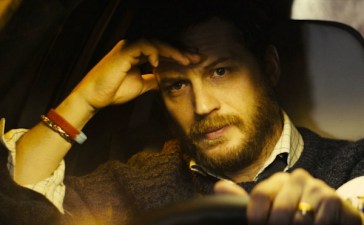 and in the process turning his life upside down. Another part was to tell a story about an ordinary guy dealing with events that aren’t going to change the world, aren’t even going to make the papers, but are a big deal in his life. Something like this could happen to any of us, and how would we deal with it?
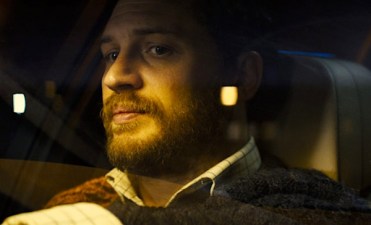 The rest of the cast appear as voices only on the other end of the phone, and in their own way are quite starry — faces that you may recognise, mainly from British TV, in even some of the smaller roles. Not that you see their faces, so, you know, you might have to look them up, or watch the making-of. Some of the performances err a little towards radio acting for me, which is kind of understandable seeing as how that’s basically how they were recorded, but there are particularly good turns from Andrew “Moriarty in
 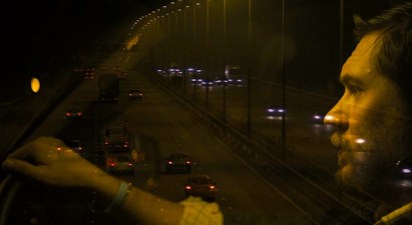 this is about what’s happening on Hardy’s face, not with his whole body. And in either form you’d lose all the photography of nighttime motorways, which have their own kind of hazy beauty. For a movie about someone making phone calls, it is intensely cinematic.
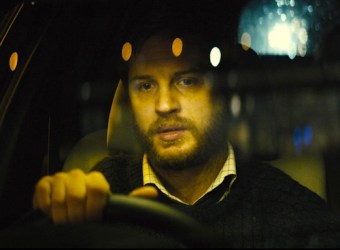 the supporting cast are so much more than “voices on the phone” (listen out, too, for Tom “
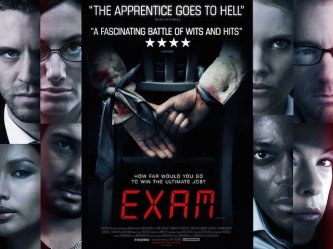 There’s an argument that the less you know going into any film the better. Naturally there are some films this applies to more than others, and Exam is one such film. Eight young professional types go into a job exam/interview; the next hour-and-a-half is all mysteries and riddles — which is why you wouldn’t want to know too much.
 Such a contained story relies heavily on its characters and the actors’ performances. Largely a cast of un- (or little-) knowns, all are decent — one or two may be subpar, but I’ve seen a lot worse. I don’t quite understand how some viewers can find White, played by Luke Mably, to be a completely likeable character in spite of his obvious flaws — he has his moments, but surely he’s not agreeable overall? Not a jot. That said, his is the standout part, a scene-stealing performance from Mably. There’s no clear-cut audience-favourite, which (from reading a few reviews) seems to be a problem for some viewers. As far as I’m concerned, it’s a good thing: never mind the realism of there being one perfect person every viewer will love, audience-favourites will either predictably win or be shockingly dispatched, so what’s the point?
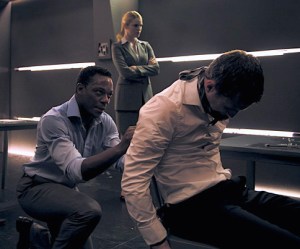 it’s quite nice to find a plot that doesn’t feel the need to tie everything in to its reveal; a plot that can wrong-foot you by occasionally focusing on something that’s ultimately irrelevant.
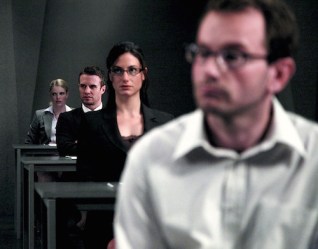 and films that invite pondering tend to invite repeat viewing; but then again it works equally well (better, ultimately) as a straight-up “what’s going on?” thriller.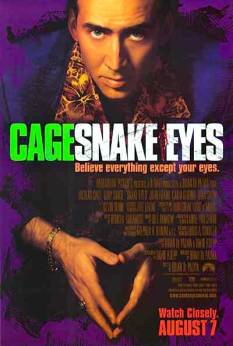
 later seasons didn’t and, in my opinion, suffered. Johnny Depp-starer
  If there’s one significant flaw, it’s that the ending is too much based on convenience and coincidence; and someone in the editing room should’ve paid more attention to removing all references to the original, deleted ending in which the casino got flooded. I have no idea why that was removed — maybe someone thought it was a bit ludicrous. But it sounds more satisfying than what was included, which, as noted, relies on a handy spot of coincidence and at least one action that seems out of character. I can forgive it though, because I liked everything else. And the post-climax montage is a suitably downbeat ending to our hero’s story — another noir trait there.
 100Films.co.uk