
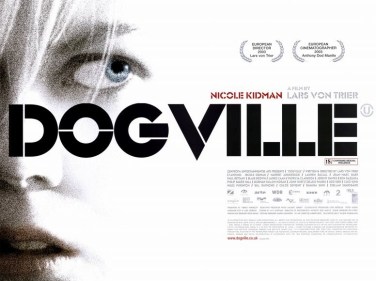
Full Title: The film “Dogville” as told in nine chapters and a prologue

Country: Denmark, Sweden, UK, France, Germany & the Netherlands
Language: English
Runtime: 178 minutes
BBFC: 15
MPAA: R
Original Release: 21st May 2003 (Belgium, Switzerland & France)
UK Release: 13th February 2004
First Seen: DVD, c.2005
Stars
Nicole Kidman (Moulin Rouge!, Stoker)
Paul Bettany (A Beautiful Mind, Priest)
Lauren Bacall (The Big Sleep, The Shootist)
Stellan Skarsgård (Insomnia, The Girl with the Dragon Tattoo)
John Hurt (The Tigger Movie, Perfume: The Story of a Murderer)
Director
Lars Von Trier (Breaking the Waves, Antichrist)
Screenwriter
Lars Von Trier (The Idiots, Melancholia)
The Story
On the run from the mob, Grace arrives in the remote town of Dogville. Its residents agree to shelter her in order to prove their community values, though in return she must do chores for them. As the search for the missing woman repeatedly visits the town, the people’s demands for recompense for the risk they are taking intensifies…
Our Hero
Grace is a sweet, desperate young woman, happy to work for the good Christian people of Dogville in payment for their kindness. As her good nature is gradually worn down, she becomes enslaved by them — though it may turn out there’s more to her than meets the eye…
Our Villains
Of course there aren’t any villains in the town of Dogville — everyone’s a morally upstanding citizen.
Best Supporting Character
Not technically a character, but the Narrator is a palpable presence in the film. The material Von Trier has written for him is just the right side of verbose, and John Hurt delivers it with inestimable class.
Memorable Quote
“Whether Grace left Dogville, or on the contrary Dogville had left her — and the world in general — is a question of a more artful nature that few would benefit from by asking, and even fewer by providing an answer. And nor indeed will it be answered here.” — Narrator
Memorable Scene
The scenes that stick in the mind from Dogville — aside from the opening shot I shall discuss next — are either harrowing, spoilersome, or both, and so don’t merit discussion in a format potentially perused by neophytes.
Technical Wizardry
The famous bare set — a black soundstage with chalk markings on the floor to represent the houses, and minimal other features or props — was inspired by the theatre of Bertolt Brecht; as was the film’s plot, so it’s rather apt. The set (or lack thereof) seems like a very “art house” idea, and a distancing one for the viewer, but it’s surprising how quickly you forget and accept it.
Making of
The opening bird’s-eye shot of the town: physically impossible, because the studio’s roof wasn’t high enough, so the final result is actually 156 separate shots stitched together.
Next time…
Supposedly the first part of a trilogy called “USA: Land of Opportunities”. The second part, Manderlay, was released in 2005, starring Bryce Dallas Howard in Kidman’s role. The concluding part, Wasington, seems to have fallen out of Von Trier’s interest.
Awards
Nominated for the Palme d’Or.
Won the Palm Dog.
What the Critics Said
“Von Trier’s detractors – and there are many – will argue that this is nothing more than filmed theatre. […] But Anthony Dod Mantle’s digital video camera isn’t simply documenting a performance. It restlessly and fearlessly intrudes into this place and into these lives. Its close-ups – capturing key emotions as they flicker across the characters’ faces – are vital to describing the moral arc of the story. This is something that can only be achieved cinematically, an intensity that’s impossible to render elsewhere, not even from the front row of a playhouse’s stalls.” — Alan Morrison, Empire
 Score:
 70%
70%What the American Critics Said
“what most reviews are discussing is the success or failure of the film as a critique on America. There’s a sense of discussion, not of the themes dissected, but more of whether the film deserved consideration as an anti-American film, and whether it was a bad film because of it. Released in an altogether post-9/11 world, attacking America in any way shape or form, cinematic, politically, or philosophically, constituted an echo of the violence of two or three years before. […] now that we’ve learned to accept critique not as an attack, but for exactly what it is, critique, we can get to the real heart of Dogville, and we can stop nitpicking whether or not it was a deserved attack on American culture, or whether it should be written off as an “anti-American” movie” — Karl Pfeiffer
(That piece goes on to be a very interesting analysis of the film, by-the-way, particularly with regards to it being an allegory for Christianity.)
What the Public Say
“Lars, despite his ever intrusive camera, keeps us at a distance from his characters. This is not a criticism nor do I think this is unintentional. I think he does this to make sure we don’t lose sight of the message he is trying to share with us. He wants us to look at ourselves through these people, not get lost in their drama. The message of Dogville is a pessimistic one: At humanity’s core, we are bad people who will turn on our brother to protect ourselves. Altruism does not exist. Americans are smugly self-righteous. And even those of us who deem ourselves most pure are never above revenge.” — Cineaste

It’s no surprise that Lars Von Trier would be responsible for such a provocative, difficult, divisive film — indeed, that’s what all his films are, aren’t they? Whether that works or not is often down to the individual, with each of his films being hailed as masterpieces by some and condemned as drivel by others. Dogville is no different. A three-hour movie that takes place in a black-box theatrical-style environment may sound tough, but engrossing performances and a symbolic storyline with a cathartic ending keep it… not enjoyable, exactly, but fascinating.

#26 will be… 28 days, 6 hours, 42 minutes, 12 seconds from the end.
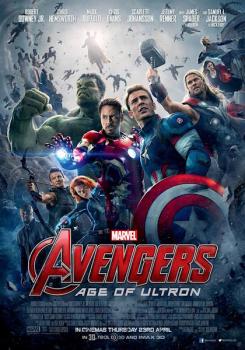 It feels kind of pointless reviewing Avengers: Age of Ultron, the written-and-directed-by Joss Whedon (and, infamously, reshaped-in-the-edit-by committee) follow-up to 2012’s “third most successful film of all time” mega-hit
 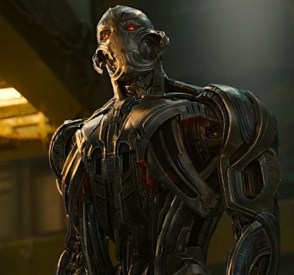 Even though the first half of that is still three years away, we’re still very much on the road to it. Heck, we have been practically since the MCU began, thanks to those frickin’ stones (if you don’t know already, don’t expect me to explain it to you), but now it’s overt as well as laid in fan-friendly easter eggs. The titular threat may rise and be put down within the confines of Age of Ultron’s near-two-and-a-half-hour running time, but no such kindness is afforded to the myriad subplots.
 (not just obvious stuff like the Hulk, but digital set extensions, fake location work, even modifying Stark’s normal Audi on a normal road because it was a future model that wasn’t physically built when filming) that stuff they genuinely did for real looks computer generated too. All that time, all that effort, all that epic logistical nightmare stuff like shutting down a capital city’s major roads for several days… and everyone’s going to assume some tech guys did it in an office, because that’s what it looks like. If you’re going to go to so much trouble to do it for real, make sure it still looks real by the time you get to the final cut. I’ll give you one specific example: Black Widow weaving through traffic on a motorbike in Seoul. I thought it was one of the film’s less-polished effects shots. Nope — done for real, and at great difficulty because it’s tough to pull off a fast-moving bike speeding through fast-moving cars. What a waste of effort!
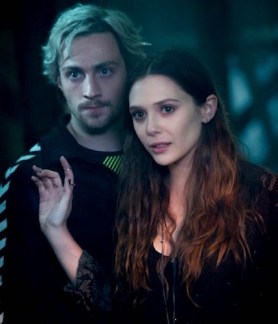 The really daft thing is, Whedon specifically added Scarlet Witch and Quicksilver… wait, are Marvel allowed to call them that? I forget. Anyway, Whedon added the Maximoff twins because, as he said himself, “their powers are very visually interesting. One of the problems I had on the first one was everybody basically had punchy powers.” I know Hawkeye’s power is more shoot-y than punchy, and we all know
  At the end of the day, what does it matter? Age of Ultron isn’t so remarkably good — nor did it go down so remarkably poorly — that it deserves a reevaluation someday. It just is what it is: an overstuffed superhero epic, which has too much to do to be able to compete with its comparatively-simple contributing films on quality grounds, but is entertaining enough as fast-food cinema. Blockbusterdom certainly has worse experiences to offer.
 Christopher Nolan’s regular director of photography (he’s lensed seven Nolan films, from
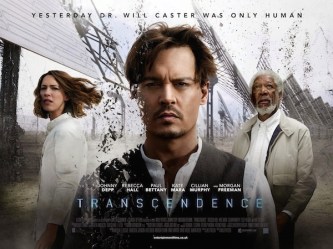
 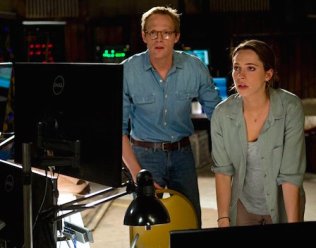 Another element that’s probably too challenging for some is where our allegiances are meant to lie. (Some spoilers follow in this paragraph.) At the start, it’s clear Depp & friends are the heroes and the murderous anti-tech terrorists are the villains. As events unfurl, however, artificial-Will perhaps goes too far, Bettany teams up with the terrorists, and eventually so do the government and Will’s other friends. There is no comeuppance for some characters who are initially begging for it; a good one self-sacrifices somewhat heroically. This doesn’t fit the usual Hollywood mould at all (well, the last bit does, sometimes), no doubt to some’s annoyance. The number of people who clamour for any sliver of originality or texture to their blockbusters, but then are unhappy when they actually get it…
 robbing the entire film of tension and nullifying any sense of surprise, and the movie doesn’t compensate with, say, a feeling of crushing inevitability. The climax in particular becomes a drawn-out exercise in connect the dots: we’ve been shown how this all ends up, now we’re just seeing the minutiae of how it got there. There’s no twist or reveal to speak of, just a wait for it to marry up with what we already know.
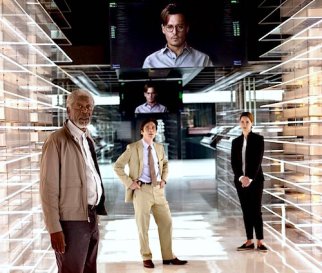 I guess that’s probably the explanation for Transcendence’s poor reception, in the end: it’s too blockbuster-y for viewers who’d like a dramatic exploration of its central moral and scientific issues, but too lacking in action sequences for those who misguidedly expected an SF-action-thriller. I maintain it’s not slow-paced, especially if you think it’s going to be, but nor does it generate doses of adrenaline on a committee-approved schedule. It’s not all it could have been, but if all you’ve heard is the mainstream drubbing, it’s probably better than you expect.
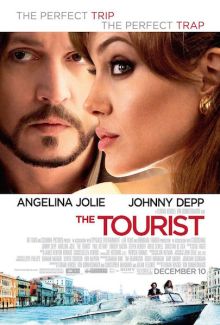 Much maligned on its release, I thought The Tourist was actually a decently entertaining light thriller.
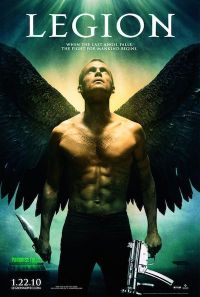 The first of two Christian-themed action movies directed by former visual effects man Scott Stewart (this his first feature as director) and starring British thesp Paul Bettany (here he plays a gun-toting angel,
 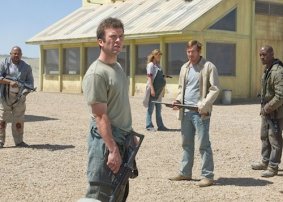 Even the action sequences not up to much, just guns firing and things exploding in the dark with almost no choreography. As an action movie you might forgive it some of the plot and character points if it could manage that, but it can’t.
 100Films.co.uk