
 The second release in Warner Premiere’s series of direct-to-video DC Universe Animated Original Movies (which now stretches to 24 titles and counting) is adapted from writer and artist Darwyn Cooke’s acclaimed comic book miniseries DC: The New Frontier, which sees Golden Age heroes (Superman, Batman, Wonder Woman) meeting Silver Age heroes (the Flash, Green Lantern) for the first time in the 1950s.
With so many characters (those are just the tip of the iceberg), Justice League: The New Frontier has a many-pronged narrative to squeeze into its brisk hour-and-ten-minutes running time. The connecting tissue is an unknown entity that has decided to destroy all life on Earth, which eventually will lead all of the various characters to come together to combat it. Other than that, I’m not even going to attempt to summarise the story because there’s so darn much going on. Uncommonly, it spends a lot of time focused on the likes of Hal Jordan (David Boreanaz) and the Martian Manhunter (Miguel Ferrer) rather than the usual big names.
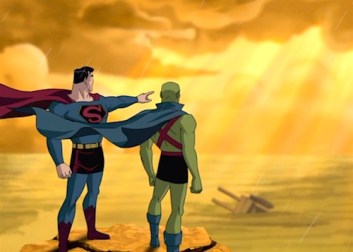
Frankly, there are too many characters, and the film doesn’t always seem to know what to do with all of them. The array of cameos in minor roles is fine, and sure to please thoroughly-versed comic book readers, but it’s the main characters who are sometimes sidelined. In some cases, literally: Wonder Woman disappears off to her island after two scenes; the Flash retires early on; Superman gets sunk in the ocean at the start of the climax. The plot feels underdeveloped too. There are snippets of Batman investigating the entity, for instance, but before he can really learn anything the thing just attacks, so his storyline was needless. Maybe Cooke’s original graphic novel had more time for all of this. If some things have had to be sacrificed to streamline the tale into a 70-minute movie, then it wouldn’t be uncommon for these DC animations. I’ve not read the book so I don’t know. 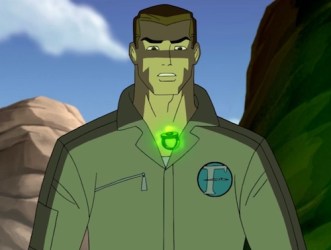 However, there are definitely bits that could’ve been sacrificed or abridged further (the Flash’s two early action sequences, for instance) to make more room to tell the story in full.
On the bright side, a period-set superhero movie makes a nice change; and it just gets on with it, rather than feeling the need to explain itself with alternate worlds or time travel or any such BS. It has the confidence to start with many of the heroes already in play, rather than worry about giving each one a full-blown origin story or something. At one point I thought it might manage to pull off something akin to Watchmen, but in the ’50s and with recognisable DC heroes. Such a comparison might be a kindness too far. There are some good concepts here, but the execution pootles out as it goes along. At times it feels a bit like a pilot episode, as if they were somehow expecting to spin a TV series out of it — for all I know maybe they were — but the problem with pilot episodes is that they are, by definition, unresolved. The New Frontier has a climax that wraps up the immediate threat, but it also feels like it was laying character and supporting cast groundwork for something longer-running.
On technical merits, the art design is… variable. At times it appears to have been inspired by Cooke’s awesome style, which is both pleasing in itself and marks a nice spot of variety from these animations’ norm, but at other points the style reverts to simplistic “Saturday morning cartoon” familiarity. Disappointingly, the actual animation is always of that level. Warner have definitely put out worse examples in this range (Superman vs The Elite), but they’ve also done much better (Batman: The Dark Knight Returns).
 I really wanted to like The New Frontier, for all sorts of reasons. It does start well, with moments of promise sparkling here and there, but the longer it spends juggling so many balls, the fewer it can keep flying smoothly. (Do balls “fly” when juggled? Anyway, you get my point.) Considered as a whole, the overall result is fairly disappointing.

* The New Frontier has never had a disc release in the UK (or a theatrical one, naturally), so has never been classified by the BBFC (I thought you needed that for streaming or download nowadays, but turns out it’s optional). Amazon choose to list it as a PG, but the US’s PG-13, aka a 12, seems nearer the mark (depending how much you care about cartoon violence and blood, anyway). ^
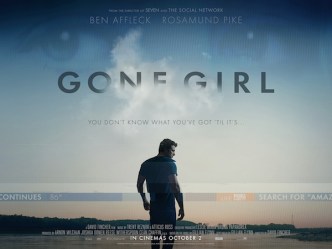 “Horrible people do horrible things to each other” is the Post-it Note summary of this dark drama-thriller from director David Fincher, adapted by screenwriter Gillian Flynn from her own novel, which is short on heroes and overloaded with villains. An alternative brief summation is, “modern society is shit.”
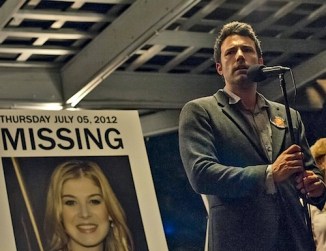 However, that opinion may stem from the same point as my view on the more praise-filled reactions: that Gone Girl is not a film as great as
 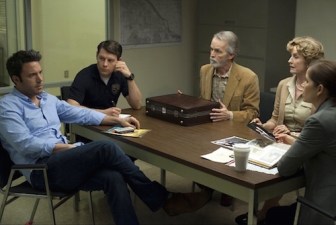 This is an argument for which I have a lot of time. The majority of Fincher’s filmography is made up of policiers and thrillers of one form or another, and even when he breaks out of that mould — in The Social Network, for instance — he often brings a similar perspective and toolset. Many of these films are borderline-rote, heavily-generic schedule-fillers at screenplay level, and would have been just that in the hands of a lesser director; in the hands of a master filmmaker, however, they become genre-transcending classics. I think that same sentence could be said about most (all?) of Hitchcock’s best films.
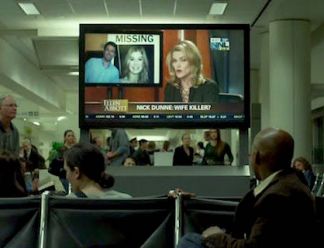 Is it for the masses, too? Maybe. In his
  a lesser actress could’ve given a performance with fewer notes and the film still would’ve functioned; or they would have struggled to contain the numerous sides to Amy’s personality in the form of a plausible human being. Pike does that, and more. She goes on my list of “people who were robbed of an Oscar because it was someone else’s ‘time’” (alongside Paul Greengrass’
 The second feature from
  and two other men’s hats, briefly has a funny bit in the middle when he tries to acquire the second hat. The film also uses swearing as a comedic crutch too often. I’m not one of those people who’s only tolerant of swearing if they feel each and every use is absolutely justifiable, and I don’t object to it as just part of dialogue, but too often the film leans on someone saying “oh shit” (or whatever) as if that’s a serviceable punchline.
 The movie’s best running gag is its titular one. At first it just seems like the concept is going to be limited to Albert sitting in a saloon and listing ways to die, which isn’t funny; but then it keeps cropping back up, sometimes unexpectedly, which really works. The whole fair thing — a running gag within a running gag — is particularly effective. If the film had traded more on this, less on farting and other bodily functions, it would’ve been much improved.
 I dread to think what the
  On Blu-ray,
  The best of the bunch is Super Manny, because Manny’s always fun and it’s the most inventively zany. Worst is Earl Scouts, because it’s just a poor Tom & Jerry / Itchy & Scratchy riff — Sky viewers won’t be missing much by not seeing it. Attack of the 50ft. Gummi Bear! falls somewhere between those two stools, as I suppose does Steve’s First Bath, though slightly less objectionably so — there’s fun to be had in how it sets up Flint’s grand uber-romantic date, then how it’s trashed by Steve and the robot built to wash him.
 On the whole, the shorts are passably entertaining if you like slapstick-y 2D animation and want to kill quarter-of-an-hour (or 22 minutes with Earl Scouts thrown in). But there’s nothing particularly innovative or original about any of them — certainly not worth going out of your way for.
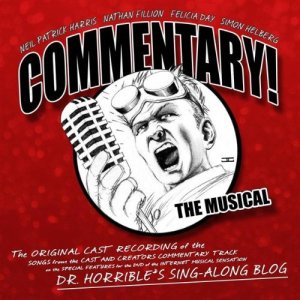 Commentary! The Musical falls somewhere between DVD extra, TV episode and short film. Whatever it should be classed as, it’s utter genius.
 100Films.co.uk