
Steven Caple Jr. | 130 mins | Blu-ray (UHD) | 2.40:1 | USA / English & Russian | 12 / PG-13

Creed II is, as its title suggests, a sequel. But it’s even more than that — it’s like a sequel squared; perhaps even a sequel cubed. How so? Well, it is, of course, a direct continuation of Ryan Coogler’s Creed, a boxing drama which itself served as a follow-up of the Rocky films. But, as if being a sequel to a follow-up wasn’t enough, Creed II is also directly connected to the plot of Rocky IV. That makes for a funny old combination of influences: whereas Creed was arguably the most grounded and realistic Rocky movie since the first (and, with it, one of the series’ very best instalments), Rocky IV is undoubtedly the most cartoonish and ridiculous entry in the canon (although it was also the most financially successful and has a certain cheesy charm). Can Creed II reconcile the tonal disparity between its two primary forebears?
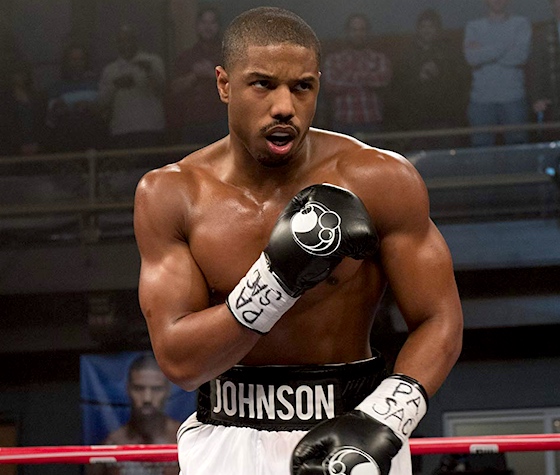
For those not up on their Rocky continuity, Russian boxer Ivan Drago (Dolph Lundgren) killed Rocky’s mate Apollo Creed during a match in the ’80s (as seen in Rocky IV). Now, Drago’s son Viktor (Florian Munteanu) is a boxer too, and with Creed’s son Adonis (Michael B. Jordan) newly crowned as the world heavyweight champion, Drago Sr arranges for Drago Jr to challenge Creed Jr — who, against the advice of Rocky (Sylvester Stallone), accepts. But with the distraction of a pregnant fiancée (Tessa Thompson) and without Rocky to train him, is Adonis actually ready to take on a Drago?
The film’s title is, obviously, meant to be read “Creed 2” because it’s a follow-up to “Creed 1”, but if you chose to read it as “Creed the 2nd” it wouldn’t be inappropriate to the movie’s themes. This is a movie all about parents and children, what they owe to each other, and how they live up to that — or fail to. It’s a meaty subject to chew on, and credited screenwriters Juel Taylor and Sylvester Stallone (there’s also a story credit for Sascha Penn and Cheo Hodari Coker) examine it from almost every conceivable angle. As Ivan pushes Viktor to vicariously reclaim their reputation, Adonis struggles with the legacy of a father he never knew, as well as the dilemma of becoming a father himself, to a daughter who may be born disabled (due to possibly inheriting her mother’s hearing condition). And while there’s a lot of father/son stuff — as you’d probably expect in a film about such a stereotypically-manly sport — the film doesn’t neglect the role of mothers either, with both Viktor’s and Adonis’s having key parts to play in how things unfold.

One aspect of that is that the film does a lot to humanise the Dragos. In Rocky IV, they were just nasty foreigners — that film is, fundamentally, anti-Russian pro-US Cold War propaganda. Here, they’re presented as people who have problems and issues of their own. I remember Stallone talking before about how it’s always more interesting if the opponent isn’t just a Villain, but is a real character with their own arc (this was in the audio commentary for Rocky Balboa, for which Stallone injected some autobiographical material into the opponent’s storyline). That’s obviously something he failed to achieve in IV, but it’s reestablished here and, well, he’s right. It’s not like it confuses the drama of the fight — there’s no question that Creed is our hero and the one we want to see triumphant — but by giving depth to the Drago’s, showing why the fight really matters to them too, it rounds out the story; and, in this case, provides additional perspectives on the parent/child themes.
It’s the way these films have something thematic to say that helps elevate them above mere punch-’em-ups. But it works as a sport/action movie too, finding some new twists within the familiar plot beats. I mean, when the Creed-Drago match comes before the film’s even reached the hour mark, you already have a fair idea how it’s gonna go. Without giving away specifics, what they’ve come up with leaves the contest as unfinished business, which is better motivation for the inevitable rematch than a simple “the hero lost the first time so he has to have a re-do so he can win”. This thinking extends to the final bout, too: it’s the first time in the series since Rocky III that the climactic fight doesn’t go all the way to the final round. It’s a nice change to dodge that predictability. Of course, these are really just variations on a theme — they’re still boxing matches; the options on the table are still “hero wins” or “hero loses” — but, as with many genre pieces, the devil is in the detail, and Creed II has good details.
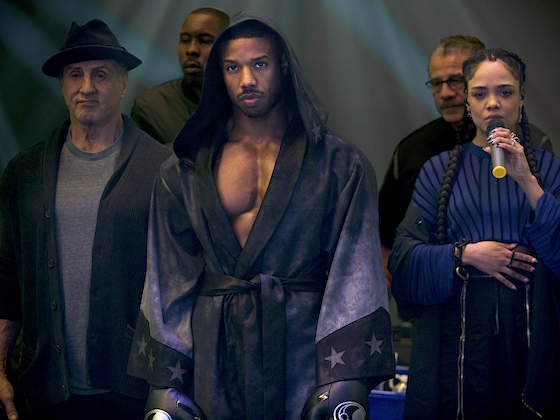
Although this is primarily the second Creed film, there’s no doubt that it’s a little bit Rocky VIII, too. Stallone keeps saying he’s done with Rocky, then comes back for one more, but this really feels like it could serve as an ending. Well, so did the previous two films, but the idea of a grudge match between the sons of Apollo and Drago is an obvious one that I’m not surprised Hollywood came up with. It factors in and closes off so much of the series’ legacy that it’s difficult to see what would be of similar import to justify a second sequel. They could always do one “just because”, of course — there’s always a way; always more to a character’s life — but whereas the very existence of Creed suggested the potential for a sequel featuring Drago, now there’s no story left begging to be told. Nonetheless, Creed III has been announced. Whether Stallone is tempted back or sticks to his guns and lets the series move on without him, only time will tell.
In the meantime, Creed II is a worthy addition to this storied franchise. If it can’t go the distance against some of the earlier entries, that’s through no fault of its own — the best Rocky/Creed films are all-timers; or, as they say in sporting circles, GOATs.

Creed II is available on Amazon Prime Video in the UK from today.


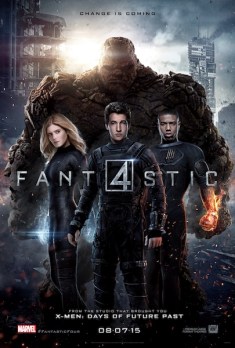 Sometimes you just have to see what all the fuss is about, even if that fuss is overwhelmingly negative. Obviously that’s the case with the most recent attempt to bring Marvel’s popular “first family” to the big screen. The behind-the-scenes stories are already the stuff of movieland legend, so I won’t repeat them here, but what of the film itself? Or the version that ended up available for public consumption, anyway.
 and serve as new pieces — like a shattered mug that’s been reassembled with lashings of superglue and using a handle from another vessel, which has inexplicably wound up a slightly different size and shape to how it used to be. Considering the studio got cold feet and insisted on massive reshoots, this is quite possibly exactly what happened.
 Fox like to keep their superhero movies Serious and Dark — and why not? Before this, it had worked pretty well for them across seven X-Men movies, while their colourful-and-cheery
  What could have been a comfortable 3-star movie, maybe even 4 if it followed through well enough, is dragged down to 2 by studio meddling. Will they never learn? Nonetheless, I actually enjoyed enough of Fantastic Four that, while it won’t be going on the long-list of contenders for the best movies I’ve seen this year, I won’t be putting it on the list for the worst either.
 The birth of the “found footage” sub-genre and the resurgence of the superhero movie began around the same time, the former with
 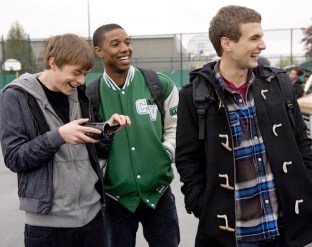 The story sees high school senior Andrew (Dane DeHaan) decide to start filming everything in his life, thanks to his borderline-abusive alcoholic father (Michael Kelly) and terminally ill mother (Bo Petersen). The same day (what a coincidence!), his cousin and only friend, Matt (Alex Russell), takes him to a party where, along with most-popular-kid-in-school Steve (Michael B. Jordan), they discover a hole in the woods with mysteries inside… Days later, all three begin to develop telekinetic powers, which they learn they can levy in various incredible ways — those ways being super, but largely without the heroic…
 This is even more pronounced in the extended version (“extended director’s cut” in the US), which includes over five minutes of extra bits that, in my opinion, make it a superior edit. Some are minor in impact, true, but there are a couple of short sequences with Andrew and Steve that deepen their relationship further, which enriches events at the end of act two. There’s also a moment that subtly prefigures the climax, and an extra bit in said finale that seems nigh-on essential to me. Considering the film still runs (just under) 90 minutes even with these additions, it’s difficult to see why they were cut in the first place. “Pace” is usually the rational for that, but if this is indeed a Director’s Cut then clearly Trank didn’t think they were an issue; equally, I can’t see why Fox would have objected. Still, they’re here to enjoy on Blu-ray…. though not on DVD… and I guess they’re not in TV screenings… Tsk.
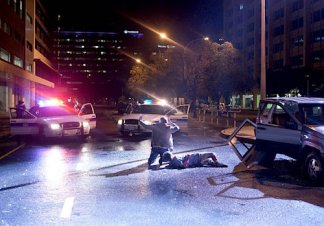 That said, spectacle it has. You wouldn’t expect that from a $12 million found-footage movie, but an epic duel through the streets of Seattle is one of the strongest climaxes to any superhero movie I can remember. It’s kind of like
  In the hands of many a desperate-to-get-noticed filmmaker, a found-footage superhero movie would likely have been a straight-to-DVD affair that could at best be described as “mediocre”. In Chronicle, however, Trank and co have crafted one of the best movies produced in either sub-genre. Most of the people involved — as well as the film they’ve all come from — can be classed as “one to watch”.
 100Films.co.uk