
James Mangold | 153 mins | Blu-ray (UHD) | 2.39:1 | USA / English & Italian |
12 / PG-13
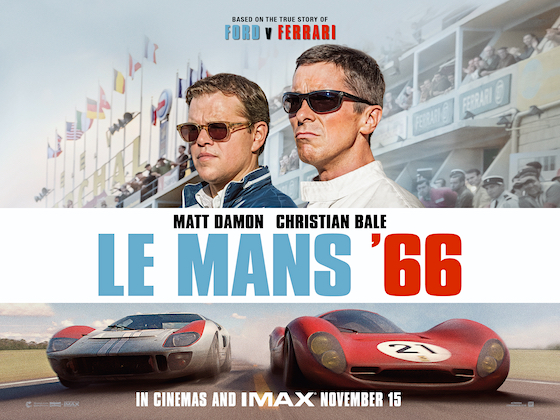
Did you know that Ford tried to buy Ferrari in the ’60s? I didn’t. As per this film, Ford were desperate to appeal to a younger market and an association with motor racing seemed the way to do that. Ferrari were the regular winners of the Le Mans 24-hour race but were struggling financially, so Ford made an offer; but Ferrari played them, merely using Ford’s interest to get a better deal from Fiat. Pissed off, Ford set about making a racing car by themselves to beat Ferrari at their own game. Enter former Le Mans-winning driver turned race-car designer Carroll Shelby (Matt Damon), a smooth-talking American who’s as adept at charming higher-ups as he is at making fast cars; and his favoured mechanic and driver, Ken Miles (Christian Bale), a quick-tempered Brit who rubs the Ford execs up the wrong way. With Ford’s money behind them, but also management watching over them, can Shelby and Miles engineer a car good enough to beat Ferrari at Le Mans?
That the film goes by one of two different titles depending where you live might seem like an incidental point of trivia — it’s not the first time this has happened (Avengers Assemble is probably the most famous recent example), and it wasn’t an artistic decision, nor even a marketing one, apparently, but instead legal necessity (according to director James Mangold, you can’t use brand names in a title in the UK and/or Europe) — but it’s also a lens through which we can consider the film’s focus. To wit, is it more about the rivalry between Ford and Ferrari (as in the original title) or winning the 1966 Le Mans race (as in the UK title)? The consensus seems to be that the original title sounds more dynamic, but I think the international one is more accurate. The head of Ford has it in for Ferrari, but our two heroes are more interested in winning the race, rivalry or not.

To some extent the story has been streamlined in that direction. The original screenplay was an ensemble about the entire team building the Le Mans car — more historically accurate, I’m sure, but I’d wager less dramatic and personal. That’s what’s gained by focusing on Shelby and Miles, the two key figures. To the film’s credit, it still doesn’t pretend they did it alone. The role attributed to other mechanics may not be as large as it was in real life, but nor does the film try to pass it off as the achievement of just two men. What it primarily adds is relatable drama. This isn’t just a movie about building and/or racing a car, but about these two particular men — what motivates them; how their ego gets in the way, especially in Miles’s case.
The film plays to the lead actors’ strengths in this respect, with Damon turning on the easy charm and Bale, who famously stays in character throughout a shoot, embodying someone who is superb at their job but can be belligerent. The standout from a quality supporting cast is Caitriona Balfe. She may just have the typical Wife role, but she’s made to be a bit more badass than that usually allows… before getting relegated it to the sidelines for the finale, naturally.
Said finale is the eponymous Le Mans event, of course. It’s not the only race sequence in the film, but it’s by far the longest. Nonetheless, they’re all suitably thrilling in how they’re shot and edited. One of the film’s genres on IMDb is “Action”, and though it doesn’t really conform to my idea of what an Action movie is — not least in the fact that there are only three or four of these “action sequence” race scenes throughout the two-and-a-half-hour movie — I can see where they’re coming from.

That runtime is quite long, but it doesn’t drag… once it gets going, anyway. The slowest part is early on, getting the story up and running, which I feel could have been streamlined. Ford’s attempt to buy Ferrari initially seems like an aside, but obviously it comes to frame the whole rivalry; but Miles’s woes with the IRS barely have anything to do with the rest of the movie, and, other than providing an extended introduction to the man, I don’t think you’d lose much by losing them. The film was clearly trimmed a fair bit, though, because there are loads of little bits you can spot in the making-of that aren’t in the finished film. Said making-of also highlights the choices behind the cinematography. The visuals are very golden — that kind of “wasn’t the past pretty” atmosphere — but the behind-the-scenes footage shows the shooting conditions to be much duller and greyer, revealing how much the orange/gold light comes from the camerawork and grading.
Le Mans ’66 might look like a film for car nuts, and I’m sure they’ll get a lot out of it — alongside the likes of Rush, I guess this kind of thing would be their favourite movie (both those films currently sit in the IMDb Top 250). But the rest of us are by no means left out, thanks to involving characters and exciting race scenes, even if some plot beats border on clichéd. Le Mans ’66 may not reinvent the wheel, but it works hard at refining it.

Le Mans ’66 is available on Sky Cinema and Now TV from midnight tonight.
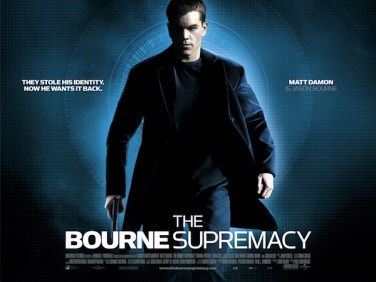
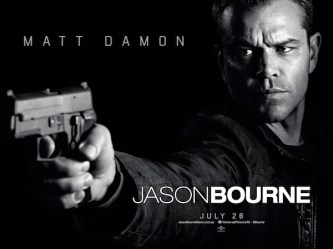 Much like the Bond films to which they’re so often compared, the Bourne movies have their devotees while only fitfully pleasing the critical establishment. This fifth movie — which is notable for marking the return of star Matt Damon and director Paul Greengrass after the semi-reboot of
  Action sequences ensue, shot with all the ShakyCam you’d expect from Greengrass. By now I imagine you have your own view on whether his style works or not. Personally, I think it’s considerably less bamboozling than when it made its debut in
  Frankly, Jason Bourne is at pains to mix in hyper-current iconography; the reasoning for Damon and Greengrass’ return now being that the world has changed and how does Bourne fit into that? So as well as social media and Greek riots we’ve got references to and riffs on hacking, Edward Snowden, government surveillance of its own citizens, the prevalence of Facebook/Twitter-esque tech companies, and so on. Sadly, I’m not sure the film’s actually got anything to say about any of these things. Greengrass and his co-writer, editor Christopher Rouse, have appropriated all these zeitgeisty concepts to make the film feel very Now, but that surface sheen is more or less where it ends. I mean, there’s a whole subplot starring Riz Ahmed as the Zuckerberg-like CEO of a social media company that I didn’t even mention in my plot summary because it’s kind of an aside. It’s kind of ironic, really, that it always seemed as if Greengrass’ more natural stomping ground was his documentary-ish real-world-exposé type movies, with his contributions to the Bourne series an unusual sideline; yet when he finally marries the two halves of his filmmaking career, it’s the action rather than current-affairs commentary that takes precedence.
 The end result is that Jason Bourne does thrill as an action movie, which seems to have been the primary goal of its makers, at the end of the day. As an action-thriller, however, the rinsed-and-repeated plot is a slightly faded imitation of former successes; a through-the-motions way to provide those impressively staged chases and punch-ups. It’s not the definitive Bourne movie one might’ve expected from the returning star/director combo (why else come back if not to perfect, or at least add to, the formula?), but instead means the film ends on an odd note: even though it wasn’t a wholly satisfying experience, and even though it doesn’t end with questions still blatantly hanging (as every Bourne movie bar Ultimatum has done), I want Damon and Greengrass to come back and do it all again, please. Only do it properly next time, yeah guys?

 Score:











 2016 Academy Awards
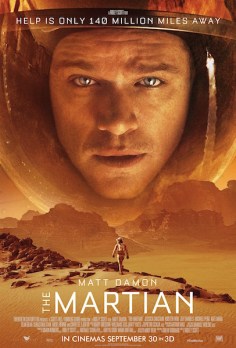 Ridley Scott’s latest arrives on Blu-ray in the UK today, with a disappointing dearth of special features (disliked
  Whether that’s appropriate or not is another matter. A well-argued
 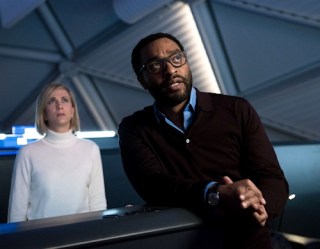 While Damon is stuck on Mars by himself, a starry supporting cast actually get to interact with each other. This is a quality ensemble and, short of writing an epic essay of a review where I just praise them all one by one, there’s little to do but list their names. That said, Jessica Chastain gets the most brazenly emotional beats as the commander who chose to leave Watney behind and has to face the consequences of her decision; Jeff Daniels treads a line between being an evil bureaucrat and just a regular bureaucrat (apparently consideration was given to turning him into a full-blown villain; thank goodness they swerved that bullet); Chiwetel Ejiofor brings easy gravitas to NASA’s director of Mars missions; Michael Peña provides some additional comic relief, if not as strikingly as he did in
  I’ve read at least one review that described The Martian as “an instant sci-fi classic”, and at least one other that described it as “no sci-fi classic”. I’m going to sit on the fence of that debate for the time being. What I will say is that it is undoubtedly an accomplished piece of entertainment. For a film that primarily concerns itself with a man applying scientific principles to tasks like “growing potatoes”, that’s surely some kind of achievement. In our current climate (both in society in general and in the “more explosions less talking, please” state of blockbuster cinema), to make space travel — and science in general — seem fun and appealing to the masses is no bad thing whatsoever.
 Mumble and his penguin pals return for another adventure, in a series the Australian film industry are reportedly inordinately proud of.
 100Films.co.uk